Margin Trading Explained for Beginners: The Complete Guide to Leverage, Risk, and Real-World Trading
Margin trading is one of the core mechanics behind modern financial markets. It powers everything from forex and indices to commodities and CFDs, allowing traders to control positions far larger than their account balance.
At first glance, it looks like a simple advantage: more exposure with less capital.
In reality, margin trading is a double-edged tool. It increases both opportunity and risk, often faster than beginners expect.
This guide breaks down how margin trading actually works in real market conditions, not just theory, so you understand exactly what happens when you place a leveraged trade.
What is margin in trading?
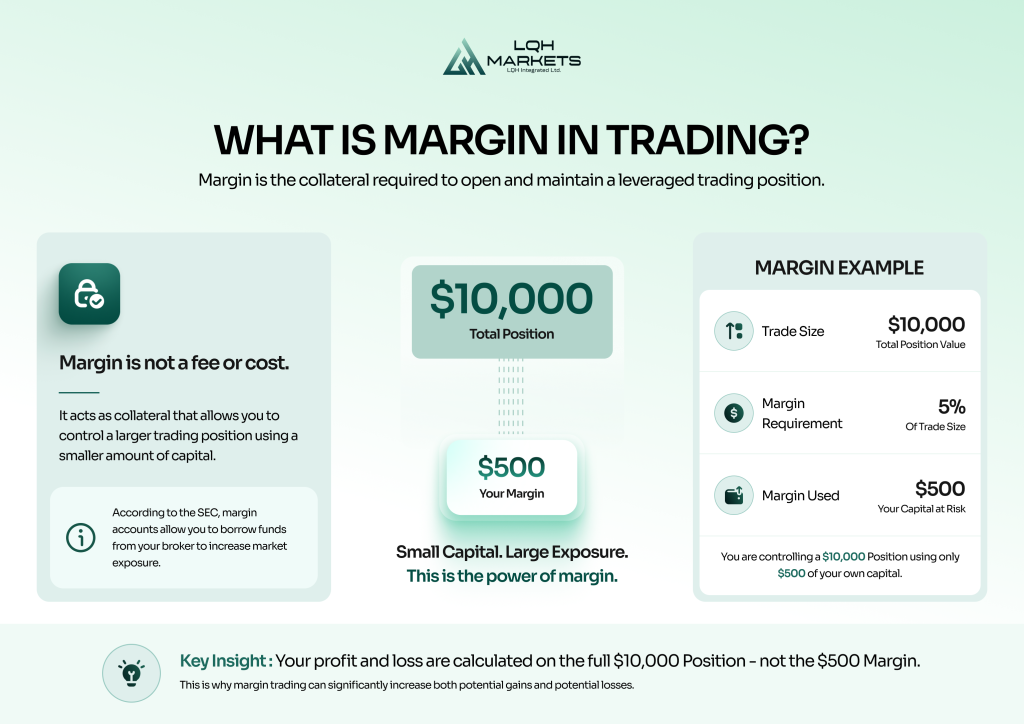
Margin is the amount of money required to open and maintain a leveraged position.
It is best understood as collateral, not a cost. According to the SEC’s investor bulletin on margin accounts, trading on margin involves borrowing funds from a broker to purchase securities or increase market exposure.
When you open a trade, your broker sets aside a portion of your funds to support the full position size.
Example:
-
- Trade size: $10,000
-
- Margin requirement: 5%
-
- Margin used: $500
You are controlling a $10,000 position using $500 of your own capital. The key detail most beginners overlook:
Your profit and loss are based on $10,000, not $500.
That is the entire reason margin trading behaves differently from standard investing
Margin vs leverage: the foundation of understanding
Margin and leverage are closely linked but serve different roles.
-
- Margin is what you commit to.
-
- Leverage is what expands your position
Example:
-
- Leverage: 20:1
-
- Required margin: 5%
This means:
-
- Every $1 you deposit controls $20 in the market
So:
-
- $500 margin → $10,000 position
Understanding this relationship is essential. Without it, risk becomes invisible.
How margin trading actually works (real mechanics)
Most beginner explanations stop at definitions. What matters is how margin behaves once you are in a live trade.
Step 1: Funding your account
You deposit $1,000 into your trading account.
This becomes your equity, which will fluctuate as trades move.
Step 2: Opening a leveraged position
You open a trade using 10:1 leverage.
-
- Position size: $10,000
-
- Margin required: $1,000
Your entire account is now supporting one trade.
Step 3: Market movement begins
Now your account is exposed to real-time price changes.
Scenario A: Market moves +2%
-
- Profit = $200
-
- Account grows to $1,200
Scenario B: Market moves -2%
-
- Loss = $200
-
- Account drops to $800
Even small market movements create large percentage changes in your account.
Step 4: Margin pressure builds
As losses increase:
-
- Equity decreases
-
- Margin level drops
-
- Risk of liquidation increases
This is where margin stops being theoretical and starts affecting decisions.
Step 5: Broker intervention
If your account falls below required thresholds:
-
- You receive a margin call
-
- Or positions are automatically closed
At this stage, control shifts away from the trader.
The key metrics that control your trades
To trade with margin effectively, you need to understand the numbers that drive your account.
Used margin
The portion of your balance currently locked in open trades.
Free margin
The capital you have left to absorb losses or open new positions.
Equity
Your real-time account value, including open profits and losses.
Margin level
Margin level determines how close you are to losing your positions.
Margin Level = (Equity ÷ Used Margin) × 100
Example:
-
- Equity: $800
-
- Used margin: $1,000
-
- Margin level: 80%
Lower margin level = higher risk of liquidation.
Margin call and liquidation (what actually happens)
These are not abstract concepts. They are mechanical triggers.
Margin call
A margin call occurs when your account falls below a required threshold.
It means:
-
- Your current position is no longer sufficiently supported
- You are at risk of forced closure
At this point, you must add funds or close trades. The SEC margin account bulletin also explains that brokers may require traders to deposit additional funds or liquidate positions if margin requirements are no longer met.
Liquidation
If no action is taken:
-
- The broker closes your positions automatically
- This can happen rapidly in volatile markets
-
- Losses are locked in immediately
In fast-moving conditions, liquidation can occur before you have time to react.
A deeper look at real risk in margin trading
This is where most content stays surface-level. In practice, margin risk is not just about losing money, it is about how quickly and uncontrollably losses can happen.
1. Leverage compresses time
Without leverage:
-
- A 5% market move is significant but manageable
With leverage:
-
- That same move can wipe out a large portion of your account within minutes
Margin reduces the time you have to react.
2. Volatility becomes more dangerous than direction
You can be correct on market direction and still lose money. Why? Because short-term fluctuations can trigger stop-outs, margin calls or liquidation before the market moves in your favour. The CME Group explanation of leverage and margin outlines how leveraged exposure can magnify both profits and losses during volatile market conditions.
3. Drawdowns accelerate disproportionately
A sequence of small losses becomes much harder to recover from.
Example:
-
- Lose 20% → need 25% to recover
-
- Lose 50% → need 100% to recover
Margin makes these drawdowns happen faster.
4. Correlated exposure risk
Many beginners unknowingly open multiple positions that behave similarly.
Example:
-
- Trading EUR/USD, GBP/USD, and Gold simultaneously
If USD strengthens, all positions move against you at once.
Margin amplifies this mistake.
5. Liquidity and slippage risk
In volatile markets:
-
- Prices can move quickly
-
- Orders may be filled at worse levels than expected
This increases losses beyond planned risk.
Common beginner mistakes (expanded and realistic)
Overcommitting capital
Using most or all available margin on a single trade.
This leaves no room for normal price movement.
Thinking in profit instead of risk
Focusing on potential gains rather than how much can be lost.
Margin punishes this mindset quickly.
Ignoring position sizing
Not adjusting trade size based on account balance.
This leads to inconsistent and unstable performance.
Chasing trades with leverage
Entering trades impulsively because leverage makes them “affordable.”
Holding losing trades too long
In leveraged trading, time is not neutral.
The longer a losing trade is held, the more margin pressure builds.
Not understanding lot sizes
Many traders open positions without knowing what a lot size represents in dollar risk.
This is where tools like a lot size calculator become essential, helping you match position size to your risk tolerance rather than guessing.
Before opening a leveraged trade, it’s worth checking exactly how much margin you’ll need and how your position size affects your risk. Use a Margin Calculator and Position Size Calculator to plan your trades before entering the market.
Pros and cons of margin trading
Understanding the advantages and disadvantages of margin trading is essential before trading with leverage.
Advantages of Margin Trading
Greater market access
One of the biggest advantages of margin trading is the ability to control larger positions without needing the full trade value upfront. Instead of committing ten thousand dollars to open a ten thousand dollar trade, a trader may only need a fraction of that amount as margin.
This lower capital requirement makes global financial markets more accessible, particularly for traders with smaller account balances. It allows participation in markets that might otherwise require substantially more capital to trade effectively.
Capital efficiency
Margin trading allows traders to use their capital more efficiently by avoiding the need to allocate their entire balance to a single position.
For example, rather than tying up all available funds in one trade, margin allows traders to distribute capital across multiple positions, strategies, or asset classes. This flexibility can improve diversification and reduce dependence on a single market outcome.
In practical terms, traders can maintain exposure to several opportunities simultaneously while keeping part of their account available as free margin.
Flexibility across different markets
Margin trading is commonly used across a wide range of financial instruments, including forex, commodities, indices, and shares through CFDs.
This flexibility allows traders to:
-
- speculate on rising or falling markets
-
- hedge existing positions
-
- react quickly to changing market conditions
Because leveraged products are designed for active trading, they provide access to both long and short opportunities without requiring ownership of the underlying asset.
Enhanced return potential
Since profits are calculated on the full position size rather than the margin deposited, margin trading can significantly increase potential returns.
For example, a small percentage move in the market can generate a much larger percentage return relative to the capital committed. This is one of the main reasons leveraged trading is attractive to active traders.
However, higher return potential always comes with proportionally higher risk, which is why leverage should be approached carefully.
Increased strategic flexibility
Margin trading can support a broader range of trading strategies, particularly in short-term markets where smaller price movements are targeted.
Traders may use leverage for:
-
- intraday trading
-
- swing trading
-
- hedging exposure
-
- scaling into positions gradually
When managed properly, margin can provide more flexibility in how positions are structured and adjusted over time.
Disadvantages of Margin Trading
Requires discipline
Without structured risk management, margin becomes unsustainable.
Amplified losses
The most significant disadvantage of margin trading is that losses increase at the same rate as gains.
Because traders are exposed to the full position size, even small market movements can have a major effect on account equity. A trade moving only a few percentage points against a heavily leveraged position can result in substantial losses or complete liquidation of margin used.
This is why leverage can become dangerous when position sizes are too large relative to account balance.
Reduced control during volatility
In standard investing, traders usually decide when to close a position. With margin trading, that control can be removed if account equity falls below required levels.
If losses continue and margin requirements are no longer met, brokers may automatically close positions to limit further exposure. This process, known as liquidation or stop-out, can happen quickly during volatile market conditions.
As a result, traders may lose positions at unfavorable prices without choosing to exit manually.
Higher psychological pressure
Leverage increases emotional intensity because account balances fluctuate more rapidly.
Larger exposure can lead to:
-
- panic during short-term volatility
-
- impulsive decision-making
-
- revenge trading after losses
-
- overconfidence after wins
This emotional pressure is one of the most underestimated aspects of margin trading, especially for beginners who are not yet accustomed to managing leveraged exposure.
Margin calls and forced liquidation
If account equity falls too low, traders may receive a margin call requiring additional funds to keep positions open.
If no action is taken, positions may be liquidated automatically. This creates additional pressure because traders are forced to make decisions while already under financial stress.
In highly volatile markets, margin calls can occur rapidly, leaving little time to react.
Greater exposure to market volatility
Leverage magnifies normal market fluctuations. Small price movements that would otherwise be manageable in a non-leveraged position can become significant when trading on margin.
This means traders do not necessarily need to be wrong on overall market direction to lose money. Short-term volatility alone may be enough to trigger stop-losses, margin calls, or liquidation before the market eventually moves in the expected direction.
Requires strong risk management discipline
Margin trading is far less forgiving than non-leveraged investing. Without clear risk management rules, losses can escalate quickly.
Successful margin trading generally requires:
-
- controlled position sizing
-
- disciplined stop-loss placement
-
- consistent risk-to-reward management
-
- careful monitoring of margin levels
Many beginner traders underestimate how important these factors become once leverage is introduced.
Overnight and gap risk
Holding leveraged positions overnight introduces additional risk because markets can gap unexpectedly due to news events, economic data releases, or geopolitical developments.
When markets reopen at significantly different prices, losses may exceed expected levels, particularly in highly leveraged positions.
This is one reason why many traders closely monitor exposure during major economic announcements and periods of increased volatility.
How margin connects to real trading platforms
Margin trading is not just a concept; it is built directly into trading platforms.
On platforms like MetaTrader 5, you can see:
-
- Margin used per trade
-
- Free margin available
-
- Margin level in real time
-
- Lot size and position exposure
This visibility is critical, because it allows you to manage trades before risk becomes uncontrollable.
Understanding how to read these metrics inside your platform is just as important as understanding the theory.
The role of position sizing (where most traders improve)
Margin trading becomes manageable when position sizing is controlled.
Instead of asking: “How much can I trade?”;
You should be asking: “How much can I afford to lose?”
This is where tools like a lot size calculator come in.
They allow you to:
-
- Define risk per trade (e.g. 1% of account)
-
- Adjust position size accordingly
-
- Align margin usage with your strategy
Without this step, margin trading becomes guesswork.
A smarter way to approach margin as a beginner
Margin should not be used to maximize exposure. It should be used to optimize efficiency while controlling risk.
A structured approach looks like:
-
- Start with low leverage
-
- Risk a small percentage per trade
-
- Monitor margin level constantly
-
- Avoid full account utilisation
-
- Focus on consistency, not trade size
This shifts margin from a liability to a controlled tool.
Margin trading on LQH Markets
Margin is only useful as a tool if the platform you’re trading on gives you the visibility to manage it properly. On LQH Markets, every position you open shows used margin, free margin, equity, and margin level in real time, so the numbers driving your account are never hidden behind menus.
You can trade leveraged positions across forex, indices, commodities, and crypto CFDs from a single MetaTrader 5 account, with stop loss and take profit functionality built into every order ticket. Position sizing is yours to control, supported by the calculation tools inside MT5 so risk per trade aligns with your strategy rather than guesswork.
If you’re learning how leverage behaves in live conditions, our demo account runs the same MT5 environment with real market pricing. Useful before committing capital to a leveraged position.
LQH Markets supports crypto-funded trading accounts, allowing traders to deposit with selected cryptocurrencies for a faster and more flexible funding experience.
Open an account or start with a demo.
Risk Disclaimer
CFDs are complex instruments with a high risk of losing all your invested capital. Only trade with money you can afford to lose. Content is for general information only and is not investment advice.
Final thoughts: margin is a multiplier, not a strategy
Margin trading does not improve your ability to trade. It increases the impact of your decisions.
That means:
-
- Good decisions scale
-
- Poor decisions accelerate losses
The biggest mistake beginners make is treating margin as an advantage without fully understanding its mechanics. In reality, it is neutral. It simply magnifies whatever approach you bring into the market.
Frequently asked questions
What is trading on margin?
Trading on margin is the process of opening positions using borrowed funds from a broker, allowing you to control a larger trade than your account balance would normally permit. Instead of paying the full value of a trade, you deposit a smaller amount known as margin, which acts as collateral. Your profit and loss are then calculated on the full position size, not just the margin used.
Is margin trading a good idea?
Margin trading can be useful when applied with proper risk management, but it is not inherently a good or bad idea on its own. It increases both potential returns and potential losses, which means outcomes depend heavily on how it is used. For beginners, margin trading often becomes risky due to overexposure, so it is generally more effective when used with lower leverage and controlled position sizing.
What is an example of a margin trade?
An example of a margin trade would be opening a $10,000 position using $500 of your own capital with 20:1 leverage. In this case, the $500 acts as margin while the remaining $9,500 is effectively borrowed exposure. If the market moves by 1% in your favor, you gain $100, but if it moves 1% against you, you lose $100, showing how small price changes can have a large impact on your account.
What is a $500 margin on a $10,000 position?
A $500 margin on a $10,000 position means you are using leverage to control a trade that is twenty times larger than your deposit. This represents 20:1 leverage, where your $500 acts as collateral for the full $10,000 position. While this increases your market exposure, it also means that profits and losses are based on the full $10,000, not the $500.
What is the difference between margin and leverage?
Margin is the amount of money required to open a trade, while leverage is the ratio that determines how much larger your position is compared to your margin. For example, with 20:1 leverage, every $1 of margin allows you to control $20 in the market. Margin is the capital you commit, whereas leverage is what amplifies your exposure and risk.