
Starting day trading with $100 is possible, but it changes your objective. You are not aiming to generate income straight away. You are learning how to execute trades, manage risk, and stay consistent under pressure.
With a small account, even a few poor decisions can wipe out your balance. That is why the focus early on should be survival and skill building rather than profit.
This guide explains how to start day trading with $100, then walks through the fundamentals of trading properly so you can build long term.
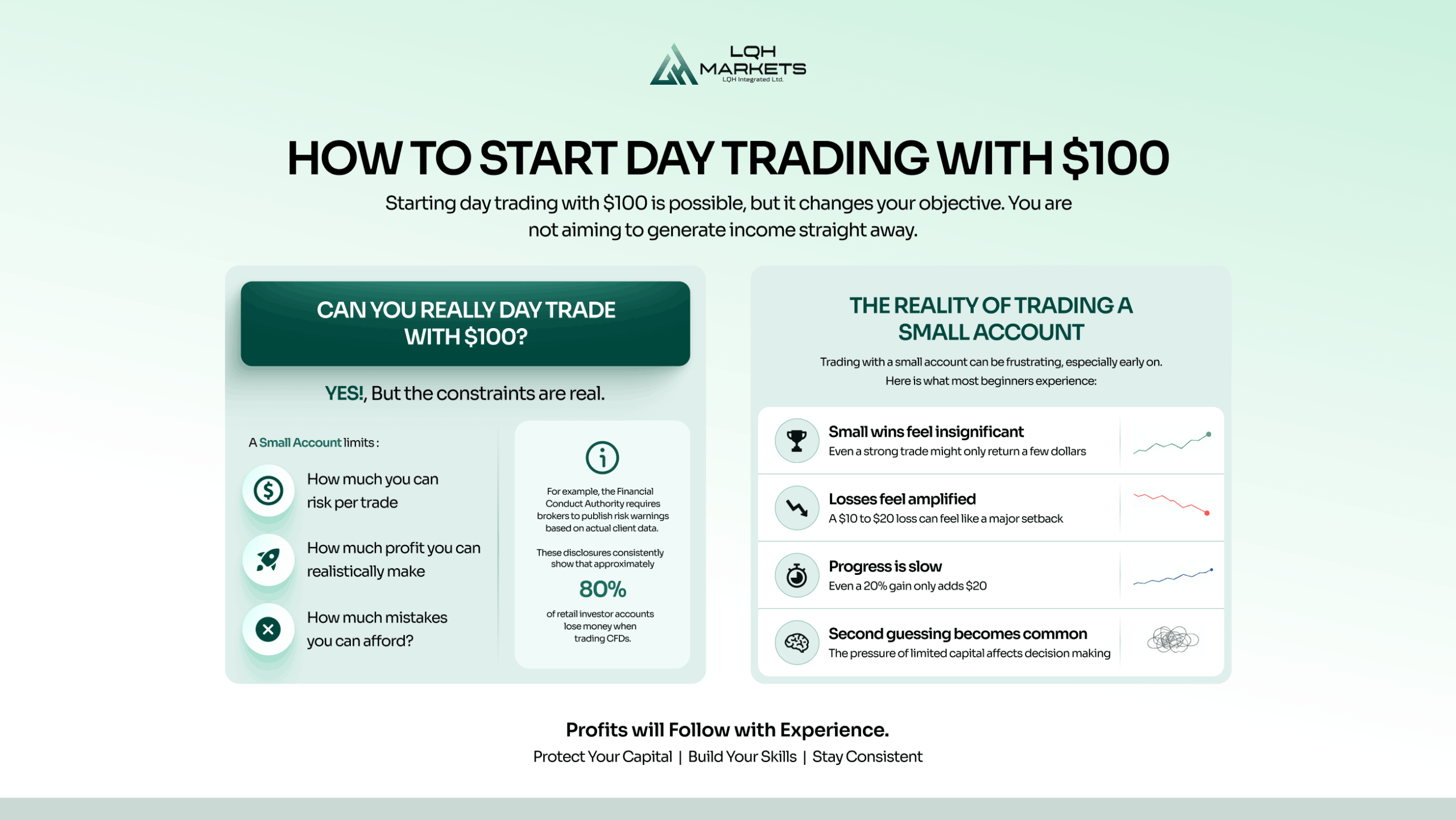
Can You Really Day Trade with $100?
Yes, but the constraints are real.
How much profit you can realistically make
-
- How much you can risk per trade
-
- How much profit you can realistically make
-
- How many mistakes you can afford
For example, the Financial Conduct Authority requires brokers to publish risk warnings based on actual client data. These disclosures consistently show that approximately 80% of retail investor accounts lose money when trading CFDs.
This is not because trading is impossible, but because most beginners:
-
- Take too much risk
- Trade without a plan
- React emotionally to market movements
With $100, your edge comes from discipline, not trying to scale quickly.
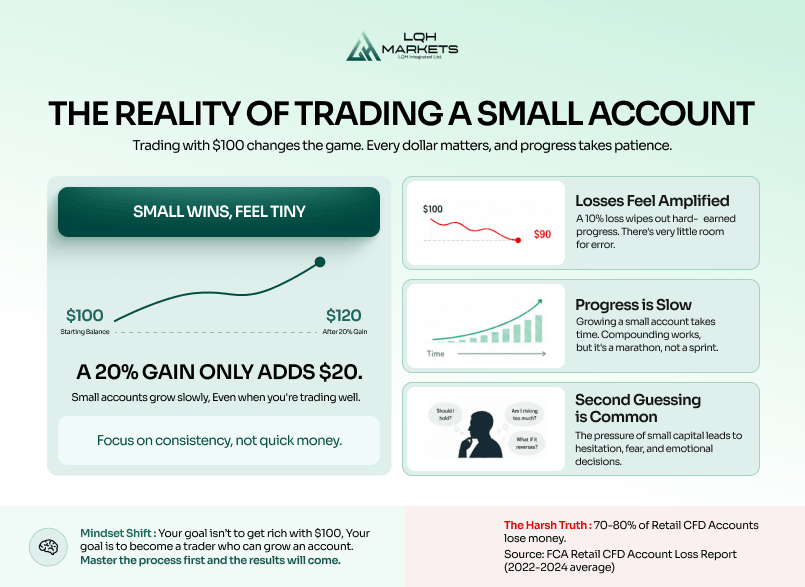
The Reality of Trading a Small Account
Trading with a small account can be frustrating, especially early on. Here is what most beginners experience:
Small wins feel insignificant
Even a strong trade might only return a few dollars
Losses feel amplified
A $10 to $20 loss can feel like a major setback
Progress is slow
Even a 20% gain only adds $20
Second guessing becomes common
The pressure of limited capital affects decision making
There is also a common misconception that small accounts can quickly be turned into large balances. While this can happen, most traders lose their initial capital before achieving consistency.
What You Need Before You Start Trading
1. A Trading Platform
A proper platform should provide:
-
- Accurate, real time pricing
-
- Advanced charting tools
-
- Fast execution
-
- Built in risk controls
Platforms like MetaTrader 5 are widely used because they combine all of these features.
2. A Basic Understanding of the Market
Before trading, you should understand:
-
How price moves
Driven by supply and demand
-
Volatility and timing
Market activity increases during major sessions
-
News impact
Economic releases can cause rapid price movements
For example, central bank announcements and inflation data releases often create short bursts of volatility followed by reversals, which can catch inexperienced traders off guard.
3. A Risk Management Plan
A structured approach should include:
- Risk per trade
Around 1% to 3% of your account
- Maximum daily loss
A fixed limit to prevent emotional trading
- Predefined exits
Every trade should include stop loss and take profit
- Consistency rules
Only take trades that meet your criteria
Traders who apply fixed risk rules tend to perform more consistently over time.
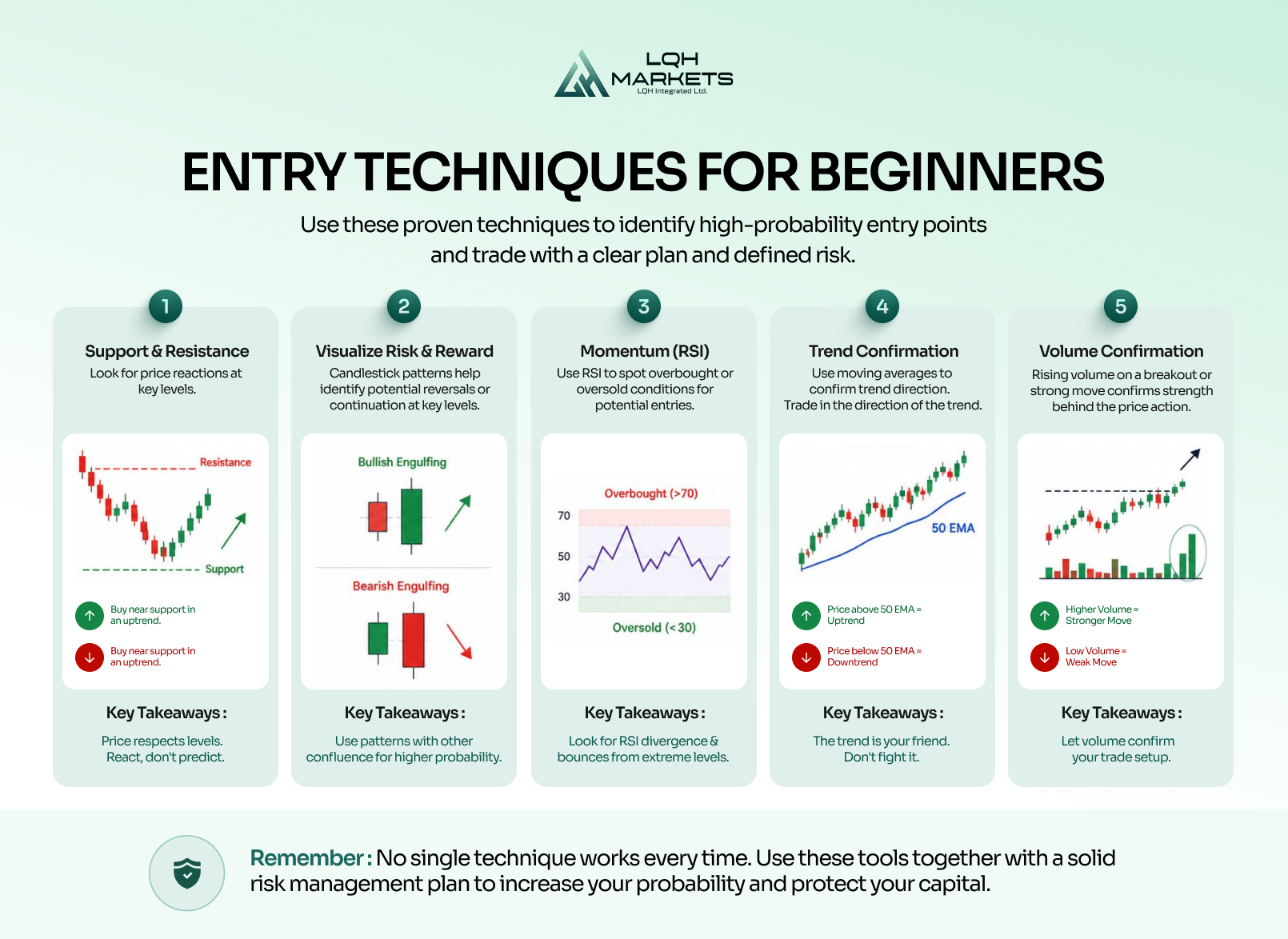
Entry Techniques for Beginners
Beginner-friendly entry techniques include:
-
Candlestick patterns and structure
Used to identify reversals or continuations.
-
Support and resistance levels
Areas where price has reacted before
-
-
Momentum indicators
Tools like RSI highlight overbought or oversold conditions -
-
Trend confirmation
Using moving averages to align with market direction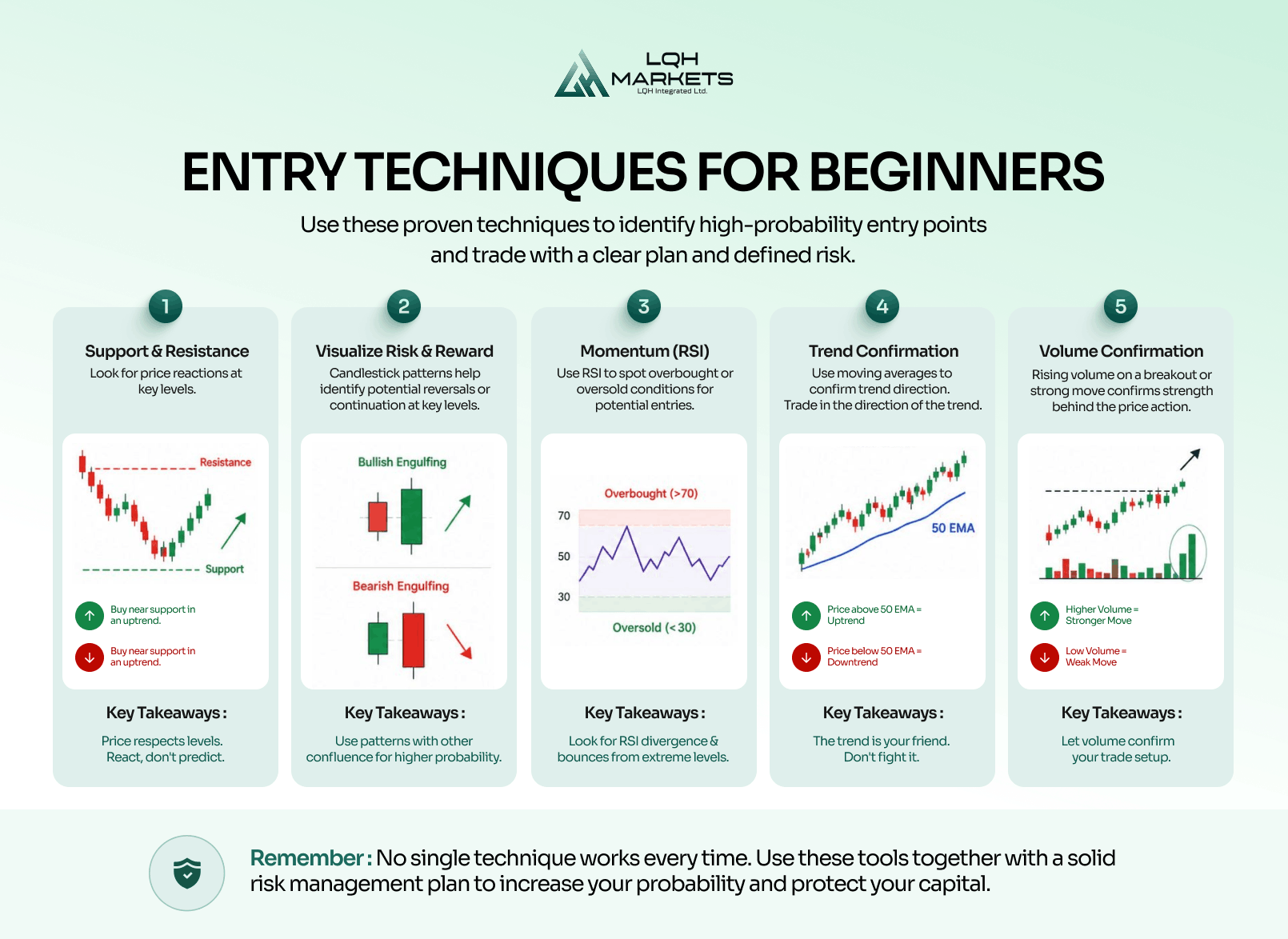
The goal is not to predict perfectly but to enter trades where risk is clearly defined.
How Day Trading Works with a Small Account
With a $100 account, day trading typically involves:
-
- Small position sizes
-
- Short timeframes such as 1 minute or 5 minute charts
-
- Liquid markets like major forex pairs
A typical trade might involve:
-
- Entering on a pullback in a trend
-
- Placing a tight stop loss
-
- Taking profit after a small move
The focus is controlled execution, not large gains.
Step by Step: How to Start Trading
Step 1: Open a Demo Account
A demo account allows you to trade in real market conditions without risking money.
Use this stage properly:
Learn how orders actually work
Market orders, limit orders, stop loss and take profit all behave slightly differently in live conditionsUnderstand price movement in real time
Charts move differently when you are watching them live compared to static examplesTest basic strategies
This is where you build confidence in a repeatable approachGet comfortable with the platform
Execution speed, chart navigation, and order placement should feel natural before going live. Skipping this step is one of the main reasons beginners lose money early.Step 2: Start with a Simple Strategy
You do not need a complex system to start trading.
A simple structure is more effective:
Identify the trend
Trade in the direction the market is already moving rather than trying to predict reversalsUse one or two indicators
For example, a moving average for trend direction and support/resistance for entryDefine your setup clearly
You should know exactly what conditions must be met before entering a tradeAvoid constant changes
Sticking to one approach allows you to measure what worksData from trading performance studies consistently shows that consistency in execution matters more than strategy complexity.
-
Step 3: Trade Small Position Sizes
With a $100 account, position size is critical. You should:
Risk a fixed percentage per trade
Around 1 to 3 percent is common for small accounts
Avoid increasing size after wins
This often leads to giving profits back quickly
Focus on staying in the market
Survival is more important than growth at this stage
Most small accounts fail because traders increase risk too quickly, not because their strategy is flawed.
Step 4: Use Stop Loss and Take Profit
Every trade should be planned before it is placed.
A structured trade includes:
Entry price
Based on your strategy, not impulse
Stop loss
Placed at a level where your trade idea is no longer valid
Take profit
A realistic target based on market structure For example, risking $2 to make $4 creates a 1:2 risk to reward ratio. This means you can still be profitable even if only half your trades succeed. Predefining exits removes emotional decision making while the trade is active.
Step 5: Review Your Trades
This is where real improvement happens. After each session:
Record your trades
Entry, exit, reasoning, and outcome.
Identify patterns
Are losses coming from specific mistakes or conditions?
Refine your approach
Focus on improving execution, not constantly changing strategy. Traders who review their performance consistently tend to improve faster than those who rely on memory or instinct.
Benefits of Day Trading with a Small Account
Lower Financial Risk
Losses are limited, making it safer to gain experience
Faster Learning
Real trading helps develop discipline and execution
Access to Leverage
Allows flexibility in position sizing
Market Accessibility
Forex and CFD markets allow entry with small capital
Drawbacks of Day Trading with a Small Account
Limited Profit Potential
Returns are small, requiring patience
Temptation to Overleverage
Trying to grow quickly often leads to losses
Psychological Pressure
Small losses feel significant
Trading Costs Matter More
Fees and spreads have a larger impact
The Risks of Day Trading
Day trading involves real financial risk, and this is amplified when working with a small account.
1. Overtrading
Overtrading happens when you take too many positions without clear setups.
This often leads to:
-
- Lower quality trades
-
- Increased exposure to random market movement
-
- Higher transaction costs over time
Many trading journals show that a small number of well planned trades outperform frequent, impulsive activity.
2. Leverage Risk
Leverage allows you to control a larger position than your account balance.
While this increases opportunity, it also means:
-
- Small price movements can result in significant losses
-
- Your account can decline rapidly if trades go against you
-
- Poor risk control is amplified
Leverage is one of the main reasons small accounts are lost quickly when not managed properly.
3. Emotional Decision Making
Trading introduces psychological pressure, especially when real money is involved.
Common behaviours include:
-
- Closing trades early out of fear
-
- Holding losing trades in the hope they recover
-
- Entering trades impulsively after missing a move
Behavioural finance research highlights that loss aversion and impulsive reactions are key drivers of poor trading outcomes.
4. Lack of Experience
Beginners often struggle with:
-
- Identifying valid trade setups
-
- Understanding market conditions
-
- Applying risk management consistently
Without experience, it is easy to misread the market and enter trades without a real edge.
5. Market Volatility
Markets can move unpredictably, especially during:
-
- Economic news releases
-
- Sudden shifts in sentiment
-
- Low liquidity periods
These conditions can trigger stop losses quickly or cause unexpected price swings.
6. Capital Erosion
With a small account, losses have a larger impact.
For example:
-
- A 10 percent loss requires more than a 10 percent gain to recover
-
- Repeated small losses can compound quickly
-
- Poor risk management can lead to complete account loss
Protecting capital is the foundation of long term trading. When you’re trading with a small account, managing risk matters more than chasing large returns. Use a Position Size Calculator to determine an appropriate trade size, and a Profit & Loss Calculator to estimate potential gains and losses before placing an order.
Common Mistakes Beginners Make
Trading Without a Plan
Entering trades without clear rules leads to inconsistent decisions and unpredictable results. A structured plan improves both discipline and performance.
Risking Too Much Per Trade
Trying to grow a small account quickly often leads to excessive risk. A few large losses can wipe out weeks of progress.
Expecting Fast Profits
Many beginners assume trading will generate quick income. In reality, progress is gradual and requires consistency over time.
Ignoring Market Conditions
Markets behave differently depending on volatility and timing. Trading the same way in all conditions often leads to poor results.
Changing Strategies Too Often
Switching strategies after a few losses prevents you from understanding whether an approach actually works. Consistency is required before meaningful improvements can be made.
Letting Emotions Drive Decisions
Fear, greed, and frustration can override logic.
This leads to:
-
- Entering trades without confirmation
-
- Exiting too early or too late
-
- Breaking risk management rules
Controlling emotions is one of the most important skills in trading.
Can You Grow a $100 Trading Account?
Yes, but it requires:
-
- Strong risk management
-
- Consistency
-
- Patience
Most successful traders focus on protecting capital before scaling up.
Trading small on LQH Markets
Starting with a small account changes what you need from a platform. Low entry barriers matter, but so does the ability to size positions properly when capital is tight.
You can open an LQH account from a small initial deposit and trade across forex, indices, commodities, and crypto CFDs on MetaTrader 5, with the micro lot sizing that makes 1-2% risk-per-trade actually achievable on a $100 balance. Stop loss and take profit are built into every order, so the risk framework in this guide can be implemented from your first trade.
The demo account uses the same MT5 environment with live market pricing. Worth working through the strategy steps in this guide there first, before any real capital is on the line.
LQH Markets supports crypto-funded trading accounts, allowing traders to deposit with selected cryptocurrencies for a faster and more flexible funding experience.
Open an account or start with a demo.
Risk Disclaimer
CFDs are complex instruments with a high risk of losing all your invested capital. Only trade with money you can afford to lose. Content is for general information only and is not investment advice.
Final Thoughts
Starting day trading with $100 is not about quick profits. It is about learning how to trade properly.
If you focus on:
-
- Managing risk
-
- Staying consistent
-
- Improving over time
You give yourself a realistic chance of long term success.
The traders who succeed are not the ones who start with the most money, but the ones who learn how to protect it.
Frequently asked questions
Can you really start day trading with $100?
Yes, you can start day trading with $100, but your expectations need to be realistic. With a small account, profits will be limited and risk management becomes critical. Most beginners use small position sizes and focus on learning rather than trying to generate income straight away.
How much can you realistically make with $100 in trading?
Returns from a $100 account are usually small, especially at the beginning. For example, a 5% gain is only $5. While higher returns are possible, they often involve higher risk. Most traders focus on consistency and gradual growth rather than trying to scale quickly.
What is the best market to trade with a small account?
Forex is one of the most accessible markets for small accounts because it allows traders to use smaller position sizes and offers high liquidity. Indices and commodities can also be traded, but spreads and volatility should be considered when starting with limited capital.
What is the biggest risk when trading with $100?
The biggest risk is losing your entire account due to poor risk management. With a small balance, even a few bad trades or overleveraging can quickly lead to significant losses. Emotional decision making and overtrading are also common issues for beginners.
Should beginners use leverage when trading with $100?
Leverage can help small account traders access larger positions, but it increases risk. Beginners should use leverage cautiously and keep their risk per trade low. Without proper risk control, leverage can quickly lead to losses rather than gains.