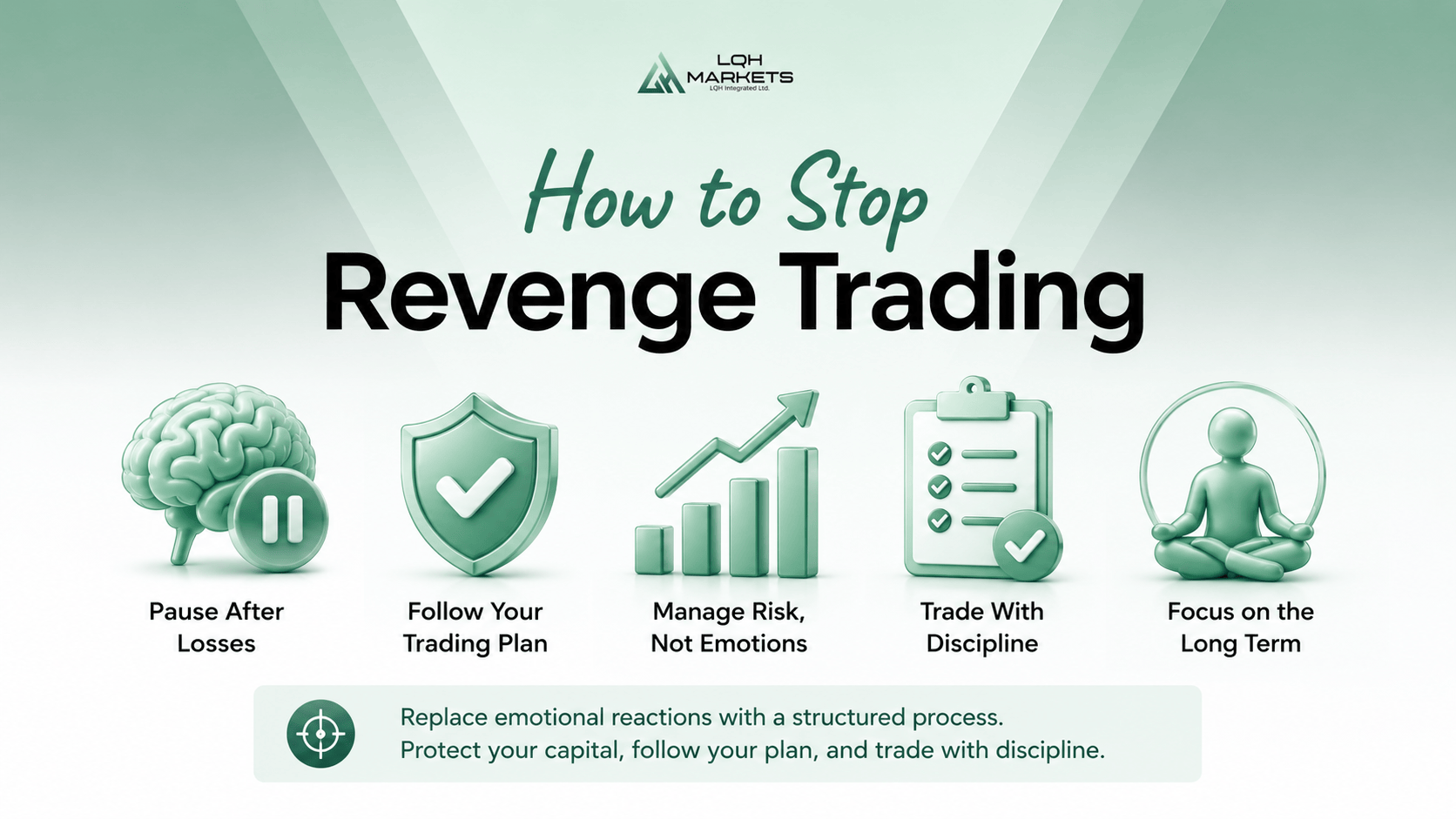
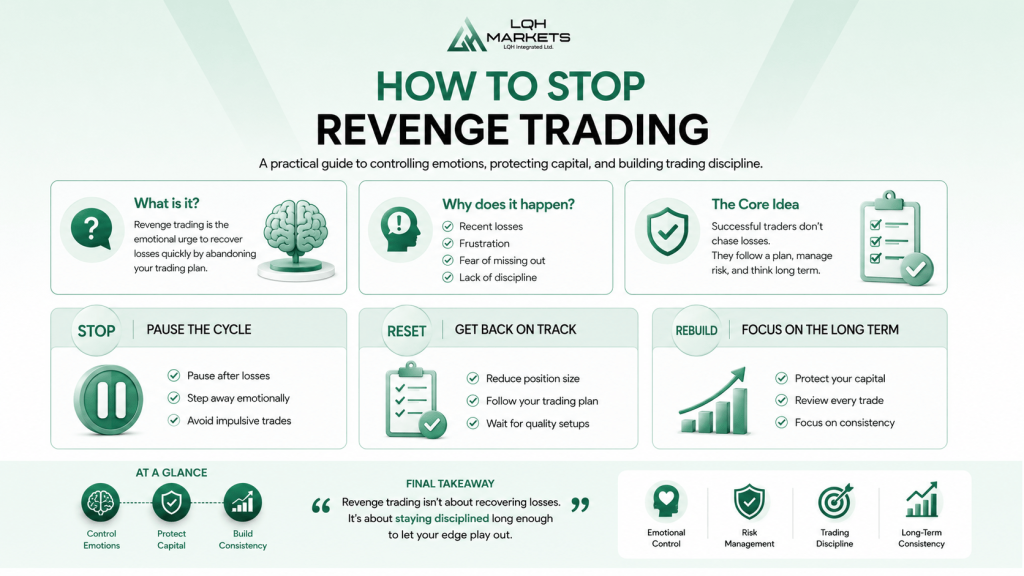
Revenge trading stops when you replace emotional decisions with a structured trading process. The fastest way to break the cycle is to pause after losses, reduce position size, follow pre-defined risk limits, and only take trades that match your trading plan. Most traders lose more money during emotional recovery attempts than during the original losing trade.
Revenge trading is one of the most common reasons retail traders blow up their accounts. It usually happens after a painful loss when a trader tries to win the money back immediately. Instead of following a strategy, they start increasing risk, forcing entries, ignoring stop losses, and trading emotionally.
Behavioural finance research from CFA Institute and Prospect Theory research by Daniel Kahneman and Amos Tversky, summarised by Encyclopaedia Britannica, suggests traders are heavily influenced by loss aversion. Losses often feel psychologically stronger than gains, which can lead to irrational decision making under pressure.
For forex traders, CFDs traders, indices traders, and day traders, learning how to stop revenge trading is essential for long term survival.
What Is Revenge Trading?
Revenge trading happens when a trader reacts emotionally after a losing trade and attempts to recover losses quickly.
Instead of waiting for a high probability setup, the trader starts chasing the market. This often leads to:
- Overtrading
- Increasing lot sizes
- Ignoring risk management
- Removing stop losses
- Entering low quality trades
- Trading outside planned hours
- Taking impulsive positions
A revenge trader is usually motivated by frustration, anger, fear, or the need to prove they were right.
For example, imagine a trader loses 2% on a GBP/USD breakout trade. Instead of stepping away, they immediately open another larger position without confirmation. That trade also loses. They then double their size again in an attempt to recover.
This emotional spiral can wipe out weeks or months of profits in a single session.
Why Revenge Trading Is So Dangerous
Revenge trading damages both your trading capital and your decision making.
When emotions take over, the brain shifts from analytical thinking to reactive thinking. Studies from Harvard Business Review have shown that emotional stress reduces rational decision making and increases impulsive behaviour.
In trading, that creates a dangerous combination.
You abandon your edge
Every profitable trader relies on a repeatable edge. Revenge trading destroys consistency because you stop following the rules that made your strategy profitable in the first place.
Losses become larger
Many revenge traders increase position sizes after losses. This creates an uneven risk profile where a few emotional trades erase many disciplined trades.
Trading psychology deteriorates
Once traders lose confidence, they often hesitate on valid setups or continue forcing trades. Emotional instability creates inconsistent execution.
You create a negative feedback loop
Losses trigger emotional trading. Emotional trading creates more losses. More losses increase frustration.
Without intervention, the cycle continues.
Common Causes of Revenge Trading
Understanding why revenge trading happens is the first step toward preventing it.
Lack of a trading plan
Traders without defined rules are more likely to make emotional decisions.
A proper trading plan should define:
- Entry conditions
- Exit conditions
- Risk per trade
- Maximum daily loss
- Trading sessions
- Position sizing
- Market conditions to avoid
Without structure, emotions fill the gap.
Risking too much per trade
Large losses create emotional pressure.
If a trader risks 10% of their account on one position, every losing trade feels catastrophic. Professional traders usually focus on capital preservation first.
Many experienced traders risk between 0.5% and 2% per trade to reduce emotional volatility.
Unrealistic expectations
Many beginners believe trading should produce fast income every day.
When markets do not cooperate, frustration builds quickly.
Trading is probabilistic. Even profitable strategies experience losing streaks.
Lack of experience
New traders often confuse random outcomes with personal failure.
A losing trade does not necessarily mean the trade was bad. Even strong setups can fail.
Experienced traders understand that losses are part of the business.
Fatigue and stress
Mental exhaustion reduces discipline.
Trading for long hours, watching multiple markets, or dealing with external stress can increase emotional reactions.
Signs You Are Revenge Trading
Many traders do not realise they are revenge trading until significant damage has already occurred.
Common warning signs include:
- Entering trades immediately after a loss
- Increasing lot sizes emotionally
- Ignoring your trading checklist
- Trading markets you do not normally trade
- Moving stop losses further away
- Refusing to accept losses
- Feeling angry at the market
- Trading continuously without breaks
- Breaking your maximum daily loss rule
The earlier you recognise these behaviours, the easier it becomes to stop the cycle.
How to Stop Revenge Trading
Stopping revenge trading requires structure, discipline, and emotional awareness.
The goal is not to eliminate emotions entirely. The goal is to stop emotions from controlling your execution.
1. Create a Maximum Daily Loss Limit
One of the most effective ways to prevent revenge trading is to define a hard daily loss limit.
For example:
- Stop trading after losing 3% in one day
- Stop trading after 3 consecutive losses
- Reduce size after a losing streak
Once the limit is reached, step away from the platform.
Professional prop firms often use daily drawdown limits because they understand emotional trading increases dramatically after losses.
2. Reduce Your Position Size
Large position sizes amplify emotions.
If every trade feels stressful, your risk is probably too high.
Reducing position size helps traders think more objectively and execute consistently.
Smaller positions also make it easier to follow your stop loss.
If you are learning risk management, our guide on margin trading explained for beginners can help traders understand how leverage impacts emotional pressure and account volatility.
3. Use Stop Losses Correctly
Many revenge traders remove stop losses because they hope losing trades will recover.
This behaviour often turns small losses into catastrophic losses.
Using properly placed stop losses protects trading capital and removes emotional decision making during volatile moves.
If you are trading on MetaTrader 5, learning proper stop placement is essential. Traders can improve execution with our guide on how to set stop loss and take profit in MT5.
4. Take a Break After a Loss
One of the simplest ways to stop revenge trading is to pause.
After a significant loss:
- Leave the trading desk
- Go for a walk
- Avoid chart watching
- Review your trade later
- Wait until emotions settle
Even a 15 minute break can reduce impulsive behaviour. Some traders use mandatory cooling off periods after consecutive losses.
5. Focus on Process Instead of Money
Revenge trading usually happens when traders become obsessed with recovering money. Profitable traders focus on execution quality instead.
Good trading habits include:
- Following setups correctly
- Respecting risk management
- Recording trades in a journal
- Maintaining consistency
- Thinking in probabilities
The market does not reward emotional urgency. It rewards disciplined execution over time.
6. Keep a Trading Journal
A trading journal helps traders identify emotional patterns.
Record:
- Why you entered the trade
- Your emotional state
- Risk size
- Trade outcome
- Mistakes made
- Market conditions
Over time, revenge trading patterns become easier to spot.
Many traders discover they revenge trade during specific market sessions or after specific types of losses.
7. Build a Repeatable Trading Strategy
Confidence comes from repetition and testing.
Traders who trust their strategy are less likely to panic after losses.
Your strategy should include:
- Clear entry rules
- Defined risk parameters
- Profit targets
- Historical testing
- Realistic expectations
Whether you trade breakouts, momentum, or pullbacks, consistency matters more than excitement.
For short term traders, strategies such as our 1 min scalping strategy micro movements article can help traders understand structured execution rather than emotional overtrading.
8. Accept That Losses Are Part of Trading
Even professional traders lose regularly.
A strategy with a strong edge can still experience:
- Losing streaks
- False breakouts
- Slippage
- Unexpected news volatility
- Choppy conditions
The goal is not to avoid losses entirely. The goal is to manage losses professionally.
Educational resources from the U.S. Securities and Exchange Commission and FINRA Investor Education consistently emphasise disciplined risk management as a core principle of long term trading.
The Psychology Behind Revenge Trading
Revenge trading is heavily linked to behavioural finance.
Several psychological biases contribute to emotional trading.
Loss aversion
Behavioural finance research shows people often feel losses more intensely than gains. According to Encyclopaedia Britannica’s overview of Prospect Theory, psychologists Daniel Kahneman and Amos Tversky found that individuals are often willing to take irrational risks to avoid accepting losses.
This helps explain why some traders increase position sizes, ignore stop losses, or double down after losing trades in an attempt to recover quickly.
Recency bias
Traders often place too much importance on recent outcomes.
A few losing trades can make traders believe their strategy no longer works.
Ego involvement
Some traders view losses as personal failures.
Instead of treating trading as probabilities, they try to prove themselves right.
That emotional attachment leads to impulsive decisions.
How Professional Traders Avoid Revenge Trading
Professional traders focus heavily on risk management and emotional control.
Common habits include:
- Fixed risk per trade
- Strict drawdown limits
- Automated stop losses
- Detailed trading plans
- Performance reviews
- Limited trading sessions
- Consistent routines
Professionals understand that preserving capital is more important than forcing profits. Many successful traders only take a small number of high quality trades each day.
One way to reduce emotional trading is to create a trading plan before entering the market. A Position Size Calculator and Profit & Loss Calculator make it easier to define your risk in advance instead of making decisions in the heat of the moment.
The Role of Technology and Trading Platforms
Trading platforms can either support discipline or encourage impulsive behaviour.
Platforms with strong execution tools, advanced charting, and reliable risk management features help traders maintain consistency.
Many traders prefer MetaTrader 5 because it supports:
- Advanced chart analysis
- Multiple asset classes
- Automated trading tools
- Flexible order management
- Risk management features
- Fast execution capabilities
Reliable execution becomes especially important during volatile market conditions.
Can Revenge Trading Ever Be Completely Eliminated?
Most traders will experience emotional impulses at some point. The difference is that disciplined traders build systems that prevent emotions from damaging their accounts. The goal is not perfection. The goal is consistency. Over time, traders who follow structured routines typically improve emotional control and reduce impulsive behaviour.
Building Long Term Trading Discipline
Long term success in trading comes from sustainability. That means:
- Protecting capital
- Managing emotions
- Following systems
- Thinking probabilistically
- Avoiding emotional decision making
Discipline often matters more than strategy. A mediocre strategy executed consistently usually outperforms a strong strategy traded emotionally.
If you are exploring different trading styles, learning whether swing trading is profitable or understanding how traders profit from short selling can help build broader market knowledge and reduce emotionally reactive decisions.
New traders should also focus on realistic growth expectations. Guides such as how to start day trading with $100 can help traders understand position sizing and risk management from the beginning.
Building Trading Discipline With LQH Markets
Revenge trading usually starts when execution becomes emotional instead of structured. After a loss, traders often abandon position sizing, ignore stop losses, or force trades outside their strategy in an attempt to recover quickly. That makes platform visibility and risk management tools more important than most traders realise.
On LQH Markets, every MetaTrader 5 account includes built in stop loss and take profit functionality, flexible position sizing, and full visibility over margin, equity, and open exposure directly inside the platform. Whether you’re trading forex, indices, commodities, or crypto CFDs, the execution environment is designed to support structured decision making rather than impulsive trading.
The same MT5 environment is available on desktop and mobile, so positions, risk levels, and active trades remain manageable even when markets move quickly. For traders working on discipline and emotional control, the demo account provides access to real market pricing and trading conditions without risking capital while refining a strategy.
Open an account or start with a demo.
Risk disclaimer
CFDs are complex instruments with a high risk of losing all your invested capital. Only trade with money you can afford to lose. Content is for general information only and is not investment advice
Final thoughts
Revenge trading is one of the fastest ways to destroy a trading account. It happens when emotions replace discipline after losses.
The solution is not chasing losses harder. The solution is creating a structured process that protects your capital and decision making.
Traders who use defined risk management, stop losses, realistic expectations, and disciplined routines are far more likely to survive long term.
At LQH Markets, traders can access flexible account options designed for different experience levels and trading styles. Whether you are focused on forex, indices, commodities, or CFDs, having access to reliable execution and professional trading tools can support more disciplined trading behaviour.
LQH Markets also provides access to MetaTrader 5, one of the most widely used trading platforms globally. MT5 offers advanced charting, risk management tools, automated trading support, and multi asset trading functionality that can help traders maintain structured execution instead of emotional decision making.
For traders working on improving consistency and emotional discipline, choosing the right broker environment matters. Strong technology, transparent execution, and access to educational resources can all play a role in helping traders avoid costly behaviours like revenge trading.
Frequently Asked Questions
Revenge trading is when a trader tries to recover losses quickly by entering impulsive trades after a losing position. Instead of following a strategy, decisions become emotional, often leading to larger losses.
Revenge trading is usually driven by frustration, loss aversion, and the desire to “win back” lost money. Behavioural finance research shows that emotional responses to losses can override rational decision making.
The most effective way is to use strict risk limits, take breaks after losses, and stick to a predefined trading plan. Reducing position size and using stop losses consistently also helps remove emotional pressure from decision making.
Yes, a clear trading plan removes guesswork and reduces emotional decision making. When entry, exit, and risk rules are predefined, traders are less likely to react impulsively after losses.
Demo trading can help traders build discipline without risking real capital, especially when learning execution and risk management. It allows traders to practice sticking to a strategy under real market conditions before trading live.