

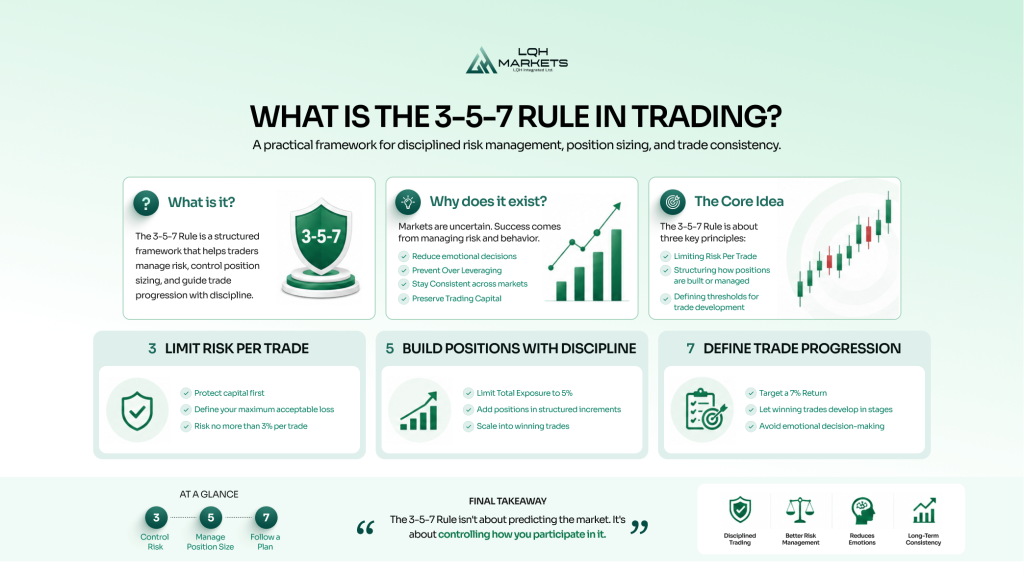
The 3 5 7 rule in trading is a structured framework that traders use to manage risk, control position sizing, and guide trade progression across defined stages. While not a universally standardized rule, it is typically interpreted as a method for limiting exposure, scaling positions, and managing trades in a disciplined and repeatable way. In practice, the rule helps traders avoid overleveraging, reduce emotional decision making, and maintain consistency across different market conditions.
Unlike widely established principles such as fixed percentage risk models or risk reward ratios, the 3 5 7 rule sits in a more flexible category. It is better understood as a practical framework rather than a rigid formula. That flexibility is precisely why it presents both an opportunity and a risk. When used correctly, it can improve trade discipline. When applied loosely or without context, it can create inconsistency.
Why rules like 3 5 7 exist in trading
Before breaking down the rule itself, it is important to understand why structured rules matter in trading at all.
Financial markets are inherently uncertain. Price movements are influenced by countless variables, many of which are unpredictable. Because of this, long term success is less about predicting outcomes and more about managing risk and behavior.
Research consistently shows that poor risk management and psychological biases are among the primary reasons traders fail. A study published by the CFA Institute highlights that disciplined processes and risk controls are central to consistent performance, especially in volatile markets.
Similarly, the U.S. Securities and Exchange Commission emphasizes that retail traders should focus on position sizing and risk exposure rather than attempting to predict short term price movements. Their guidance reinforces the idea that structured frameworks are essential for capital preservation:
The 3 5 7 rule fits into this broader philosophy. It is not about predicting the market. It is about controlling how you participate in it.
The core idea behind the 3 5 7 rule
At its core, the 3 5 7 rule is about three things:
- Limiting risk per trade
- Structuring how positions are built or managed
- Defining thresholds for trade development
The numbers themselves are not universal constants. Different traders interpret them slightly differently. However, most variations fall into a consistent structure:
1. The “3” component
This typically refers to limiting risk on a single trade.
In many interpretations, this means:
- Risking no more than 3 percent of total capital on a single position
- Or structuring trades so that losses remain small and controlled
This aligns closely with established risk management principles. Academic and institutional research generally supports even lower risk per trade, often around 1 to 2 percent. For example, Van Tharp, a well known trading psychologist, has extensively documented the importance of position sizing in risk control. His work emphasizes that survival in trading depends more on risk control than entry precision.
While 3 percent is slightly higher than conservative models, it can still be viable depending on account size and strategy. The key point is consistency. The rule forces traders to define risk before entering a trade, rather than reacting after the fact.
2. The “5” component
The “5” is often interpreted as a guideline for position scaling or trade development.
Common interpretations include:
- Limiting total exposure across multiple positions to 5 percent
- Adding to winning trades in structured increments
- Allowing a trade to develop through defined stages rather than entering full size immediately
This reflects a principle widely used in professional trading known as pyramiding. Instead of committing full capital upfront, traders scale into positions as the trade proves itself.
The concept of scaling into trades is supported by research in behavioral finance. Gradual commitment reduces emotional pressure and allows traders to adapt to new information. The Bank for International Settlements has published multiple reports on market behavior that highlight how incremental positioning can reduce exposure to sudden volatility shocks
In practical terms, the “5” component encourages patience. It discourages the common mistake of going all in too early.
3. The “7” component
The “7” is typically associated with profit targets, trade duration, or maximum exposure thresholds.
Depending on the version, it may refer to:
- Targeting a 7 percent return on a trade
- Allowing a trade to develop across multiple stages before exit
- Defining an upper boundary for total exposure or risk accumulation
This part of the rule is the least standardized, but it serves an important function. It introduces structure to trade exits.
One of the most common weaknesses among traders is inconsistent exit behavior. Many traders cut winners too early and let losses run. This behavior is well documented in behavioral finance literature as the disposition effect.
A paper published by the National Bureau of Economic Research shows that investors tend to realize gains too quickly while holding onto losing positions for too long. This directly harms performance
By defining a clear target or progression, the “7” component helps counter this bias.
How the 3 5 7 rule works in practice
To understand the rule properly, it helps to see how it might be applied in a real trading scenario.
Imagine a trader with a 10,000 account.
Using a structured interpretation of the rule:
- They risk a maximum of 3 percent per trade, which equals 300
- They scale into the position rather than entering fully at once
- They aim for a structured progression that allows the trade to reach a defined target
Instead of entering a full position immediately, they might:
- Enter a small initial position
- Add to the trade only if it moves in their favor
- Manage risk dynamically as the trade develops
This approach achieves several things:
First, it reduces initial exposure. If the trade fails early, losses remain limited.
Second, it aligns position size with confirmation. The more the market proves the idea correct, the larger the position becomes.
Third, it creates a structured exit plan. The trader is not guessing when to take profit.
Strengths of the 3 5 7 rule
When applied correctly, the rule offers several advantages.
It enforces discipline
Many traders struggle not because they lack knowledge, but because they lack structure. The 3 5 7 rule forces decisions to be made in advance.
Research in behavioural finance shows that rule based decision making can help reduce the impact of emotional and cognitive biases during uncertain market conditions. Structured systems often lead to more consistent execution compared to purely discretionary approaches.
It reduces emotional trading
By defining risk and progression beforehand, the rule limits impulsive decisions.
Emotional trading is one of the most documented causes of losses. Fear and greed often lead traders to:
- Overtrade
- Increase position size after losses
- Exit trades prematurely
A predefined framework helps neutralize these tendencies.
It supports capital preservation
Survival is the first objective in trading. Without capital, no strategy matters.
By limiting risk and controlling exposure, the 3 5 7 rule prioritizes longevity. This is consistent with professional trading principles, where risk management is always prioritized over return maximization.
The 3-5-7 rule is most effective when combined with proper trade planning. Use our Position Size Calculator to keep your risk within your chosen limits and our Profit & Loss Calculator to assess potential returns before entering a position.
Limitations and misconceptions
Despite its benefits, the 3 5 7 rule is not a complete trading system.
It is not universally defined
One of the biggest issues is inconsistency. Different sources define the rule differently. This can create confusion and reduce credibility if not addressed properly.
The solution is simple. Define your version clearly and apply it consistently.
It does not guarantee profitability
No rule or framework can eliminate risk. The 3 5 7 rule improves structure, but it does not improve trade accuracy on its own.
A trader still needs:
- A valid strategy
- Market understanding
- Consistent execution
It can encourage overconfidence if misunderstood
If traders interpret the rule as a shortcut to profitability, they may overlook its limitations.
Risk management reduces losses. It does not create winning trades.
How it compares to other risk management rules
To understand its place in trading, it helps to compare it to more established models.
Fixed percentage risk model
This is one of the most widely accepted approaches.
Traders risk a fixed percentage of capital on each trade, often 1 to 2 percent.
Compared to this model, the 3 5 7 rule is:
- More flexible
- Less standardized
- More focused on trade progression
Risk reward ratio
This focuses on the relationship between potential profit and potential loss.
For example, a 1 to 3 ratio means risking 1 to make 3.
The 3 5 7 rule complements this concept rather than replacing it. It adds structure to how trades are managed rather than just defining outcomes.
Kelly Criterion
This is a mathematical formula used to determine optimal position sizing.
It is far more complex and rarely used by retail traders in its pure form.
Compared to this, the 3 5 7 rule is:
- Simpler
- More practical
- Easier to implement
When the 3 5 7 rule makes sense
This framework is most useful for:
- Traders who lack structure
- Traders who struggle with risk control
- Traders who want a repeatable process
It is particularly effective for discretionary traders who need a framework to guide decision making without relying entirely on rigid systems.
When it does not
It is less effective for:
- Algorithmic strategies that require precise mathematical models
- High frequency trading where timing is critical
- Traders who already use strict quantitative risk systems
Using trading rule 3 5 7 with LQH Markets
The 3 5 7 rule only works if your platform gives you the control to manage risk precisely while trades are live. On LQH Markets, every MetaTrader 5 account includes the position sizing flexibility, stop loss functionality, and execution tools needed to apply structured risk management properly rather than approximating it.
You can trade forex, indices, commodities, and crypto CFDs from a single MT5 account, with stop loss and take profit built directly into every order ticket. Whether you’re limiting exposure on a single trade or scaling positions gradually as part of a structured approach like the 3 5 7 rule, MT5 gives you full visibility over margin, equity, and open risk in real time.
The same execution environment is available on demo accounts using live market pricing, making it possible to test how a risk management framework performs before committing real capital. Useful if you’re refining position sizing, trade scaling, or exit discipline under real market conditions.
LQH Markets supports crypto-funded trading accounts, allowing traders to deposit with selected cryptocurrencies for a faster and more flexible funding experience.
Open an account or start with a demo.
Risk disclaimer
CFDs are complex instruments with a high risk of losing all your invested capital. Only trade with money you can afford to lose. Content is for general information only and is not investment advice.
Final thoughts
The 3 5 7 rule in trading is best understood as a structured framework for managing risk, scaling positions, and guiding trade development. It is not a universal rule, and it is not a complete strategy. Its value lies in the discipline it creates.
For newer traders, it can provide a clear and practical way to approach the market. For more experienced traders, it can serve as a flexible overlay to existing strategies.
What matters is not the numbers themselves, but the principles behind them. Controlled risk, structured decision making, and consistent execution are what ultimately determine success in trading.
If those principles are applied correctly, the specific framework becomes less important. The outcome becomes far more consistent.
Frequently asked questions
The 3 5 7 rule is a structured way to manage trades by defining how much you risk, how you build positions, and how you handle profits. Most interpretations focus on limiting risk per trade, scaling into positions as they develop, and using predefined targets or thresholds to guide exits. It is not a fixed formula but a practical framework designed to improve consistency.
No, it is not a standalone strategy and it is not universally proven in the same way as established risk models. It does not generate trade ideas or predict market direction. Instead, it improves how trades are managed. Its effectiveness depends entirely on the underlying strategy and how consistently it is applied.
The rule forces traders to define risk before entering a trade and to control exposure as the trade develops. This aligns with widely accepted principles in financial risk management. For example, research from the CFA Institute emphasizes that controlling downside risk is a key driver of long term performance rather than trying to maximize individual trade outcomes.
Yes, especially for beginners who struggle with overtrading or inconsistent position sizing. The framework introduces structure without requiring complex calculations. However, it should still be combined with a clear trading strategy and an understanding of market conditions.
Yes, the rule is flexible and can be applied across forex, indices, commodities, and equities. Since it focuses on risk and trade management rather than specific setups, it can be adapted to different markets. The key is adjusting position sizes and expectations based on volatility and liquidity.