
Profits from CFD trading can be subject to Capital Gains Tax (CGT) in the UK. For individual traders, gains from CFDs will generally fall within the CGT regime, although the exact tax treatment depends on your circumstances and how you trade.
For the 2026/27 tax year, individuals have a £3,000 annual Capital Gains Tax exempt amount. Taxable gains above the available allowance are generally charged at 18% or 24%, depending on your taxable income and the amount of the gain.
However, CFD tax is more nuanced than simply applying a tax rate to every profitable trade. Losses, other investments, your total annual gains and the distinction between CFD trading and spread betting can all affect your tax position.
This guide explains how CFD taxation works in the UK, the current CGT rates and allowances, how losses may be treated and what traders should consider when keeping records.
Important: Tax treatment depends on individual circumstances and may change. This guide provides general information and is not tax advice. If you are unsure about your tax position, consult HMRC or a qualified tax professional.
Are CFD Profits Taxable in the UK?
Yes. Profits generated from CFD trading by individuals can be subject to Capital Gains Tax in the UK.
A Contract for Difference is a derivative rather than ownership of the underlying asset. HMRC’s guidance on Contracts for Difference describes a CFD as a type of derivative involving payments based on fluctuations in the value or price of an asset or index. Retail CFDs allow investors to take a view on whether the price of a share, index or other asset will rise or fall without owning that underlying asset.
For most individual investors, the relevant tax consideration when making gains through CFDs is Capital Gains Tax rather than Income Tax. However, tax treatment is circumstance-dependent and different rules can apply to companies and certain trading activities.
How Much Capital Gains Tax Do CFD Traders Pay?
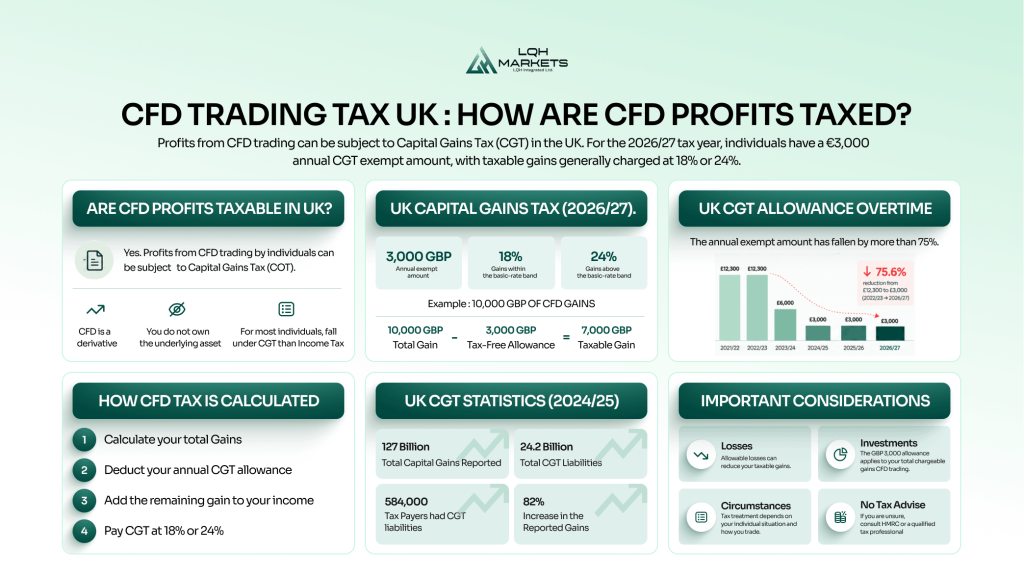
For the 2026/27 UK tax year, the main Capital Gains Tax rates for individuals are:
| Tax position | CGT rate |
| Gains falling within the basic-rate band | 18% |
| Gains falling above the basic-rate band | 24% |
| Annual exempt amount | £3,000 |
The rate is not determined simply by whether somebody describes themselves as a basic or higher-rate taxpayer.
Under the current Capital Gains Tax rates published by HMRC, individuals calculate their taxable gains after deducting the available tax-free allowance and then add the remaining amount to their taxable income. Gains falling within the basic-rate band are charged at 18%, while the portion above the basic-rate band is charged at 24%.
A gain can therefore cross the threshold, resulting in part of it being charged at 18% and the remainder at 24%.
The £3,000 annual exempt amount also applies to an individual’s overall chargeable gains. It is not a separate £3,000 allowance specifically for CFD trading.
Example: £10,000 of CFD gains
Consider a simplified example where a UK trader has £10,000 of net chargeable gains from CFD trading during the 2026/27 tax year and has their entire £3,000 annual exempt amount available.
That leaves:
£10,000 gain – £3,000 annual exempt amount = £7,000 taxable gain
If all £7,000 falls within the individual’s basic-rate band, CGT at 18% would produce a tax liability of:
£7,000 × 18% = £1,260
If all of the taxable gain instead falls above the basic-rate band and is taxed at 24%, the liability would be:
£7,000 × 24% = £1,680
This is deliberately simplified. Other capital gains, allowable losses and an individual’s wider tax position can alter the calculation.
The UK Capital Gains Tax Allowance Has Fallen by More Than 75%
One reason CFD taxation may now be relevant at considerably lower levels of profit is the sharp reduction in the UK’s Capital Gains Tax annual exempt amount.
The allowance available to most individuals has changed as follows:
| Tax year | CGT annual exempt amount |
| 2021/22 | £12,300 |
| 2022/23 | £12,300 |
| 2023/24 | £6,000 |
| 2024/25 | £3,000 |
| 2025/26 | £3,000 |
| 2026/27 | £3,000 |
That represents a 75.6% reduction from £12,300 in 2022/23 to £3,000 in 2026/27.
The change matters because the allowance applies to an individual’s overall chargeable gains, including gains from other relevant investments. A trader who also realises gains elsewhere could therefore use some or all of the allowance before considering their CFD gains.
The reduction was introduced in stages. The government’s policy on reducing the Capital Gains Tax annual exempt amount reduced it from £12,300 to £6,000 for 2023/24 and then to £3,000 from 2024/25.
HMRC’s latest CGT statistics show a measurable consequence. It says the reduction from £6,000 to £3,000 resulted in taxpayers with gains within that range becoming liable to CGT and contributed to additional taxable disposals and gains being reported.
In other words, a level of annual capital gain that would previously have sat comfortably below the CGT allowance can now potentially create a tax liability.
How Much Tax Does the UK Collect from CFD Trading?
There is currently no reliable public figure showing exactly how much Capital Gains Tax HMRC collects specifically from retail CFD trading.
HMRC publishes extensive Capital Gains Tax statistics, but its published data does not isolate retail CFD trading as a standalone category. It would therefore be misleading to describe the UK’s overall investment-related CGT receipts as tax generated by CFDs.
What the data does show is the scale of the wider UK CGT system.
According to the latest HMRC Capital Gains Tax statistics, in the 2024/25 tax year:
- UK taxpayers reported £127 billion of capital gains
- total CGT liabilities reached £24.2 billion
- 584,000 taxpayers had CGT liabilities
- total reported gains increased by 82% from the previous tax year
- CGT liabilities increased by 89%
Both gains and CGT liabilities reached record levels.
These figures should not be interpreted as CFD statistics. They instead provide context for the size of the UK Capital Gains Tax system and the increasing number of people whose realised gains fall within it.
What Is the Capital Gains Tax Allowance for CFD Trading?
The Capital Gains Tax annual exempt amount is £3,000 for individuals in 2026/27.
HMRC’s current Capital Gains Tax rates and allowances confirm that the £3,000 allowance also applied in 2024/25 and 2025/26.
There is no separate CFD tax allowance.
For example, suppose someone makes:
- £2,000 in chargeable gains from other investments
- £4,000 in net chargeable CFD gains
Those gains would not each receive a £3,000 allowance. Subject to the individual’s circumstances and any available losses or reliefs, they would be considered together when calculating the individual’s CGT position.
Do You Pay Stamp Duty on CFDs in the UK?
No. Opening or closing a CFD does not normally create a UK Stamp Duty or Stamp Duty Reserve Tax liability.
The reason is the distinction between trading a CFD on a share and buying the share itself.
Under HMRC’s guidance on CFDs and Stamp Duty, issuing or closing a CFD does not involve purchasing a stock, marketable security or chargeable security. There is therefore no Stamp Duty or Stamp Duty Reserve Tax liability on the CFD transaction itself.
This is one of the important tax differences between gaining exposure to shares through CFDs and directly purchasing certain UK shares.
The absence of Stamp Duty does not mean CFD trading is tax-free. Capital Gains Tax can still apply to gains.
Can CFD Trading Losses Reduce Your Tax Bill?
CFD losses can potentially be relevant when calculating an individual’s overall Capital Gains Tax position.
Capital Gains Tax is based on net chargeable gains after applying relevant losses and reliefs rather than simply adding up profitable transactions and ignoring losing ones.
For example, imagine a trader realises:
- £12,000 of gains from profitable CFD positions
- £5,000 of allowable losses
Ignoring other investments and assuming the losses qualify, the trader’s net gain would be:
£12,000 – £5,000 = £7,000
If the full £3,000 annual exempt amount were then available, the remaining taxable gain would be £4,000.
Unused allowable capital losses may also potentially be carried forward and deducted from future gains, subject to HMRC’s rules.
The treatment of losses is one of the important distinctions between CFDs and financial spread betting.
CFD Tax vs Spread Betting Tax in the UK
CFDs and financial spread betting can both provide leveraged exposure to financial markets, but their UK tax treatment is not necessarily the same.
| Tax consideration | CFD trading | Financial spread betting |
| Capital Gains Tax | Can apply | Winnings generally outside CGT |
| Stamp Duty on the trade | No | No |
| Capital losses potentially usable against chargeable gains | Potentially | Generally no |
| Ownership of underlying asset | No | No |
| Leveraged product | Yes | Yes |
Spread-betting winnings are generally outside Capital Gains Tax, whereas CFD gains can be chargeable.
The difference also works in the opposite direction. A loss from spread betting generally cannot be treated as an allowable capital loss in the same way that a qualifying CFD loss potentially can.
For UK traders comparing CFDs with spread betting, taxation is therefore better understood as a difference in tax treatment, rather than assuming one product is automatically better than the other.
Individual circumstances can affect the outcome, and professional tax advice may be appropriate where the position is unclear.
Are CFDs Subject to Income Tax Instead?
For most individuals investing or speculating through retail CFDs, Capital Gains Tax is generally the more relevant tax regime.
However, there is no rule saying every financial-market transaction undertaken by every individual must receive identical treatment.
HMRC considers the facts and circumstances surrounding financial trading activities, and different rules apply to businesses and companies.
Companies, for example, fall under a different regime. CFDs can fall within the derivative contracts regime for Corporation Tax purposes.
Someone trading CFDs through a company should therefore not assume that the individual CGT rules described in this article apply to them.
How Do UK CFD Regulations Affect Traders?
Taxation and financial regulation are separate issues, but both are important considerations for UK CFD traders.
The Financial Conduct Authority has introduced specific protections for CFDs sold to UK retail clients.
The FCA’s rules for CFDs offered to retail consumers require providers to:
- limit leverage to between 30:1 and 2:1, depending on the underlying asset
- close positions when account funds fall to 50% of the margin required to maintain open positions
- provide negative balance protection so retail clients cannot lose more than the total funds in their CFD account
- refrain from offering monetary or non-monetary incentives to encourage retail CFD trading
- display standardised risk warnings showing the percentage of the firm’s retail client accounts that lose money
These protections are particularly important because leverage magnifies both potential gains and potential losses.
Tax treatment should therefore never be considered in isolation from the risks associated with leveraged trading.
How Should CFD Traders Keep Records for Tax?
Keeping complete trading records can make calculating gains and losses substantially easier.
UK CFD traders should consider retaining records showing:
- opening and closing dates
- instrument traded
- position size
- opening and closing prices
- realised profit or loss
- transaction charges
- account statements
- deposits and withdrawals
- relevant currency conversions
- any other costs potentially relevant to calculating gains or losses
Most CFD platforms provide account statements and transaction histories, but traders should not necessarily rely on indefinite access to an online account.
Downloading annual statements and retaining your own records can provide a clearer history if information is required for a future tax return.
Records may also need to cover investments held across multiple providers because CGT is based on the taxpayer’s overall position rather than being calculated independently for each broker.
Do You Have to Tell HMRC About CFD Profits?
Whether you need to report gains depends on your individual circumstances, including your total gains, losses, reliefs and other disposals during the tax year.
The important point is that tax is not assessed independently on every successful CFD position.
A trader could make hundreds of winning and losing trades during a year. The relevant calculation considers gains and allowable losses according to CGT rules before determining the resulting taxable gain.
Traders should therefore check current HMRC reporting requirements for the relevant tax year rather than assuming that withdrawing money from a CFD account is what creates a tax liability.
Are CFD Profits Taxed When You Withdraw the Money?
A withdrawal from your trading account is not, by itself, what determines whether a capital gain has arisen.
Leaving realised trading profits in a CFD account does not automatically defer the relevant tax treatment until the money reaches your bank account. Similarly, transferring existing money between your bank account and trading account does not itself represent a trading profit.
The underlying transactions and when gains or losses are realised are what matter.
Traders should therefore maintain transaction records rather than attempting to calculate their tax position simply by comparing deposits with withdrawals.
Trading CFDs in the UK with LQH Markets
LQH Markets provides access to CFD trading across a range of global financial markets, allowing traders to take positions on rising or falling prices without owning the underlying asset.
Depending on the instruments available to you, CFDs can provide exposure to markets including forex, shares, indices, commodities and cryptocurrencies from a single trading account.
Before trading, UK clients should understand both the risks of leveraged products and their potential tax obligations. CFD profits can contribute towards an individual’s overall chargeable gains, while losses may also be relevant when calculating their Capital Gains Tax position.
Tax should therefore be considered alongside factors such as trading costs, leverage, margin requirements and risk management rather than after trades have already been made.
Create an LQH Markets account to explore the markets available to trade, or open a demo account to practise CFD trading in a simulated environment before trading with real funds.
CFDs are complex instruments and come with a high risk of losing money rapidly due to leverage. Make sure you understand how CFDs work and whether you can afford to take the high risk of losing your money.
Risk disclaimer
CFDs are complex instruments with a high risk of losing all your invested capital. Only trade with money you can afford to lose. Content is for general information only and is not investment advice.
CFD Tax in the UK: Key Takeaways
CFD profits can be subject to Capital Gains Tax for UK individuals.
For the 2026/27 tax year, the annual CGT exempt amount for individuals is £3,000, while the main CGT rates are 18% and 24%. The rate actually paid depends on the trader’s taxable income, gains, available allowance, losses and wider circumstances.
The annual exempt amount has also fallen substantially. It stood at £12,300 as recently as 2022/23 but is now £3,000, a reduction of more than 75%. That means relatively modest capital gains can now exceed the available allowance.
CFDs themselves do not normally attract Stamp Duty or Stamp Duty Reserve Tax because the trader does not purchase the underlying security.
Losses can also matter. Subject to HMRC’s rules, allowable CFD losses may reduce chargeable gains, creating an important distinction from financial spread betting.
And while the UK publishes detailed CGT statistics, HMRC does not currently provide a standalone figure for tax generated specifically by retail CFD trading. The broader figures are nevertheless substantial: CGT liabilities reached a record £24.2 billion in 2024/25.
UK traders should keep detailed transaction records and check the latest HMRC guidance or seek professional tax advice where their circumstances are unclear.
Frequently Asked Questions
No. CFD profits are not automatically tax-free in the UK. For individuals, gains can be subject to Capital Gains Tax after accounting for available allowances, losses and the trader’s individual circumstances.
The annual CGT exempt amount for individuals is £3,000 for the 2026/27 tax year. It applies across relevant capital gains rather than being a separate £3,000 allowance exclusively for CFD trading.
No. HMRC states that issuing or closing a CFD does not create a Stamp Duty or Stamp Duty Reserve Tax liability because the transaction does not involve purchasing the underlying chargeable security.
Allowable capital losses may be used when calculating net chargeable gains, subject to HMRC rules. Unused allowable losses can potentially be carried forward. Individual circumstances can differ, so traders should consult current HMRC guidance or a tax professional.
The products have different tax treatment. CFD gains can be subject to CGT and qualifying losses may potentially reduce chargeable gains. Spread-betting winnings are generally outside CGT, but losses generally cannot be used as capital losses. Individual circumstances can alter the tax treatment.