Forex prices can move quickly, and traders do not always want to enter a position at the current market price. A pending order allows a trader to define a price in advance and instruct the platform to act only if the market reaches it.
Two of the most commonly confused pending orders are the buy stop and the buy limit. Both are instructions to open a long forex position, but they express different ideas about what price may do next. A buy stop is placed above the current market price and is generally associated with a potential upward breakout. A buy limit is placed below the current market price and is generally used when a trader expects a pullback before a possible rise.
Their sell-side equivalents work in the opposite direction. A sell stop is placed below the market, while a sell limit is placed above it.
This guide explains what buy stop and buy limit orders mean in forex, how all four pending order types differ, and what traders should consider before using them.
What Is a Pending Order in Forex?
A pending order is an instruction to open a forex trade later, once a currency pair reaches a specified price. It differs from a market order, which requests execution at the best price currently available.
Pending orders can be useful when a trader has identified a potential entry level but does not want to monitor the chart continuously. They can also support a more structured approach by making the intended entry, position size and risk controls explicit before the market reaches that level.
The four standard pending entry orders are:
- Buy stop
- Buy limit
- Sell stop
- Sell limit
The key distinction is not simply whether the trader wants to buy or sell. It is also whether the chosen entry sits above or below the current price.
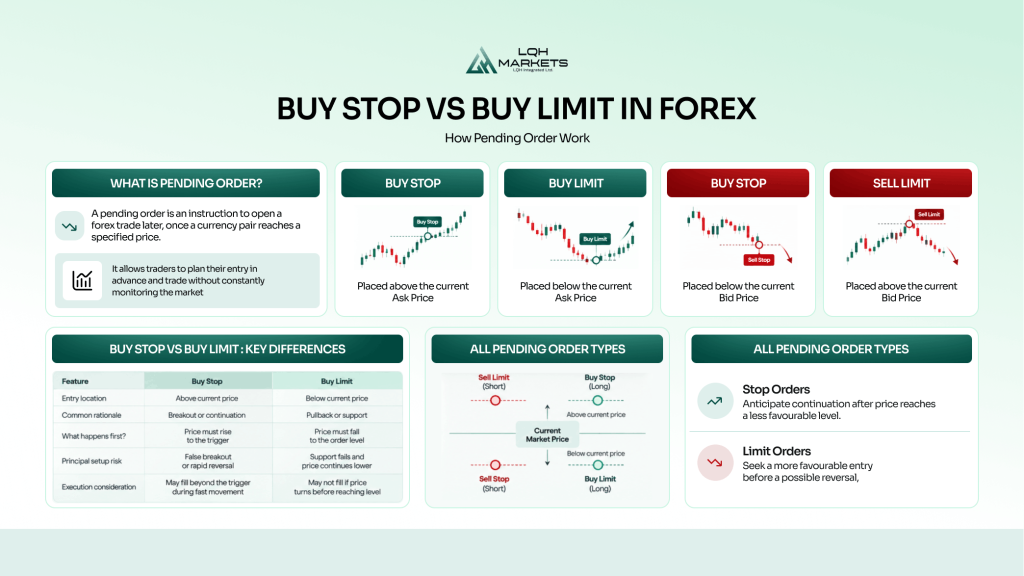
| Pending order | Position opened | Placed relative to current price | Typical market idea |
| Buy stop | Long | Above the current Ask price | Price may continue rising after reaching a higher level |
| Buy limit | Long | Below the current Ask price | Price may fall to a lower level and then rise |
| Sell stop | Short | Below the current Bid price | Price may continue falling after reaching a lower level |
| Sell limit | Short | Above the current Bid price | Price may rise to a higher level and then fall |
These placements follow the standard definitions in MetaTrader 5’s explanation of pending order types.
What Is a Buy Stop in Forex?
A buy stop is a pending instruction to buy a currency pair at a price above its current market level. The order remains inactive unless the Ask price reaches the specified trigger.
Traders often use a buy stop when they do not want to enter merely because price is approaching resistance. Instead, they want the market to trade above a chosen level before opening a long position.
Imagine EUR/USD is quoted around 1.1000 and a trader identifies resistance at 1.1050. They might place a buy stop at 1.1060. If the Ask price reaches the trigger, the buy order is activated. If EUR/USD never reaches 1.1060, no position is opened.
The logic is conditional: “I only want to buy if the market first demonstrates enough strength to reach this higher price.”
A buy stop may form part of a breakout, trend-continuation or rules-based plan. Reaching the trigger does not confirm that price will continue upwards: breakouts can fail and price can reverse shortly after activation.
What Is a Buy Limit in Forex?
A buy limit is a pending instruction to buy a currency pair at a price below its current market level. It is generally used when a trader expects price to fall to a more favourable entry level and then rise.
Suppose GBP/USD is trading around 1.2800 and a trader identifies potential support near 1.2750. Rather than buying immediately, they could place a buy limit at 1.2750. The order can only be filled if the market falls to the relevant level.
The logic is: “I want to buy, but only at this lower price or better.”
A buy limit may form part of a pullback, support or range-trading plan. A lower entry is not automatically a better trade: the market may be falling because the bullish idea is weakening and can continue through the anticipated support.
Buy Stop vs Buy Limit: What Is the Difference?
Both orders aim to open a long position, but they are placed on opposite sides of the current market.
| Feature | Buy stop | Buy limit |
| Entry location | Above current price | Below current price |
| Common rationale | Breakout or upward continuation | Pullback, retracement or support reaction |
| What happens first? | Price must rise to the trigger | Price must fall to the order level |
| Principal setup risk | False breakout or rapid reversal | Support fails and the decline continues |
| Execution consideration | May be filled beyond the trigger during fast movement | May not fill if price turns before reaching the level |
The choice should follow the setup rather than a general belief that one order is better. A breakout plan and a pullback plan make different assumptions, so they require different entry instructions.
What Is a Sell Stop in Forex?
A sell stop is the bearish counterpart to a buy stop. It is placed below the current Bid price and is used to open a short position if the market falls to the specified trigger.
For example, if USD/JPY is trading around 150.00 and a trader believes a break below support at 149.50 could lead to further weakness, they might place a sell stop at 149.40. The order activates only if the Bid price reaches that lower level.
A sell stop is commonly associated with downside breakouts or bearish continuation. However, a move below support can fail just as a move above resistance can. Price can trigger the position and then rebound sharply.
What Is a Sell Limit in Forex?
A sell limit is placed above the current Bid price. It expresses the view that price may first rise to a higher level before turning lower.
Assume AUD/USD is trading near 0.6600 and a trader identifies potential resistance around 0.6650. A sell limit at that level would seek to open a short position only if price rises to it.
Sell limits are often associated with resistance, pullbacks within a downtrend or the upper boundary of a range. As with a buy limit, the anticipated reversal may not occur. Price can break through the level and continue rising after the position has opened.
Stop Orders vs Limit Orders in Forex
The four pending entries can be understood through two simple families:
- Stop entry orders anticipate possible continuation after price reaches a less favourable level: buy stop above the market, sell stop below it.
- Limit entry orders seek a more favourable entry before a possible reversal: buy limit below the market, sell limit above it.
“Less favourable” here refers only to the entry price compared with the current quote. A buy stop accepts a higher price and a sell stop accepts a lower price because reaching that level is part of the trader’s confirmation criteria.
This is also why a buy stop should not be confused with a stop loss. A buy stop is normally used to enter a long position. A stop loss is attached to an open position to request an exit if price moves against it. The word “stop” describes the trigger mechanism, but the purpose is different.
How Bid and Ask Prices Affect Pending Forex Orders
Forex platforms quote two prices:
- The Bid is the price at which a trader can sell.
- The Ask is the price at which a trader can buy.
The difference between them is the spread. Buy orders are triggered and executed with reference to the Ask price, while sell orders use the Bid price. A chart displaying only the Bid can therefore appear not to have touched a buy-order level even though the unseen Ask reached it.
This becomes particularly important when spreads widen. Around major economic announcements, the transition between trading sessions or periods of low liquidity, the distance between Bid and Ask can increase. That may change when an order triggers and the price available for execution.
Does a Pending Order Guarantee the Entry Price?
No. A trigger price and an execution price are not always identical.
When a buy stop or sell stop is activated, the resulting order is filled using available liquidity. If the market moves quickly or gaps through the trigger, the final price may be different. This is known as slippage. Slippage can be negative or positive, although traders often focus on the risk of a worse fill.
A limit order provides price control, but it does not guarantee a fill. Price may stop just short of the level, or insufficient liquidity may be available to fill the full requested volume. Platform rules, the instrument and the execution model can also affect the outcome.
MetaTrader notes that stop orders are normally processed until the relevant stop price is reached, while limit and stop-limit structures behave differently within the trading system. Traders should therefore understand the order execution rules used by their platform, not treat every pending order as a promise of exact execution.
Example: Choosing Between a Buy Stop and Buy Limit
Suppose EUR/USD is trading at 1.1000, with support around 1.0950 and resistance around 1.1050. A breakout trader might place a buy stop at 1.1060, so a position opens only if price rises beyond resistance. A pullback trader might instead place a buy limit at 1.0960, so entry requires price to fall towards support.
These illustrative levels are not recommendations. They show how the order follows the thesis: one trader wants evidence of upward movement, while the other wants a lower entry near anticipated support. Either plan would also need a defined stop loss, position size and potential exit.
Common Mistakes With Forex Pending Orders
Common errors include confusing a buy stop entry with a stop-loss exit, placing an order on the wrong side of the market and ignoring the Bid/Ask spread. Reaching a technical level does not confirm that continuation or reversal will follow. Stop entries can be caught by false breakouts, while limit entries can activate as price moves decisively through assumed support or resistance.
A pending order automates entry, not decision-making. A plan should define why the level matters, where the idea becomes invalid, the position size, the intended exit and whether the order should expire. Old instructions should be reviewed before major news or after market structure changes.
Forex CFDs are leveraged, so relatively small moves can produce larger gains or losses relative to the margin committed. The UK Financial Conduct Authority describes CFDs as high-risk products that are not suitable for all retail consumers. A pending entry does not limit risk unless suitable exposure and exit controls are also in place.
Trading Forex Pending Orders With LQH Markets
LQH Markets provides access to forex trading through MetaTrader 5, where traders can place buy stop, buy limit, sell stop and sell limit orders from the order window or chart interface. Pending orders can be combined with stop-loss and take-profit instructions, helping traders define entry and exit conditions before a position opens.
MT5 also provides charting, multiple timeframes and order-management tools across desktop and mobile. Traders should still account for the spread, available liquidity, volatility and the possibility of slippage. No order type removes market risk or guarantees that a strategy will perform as expected.
If you want to practice selecting and placing pending orders before risking live capital, you can start with an LQH Markets demo account. When you are ready to trade live and understand the risks, you can create an LQH Markets account and access forex markets through MT5.
Risk Disclaimer
CFDs are complex instruments with a high risk of losing all your invested capital. Only trade with money you can afford to lose. Content is for general information only and is not investment advice.
Conclusion
The simplest way to remember the difference is that buy stops and sell limits sit above the current market, while buy limits and sell stops sit below it.
Where the order sits reveals the trading idea. Stop entries wait for price to move further in the anticipated direction before opening a position. Limit entries wait for a pullback to a more favourable price. Neither approach predicts what happens next, and neither removes the execution and leverage risks involved in forex CFD trading.
Understanding the order instruction is therefore only the first step. A complete plan should also define position size, invalidation, potential exit, costs and what happens if market conditions change before the order is triggered.
Buy Stop vs Buy Limit Frequently Asked Questions
A buy stop is positioned above the current market and waits for price to rise. A buy limit is positioned below the market and waits for price to fall. Both open long positions, but they represent different expectations about the route price may take before entry.
Yes. A stop entry can be filled at the next available price after triggering, creating slippage. A limit order controls the acceptable price but may remain unfilled.
A buy stop is a pending order placed above the current market price. It becomes a market order when the specified level is reached and is commonly used when a trader wants to enter only after price has moved higher, such as following a potential resistance breakout. Execution at the exact trigger price is not guaranteed.
A buy limit is a pending order placed below the current market price. It is used to request a long entry at the chosen price or lower, often when a trader expects a pullback before a possible rise. The order will remain unfilled if the market does not fall to the specified level.
A sell stop is placed below the current market and opens a short position if price falls to its trigger level. A sell limit is placed above the current market and seeks to open a short position after price rises to the chosen level. A sell stop generally reflects a continuation or breakdown idea, while a sell limit generally anticipates a reversal after a rally.
That depends on the expiry setting selected when the order is placed. A good-till-cancelled order can remain active until it is executed or removed, while an order with a specified expiry is cancelled automatically at the chosen time. Traders should review pending orders regularly because market conditions and the original rationale can change.