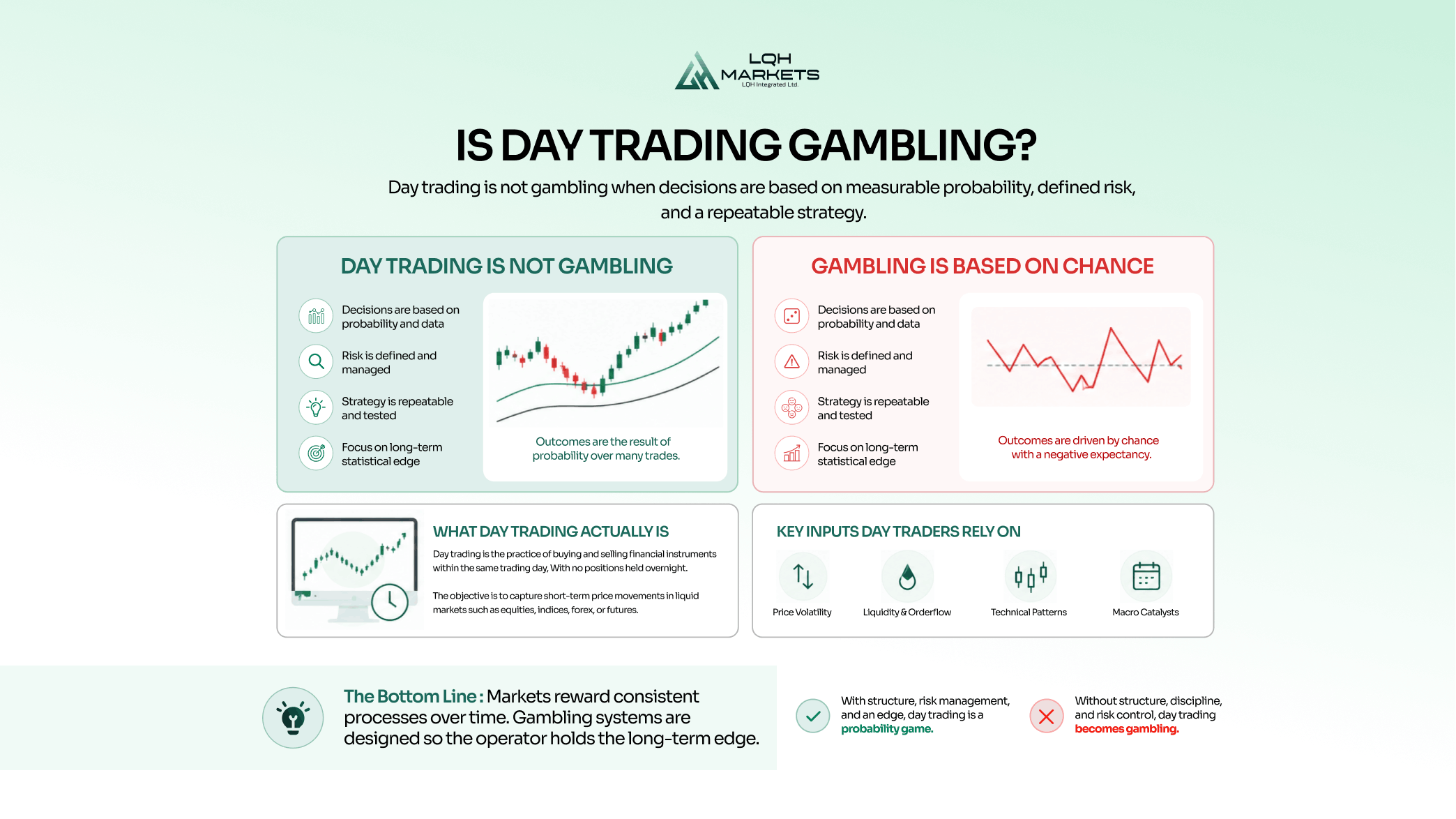
Day trading is not gambling when decisions are based on measurable probability, defined risk, and a repeatable strategy. It becomes similar to gambling only when structure is removed and decisions are driven by emotion instead of expectancy.
The key distinction is not speed or frequency of trading, but whether outcomes are generated through a statistical edge or through isolated, reactive bets. Trading operates on probabilistic distribution over many outcomes, while gambling relies on exposure to outcomes without a controllable edge.
To understand this properly, it is necessary to separate perception from mechanics. Markets reward consistent processes over time, while gambling systems are structured so that the operator holds the long-term edge. Day trading sits between these concepts only when it is stripped of discipline, which is why it is often misclassified.
What day trading actually is
Day trading is the practice of buying and selling financial instruments within the same trading day, with no positions held overnight. The objective is to capture short term price movements in liquid markets such as equities, indices, forex, or futures.
According to the U.S. Securities and Exchange Commission, day trading involves “the frequent buying and selling of securities within the same day” and is typically characterised by high turnover and reliance on intraday volatility rather than long term fundamentals.
Day traders attempt to extract small price inefficiencies repeatedly. Unlike investors, they are not primarily concerned with long term value appreciation. Instead, they rely on:
- Price volatility
- Liquidity and order flow
- Technical patterns
- Macro catalysts within the trading day
This structure matters because it introduces both opportunity and fragility. Small edges can compound quickly, but so can small mistakes.
What gambling actually is
Gambling is the act of risking money on outcomes determined primarily by chance, where the participant has a negative long-term expected return.
In regulated gambling environments such as casinos, the house edge ensures long term profitability for the operator. The participant may win in the short term, but probability is structurally against them.
The American Psychiatric Association defines gambling disorder as persistent and recurrent problematic gambling behaviour that disrupts personal and financial functioning, often driven by loss chasing and impaired control.
This definition becomes relevant because many failed traders exhibit identical behavioural patterns: escalation, revenge trading, and loss chasing.
Day trading vs gambling: the real differences
The confusion arises because both involve risk, uncertainty, and short term outcomes. However, structurally they are not the same when executed properly.
The difference between trading and gambling becomes clearest when comparing how each system generates outcomes and manages risk.
| Factor | Day Trading | Gambling |
| Edge source | Strategy, data, execution | House odds or chance |
| Outcome control | Partial (risk management, timing, selection) | None |
| Long term expectation | Can be positive with edge | Negative for participant |
| Skill component | High (analysis, discipline, execution) | Low or irrelevant |
| Risk control | Position sizing, stops, hedging | Typically fixed or none |
| Feedback loop | Data-driven performance review | Outcome driven, often emotional |
The critical distinction is edge. In trading, edge is not guaranteed, but it can be developed through testing, data, and discipline. In gambling, edge is structurally against the participant.
The Financial Industry Regulatory Authority highlights that frequent trading on margin can amplify both gains and losses, which increases the importance of disciplined risk management rather than speculative behaviour.
Why day trading is seen as gambling
Day trading gets labelled as gambling because outsiders and losing participants often judge it by outcomes rather than structure. From the outside, both involve risk, uncertainty, and short term results. A win looks like luck, a loss looks like bad luck, and the underlying decision framework is invisible.
This is where the misconception starts. Gambling is defined by a negative expected value for the participant over time. Trading, when structured correctly, is defined by the pursuit of a positive expected value through repeatable conditions. The similarity is superficial because both involve uncertainty, but uncertainty is not the same as randomness.
In gambling, outcomes are designed to be independent of skill. In trading, outcomes are probabilistic but influenced by execution quality, timing, and risk control.
The correct distinction is simple: gambling is participation without control over edge, while trading is participation with conditional control over edge.
The real distinction between trading and gambling: probability vs uncertainty
The core misunderstanding comes from treating uncertainty as randomness. Markets are uncertain, but they are not random in the same way gambling systems are structured to be.
Trading operates on probability distributions. Outcomes vary, but they cluster around statistical expectations when a valid edge exists. Gambling systems, by contrast, are designed so that the participant has no long term positive expectation.
This is why the comparison fails structurally. Trading is not about certainty, it is about measurable repetition over time. Gambling is about exposure to outcomes without a controllable edge.
Why expectancy, not prediction, defines legitimate trading
Day trading stops being a structured activity not because the market changes, but because the trader stops operating on expectancy. Expectancy means every trade is taken because it fits a setup that has been statistically validated over a large enough sample size. The individual outcome is irrelevant because it is absorbed into a distribution.
Hope based thinking replaces this when traders begin to act on what they believe will happen in a single instance rather than what has been shown to happen over many instances.
A probability based trader says: this setup wins 55 percent of the time with a 1.5 to 1 reward to risk ratio over 200 trades.
A hope based trader says: this looks like it should bounce.
Same market, completely different framework.
How structured strategies create statistical edge in markets
Strategies themselves do not determine whether trading is disciplined or not. The structure around execution is what matters.
Trend following, for example, only works when trends are defined objectively and entries occur after confirmation rather than anticipation. Without that, it becomes reactive decision making rather than structured participation.
Breakout trading requires predefined levels, confirmation criteria, and invalidation points. Without those, breakouts are just volatility events interpreted emotionally.
Mean reversion strategies rely on defined assumptions about deviation from averages and only function properly within appropriate volatility conditions.
The key point is that strategies do not become unreliable because markets are random. They fail when they are no longer executed consistently as probability models.
When expectancy is respected, losses are part of expected distribution. When expectancy is ignored, every outcome is interpreted emotionally, which distorts decision making.
Where traders abandon structure and shift into reactive behaviour
Most traders do not fail because they lack strategies. They fail because execution becomes reactive instead of structured.
Position sizing becomes inconsistent, often increasing after losses or wins based on emotion rather than predefined risk rules. This alone destroys statistical consistency.
Trade selection becomes diluted. Instead of waiting for defined setups, traders begin taking marginal opportunities due to impatience or the need to recover losses.
Exit decisions also become emotional. Trades are closed early due to fear or held too long due to hope, rather than being managed according to predefined invalidation logic.
At this stage, the system is no longer being executed. It is being overridden by reaction to recent outcomes, which removes any connection to expectancy.
Why emotional responses do not make trading equivalent to gambling
Both trading and gambling produce emotional responses because both involve uncertainty and immediate feedback.
However, emotion is not what defines the system. It is how emotion is handled.
In gambling, emotional response is embedded into the experience. The system is designed around uncertainty and reward cycles.
In trading, emotional response is a byproduct of variance in a probabilistic system. It becomes problematic only when it overrides structured decision making.
Behavioural finance research highlights how biases such as overconfidence, recency bias, and loss aversion distort decision making under uncertainty, especially in fast feedback environments.
The presence of emotion does not change classification. The role emotion plays in decision making does.
How risk discipline preserves trading as a probability system
Trading only resembles gambling when probability is no longer the foundation of decision making.
Risk becomes inconsistent rather than predefined. Losses are treated as urgent problems to fix rather than expected outcomes within a distribution. Strategy becomes secondary to emotional recovery.
At this point, the trader is no longer operating within a system. They are reacting to individual outcomes as isolated events.
The breakdown is not lack of knowledge, but loss of statistical thinking. Once expectancy is removed, trades lose their connection to a structured model and become randomised decisions.
Successful traders rely on risk management and disciplined position sizing rather than chance. Our Position Size Calculator and Profit & Loss Calculator can help you plan every trade with defined risk before you enter the market.
How LQH Markets reinforces structured, probability-based trading
Trading only stays probability-based when execution remains consistent. Once risk becomes reactive, position sizing changes emotionally, or trades are entered without defined conditions, the line between trading and gambling starts to disappear.
LQH Markets gives traders access to the MT5 environment used by active market participants across forex, indices, commodities, and crypto CFDs, with the tools needed to apply structured risk management directly inside the platform. Used margin, free margin, equity, and margin level are all visible in real time, while stop loss and take profit functionality are built into every order ticket so risk can be predefined before a position is opened.
Position sizing, execution, and trade management can all be controlled directly within MetaTrader 5, allowing strategies to be applied consistently rather than adjusted emotionally from trade to trade. Whether managing a trend-following setup, breakout strategy, or short-term intraday position, the framework remains anchored in measurable risk rather than isolated outcomes.
For traders still refining execution discipline or testing whether a strategy has genuine expectancy over a larger sample size, the demo account runs the same MT5 environment with live market pricing. This allows trading processes to be developed under real market conditions before capital is exposed to unnecessary risk.
LQH Markets supports crypto-funded trading accounts, allowing traders to deposit with selected cryptocurrencies for a faster and more flexible funding experience.
Open an account or start with a demo.
Risk disclaimer
CFDs are complex instruments with a high risk of losing all your invested capital. Only trade with money you can afford to lose. Content is for general information only and is not investment advice
Conclusion: trading remains probability-based when structure is maintained
Day trading is not gambling when decisions are driven by probability and defined edge rather than emotion or uncertainty.
The distinction is not in outcomes but in decision structure. Trading is a system of expectancy where results emerge over a distribution of trades. Gambling is a system of exposure without edge, where outcomes are independent of controllable processes.
When trading is structured correctly, losses are expected, variance is normal, and performance is measured over a series of outcomes rather than individual trades. When structure breaks down, decisions become reactive and isolated, and trading begins to resemble gambling in practice rather than definition.
The difference ultimately comes down to whether decisions remain anchored in probability over time or drift into emotional reaction in the short term.
FAQs
Day trading is not gambling when it is based on a structured process, defined risk, and a measurable statistical edge. It becomes comparable to gambling only when decisions are made without expectancy, risk control, or repeatable strategy. The key distinction is not the speed of trading but whether outcomes are driven by probability or by random, emotionally driven decisions.
The difference lies in expectancy and control over edge. Gambling systems are designed so the participant has a negative long term expectation, while trading systems can be built with a positive expected value when strategies are tested and applied consistently. Trading allows for risk management, defined entries and exits, and performance tracking over time, whereas gambling outcomes are independent of skill.
Most traders fail because they abandon probability-based decision making and shift into reactive, emotion-driven execution that breaks the underlying structure of their strategy. Instead of applying consistent risk, defined setups, and repeatable processes, they vary behaviour based on recent wins or losses, which removes any statistical edge over time.
Yes, but only when trading is treated as a probability based process rather than a prediction exercise. Profitability comes from applying a tested edge consistently over time with controlled risk per trade. Individual trades are uncertain, but a structured approach allows outcomes to stabilise over a larger series of trades. Without this structure, results become random and difficult to sustain.
Professional traders avoid gambling-like behaviour by removing emotion from decision making and anchoring all activity to predefined rules. This includes fixed risk per trade, clearly defined entry conditions, and consistent trade management based on invalidation rather than impulse. They focus on long term expectancy rather than individual outcomes, treating losses as part of distribution rather than as mistakes to recover from.