In trading, stop loss and stop limit orders are two of the most important risk management tools, yet they behave very differently in live market conditions. Understanding how each works is essential for managing execution risk in forex, indices, and other leveraged markets.
In MetaTrader 5 (MT5) environments, including broker platforms such as LQH Markets, both order types are available through standard stop orders and advanced pending order structures. However, they serve fundamentally different purposes: one prioritises execution certainty, while the other prioritises price control.
This guide explains how each order works, how MT5 handles them, and when each should be used.
What Is a Stop Loss Order
A stop loss order is a protective exit instruction. It tells the trading platform to close a position if price reaches a predefined level.
Once triggered, the order becomes a market order. This means it executes at the best available price at that moment rather than the exact level set by the trader.
How Stop Loss Works in MT5
In MetaTrader 5, when the market price reaches the stop loss level:
- The stop condition is triggered
- The position is converted into a market order
- The order is filled at the next available bid or ask price
This execution model prioritises triggering position exit in most market conditions.
Financial education sources commonly highlight that stop loss orders are designed to ensure exit rather than guarantee execution price precision, especially in volatile markets such as forex and indices.
Example Scenario
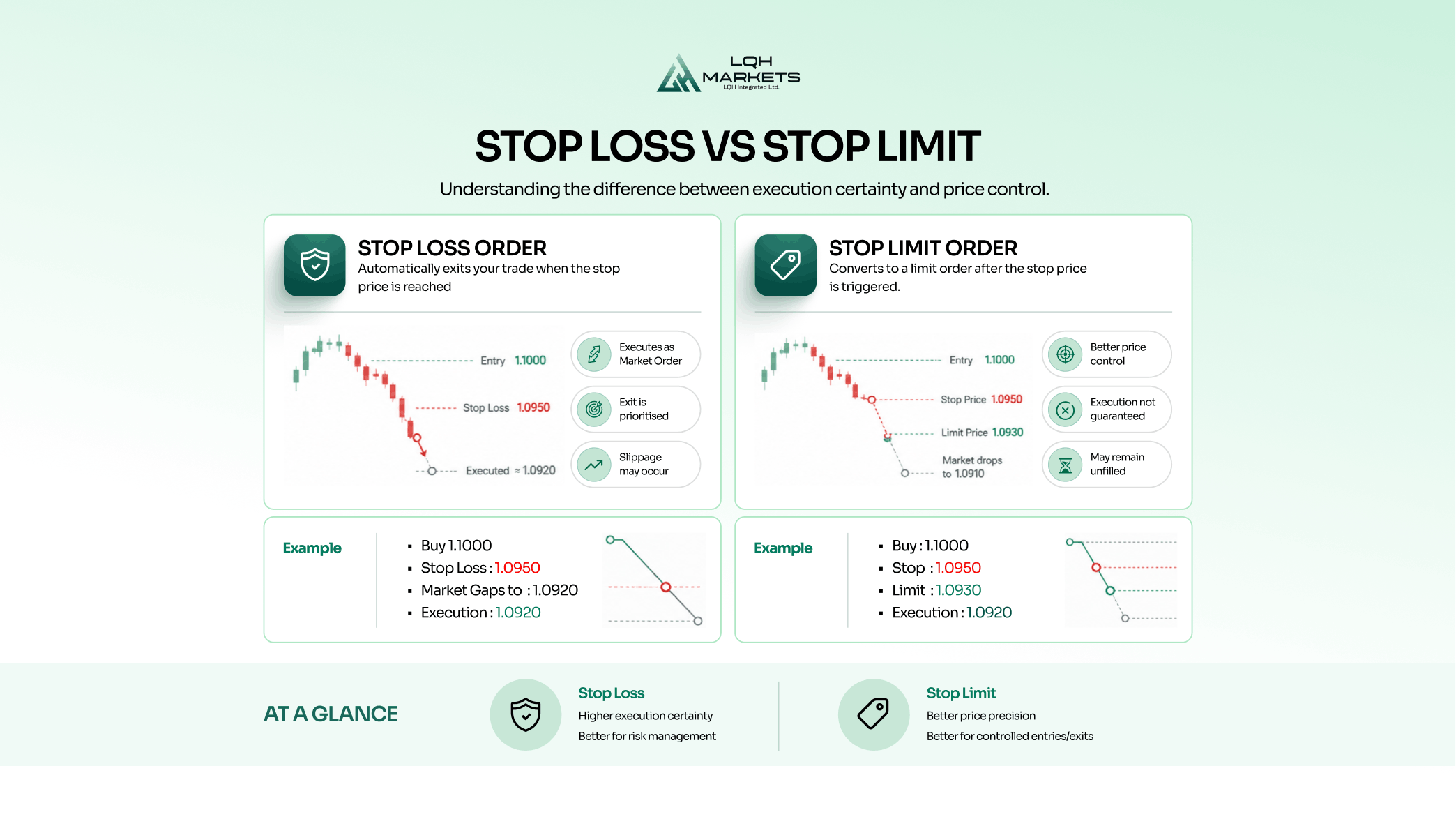
Assume a trader buys EUR/USD at 1.1000 and sets a stop loss at 1.0950. If the market falls rapidly due to economic news and gaps down to 1.0920, the position will still be closed, but the execution may occur near 1.0920 instead of 1.0950.
This difference is known as slippage, which is a normal part of fast-moving financial markets.
Key Characteristics of Stop Loss Orders
- Designed to trigger position exit in most market conditions
- Executes as a market order once triggered
- Does not guarantee exact price level
- Exposure to slippage during volatility
- Designed primarily for risk control
What Is a Stop Limit Order
A stop limit order is a two-stage order type that introduces price control into the execution process. Unlike stop loss orders, execution is not guaranteed if the market moves beyond the limit price without trading within that range.
It consists of two components:
- A stop price, which activates the order
- A limit price, which defines the worst acceptable execution level
Once the stop price is reached, the order becomes a limit order rather than a market order. In systems that support stop limit functionality within MT5:
How Stop Limit Works in MT5
- The market reaches the stop price
- The order is activated
- The order becomes a limit order
- It will only execute at the limit price or better
If the market moves beyond the limit price too quickly, the order may not execute at all.
Example Scenario
A trader holds EUR/USD at 1.1000 and sets:
- Stop price at 1.0950
- Limit price at 1.0930
If the market falls rapidly to 1.0910 without trading at or above 1.0930 after activation, the order will not fill. This introduces execution uncertainty in exchange for tighter price control.
Key Characteristics of Stop Limit Orders
- Provides control over execution price
- Does not guarantee execution
- May fail in fast-moving markets
- Reduces slippage when filled
- Best suited for controlled liquidity conditions
Core Difference Between Stop Loss and Stop Limit
The primary difference lies in what happens after the trigger condition is reached.
A stop loss becomes a market order, prioritising execution. A stop limit becomes a limit order, prioritising price control.
Industry explanations from brokers and trading education platforms consistently highlight this distinction as the key behavioural difference between the two order types.
Execution Comparison
Stop loss orders prioritise execution certainty, meaning the trade will usually close even in volatile conditions, but the final price may differ from the intended level.
Stop limit orders prioritise price certainty, meaning execution only occurs within defined price boundaries, but the trade may not execute at all if conditions move too quickly.
Market Behaviour
- Stop loss may experience slippage
- Stop limit avoids slippage but may not execute
Failure Conditions
- Stop loss: usually executes, but not always at intended price
- Stop limit: may not execute at all if price moves too quickly
Why This Matters in Modern MT5 Trading
In modern financial markets, especially forex and indices, price movement can be rapid due to:
- Economic news releases
- Liquidity gaps between sessions
- Algorithmic trading activity
- Sudden volatility spikes
These conditions directly affect order execution behaviour.
Stop loss orders are generally more reliable for ensuring position closure during volatility, while stop limit orders may fail if the market bypasses the limit range.
Volatility Scenario Example
During high-impact news events such as inflation or interest rate releases:
- Stop loss orders are more likely to execute, although slippage may occur
- Stop limit orders may not execute if price moves through the limit zone too quickly
This makes stop loss orders more suitable for risk control in volatile conditions.
How MT5 Handles Stop Loss and Stop Limit Orders
MetaTrader 5 supports both standard stop orders and advanced pending order structures.
Stop Loss in MT5
- Attached to open positions
- Automatically triggers when price is reached
- Converts into a market order
- Executes using available liquidity
This makes it a core risk management tool across all MT5 trading environments.
Stop Limit Orders in MT5
MT5 also supports stop limit style pending orders, which combine trigger and limit conditions.
These require:
- A trigger price
- A limit execution price
Once triggered, execution depends on whether the market trades within the defined limit range.
Stop limit orders are typically used for controlled execution strategies rather than emergency risk management.
When to Use Stop Loss
Stop loss orders are widely used because they prioritise execution certainty.
They are most appropriate for:
- Forex trading
- Index trading
- High volatility conditions
- Leveraged trading environments
- Active sessions such as London and New York
Stop loss orders are widely used because they prioritise execution certainty, which is essential when managing leveraged positions.
When to Use Stop Limit
Stop limit orders are more specialised and are used when price precision is more important than guaranteed execution.
They are most appropriate for:
- Low volatility conditions
- Algorithmic trading strategies
- Controlled liquidity environments
- Situations where slippage must be minimised
However, the key limitation is that trades may not execute if price moves too quickly beyond the limit level. In fast-moving markets, stop limit orders may not execute at all if price bypasses the limit zone without sufficient liquidity.
Common Trader Mistakes
One of the most common mistakes is assuming that stop limit orders provide the same protective function as stop loss orders.
They do not. A stop limit order may fail to execute entirely under fast market conditions.
Another common issue is setting stop losses too tightly, which can result in frequent premature exits due to normal market volatility.
Traders also often underestimate liquidity conditions. In low liquidity environments, price gaps can increase slippage risk for stop loss orders and execution failure risk for stop limit orders.
Whichever order type you use, your overall risk should still be calculated before placing a trade. A Position Size Calculator helps you size positions around your stop-loss, while the Profit & Loss Calculator estimates your potential risk and reward.
Setting stop loss and stop limit on LQH Markets
Every MT5 account on LQH Markets supports the stop loss functionality covered throughout this guide, alongside the advanced pending order types used for stop limit execution strategies. Whether you’re managing downside risk on forex positions or refining entry logic around volatility, the full order management framework is available directly inside MetaTrader 5.
You can place stop loss orders during execution, modify them from the trade terminal, or adjust them directly from the chart interface on desktop and mobile. MT5 also supports stop limit pending orders for traders who want tighter control over execution price in specific market conditions, particularly when building more structured or algorithmic strategies across forex, indices, commodities, and crypto CFDs.
If you’re learning how stop loss and stop limit orders behave during live market volatility, the demo account runs the same MT5 trading environment with real market pricing and execution conditions. Useful for understanding slippage, order triggering, and execution behaviour before managing live capital.
LQH Markets supports crypto-funded trading accounts, allowing traders to deposit with selected cryptocurrencies for a faster and more flexible funding experience.
Open an account or start with a demo.
Summary of Key Differences
Stop loss orders ensure that a position is closed when the market reaches a defined level. They prioritise execution and accept potential slippage.
Stop limit orders provide control over execution price but do not guarantee that execution will occur. They prioritise price discipline over certainty.
The choice between them depends on whether a trader values guaranteed exit or strict price control.
Risk disclaimer
CFDs are complex instruments with a high risk of losing all your invested capital. Only trade with money you can afford to lose. Content is for general information only and is not investment advice.
Conclusion
The difference between stop loss and stop limit orders is not simply technical. It is structural and directly impacts trade outcomes.
In MT5 environments such as those used by LQH Markets, stop loss orders are widely used as a core risk management tool due to their execution reliability in most market conditions and particularly in fast and volatile markets. Stop limit orders remain useful in specific strategies where price control is more important than execution certainty.
Understanding how each behaves in real market conditions is essential for effective risk management and consistent trading performance.
Frequently asked questions
A stop loss order becomes a market order once triggered, meaning it will execute at the best available price, even if that price is different from the level set. A stop limit order becomes a limit order after being triggered, meaning it will only execute at the specified limit price or better. The key difference is that stop loss prioritises execution certainty, while stop limit prioritises price control.
A stop limit order can fail to execute if the market moves too quickly past the limit price without trading within that range. This often happens during high volatility events such as major economic announcements. Since the order only fills at the limit price or better, there is no guarantee of execution if price gaps beyond that level.
A stop loss is not guaranteed to close a trade at the exact price, but it is highly likely to close the position once triggered. It becomes a market order, which means it will execute at the next available price. In fast-moving markets, this may result in slippage, but the trade will usually still be closed.
For most forex trading on MetaTrader 5, stop loss orders are preferred. This is because forex markets can move quickly and liquidity can change rapidly. Stop loss orders ensure that positions are exited even during volatile conditions, which is essential for risk management in leveraged trading environments like MT5 platforms used by brokers such as LQH Markets.
A stop limit order is best used when price precision is more important than guaranteed execution. This may include low volatility conditions, algorithmic trading strategies, or situations where avoiding slippage is critical. However, traders must accept the risk that the order may not execute if the market moves too quickly.