
Your stop loss usually hits because the market moved beyond the level your trade setup could realistically sustain. In most cases, stop outs are caused by normal volatility, liquidity driven movement, or stop placement that does not align properly with market structure. A stop loss simply represents the price level where your original trade idea is considered invalid.
It is also common for price to reverse after a stop loss is triggered. This happens across forex, indices, crypto, and commodities and is usually a reflection of how liquidity is delivered in the market rather than any targeted action against individual traders. In most situations, it is a structural outcome of order flow rather than intent.
Experienced traders expect stop losses to be hit as part of normal trading. The difference between consistency and inconsistency is not avoiding losses, but placing stops logically, managing risk correctly, and executing trades with discipline over time.
What A Stop Loss Actually Does
A stop loss is a predefined price level that automatically closes a trade in order to limit downside risk. On platforms such as MetaTrader 5, stop losses are attached to positions and executed server side without requiring manual intervention from the trader.
According to MetaTrader documentation, a stop loss is designed specifically to close a trade once price reaches a predefined adverse level against the position.
A stop loss does not guarantee that a trade will succeed or fail. Instead, it defines the point at which the original trade idea is considered invalid based on risk parameters.
The primary purpose of a stop loss is capital protection. Without it, a single adverse move in the market can create disproportionately large drawdowns that are difficult to recover from, especially when leverage is involved.
Why Your Stop Loss Hit
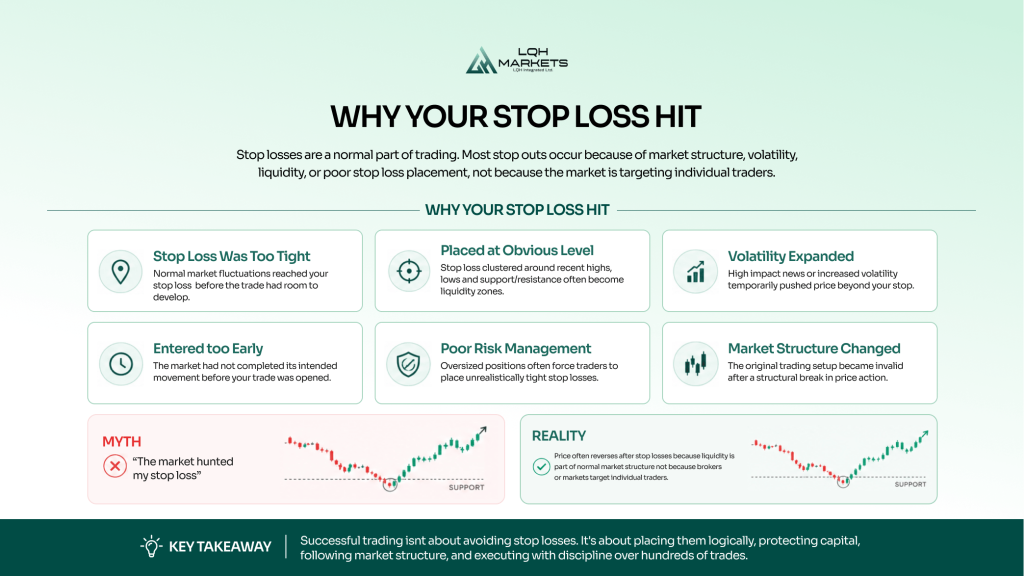
Stop losses are triggered for a combination of technical, behavioural, and structural reasons. Once you understand how market structure and volatility interact, most stop outs become explainable rather than random.
1. Your Stop Loss Was Too Tight
Markets do not move in straight lines. Even strong trends contain pullbacks, retracements, and short bursts of volatility that can temporarily move against the prevailing direction.
If a stop loss is placed too close to the entry, it becomes vulnerable to being triggered by normal price fluctuations rather than a genuine invalidation of the trade idea.
For example, EUR/USD can easily move 20 to 40 pips during normal sessions without changing overall direction. Gold often reacts sharply during US market open, while indices such as the Nasdaq can move aggressively around macroeconomic data releases. Crypto markets can also experience rapid and unpredictable short term spikes.
Because of this, small or overly tight stops often fail not because the idea is wrong, but because they do not account for realistic volatility conditions.
Traders typically use tools such as Average True Range, market structure, swing highs and lows, liquidity zones, and support and resistance levels to define more realistic stop distances.
2. Your Stop Loss Was Placed At An Obvious Level
Retail traders often place stop losses in predictable locations, which creates natural clusters of liquidity in the market. These commonly include areas just below support, above resistance, around prior highs or lows, and at round psychological numbers.
These zones tend to attract liquidity because many traders are observing similar levels and making similar decisions.
As price moves, it often pushes into these areas before reversing. This behaviour is frequently described as a liquidity sweep, where the market briefly trades into a zone of concentrated orders before continuing in the underlying direction.
This is not usually the result of broker targeting. Instead, it reflects how liquidity is accessed and filled within the market structure itself.
Stops placed slightly beyond obvious structure levels tend to reduce the likelihood of being triggered by short term liquidity movements.
3. Volatility Expansion
Market volatility is not constant. It expands and contracts depending on time of day, news flow, and broader macroeconomic conditions.
A stop loss that works effectively during quiet trading conditions can fail during periods of high volatility such as central bank announcements, economic data releases, market opens, or low liquidity sessions.
MetaTrader documentation also highlights that execution is based on bid and ask pricing rather than the visual candle price alone, which means spreads can play a significant role in triggering stop losses.
As a result, traders sometimes experience stop outs even when price action on the chart does not appear to have touched the stop level directly.
4. Early Entry
Another common reason stop losses are hit is premature entry into a trade setup. When traders enter before confirmation of structure, momentum, or support and resistance validation, they expose themselves to short term noise in the market.
This often results in trades being stopped out during normal retracements before the intended move develops.
Examples include entering long before support has been confirmed, shorting before a breakdown is established, or taking breakout trades before momentum has fully formed.
Waiting for confirmation reduces exposure to these unnecessary stop outs and improves trade quality over time.
5. Risk Management Issues
Many stop loss problems are not caused by market structure but by position sizing. When traders use large position sizes with tight stops, even small adverse movements create emotional pressure that can distort decision making.
This often leads to behaviours such as moving stops, exiting trades early, or entering revenge trades after a loss.
More experienced traders typically risk only a small percentage of their account per trade, which allows them to remain emotionally neutral and consistent even during losing streaks.
If you are learning how leverage affects exposure, see Margin trading explained for beginners for a deeper understanding of how position sizing impacts risk.
6. Market Structure Changed
In some cases, the stop loss is simply correct. The market invalidates the trade idea and continues in the opposite direction.
This is a normal part of trading and happens even to large institutional participants.
A properly placed stop loss ensures that losses remain controlled and predictable.
Problems arise when traders refuse to accept invalidation and instead remove stops, average down into losing positions, or hold trades emotionally in the hope of reversal.
Why Price Reverses After Stops
One of the most frustrating experiences in trading is when price hits your stop loss and then immediately reverses in the original direction of your trade.
Liquidity Driven Movement
Markets require liquidity to execute large orders. Areas where many stop losses are clustered provide this liquidity. When price reaches these zones, orders are triggered and filled, allowing larger participants to enter or exit positions efficiently.
Once sufficient liquidity has been absorbed, price can reverse direction.
Market Noise
All markets contain a degree of randomness in short term price movement. If a stop loss is placed within this noise, it becomes vulnerable to being triggered even when the broader trade idea remains valid.
Early Positioning
In some cases, traders enter before the market has fully established structure. This leaves the position exposed to interim price fluctuations that can trigger stops prematurely.
Bad Stop vs Good Stop
A poor stop loss is typically placed without consideration of volatility or structure. It is often too tight, positioned in obvious retail zones, or placed emotionally rather than logically.
A good stop loss is based on market structure, adjusted for volatility, aligned with the trading strategy, and consistently applied across similar setups.
A stop loss should represent invalidation of the trade idea rather than convenience or arbitrary distance.
Trading Styles and Stop Loss Behaviour
Scalping
Scalping involves short term trades that aim to capture small price movements. Stop losses are usually tighter but must still account for volatility and execution conditions. Poorly placed stops in scalping strategies are particularly vulnerable to spread and noise.
Swing Trading
Swing trading requires wider stop losses because trades are held over multiple sessions. This allows the market more space to develop but requires careful position sizing to manage risk effectively.
Day Trading
Day trading focuses on intraday moves and requires disciplined risk management to survive frequent exposure to volatility throughout a single trading session.
Emotional Trading Problems
Repeated stop losses often lead to emotional trading behaviour, especially among less experienced traders. This can include removing stop losses entirely, increasing position size after losses, overtrading, or entering trades without confirmation.
These behaviours significantly reduce consistency and increase risk exposure over time.
How Professionals Handle Stops
Professional traders expect losses as part of their overall strategy. Their focus is on consistency, disciplined risk management, long term expectancy, and following a repeatable process rather than reacting emotionally to individual trades.
In professional trading, a single trade has little importance. Performance is evaluated across a large sample of trades rather than isolated outcomes.
Improving Stop Placement
Improving stop loss performance comes from refining processes rather than attempting to eliminate losses entirely. Traders typically focus on understanding volatility, using structure based stops, adjusting position size appropriately, waiting for confirmation before entry, and maintaining a trading journal to identify recurring behavioural patterns.
MetaTrader 5 Execution
MetaTrader 5 executes stop losses on a server side basis, meaning they remain active even if the trading platform disconnects. This ensures that risk management rules remain in place regardless of user connectivity.
For practical setup, see how to set stop loss and take profit in MT5.
Stop Losses Are Survival Tools
No trader can avoid losses completely. Long term success depends on survival, consistency, and disciplined risk control rather than trying to eliminate losing trades.
Many stop-loss problems stem from position sizing and trade planning rather than the stop itself. Before your next trade, use a Position Size Calculator to align your lot size with your risk tolerance and our Profit & Loss Calculator to understand the potential outcome.
Setting stop loss on LQH Markets
Stop loss placement only works if the platform gives you enough visibility to manage trades properly once they are live. On LQH Markets, every MetaTrader 5 account includes integrated stop loss and take profit functionality directly inside the order ticket, so risk parameters can be defined before the trade is even opened rather than managed emotionally afterwards.
You can trade forex, indices, commodities, and crypto CFDs from a single MT5 account while monitoring open positions, margin usage, equity, and unrealised profit and loss in real time. That matters when volatility increases and stop placement becomes part of trade survival rather than just trade entry.
Different trading styles also require different execution conditions, which is why LQH Markets offers multiple account types depending on how you trade. Whether you are scalping short term volatility, day trading intraday momentum, or holding swing positions over longer timeframes, the execution environment and risk management tools remain consistent across the platform.
If you are refining stop placement, testing volatility behaviour, or learning how your strategy performs under live market conditions, the demo account runs the same MetaTrader 5 environment with real market pricing before risking capital.
LQH Markets supports crypto-funded trading accounts, allowing traders to deposit with selected cryptocurrencies for a faster and more flexible funding experience.
Open an account or start with a demo.
Risk disclaimer
CFDs are complex instruments with a high risk of losing all your invested capital. Only trade with money you can afford to lose. Content is for general information only and is not investment advice
Final thoughts
Your stop loss hit because the market moved beyond the level where your trade idea remained valid, or because volatility and structure were not fully accounted for in your stop placement.
This is a normal part of trading and happens to all traders regardless of experience level.
Consistent traders focus on risk control, emotional discipline, strategy execution, adaptation to market conditions, and probability based thinking rather than trying to avoid losses entirely.
Stop losses are not the problem. Poor risk design and execution are the real issues.
Frequently Asked Questions
When your stop loss is hit, it means the market price reached the predefined level where your trade is automatically closed to limit further loss. It does not necessarily mean the strategy is wrong, only that the price moved beyond your risk threshold for that setup.
You cannot avoid stop outs completely, but you can reduce them by aligning stop placement with market structure, using realistic volatility based distances, and avoiding entries without confirmation. Many stop outs happen because stops are too tight or placed in obvious liquidity zones.
Most day traders fail due to poor risk management, overleveraging, emotional decision making, and lack of a tested strategy. Frequent trading without consistency or proper risk control leads to account drawdowns even when some individual trades are successful.
The 7% rule generally refers to limiting total portfolio or account drawdown exposure rather than a fixed stop loss per trade. Some traders use it as a maximum loss threshold before reassessing strategy or reducing risk. It is not a universal trading rule and varies by strategy and risk profile.
Yes, this is common in all financial markets. It usually happens when price briefly moves into liquidity areas where stop orders are clustered before continuing in the original direction. This is a normal part of market structure and volatility.