ECN, STP, and market maker are the three primary broker execution models used in retail forex and CFD trading. The difference comes down to how orders are routed, where pricing originates from, and whether the broker acts as a counterparty to client positions. A true ECN broker connects traders directly to institutional liquidity providers, STP brokers route orders externally through liquidity partnerships, while market makers may internalise order flow and provide liquidity in house.
Understanding the difference matters because execution quality directly affects spreads, slippage, latency, fill consistency, and trading costs over time. For active traders using MetaTrader 5, algorithmic systems, or short term strategies, broker infrastructure can materially influence trading performance.
The retail trading industry has evolved significantly over the last decade. According to the latest Bank for International Settlements Triennial Survey, global forex turnover reached $9.6 trillion per day in 2025 (up 28% from $7.5 trillion three years earlier), highlighting the growing scale of institutional and retail participation across currency markets. As trading volumes increase, traders are becoming more aware of execution quality, liquidity access, and how brokers process orders behind the scenes.
What is an ECN broker?
ECN stands for Electronic Communication Network. A true ECN broker connects traders directly to a network of institutional liquidity providers, including banks, non bank market makers, hedge funds, and other market participants.
Rather than generating synthetic pricing internally, ECN brokers aggregate executable bid and ask quotes from multiple external liquidity sources. The U.S. Securities and Exchange Commission defines an ECN as an electronic trading system that automatically matches buy and sell orders at specified prices.
In practice, ECN execution typically includes:
- Direct market access to aggregated liquidity pools
- Variable spreads based on live market depth
- Low latency order routing infrastructure
- Transparent execution without dealing desk intervention
- Institutional style pricing with separate commission structures
Because pricing is sourced from external liquidity venues, ECN spreads can tighten substantially during highly liquid trading sessions. Major forex pairs may trade near zero spread during London and New York overlap periods, although spreads naturally widen during volatility or reduced liquidity conditions.
This structure is particularly attractive to:
- Scalpers
- Algorithmic traders
- High frequency trading strategies
- Professional style intraday traders
- Traders using expert advisors on MT5
Execution speed becomes especially important during macroeconomic events. During central bank announcements or major economic releases, liquidity providers may widen spreads or reduce quoted depth temporarily. In a true ECN environment, traders see these real market conditions reflected directly through the platform.
This is why risk management remains essential regardless of execution model. Traders using leveraged products should understand exposure sizing before entering volatile markets. Tools such as a lot size calculator help traders quantify position risk relative to account equity and stop loss placement.
What is an STP broker?
STP stands for Straight Through Processing. An STP broker routes client orders directly to external liquidity providers using automated order routing systems without manual dealer intervention.
Unlike a true ECN environment, STP brokers do not necessarily provide access to a centralised liquidity network or visible depth of market. Instead, they typically maintain relationships with one or more liquidity providers and pass orders externally using straight through execution technology.
STP brokers often generate revenue through spread markups rather than separate commissions.
In practice, STP execution may include:
- Automated order routing
- External liquidity sourcing
- Reduced manual intervention
- Variable spreads
- Faster execution than traditional dealing desk models
The distinction between ECN and STP has become increasingly blurred in modern brokerage infrastructure. Some brokers use hybrid liquidity aggregation systems that combine STP routing with ECN style pricing environments.
However, there are still important differences. True ECN execution prioritises direct access to institutional liquidity pools and transparent market pricing, while STP execution focuses primarily on automated external routing.
Industry discussions among professional traders increasingly emphasise that execution quality matters more than marketing terminology alone.
This means traders should evaluate factors such as:
- Average execution speed
- Slippage consistency
- Liquidity depth
- Spread stability
- Broker regulation
- Infrastructure reliability
- Order rejection frequency
rather than relying solely on broker labels.
What is a market maker broker?
A market maker broker provides liquidity internally by continuously quoting buy and sell prices to traders. In some cases, the broker may take the opposite side of client trades rather than routing positions externally into institutional liquidity venues.
The SEC defines market makers as firms that stand ready to buy and sell securities at publicly quoted prices.
Market makers play an important role in financial markets because they provide continuous liquidity and maintain tradable pricing during varying market conditions.
Within retail forex and CFD markets, market makers are often referred to as dealing desk brokers because order flow may be internalised rather than passed directly into external liquidity pools.
This does not automatically imply poor execution quality. Many regulated market makers operate sophisticated risk management systems and provide stable execution environments for retail traders.
Potential advantages may include:
- Fixed spreads
- Lower visible commission costs
- Simplified pricing structures
- Stable execution for smaller trade sizes
- Consistent liquidity during quieter sessions
However, market makers can create structural conflicts of interest because the broker may act as the counterparty to client trades.
For this reason, regulation and execution transparency matter significantly. The Commodity Futures Trading Commission has repeatedly warned traders about risks associated with unregulated retail forex operators.
A regulated market maker operating under strict compliance standards is fundamentally different from an offshore broker with limited oversight.
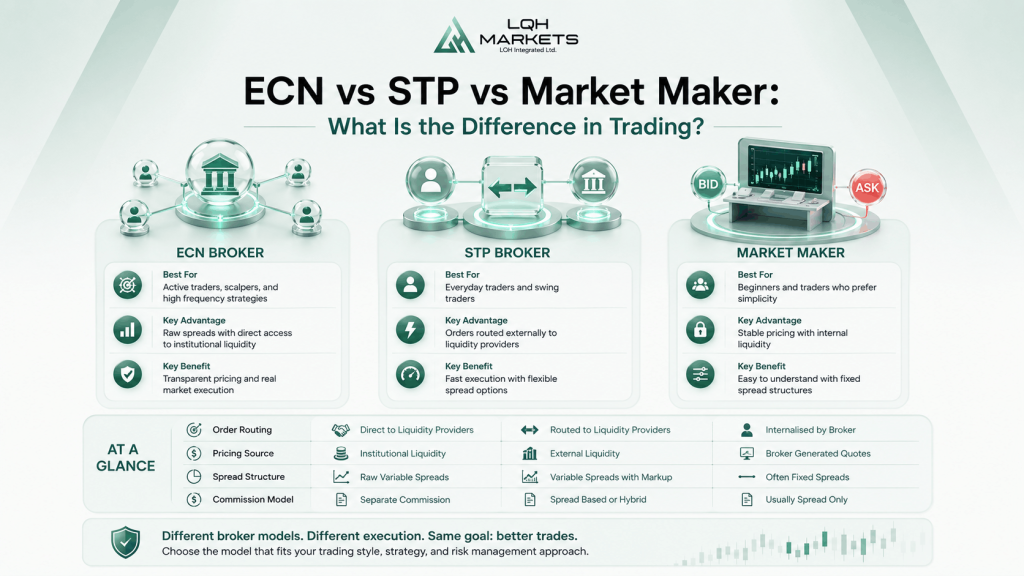
ECN vs STP vs Market Maker: Key Differences
| Feature | ECN Broker | STP Broker | Market Maker |
| Order routing | Direct liquidity aggregation | Routed externally to LPs | Often internalised |
| Pricing source | Institutional liquidity pool | External liquidity providers | Broker generated quotes |
| Spread structure | Raw variable spreads | Variable spreads with markup | Often fixed spreads |
| Commission model | Separate commission | Spread based or hybrid | Usually spread only |
| Dealing desk intervention | No dealing desk | Limited intervention | Internal dealing possible |
| Market depth visibility | Sometimes available | Usually unavailable | Not applicable |
| Slippage exposure | Reflects real liquidity conditions | Moderate | Sometimes smoothed internally |
| Best suited for | Active traders and scalpers | General retail traders | Beginners and casual traders |
Why execution quality matters more than labels
Many traders assume that all ECN brokers automatically provide superior execution. In reality, execution quality depends on infrastructure, liquidity relationships, risk management systems, and regulatory standards.
A broker marketing itself as ECN may still suffer from:
- Poor liquidity aggregation
- High execution latency
- Frequent slippage
- Weak infrastructure redundancy
- Limited institutional liquidity relationships
By contrast, a true ECN brokerage with strong institutional partnerships and low latency execution architecture can provide significantly better trading conditions during volatile periods.
This distinction matters because modern financial markets increasingly depend on sophisticated liquidity management systems. According to the BIS, institutional FX dealers have become increasingly capable of internalising client flow while maintaining market stability during periods of elevated volatility.
As a result, many retail brokers now operate hybrid execution environments combining:
- Internal risk warehousing
- External STP routing
- Liquidity aggregation engines
- Dynamic spread management systems
For traders, the most important question is no longer simply whether a broker is ECN or STP. The better question is:
“Does the broker provide transparent execution, institutional grade liquidity access, and stable order routing across changing market conditions?”
Which broker type is best for scalping?
Scalpers and high frequency traders generally prefer true ECN or low latency STP environments because spread costs and execution delays have a direct impact on profitability.
Strategies such as a 1 minute scalping strategy using micro movements rely on capturing relatively small price inefficiencies over short timeframes. Wide spreads or inconsistent fills can materially reduce edge.
Scalpers typically prioritise:
- Tight spreads
- Fast execution speeds
- Low latency infrastructure
- Minimal requotes
- Stable liquidity access
- VPS compatibility for automated systems
This becomes especially important during periods of heightened volatility across forex, gold, indices, and crypto CFD markets.
Which broker type is best for beginners?
Beginners often focus too heavily on broker labels instead of learning core trading fundamentals such as leverage management, risk allocation, and position sizing.
For newer traders, execution transparency matters, but education and risk management infrastructure are equally important.
Many traders first need to understand concepts such as:
- Margin utilisation
- Stop loss placement
- Position sizing
- Volatility management
- Risk to reward ratios
before execution model differences become operationally significant.
For example, traders learning margin trading (explained in our beginners guide) should first understand how leveraged exposure magnifies both gains and losses.
Similarly, many retail traders misunderstand slippage and execution during volatility. In reality, stop losses are often triggered because of market structure and liquidity dynamics rather than manipulation. Understanding why your stop loss hits can help traders approach execution more realistically.
Regardless of which execution model your broker uses, it’s important to understand the cost and risk of every trade. A Margin Calculator, Profit & Loss Calculator, and Position Size Calculator can help you prepare trades before placing an order.
The rise of hybrid broker infrastructure
The modern brokerage industry increasingly relies on hybrid execution architecture rather than purely isolated models.
Many brokers now combine:
- Internal liquidity management
- External STP routing
- Institutional liquidity aggregation
- Smart order routing technology
- Dynamic execution management systems
Hybrid models allow brokers to optimise execution quality, manage risk exposure, and maintain pricing competitiveness across different market conditions.
However, true ECN brokers remain differentiated because client orders are routed directly to liquidity providers rather than processed through internal dealing structures.
For many active traders, this provides greater confidence in execution transparency and pricing neutrality.
Trading with LQH Markets
LQH Markets gives traders access to MetaTrader 5, competitive variable spreads, low latency execution, and flexible account options across forex, indices, commodities, and crypto CFDs. This gives traders access to transparent market pricing, low latency execution infrastructure, and spreads that reflect real market liquidity conditions.
For active traders using MetaTrader 5, execution quality is only one part of the overall trading environment. Risk management tools, platform stability, and account flexibility are equally important.
LQH Markets provides:
- Multiple trading account options
- MetaTrader 5 access
- Fast and reliable trade execution
- Integrated stop loss and take profit functionality
- Flexible leverage and position sizing
- Real time margin visibility
- Access to a lot size calculator
This is particularly relevant for traders exploring leveraged strategies such as short selling for beginners or learning how to profit from short selling across volatile asset classes.
Longer term traders can also implement technical strategies such as the golden cross trading pattern or evaluate whether swing trading is profitable directly through MT5’s advanced charting and analytical tools.
Open an account or start with a demo.
Risk disclaimer
CFDs are complex instruments with a high risk of losing all your invested capital. Only trade with money you can afford to lose. Content is for general information only and is not investment advice
Final thoughts
ECN, STP, and market maker brokers each serve different roles within modern trading markets. The best choice depends on trading style, execution requirements, and how important direct liquidity access is to the trader’s strategy.
True ECN brokers are generally preferred by active traders seeking institutional style pricing, transparent execution, and direct access to aggregated liquidity providers. STP brokers offer automated external routing with simplified pricing structures, while market makers continue to provide accessible trading environments for many retail participants.
Ultimately, execution quality depends less on marketing terminology and more on liquidity infrastructure, regulatory oversight, pricing transparency, and risk management systems.
For traders operating in fast moving leveraged markets, understanding how orders are processed is an important part of building a consistent and sustainable trading approach.
Frequently asked questions
ECN trading is often preferred by some active traders because it can provide access to aggregated external liquidity and variable market pricing. However, the quality of execution depends on factors such as liquidity relationships, technology infrastructure, and market conditions, meaning both ECN and STP environments can suit different trading styles.
Some market maker brokers may act as the counterparty to client trades because they can internalise order flow rather than routing all positions externally. This is a recognised industry model, which is why traders should consider factors such as regulation, execution transparency, and broker reputation when evaluating providers.
Some scalpers prefer ECN or low latency STP environments because execution speed and spread costs can affect short term trading strategies. However, trading conditions vary between brokers and may change depending on market liquidity and volatility.
ECN accounts may offer tighter spreads during highly liquid market sessions because pricing is sourced from external liquidity providers. However, spreads are variable and can widen during periods of volatility, reduced liquidity, or major economic announcements.
Traders can review a broker’s execution policy, pricing structure, regulatory status, and disclosures relating to liquidity providers and order routing. Transparent commission structures, variable spreads, and no dealing desk execution are commonly associated with ECN style environments.