
Choosing between a raw spread account and a standard account comes down to one thing: how your trading costs are structured. A raw spread account usually offers tighter spreads with a separate commission, while a standard account wraps the broker’s fee into a wider spread with no explicit commission. Neither is automatically “better.” The right choice depends on how often you trade, your strategy, your position size, and how sensitive your system is to execution costs.
That distinction matters more today than ever. Global foreign exchange trading volumes reached roughly $9.6 trillion per day in 2025 according to the Bank for International Settlements, showing how competitive and liquid modern FX markets have become. With so many brokers competing for order flow, account structure has become one of the main ways platforms differentiate themselves.
Many beginner traders focus entirely on leverage or platform features while ignoring transaction costs. In reality, spreads, commissions, slippage, and execution quality can have a larger long term impact on profitability than the trading strategy itself.
What Is a Standard Trading Account?
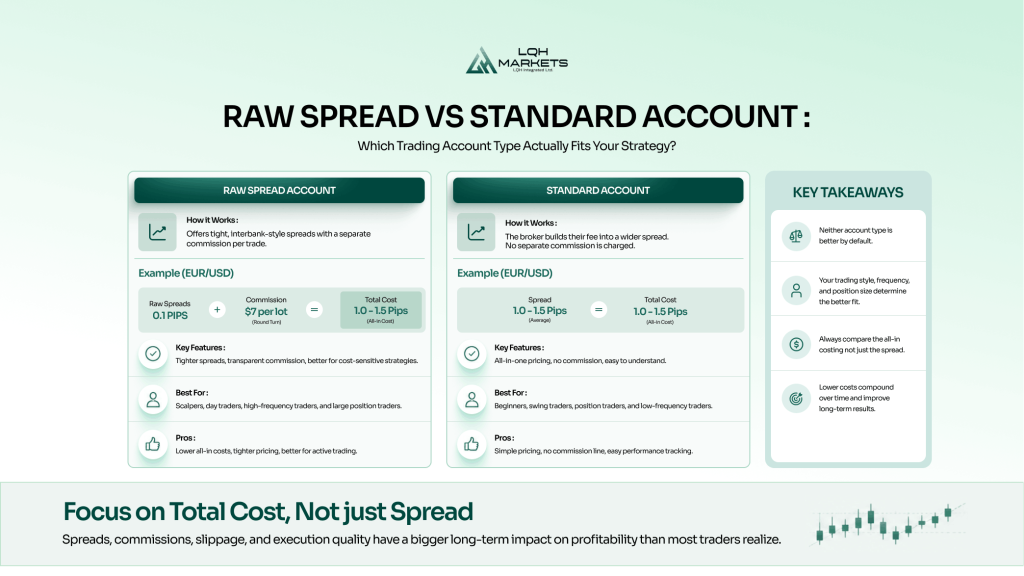
A standard account is the simplest pricing model in forex and CFD trading. Instead of charging a separate commission, the broker builds its fee into the spread.
The spread is the difference between the bid price and the ask price. If EUR/USD is quoted at 1.1050 / 1.1051, the spread is 1 pip. In a standard account, brokers often widen that spread slightly to cover operational costs and profit margins.
For example:
- EUR/USD on a standard account might average 1.0 to 1.5 pips
- No additional commission is charged
- Your trading cost is embedded directly into the execution price
This simplicity is why standard accounts remain popular among beginners and lower frequency traders.
A trader opening one or two swing trades per week may not notice much difference between paying a 1.2 pip spread and paying a raw spread plus commission. The convenience of a commission free structure can also make performance tracking easier.
Standard accounts are commonly used by new traders, swing traders, position traders, traders using smaller lot sizes, and traders who prefer simplified cost structures. The appeal is both practical and psychological, as many traders prefer not to see a separate commission line deducted from every trade, even if the all in cost may ultimately be similar.
What Is a Raw Spread Account?
A raw spread account separates the spread from the broker commission. Instead of widening the spread, the broker provides pricing that is closer to underlying liquidity provider quotes. The spread can sometimes fall near zero during highly liquid market conditions, particularly on major currency pairs like EUR/USD. The broker then charges a fixed commission per lot traded.
Typical raw spread pricing might look like this:
- EUR/USD spread: 0.1 to 0.3 pips
- Commission: fixed amount per lot per side
- Total cost = spread + commission
This model is often associated with ECN or institutional style trading environments because it provides more transparent pricing.
Raw spread accounts are typically favoured by traders who rely on precision and lower transaction costs. This often includes scalpers, day traders, and algorithmic traders running automated systems through platforms like MetaTrader 5. Traders executing larger position sizes or higher trading volume also tend to pay closer attention to spread efficiency, since even small differences in execution costs can compound significantly over time.
The tighter spread becomes especially important for short term trading systems where small price movements determine profitability.
A scalping strategy targeting 5 pips per trade is highly sensitive to spread costs. A strategy targeting 150 pips over several days is far less affected.
The Real Difference: Cost Structure
The biggest misconception in trading is that raw spread accounts are always cheaper. They are not. The actual question is whether your trading style benefits more from lower spreads or simplified pricing.
Here is a practical example.
Standard Account Example
- EUR/USD spread: 1.2 pips
- Commission: none
- 1 standard lot traded
Approximate trading cost:
$12 total round trip
Raw Spread Account Example
- EUR/USD spread: 0.2 pips
- Commission: $7 round trip
- 1 standard lot traded
Approximate trading cost:
$9 total round trip
In this example, the raw spread account is slightly cheaper.
But now imagine:
- You trade very infrequently
- Your average target is 200 pips
- You hold positions for several days
The difference between $9 and $12 becomes almost irrelevant compared to overnight financing, swap rates, or strategy quality. This is why professional traders focus on total execution quality rather than marketing phrases like “zero spread.”
Why Scalpers Usually Prefer Raw Spread Accounts
Short term traders are highly sensitive to friction. If a trader enters and exits dozens of positions per day, every fraction of a pip matters.
For example:
- A 2 pip spread on a 5 pip scalp target consumes 40% of the move
- A 0.2 pip spread plus commission dramatically lowers break even distance
This is one reason many scalpers gravitate toward raw spread environments paired with fast execution. It also explains why traders using automated systems on platforms like MetaTrader 5 often prioritise raw pricing. Algorithmic systems depend on consistency. Small variations in spread can materially alter backtested performance.
That said, low spreads alone do not guarantee good execution. Slippage, latency, liquidity depth, and order routing matter just as much.
Many experienced traders eventually realise that execution quality is often more important than a marginal spread difference. Reddit discussions among active FX traders frequently highlight that poor execution can cost more than the advertised spread savings themselves.
Why Swing Traders Often Choose Standard Accounts
Swing traders typically hold positions for days or weeks.Their profit targets are larger, meaning the spread becomes a smaller percentage of the total trade outcome.
A trader targeting 300 pips is not usually concerned about saving 0.5 pips on entry. Instead, many longer term traders value simplicity and convenience over marginal spread reductions. A standard account can make trade management easier because costs are built directly into the spread rather than separated into commission charges. Some traders also prefer the cleaner reporting structure and simpler accounting, particularly when reviewing performance across longer holding periods.
For newer traders especially, simplicity reduces confusion. This matters because trading already involves managing risk exposure, margin, position sizing, emotional discipline, volatility, and macro news events.Adding complex commission structures before understanding basic execution can sometimes overwhelm inexperienced traders.
Execution Quality Matters More Than Marketing
One of the biggest shifts in modern retail trading is that traders are becoming more aware of execution transparency.
Regulators have repeatedly warned traders about misunderstanding OTC forex pricing and execution models. The U.S. Commodity Futures Trading Commission notes that many traders do not realise they are trading directly against dealer pricing environments rather than on a centralised exchange.
That does not automatically mean a broker is acting improperly. OTC forex is simply structured differently from exchange traded equities or futures.
However, it does mean traders should pay close attention to overall execution quality rather than focusing purely on headline spreads. Factors such as spread widening during volatile conditions, slippage around major economic releases, platform stability, liquidity access, and commission transparency can all materially affect trading performance. A broker advertising “0.0 pip spreads” on a homepage means very little if execution quality deteriorates during live market conditions.
This becomes especially important during high volatility events such as Non Farm Payrolls, CPI releases, central bank decisions, geopolitical headlines, or broader risk off market sessions where spreads can widen rapidly across the market. During these periods, spreads can widen significantly across the entire market regardless of account type.
The Rise of Transparent Pricing in Forex
Retail trading has become significantly more sophisticated over the past decade. Traders today increasingly expect institutional style execution, faster order processing, transparent pricing, access to professional trading platforms, real time margin visibility, and more advanced risk management tools as standard rather than premium features.
That evolution mirrors broader growth in the FX market itself. According to BIS data, daily forex turnover rose sharply between 2022 and 2025 as volatility, technology adoption, and institutional participation continued increasing.
As competition between brokers intensifies, traders are evaluating far more than just spreads alone. Platform reliability, withdrawal speed, market depth, asset selection, educational resources, mobile functionality, customer support, and overall execution quality now all play a role in broker selection. This is why account type should never be viewed in isolation from the wider trading environment being offered.
Which Account Type Is Better for Beginners?
For most beginners, a standard account is often easier to understand initially. The pricing is straightforward. There is no separate commission calculation. Trade costs are visible directly in the spread. However, traders planning to specialise in scalping, intraday trading, news trading or algorithmic trading may eventually benefit from transitioning toward raw spread pricing as their execution requirements become more demanding.
The important point is that beginners should avoid choosing an account type purely because social media labels it “professional.” Institutional sounding terminology alone does not improve profitability as risk management matters more.
Many traders lose money because of poor discipline, oversized positions, or emotional decision making rather than account structure itself. The CFTC has repeatedly highlighted the high percentage of retail forex traders who lose money overall.
How Account Type Affects Risk Management
Trading costs directly affect risk reward ratios. For example:
If your strategy risks 10 pips to target 15 pips:
- A wider spread materially changes the trade profile
- A tighter spread improves flexibility
This becomes especially relevant for traders learning concepts like the 3 5 7 rule or building structured risk frameworks around position sizing. It also impacts stop placement.
Traders often wonder why their stop loss hits even when the market later moves in their favour. In many cases, overly tight stops combined with spread fluctuations during volatile periods contribute to premature exits.
Understanding spread behaviour is therefore part of practical risk management, not just broker comparison.
Raw Spread vs Standard Account for MT5 Traders
Platform choice also influences account selection. Many active traders using MetaTrader 5 prefer raw spread accounts because MT5 supports:
- Automated trading
- Expert advisors
- Advanced charting
- Faster order management
- Multi asset execution
For traders learning how to set stop loss and take profit in MT5, tighter execution environments can help improve precision when entering or managing short term trades.
This becomes even more important in strategies like 1 min scalping strategy micro movements where transaction costs can materially impact performance.
Why Lot Size Matters More Than Most Traders Think
Account structure only tells part of the story. Position size determines how much spreads and commissions actually cost you.
For example:
- 0.5 pip on a micro lot is minor
- 0.5 pip on multiple standard lots becomes significant
This is why professional traders constantly calculate exposure before entering positions. Using a lot size calculator can help traders understand how spread costs, leverage, and stop distance affect real account risk. Many beginners underestimate how quickly poor sizing compounds losses.
Similarly, comparing account types is only one part of choosing how to trade. You can also estimate your margin requirements, position size and potential profit or loss using our Margin Calculator, Position Size Calculator, and Profit & Loss Calculator before placing your next order.
So Which Account Type Should You Choose?
| Choose a Standard Account if… | Choose a Raw Spread Account if… |
| You trade infrequently | You scalp or day trade |
| You prefer simplicity in pricing | You trade high volume |
| You are newer to trading | You use automated systems |
| You hold positions longer term | You require tighter spreads |
| You do not rely on extremely tight entries | You prioritise execution precision |
Neither account type guarantees success. The better question is whether the account structure matches your actual trading behaviour.
Why Some Traders Prefer Flexible Account Structures
One issue with some brokers is that they force traders into a single pricing structure regardless of strategy. Modern traders increasingly want flexibility.
A swing trader may eventually transition into intraday trading. A discretionary trader may begin automating strategies. A beginner may later require institutional style execution tools. This is where brokers offering multiple account structures can become more practical long term.
LQH Markets gives traders access to both raw spread and commission free account structures, allowing traders to choose pricing that aligns with their actual strategy rather than forcing a one size fits all model. Short term traders may prefer institutional style raw spreads with commission based pricing, while newer or longer term traders may prefer the simplicity of spread only execution.
Alongside different account structures, traders also gain access to:
- MetaTrader 5 trading platform functionality
- Advanced charting and execution tools
- Automated trading support
- Risk management tools
- Multi asset market access
- Practical utilities like the lot size calculator
For traders building structured strategies around concepts like margin trading explained for beginners, how to start day trading with $100, or is swing trading profitable, choosing the right account structure can become part of the overall risk management process rather than just a pricing decision.
Why LQH Markets Appeals to Different Trading Styles
| Feature | Raw Spread Account | Standard / Commission Free Account |
| Spread Structure | Raw spread pricing | Spread only pricing |
| Commission | Fixed commission per lot | No separate commission |
| Best Suited For | Scalpers, day traders, algorithmic traders | Swing traders, beginners, lower frequency traders |
| Cost Transparency | Spread + visible commission | Costs built into spread |
| MT5 Compatibility | Yes | Yes |
| Automated Trading Support | Yes | Yes |
| Trading Style Focus | Precision execution | Simplicity and convenience |
Rather than positioning one account type as universally superior, LQH Markets allows traders to choose the structure that fits how they actually trade.
That matters because the best account type is not determined by marketing language. It depends on:
- Trade frequency
- Average holding time
- Position sizing
- Risk management
- Strategy sensitivity to spreads
- Execution requirements
For example, traders focused on very short term execution may prioritise tighter spreads for strategies such as 1 min scalping strategy micro movements, while longer term traders focused on broader technical structures like the golden cross may place less emphasis on fractional spread differences.
LQH Markets supports crypto-funded trading accounts, allowing traders to deposit with selected cryptocurrencies for a faster and more flexible funding experience.
Open an account or start with a demo.
Risk disclaimer
CFDs are complex instruments with a high risk of losing all your invested capital. Only trade with money you can afford to lose. Content is for general information only and is not investment advice.
Final Thoughts
The debate between raw spread vs standard accounts is ultimately about trading style, not which account sounds more professional.
Raw spread accounts can offer tighter pricing for active traders, particularly scalpers, day traders, and algorithmic systems. Standard accounts simplify the trading experience by incorporating costs into the spread, which can suit beginners and longer term traders more effectively.
Neither account type guarantees profitability. Risk management, execution quality, discipline, and strategy consistency still matter far more than whether a spread starts at 0.0 pips.
What matters most is choosing an environment that aligns with the way you actually trade.
For traders looking for flexibility, LQH Markets trading accounts provide access to both commission free and raw spread pricing models alongside MetaTrader 5, practical risk management tools, and account options designed to support different trading approaches as traders evolve over time.
Ready to get started? Open a live LQH Markets account or start with a demo account.
FAQs
What is the main difference between a raw spread and standard accounts?
A raw spread account offers tighter spreads with a separate commission charged per trade, while a standard account includes the broker’s fee within the spread itself. Raw spread accounts are often preferred by active traders, whereas standard accounts are commonly chosen for simplicity.
Are raw spread accounts better for scalping?
Many scalpers prefer raw spread accounts because tighter spreads can reduce overall transaction costs on short term trades. Since scalping strategies often target smaller price movements, execution costs can have a larger impact on profitability.
Do standard accounts have hidden fees?
Standard accounts are not necessarily hiding fees, but the broker’s costs are built into the spread rather than shown as a separate commission. This can make pricing simpler for beginners, although the all in trading cost may sometimes be higher than a raw spread model.
Which account type is better for beginners?
Many beginners start with standard accounts because they are easier to understand and manage. However, traders who plan to focus on intraday trading, scalping, or automated strategies may eventually prefer the tighter pricing structure of a raw spread account.
Does LQH Markets offer both raw spread and standard style accounts?
Yes, LQH Markets offers both raw spread and commission free account structures, allowing traders to choose the pricing model that best fits their trading style. Traders also gain access to MetaTrader 5, risk management tools, and utilities such as the lot size calculator.