
Slippage in forex trading happens when your order is executed at a different price from the one you expected. It is most common during periods of high volatility, low liquidity, or rapid price movement, where prices change faster than brokers or liquidity providers can fill orders. Slippage can be either negative or positive, meaning traders may receive a worse or better execution price depending on market conditions.
For forex traders, slippage is not just a technical detail. It directly affects trade entries, exits, stop losses, risk management, and long term profitability. Whether you are scalping major currency pairs, swing trading around economic releases, or managing larger positions during volatile sessions, understanding what causes slippage is essential for improving execution quality and reducing unexpected trading costs.
What Is Slippage in Forex?
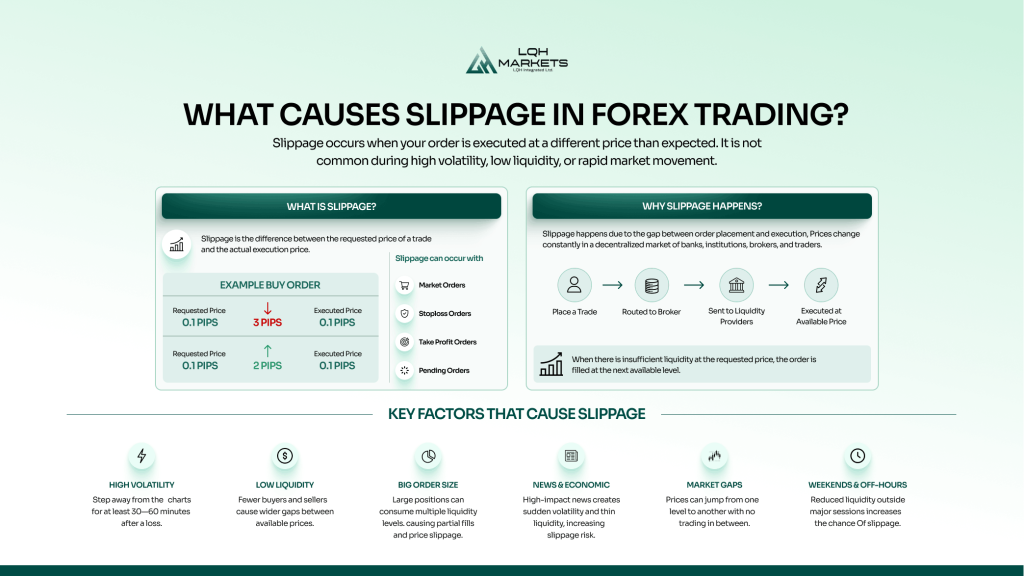
Slippage refers to the difference between the requested price of a trade and the actual execution price. In fast moving markets, prices can change in milliseconds between the moment an order is placed and when it reaches the market for execution.
For example, if a trader places a buy order for EUR/USD at 1.1000 but the order is filled at 1.1003, the trade experienced 3 pips of negative slippage. If the order was instead filled at 1.0998, the trader would receive positive slippage.
Slippage can occur with:
- Market orders
- Stop loss orders
- Take profit orders
- Pending orders during volatile conditions
According to the Bank for International Settlements (BIS) Triennial Central Bank Survey, the forex market processes trillions of dollars in daily volume. Despite this deep liquidity, prices can still move rapidly when market participation changes suddenly or when liquidity temporarily disappears.
Why Slippage Happens in Forex Trading
At its core, slippage is caused by the gap between order placement and order execution. Forex prices are constantly changing because the market operates through a decentralised network of liquidity providers, banks, institutions, brokers, and traders.
When there is insufficient liquidity available at the requested price, the order must be filled at the next available level.
Several conditions increase the likelihood of slippage.
High Market Volatility
Volatility is one of the biggest causes of slippage in forex trading. When prices move aggressively in a short period of time, execution prices can change before orders are completed.
This is especially common during:
- Central bank announcements
- Inflation data releases
- Non Farm Payrolls (NFP)
- Geopolitical events
- Unexpected economic news
For example, when the Federal Reserve changes interest rate expectations, USD pairs can move dozens of pips within seconds. During these moments, liquidity providers widen spreads or pull liquidity entirely, increasing the chance of slippage.
Academic research in market microstructure and financial econometrics shows that during periods of heightened volatility, order book depth can deteriorate rapidly and liquidity provision becomes less stable, leading to wider bid-ask spreads and increased execution price deviation.
Traders using high leverage or short term strategies are particularly exposed because even small price gaps can significantly affect profitability.
Low Liquidity Conditions
Liquidity refers to how easily orders can be executed without substantially moving price. The forex market is highly liquid overall, but liquidity varies depending on the currency pair, trading session, and time of day.
Slippage becomes more common when liquidity is lower, including:
- During market rollover periods
- Around session closes and opens
- On holidays
- In exotic currency pairs
- During overnight trading hours
Major pairs like EUR/USD and GBP/USD typically have deeper liquidity than exotic pairs such as USD/TRY or EUR/ZAR. The deeper the liquidity pool, the easier it is for orders to be matched close to the requested price.
This is one reason why many beginner traders focus on major currency pairs when learning execution and risk management, especially if they are still developing consistency and position sizing discipline. Traders exploring smaller accounts may also benefit from understanding position exposure through guides like margin trading explained for beginners and how to start day trading with $100.
Economic News Releases
Major economic announcements are one of the most recognised triggers for slippage.
When new information enters the market, traders and institutions rapidly adjust positions, creating sudden surges in buying or selling pressure. This can cause prices to jump between levels without trading smoothly through every price point.
Common high impact events include:
- US Non Farm Payrolls
- CPI inflation releases
- Interest rate decisions
- GDP reports
- Employment data
- Central bank speeches
During these events, stop loss orders are particularly vulnerable. Traders may expect a stop loss to close at a specific level, only for price to gap through that level before execution occurs.
This is why understanding the mechanics behind why your stop loss gets hit and the difference between stop loss vs stop limit orders is important for execution management.
Academic research in financial mathematics from Imperial College London highlights that execution price deviations are closely linked to liquidity constraints and the dynamic structure of order books in fragmented markets.
Order Size and Market Depth
Large trade sizes can also contribute to slippage. If the requested trade volume exceeds the available liquidity at a particular price, the order may be filled across multiple price levels.
For example:
- 1 lot may execute instantly with minimal slippage
- 50 lots may require multiple liquidity providers to fill the order
Institutional traders often split large orders into smaller segments specifically to minimise market impact and execution costs.
Retail traders usually encounter this issue less frequently, but it can still occur during illiquid conditions or when trading volatile instruments like gold or crypto CFDs.
Broker Execution Model
The broker’s execution infrastructure also affects slippage frequency and severity.
Different broker models process orders differently:
- ECN brokers route orders directly to liquidity providers
- STP brokers pass orders through external providers
- Market makers may internalise trades
Execution speed, liquidity access, and pricing technology all influence how closely orders are filled to requested prices.
Traders comparing execution environments often research the differences between ECN and STP brokers because execution quality can affect spreads, requotes, and slippage behaviour.
A broker with access to multiple liquidity providers may be able to offer deeper liquidity pools and faster execution during volatile periods.
Internet Latency and Technology Delays
Slippage is not always caused by the market itself. Sometimes it results from delays between the trader’s device and the broker’s servers.
Factors include:
- Slow internet connections
- High latency
- VPS quality
- Platform overload
- Hardware limitations
Even milliseconds matter in fast moving markets, particularly for scalpers and algorithmic traders.
Platforms like MetaTrader 5 are designed to support rapid execution and advanced order management, but execution quality still depends on the trader’s connection and broker infrastructure.
This is especially relevant for traders using short term systems such as a 1 minute scalping strategy, where execution precision can materially impact results.
Slippage During Gaps
Although forex trades nearly 24 hours a day, gaps can still occur.
Weekend gaps are particularly important. If major geopolitical or economic developments occur while markets are closed, prices may reopen significantly above or below Friday’s closing price.
In these situations:
- Stop losses may execute beyond intended levels
- Pending orders may fill at worse prices
- Spread widening may intensify execution costs
Gaps are a reminder that stop losses reduce risk but do not guarantee a precise exit price in all market conditions.
Positive vs Negative Slippage
Many traders focus only on negative slippage, but positive slippage also exists.
Negative Slippage
This occurs when traders receive a worse price than expected.
Examples include:
- Buying at a higher price
- Selling at a lower price
- Stop losses executing beyond the requested level
Positive Slippage
Positive slippage occurs when traders receive a better execution price.
Examples include:
- Buying below the requested price
- Selling above the requested price
Fair and transparent execution environments should allow both positive and negative slippage rather than systematically filtering only one side.
How Slippage Affects Trading Performance
Slippage can seem minor on individual trades, but over time it can materially affect strategy performance.
This is especially true for:
- Scalpers
- High frequency traders
- News traders
- Tight stop loss strategies
For example, a strategy targeting 5 pips per trade may struggle if average slippage consumes 1 to 2 pips consistently.
Slippage also affects:
- Risk reward ratios
- Backtesting accuracy
- Win rate expectations
- Position sizing calculations
This is why disciplined traders monitor execution statistics over time rather than focusing only on trade direction.
Can Slippage Be Avoided Completely?
No. Slippage is a natural part of financial markets and cannot be eliminated entirely.
However, traders can reduce its frequency and impact by improving execution conditions and managing risk more effectively.
How to Reduce Slippage in Forex Trading
Trade During High Liquidity Sessions
The London and New York sessions generally provide the deepest liquidity and tightest spreads for major forex pairs.
Trading during active sessions can reduce execution gaps compared to illiquid periods.
Avoid Trading Major News Releases
Unless news volatility is part of the strategy, many traders avoid entering positions immediately before high impact announcements.
Economic calendars can help traders identify periods where slippage risk increases substantially.
Use Limit Orders Where Appropriate
Limit orders specify the exact price traders are willing to accept.
Unlike market orders, limit orders will not execute at worse prices, though they also may not fill if the market moves too quickly.
Reduce Position Size
Smaller trade sizes are generally easier to execute efficiently, particularly in fast moving conditions.
Position sizing tools can help traders calculate appropriate exposure relative to account size and volatility.
Improve Trading Infrastructure
Using stable internet, low latency VPS services, and reliable execution platforms can help reduce technology related delays.
Choose a Broker With Strong Execution
Execution quality matters. Traders often evaluate:
- Liquidity access
- Average execution speed
- Order routing transparency
- Platform stability
- Spread consistency
Reliable execution becomes particularly important for active traders, short term systems, and automated strategies.
While slippage can’t always be avoided, you can prepare for its impact by understanding your trade size, margin requirements and potential outcomes before entering the market. Try our Profit & Loss Calculator and Margin Calculator to plan your trades more effectively.
Slippage and Risk Management
Slippage should be incorporated into overall trading risk management rather than treated as a rare exception.
Professional traders often account for:
- Spread costs
- Commission costs
- Expected slippage
- Volatility exposure
This creates more realistic expectations around trade performance and drawdown potential.
Understanding execution risk also supports better emotional discipline. Traders who fail to account for slippage sometimes react impulsively after unexpected losses, which can contribute to behaviours explored in our guides on how to stop revenge trading and stay consistent in trading.
Why Execution Quality Matters for Modern Traders
Modern forex trading increasingly depends on execution infrastructure. Strategy quality still matters, but execution efficiency can influence whether a profitable system remains profitable after real market conditions are applied.
This is particularly relevant for:
- Scalping strategies
- Automated trading systems
- Short term momentum trading
- CFD trading during volatile sessions
Features such as fast order routing, transparent pricing, and access to deep liquidity pools can all help improve execution consistency.
For traders using MetaTrader 5, tools like integrated stop loss functionality, custom indicators, advanced charting, and automated trading support can also assist with execution and risk management workflows.
Trading Forex With LQH Markets
At LQH Markets, traders can access multiple account types designed for different trading styles, whether they are newer traders learning execution fundamentals or experienced traders focused on spread efficiency and platform performance.
Through access to MetaTrader 5, traders can manage positions using advanced charting tools, flexible order types, and integrated risk management features. LQH Markets also provides trading calculators, including lot size tools that help traders measure exposure more accurately before entering positions.
For traders developing structured trading systems, understanding execution mechanics such as slippage is just as important as technical analysis or strategy selection. A strong trading environment combines education, risk management tools, platform stability, and transparent execution practices.
Ready to get started? Open a live LQH Markets account or start with a demo account.
Risk disclaimer
CFDs are complex instruments with a high risk of losing all your invested capital. Only trade with money you can afford to lose. Content is for general information only and is not investment advice.
Final thoughts
Slippage in forex trading is primarily caused by volatility, liquidity changes, rapid price movement, and execution delays. While it cannot be removed entirely, traders who understand how slippage works can take practical steps to reduce its impact through better timing, risk management, infrastructure, and broker selection.
Execution quality is often overlooked by newer traders, yet it plays a major role in real world trading performance. Even profitable strategies can underperform if spreads widen excessively or orders are consistently filled at worse prices.
By learning how slippage occurs and adapting trading practices accordingly, traders can make more informed decisions about order placement, risk exposure, and execution environments over the long term.
FAQs
Slippage occurs when a forex trade is executed at a different price from the one requested. This usually happens during periods of high volatility or low liquidity when prices move faster than orders can be filled. Slippage can be either positive or negative depending on the execution price received.
No, slippage is not always negative. While traders often focus on receiving worse execution prices, positive slippage can also occur when an order is filled at a more favourable price than expected. In transparent execution environments, both positive and negative slippage are possible.
Major economic announcements can cause rapid price changes and temporary liquidity shortages in the forex market. During these periods, orders may not be matched at the requested price because the market moves before execution is completed. This is common during events such as Non Farm Payrolls or central bank rate decisions.
Stop losses help manage downside risk, but they do not guarantee an exact exit price in fast moving markets. If price gaps through the stop level during volatility, the order may execute at the next available market price instead. This is why traders should consider slippage as part of their overall risk management strategy.
Traders can reduce slippage by trading during high liquidity sessions, avoiding major news releases, using appropriate position sizing, and choosing brokers with strong execution infrastructure. Reliable platforms like MetaTrader 5 and access to deep liquidity pools may also help improve execution consistency.