Consistency in trading comes from following the same process through winning and losing periods, rather than chasing short term profits or reacting emotionally to every market move. Traders who survive long term are usually not the ones with the most complex strategy. They are the ones who can manage risk, execute the same plan repeatedly, and avoid making impulsive decisions when volatility increases.
Most traders already know what they should do. The difficult part is doing it consistently over hundreds of trades. Research into trader psychology and behavioural finance repeatedly shows that emotional decision making, overtrading, and poor risk management are some of the biggest reasons traders fail to maintain long term profitability.
Consistency in Trading Is About Process, Not Individual Trades
One of the biggest mistakes traders make is judging themselves based on a single trade outcome. A profitable trade can still be poorly executed, while a losing trade can follow the plan perfectly.
Consistent traders think in probabilities. They understand that even a strong strategy will produce losses, drawdowns, and periods where market conditions do not suit their system. The goal is not to win every trade. The goal is to execute a repeatable edge over a large sample size.
The law of large numbers is often referenced in trading literature to explain why edge only becomes visible over a large sample of trades, particularly in probabilistic systems and systematic trading approaches: law of large numbers in trading consistency. If you constantly change your approach after two or three losses, you never give your edge enough time to play out.
Mark Douglas’s framework on trading consistency explains that successful traders move as many decisions as possible into the planning phase before entering the market. Risk, entry criteria, position size, and exit rules are defined in advance rather than decided emotionally during the trade.
That is why consistency starts before you even place a trade.
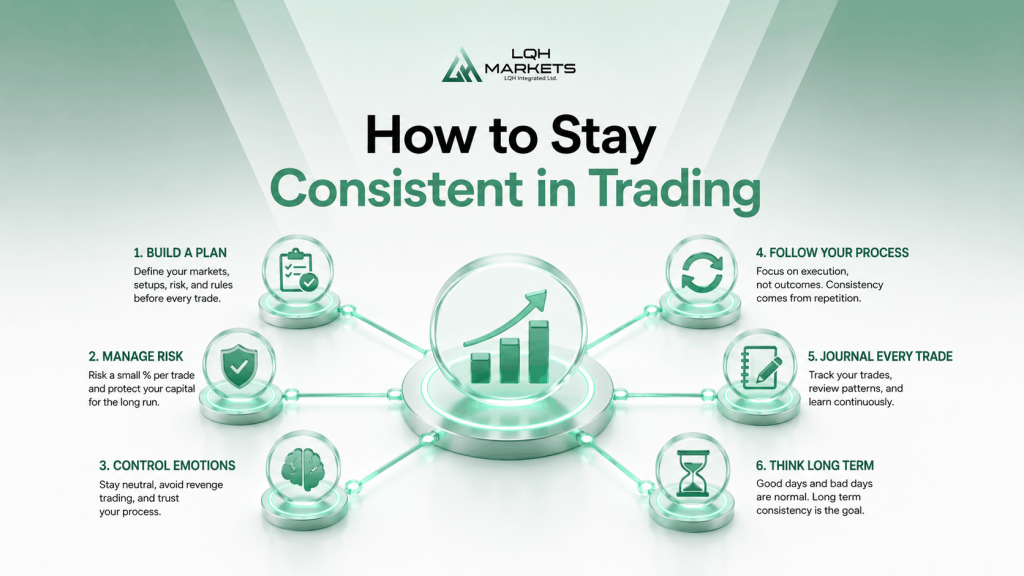
Build a Structured Trading Plan
A trading plan creates structure during volatile market conditions. Without one, traders often rely on emotion, social media sentiment, or fear of missing out.
A proper trading plan should define:
- What markets you trade
- What setups qualify for entry
- When you trade
- How much you risk per position
- Where stop losses and take profits are placed
- When you avoid trading entirely
The more specific the rules are, the easier it becomes to repeat them consistently.
For example, if you trade breakouts during the London session, your plan should define exactly what counts as a valid breakout. Vague rules lead to inconsistent execution.
Many traders also improve consistency by limiting the number of setups they take. Trying to scalp one day, swing trade the next, and then trade news events creates conflicting decision making. Traders who focus on a small number of repeatable setups often perform better over time because they develop pattern recognition and discipline.
If you are still refining risk parameters, understanding concepts like margin trading explained for beginners can help build a more stable foundation before increasing exposure.
Risk Management Is What Creates Long Term Survival
A large part of consistency comes from staying in the game long enough for your edge to work.
The financial industry treats risk management as a core requirement because uncontrolled exposure can destroy accounts quickly. The National Futures Association states that risk management programmes must define exposure limits, stress testing procedures, and tolerance thresholds because leverage increases the potential for rapid losses.
Retail traders often ignore this until they experience a major drawdown.
Consistent traders usually risk a small percentage of capital per trade. This protects the account from emotional decision making and prevents one bad trade from creating catastrophic losses.
Position sizing matters just as much as the setup itself. Even a profitable strategy can fail if position sizes become too large during emotional periods.
That is why tools like a lot size calculator are important. Instead of estimating exposure manually, traders can calculate position sizes based on account balance, stop loss distance, and acceptable risk.
Risk management also means accepting losses quickly rather than widening stop losses in the hope that the market reverses. Traders who constantly interfere with trades usually create inconsistent results because the strategy is no longer being executed correctly.
If you struggle with stops getting triggered prematurely, understanding why your stop loss hits can help separate normal market volatility from poor trade placement.
Consistency comes from following the same risk management process on every trade. Using a Position Size Calculator alongside the Profit & Loss Calculator can help you apply a repeatable approach to every position you take.
Emotional Control Is a Competitive Advantage
Trading psychology is often underestimated because traders prefer focusing on strategy and indicators. In reality, emotional regulation is one of the biggest differentiators between consistent and inconsistent traders.
Research from Oxford Academic highlights that trader decision making is heavily influenced by cognitive biases, emotional reactions, and self regulation challenges.
This becomes obvious during losing streaks.
Many traders increase position sizes after losses, revenge trade to recover capital quickly, or abandon their plan entirely after a few losing trades. Others become overly cautious after losses and stop executing valid setups.
Both reactions damage consistency.
Professional traders often focus on emotional neutrality rather than excitement. The objective is not to feel confident on every trade. The objective is to follow the process regardless of recent outcomes.
One practical way to improve emotional consistency is reducing screen time. Constantly watching every tick movement can create anxiety and encourage impulsive decisions.
This is one reason swing trading appeals to many traders. Longer timeframes reduce noise and emotional pressure compared to lower timeframe scalping. If you are exploring longer term approaches, is swing trading profitable explains the advantages and limitations of swing trading strategies.
Journaling Creates Accountability
Many traders know their weaknesses but never document them properly. A trading journal creates accountability because it exposes recurring patterns.
A good journal should track more than profits and losses. It should also record:
- Why the trade was taken
- Whether the setup matched the plan
- Emotional state during execution
- Risk to reward ratio
- Market conditions
- Mistakes made during management
Over time, patterns become visible.
For example, you may discover that most losing trades happen outside your preferred trading hours, or that impulsive entries increase after consecutive losses.
Trading psychology research consistently highlights journaling as a key tool for improving self awareness and execution discipline.
Without data, traders rely on memory, and memory is usually distorted by emotion.
Consistency Requires Realistic Expectations
One reason traders become inconsistent is unrealistic expectations about how quickly trading profits should grow.
Social media has created the impression that traders should double accounts every month or turn small balances into full time incomes immediately. In reality, professional trading is usually slower, more methodical, and heavily focused on risk control.
The SEC warns that many traders underestimate the risks associated with leverage and short term trading activity. It also highlights that many day traders experience significant losses during their early trading period.
Consistent traders focus on stable execution instead of aggressive growth targets.
This mindset shift changes behaviour dramatically. Instead of forcing trades to meet unrealistic daily income goals, traders become more selective and patient.
A useful framework for managing expectations is the 3 5 7 rule, which helps traders think more clearly about risk exposure, trade frequency, and sustainable growth.
Avoid Overtrading
Overtrading is one of the fastest ways to destroy consistency.
Research into investor behaviour shows that excessive trading activity often leads to poorer performance because emotional decisions increase while discipline decreases.
Overtrading usually happens for three reasons:
- Trying to recover losses quickly
- Trading out of boredom
- Fear of missing opportunities
Consistent traders understand that not trading is sometimes the best decision.
Markets move through different conditions. Some periods favour trend following strategies, while others become range bound and unpredictable. Trying to force trades during unsuitable conditions usually creates unnecessary losses.
This is especially important for short term traders. Lower timeframe trading can create the illusion that opportunities are constant, but high frequency execution without discipline often reduces overall performance.
If you trade very short timeframes, strategies like 1 min scalping strategy micro movements require strict risk control and clear execution rules to avoid emotional trading.
Focus on One Strategy Before Expanding
Many traders constantly switch strategies after short periods of underperformance.
They move from trend trading to scalping, then to indicators, then to price action, without giving any approach enough time to develop competence.
Consistency usually improves when traders specialise.
That does not mean using only one market forever, but it does mean developing mastery in one core approach before expanding into others.
For example, if you primarily trade trend continuation setups, understanding concepts like the golden cross can help improve your ability to identify stronger directional conditions instead of randomly changing systems.
The same principle applies to short selling. Traders who understand how downside momentum behaves often become more consistent during bearish conditions rather than avoiding short exposure entirely. Resources like short selling for beginners can help traders understand how to approach declining markets more systematically.
Your Environment Affects Trading Discipline
Consistency is not only about strategy. It is also about the environment.Fatigue, distractions, stress, and poor routines all influence execution quality.
Many professional traders follow structured routines before trading sessions begin. They review economic calendars, identify key levels, assess volatility conditions, and define risk exposure before entering the market.
Routine reduces impulsive behaviour because fewer decisions need to be made emotionally in real time.
It is also important to avoid treating trading like entertainment. Traders who constantly seek excitement often increase risk unnecessarily because disciplined execution feels too slow, a behaviour pattern discussed in research published in the CFA Institute Enterprising Investor blog.
This is where many people confuse speculation with gambling. Trading without defined risk, structure, or statistical reasoning becomes increasingly random over time. The difference is explained clearly in is day trading gambling.
Technology and Execution Matter More Than Many Traders Realise
Consistency is difficult when trading tools create friction.
Execution speed, chart stability, order management, and risk visibility all affect decision making. If traders cannot monitor exposure properly or calculate position sizes accurately, mistakes become more common during volatile conditions.
That is one reason many traders use MetaTrader 5. The platform allows traders to manage stop losses, take profits, chart analysis, and position monitoring from one interface.
Understanding how to set stop loss and take profit in MT5 is especially important because structured exits reduce emotional trade management and improve consistency over time.
For newer traders, starting with manageable account sizes can also reduce psychological pressure. Guides like how to start day trading with $100 can help traders focus on execution quality before scaling exposure.
Why Consistent Traders Prioritise the Right Trading Environment
Consistency improves when execution, risk visibility, and position sizing are built into the trading environment rather than managed manually under pressure. On LQH Markets, every MT5 account shows used margin, free margin, equity, and margin level in real time, so traders always understand how each position affects overall exposure.
You can trade forex, indices, commodities, and crypto CFDs from a single MetaTrader 5 platform with stop loss and take profit built into every order ticket. Position sizing is fully controlled by the trader, supported by MT5 tools that help align risk per trade with a defined strategy instead of estimation.
Stop loss and take profit levels can be set at order placement, adjusted in the trade terminal, or moved directly on the chart, making execution more direct and reducing the gap between planning and action. This helps maintain consistency when markets move quickly and decisions need to be executed without hesitation.
If you’re refining strategies or testing risk management in live conditions, the demo account runs the same MT5 environment with real market pricing, allowing you to build consistency before committing capital.
Open an account or start with a demo.
Risk disclaimer
CFDs are complex instruments with a high risk of losing all your invested capital. Only trade with money you can afford to lose. Content is for general information only and is not investment advice
Final thoughts
Consistency in trading is not built through prediction. It is built through repetition, structure, and risk control.
Most traders already know basic trading concepts, but long term improvement usually comes from executing those concepts consistently through both winning and losing periods. Traders who survive over the long run are typically the ones who control risk carefully, avoid emotional reactions, and follow a repeatable process instead of chasing short term excitement.
There will always be losing trades, difficult market conditions, and periods where performance slows down. Consistency comes from managing those periods without abandoning your plan or increasing risk impulsively.
The traders who improve over time are usually not the ones searching for perfect indicators. They are the ones refining their execution, reviewing mistakes honestly, and staying disciplined across a large sample of trades.
Over time, that consistency compounds.
Frequently asked questions
Consistency is important because trading outcomes are based on probabilities rather than individual results. A consistent approach allows traders to apply the same edge over many trades, which is where long term performance becomes measurable.
Most traders lose consistency due to emotional decision making, such as overtrading, revenge trading, or changing strategies after short term losses. These behaviours disrupt a structured process and make results unpredictable over time.
Risk management ensures that no single trade has a disproportionate impact on the account. By controlling position size and using stop losses properly, traders can survive losing streaks without deviating from their strategy.
No, having a strategy alone is not enough. Consistency comes from executing that strategy the same way over time, even during losing periods or when market conditions are not ideal.
Yes, in many cases psychology has a greater impact than the strategy itself. Even a strong system can fail if a trader cannot control emotions, follow rules, and avoid impulsive decisions.