
An open price trading strategy is a price action approach that uses a market’s opening price to quickly identify whether buyers or sellers are in control of a trading session. Traders use this directional bias to help filter trades, improve timing, and avoid trading against short-term momentum.
Rather than relying solely on lagging technical indicators, the strategy uses the opening price as a reference point alongside market structure, support and resistance, and risk management to identify higher-probability setups.
In this guide, you’ll learn how an open price trading strategy works, how to identify bullish and bearish bias, common mistakes to avoid, and how to incorporate it into your trading plan.
What Is an Open Price Trading Strategy?
An open price trading strategy uses the opening price of a trading session as a key reference point for determining market direction.
Rather than immediately looking at moving averages, oscillators, or other indicators, traders observe how price behaves around the opening level.
The basic concept is straightforward:
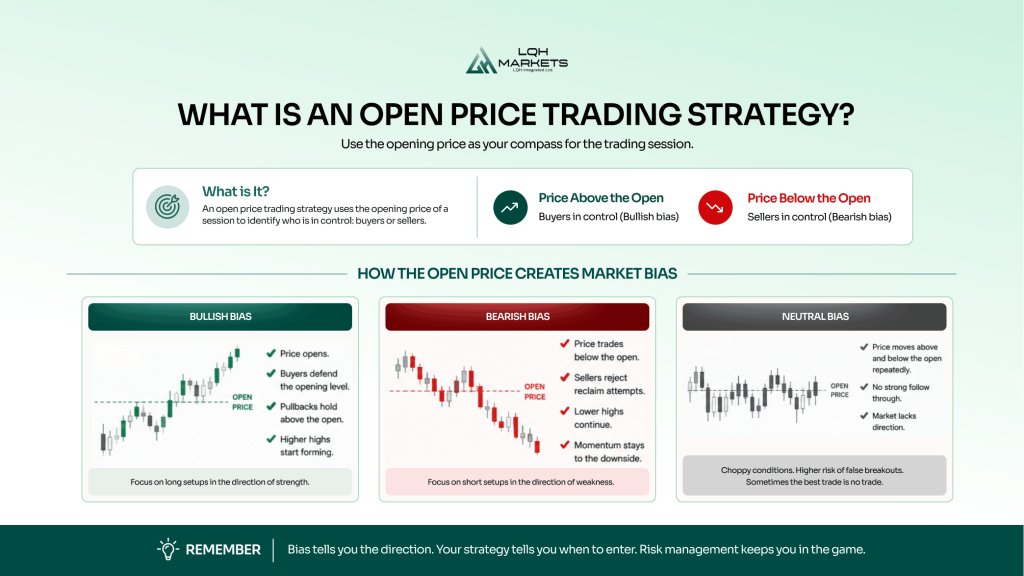
- Trading above the opening price generally suggests buyers are controlling the session.
- Trading below the opening price suggests sellers have greater control.
- Price repeatedly crossing the opening level often indicates indecision and a ranging market.
The opening price acts as a psychological benchmark because it represents the first agreed transaction between buyers and sellers for that session.
Many institutional trading desks also monitor opening prices closely because they often coincide with increased liquidity and execution of overnight orders.
Why Does the Opening Price Matter?
The market open is one of the most active periods of the trading day, as participants react to overnight developments, execute pending orders, and establish the session’s opening price.
On exchange-traded markets, the opening auction is designed to match buy and sell orders while facilitating price discovery, according to the NYSE Opening and Closing Auctions Fact Sheet. This process helps establish a fair opening price based on available supply and demand.
For traders, the opening price provides an early reference point for assessing market sentiment. While not every session develops into a trend, observing how price behaves around the open can help traders identify whether buyers or sellers are gaining control.
How the Open Price Creates Market Bias
Bias simply means identifying which side currently has the higher probability.
Instead of predicting where price will eventually move, traders ask:
“Who appears to be in control right now?”
The opening price provides one of the quickest answers.
Bullish Bias
A bullish bias develops when:
- Price opens.
- Buyers immediately defend the opening level.
- Pullbacks fail to trade below the open.
- Higher highs begin forming.
In this environment, traders generally prefer looking for long opportunities rather than selling into strength.
Bearish Bias
A bearish bias develops when:
- Price trades below the opening level.
- Sellers reject attempts to reclaim it.
- Lower highs continue developing.
- Momentum remains to the downside.
Instead of trying to buy every dip, traders focus on identifying quality short setups.
Neutral Bias
Sometimes neither side wins. Price may repeatedly move above and below the opening level without commitment.
These sessions often produce:
- Choppy price action
- False breakouts
- Increased stop-outs
- Lower reward-to-risk opportunities
Recognizing neutral conditions early can be just as valuable as identifying strong trends. Sometimes the best trade is no trade.
The Open Price Is Not Support or Resistance
One common misunderstanding is treating the opening price like a traditional support or resistance level. It isn’t. Instead, think of it as a dynamic line that reflects current market sentiment. A market can trade above the opening price while still pulling back multiple times.
Likewise, a bearish session can briefly rally above the open before sellers regain control. The important observation isn’t whether price touches the opening level. It’s how price reacts afterward.
Using Multiple Timeframes
The opening price becomes even more powerful when combined with higher timeframe analysis.
For example:
If the daily trend is bullish and today’s price remains above the daily open, both longer-term and intraday momentum may align.
Conversely, if the higher timeframe remains bearish while the intraday session struggles below its opening price, short opportunities may carry higher probability.
This top-down approach prevents traders from trading against the broader trend.
Combining the Open With Market Structure
The opening price should never be viewed in isolation.
Instead, combine it with:
- Higher highs and higher lows
- Lower highs and lower lows
- Trendlines
- Supply and demand zones
- Previous day’s high and low
When multiple factors point in the same direction, confidence in the trade increases.
For example:
Price remains above today’s open.
The market breaks yesterday’s high.
A higher low forms.
This creates significantly stronger evidence than relying on the opening price alone.
Waiting for Confirmation
One of the biggest mistakes traders make is entering immediately after the market opens. The first few minutes can be extremely volatile.
The opening minutes of a trading session often involve rapid price discovery as markets react to overnight news and pending orders. Rather than entering immediately, many traders prefer to wait for price to establish a clearer direction before looking for confirmation through market structure.
This avoids getting trapped in opening whipsaws.
Example of a Bullish Open Price Strategy
Imagine EUR/USD opens at 1.1700.
Within the first 20 minutes:
- Price rallies to 1.1725.
- Pulls back to 1.1708.
- Buyers step back in.
- A new high forms at 1.1740.
Rather than buying randomly, traders observe that every retracement remains above the opening price.
The opening level acts as a directional filter. Buying pullbacks now aligns with current market sentiment.
Example of a Bearish Session
Now imagine the opposite.
NASDAQ opens.
Price immediately falls below the opening level.
Every recovery stalls beneath the open.
Lower highs continue developing.
The opening price now represents an area where sellers repeatedly regain control.
Instead of trying to buy every bounce, traders wait for rallies toward the opening level before looking for bearish confirmation.
False Breaks Around the Open
No strategy works perfectly.
Sometimes price will:
- Break above the opening price.
- Attract buyers.
- Reverse sharply lower.
These false moves are common during news releases or periods of uncertainty. This is why traders should never enter solely because the price crossed the opening level. Confirmation remains essential.
Risk Management Still Comes First
Even with a strong directional bias, losses remain part of trading.
Risk management is what keeps traders in the game long enough for their edge to play out.
Good practices include:
- Risking only a small percentage of your trading capital on each position.
- Setting stop-loss levels before entering a trade.
- Maintaining a favourable risk-to-reward ratio.
- Avoiding emotional decisions after winning or losing trades.
If you’re still refining your exits, understanding the difference between a stop-loss and stop-limit order can help you choose the right order type for different market conditions. Likewise, learning how to set stop-loss and take-profit orders in MT5 ensures your risk controls are in place before emotions take over.
Regardless of the strategy you use, every trade should have a predefined exit plan and position size before you enter the market. No trading strategy is successful all the time, so limiting losses and protecting your trading capital is essential for long-term consistency.
Markets Where Open Price Trading Works Best
Open price strategies can be applied across many markets, including:
- Forex
- Stock indices
- Individual stocks
- Commodities
- Futures
Each market has unique opening characteristics.
For example:
Forex trades nearly 24 hours a day, but many traders pay close attention to the London and New York session opens because liquidity increases significantly.
Equity indices often see their highest volatility shortly after the official cash market opens.
Common Mistakes
Trading Every Open
Not every session develops into a trend. Some days remain range-bound from start to finish. Patience is part of the strategy.
Ignoring News
Scheduled economic announcements and unexpected news events can quickly change market conditions. Checking the economic calendar before trading can help you identify periods when volatility may increase and price movements become less predictable.
Trading Against Higher Timeframes
Buying above today’s open while the weekly trend remains strongly bearish may reduce the probability of success. Context matters.
Moving Stops Emotionally
Once a trade is placed, constantly widening stop-losses usually increases losses rather than improving outcomes. If you’ve ever wondered why your stop-loss gets hit, the answer is often related to entries, position sizing, or placing stops in obvious areas, not simply bad luck.
Combining Open Price With Other Strategies
Many traders use the opening price alongside complementary techniques rather than treating it as a complete trading system.
For example:
- A trader using a 1-minute scalping strategy may only take long setups when price is above the session open.
- Swing traders evaluating whether swing trading is profitable can use the opening price to improve the timing of entries on lower timeframes.
- Traders using trend signals such as the Golden Cross can look for additional confirmation from the current session’s bias.
- If you’re trading on margin, understanding concepts explained in margin trading helps you appreciate why disciplined risk management becomes even more important when leverage is involved.
The opening price can also complement broader trading rules. For example, traders following structured risk frameworks like the 3-5-7 rule in trading may use opening bias as an additional filter before committing capital.
The Psychological Advantage
One overlooked benefit of an open price trading strategy is simplicity.
Instead of filling charts with numerous indicators that may generate conflicting signals, traders start the day by answering one question:
Who is currently in control?
This clarity can reduce hesitation, discourage overtrading, and make it easier to remain disciplined throughout the session.
Maintaining that discipline is often harder than finding a strategy. Traders who struggle with impulsive decisions may benefit from learning how to stop revenge trading and building routines that promote consistent trading habits over chasing every market move.
Risk disclaimer
CFDs are complex instruments with a high risk of losing all your invested capital. Only trade with money you can afford to lose. Content is for general information only and is not investment advice.
Using open price strategy with LQH Markets
If you’re looking to apply an open price trading strategy in live markets, having a reliable trading platform and access to the instruments you want to trade is just as important as the strategy itself. LQH Markets provides access to a wide range of markets through MetaTrader 5, giving traders the tools and market access needed to analyse opening price movements and manage positions from a single platform.
Ready to get started? Open a live LQH Markets account or start with a demo account.
Final Thoughts
The open price trading strategy isn’t about predicting the future. It’s about reading what the market is revealing in real time.
By observing whether buyers or sellers defend the opening level, traders can quickly establish a directional bias, avoid trading against momentum, and improve the quality of their trade selection. However, the opening price should never be used in isolation. The most effective approach is to combine it with market structure, higher timeframe analysis, confirmation signals, and disciplined risk management.
At LQH Markets, traders can apply open price strategies across a wide range of global markets using the MT5 trading platform, with access to Forex, Indices, Stocks, Commodities and Cryptocurrencies. Whether you’re learning to identify intraday bias, practising execution on a demo account, or refining your risk management techniques, the platform provides the tools needed to put structured trading strategies into practice. Understanding concepts such as ECN vs STP vs market maker execution, how ECN trading works, and choosing between a raw spread or standard account can also help you select the trading environment that best matches your strategy and style.
FAQ
What is an open price trading strategy?
An open price trading strategy uses the session’s opening price as a reference point to identify whether buyers or sellers are controlling the market. Traders then look for opportunities that align with that intraday bias rather than trading against momentum.
Does trading above the opening price always mean the market is bullish?
No. While trading above the opening price often suggests buying pressure, traders should also consider market structure, higher timeframes, volume, and key support and resistance levels before entering a trade.
Which markets can you use an open price trading strategy on?
The strategy can be applied to forex, stocks, indices, futures, and commodities. It is most effective in markets that have clearly defined trading sessions or periods of increased liquidity.
Should beginners use the open price trading strategy?
Beginners can learn the principles of an open price trading strategy because it focuses on price action rather than relying solely on technical indicators. However, no trading strategy guarantees results, so it’s important to practise on a demo account, use appropriate risk management, and only trade with capital you can afford to lose.
What is the biggest mistake when using the open price?
A common mistake is entering trades immediately after the market opens without waiting for confirmation. The opening minutes can be highly volatile, increasing the likelihood of false breakouts and whipsaws.