


Understanding central bank interest rates is fundamental for any serious CFD trader. These rates are not merely economic statistics; they are powerful levers that central banks wield to steer economies, manage inflation, and, crucially, influence the valuation of national currencies on the global stage. For traders, shifts in interest rate policy can unlock significant opportunities and risks across various asset classes, particularly in the forex market.
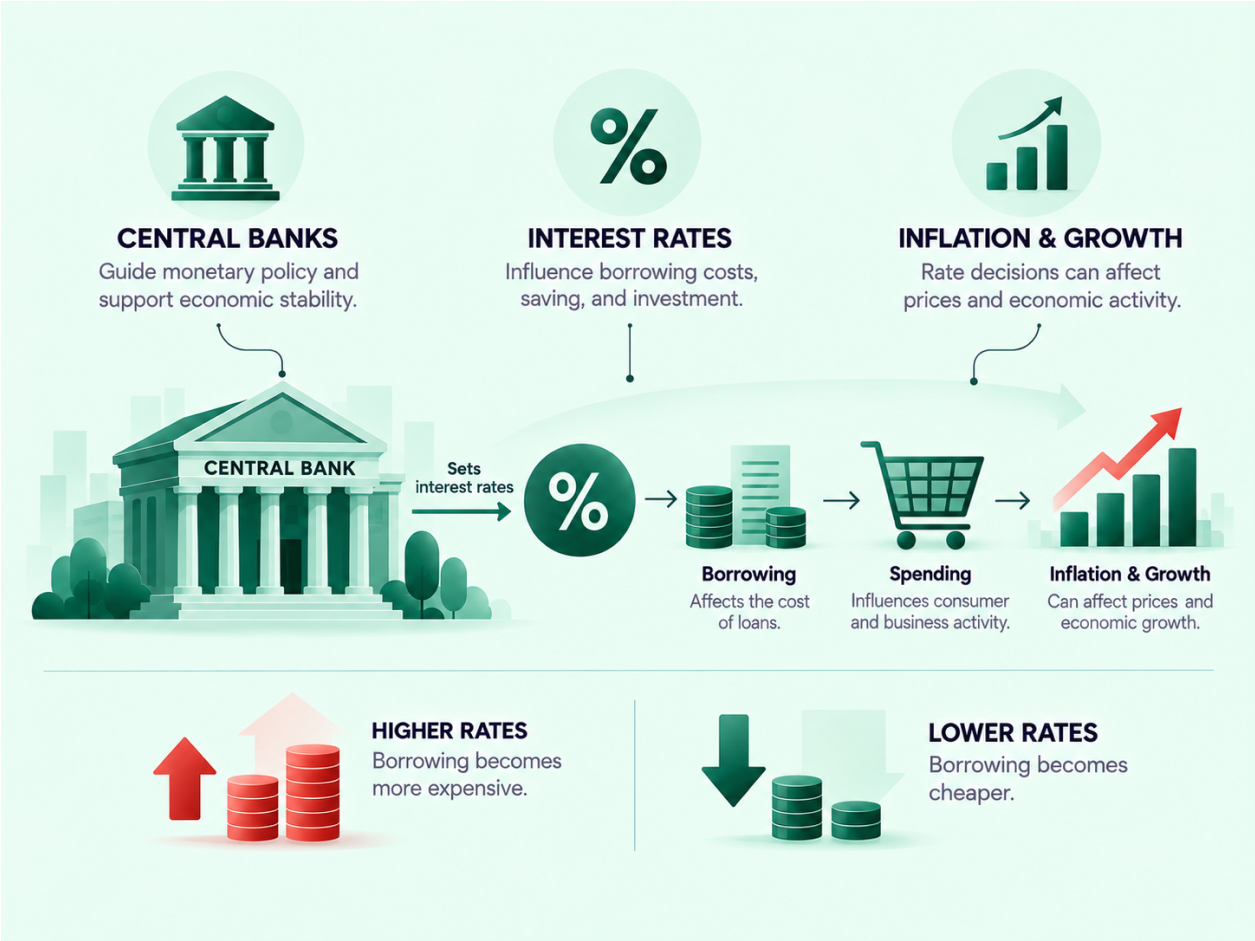
Central banks are state institutions that manage an economy’s monetary policy, including the money supply and interest rates. Interest rates represent the cost of borrowing capital and the return earned on funds provided, directly influencing demand for a currency.
Understanding Central Banks and Interest Rates
Central banks serve as the financial backbone of a nation, entrusted with the critical responsibility of maintaining economic stability. Their primary tools for achieving this include managing the money supply—the total amount of cash, credit, and other financial instruments in circulation—and setting interest rates.
What is a Central Bank?
A central bank is an independent national authority that conducts monetary policy, regulates banks, and provides financial services. Key examples include the U.S. Federal Reserve (the Fed), the European Central Bank (ECB), and the Bank of England (BoE). Their mandates often involve keeping inflation at a target level (e.g., around 2%), promoting maximum sustainable employment, and ensuring the stability of the financial system.
The Role of Interest Rates
Interest rates are essentially the price of money. They represent the fee borrowers pay for accessing capital and the reward lenders receive for providing it. These rates are dynamic, influenced by macroeconomic conditions, the creditworthiness of borrowers, and the duration of the loan.
Central banks influence these rates through various monetary policy tools:
- Open Market Operations: The buying and selling of government securities in the open market to control the money supply and, by extension, short-term interest rates.
- The Discount Rate: The interest rate at which commercial banks can borrow money directly from the central bank. A lower discount rate encourages banks to borrow more, increasing liquidity in the system, and vice-versa.
By adjusting these rates, central banks can either stimulate or restrain economic activity, directly impacting the demand for a currency.
Interest Rates as a Monetary Policy Lever
Central banks strategically adjust interest rates to navigate the ebb and flow of the economic cycle, aiming for a delicate balance between growth and stability.
Navigating the Economic Cycle
Imagine the economy as a car, and the central bank as its driver.
- Expanding Economy (Inflation Risk): When the economy is growing rapidly, consumer spending and investment surge. This can lead to “too much money chasing too few goods,” causing prices to rise—a phenomenon known as inflation. In this scenario, the central bank might “tap the brakes” by raising interest rates. This makes borrowing more expensive, discouraging spending and investment, and encouraging saving, thereby cooling down inflationary pressures.
- Contracting Economy (Deflation/Recession Risk): Conversely, during an economic slowdown or recession, demand falls, potentially leading to deflation (falling prices) and rising unemployment. The central bank might then “hit the accelerator” by lowering interest rates. This makes borrowing cheaper, stimulating spending and investment, and discouraging saving, injecting money back into the system to spur growth.
Beyond Rates: Central Banks’ Broader Toolkit
Beyond these conventional tools, central banks also employ non-conventional measures, particularly during severe economic downturns or when interest rates hit the “zero lower bound” (meaning they cannot be cut further). One such tool is Quantitative Easing (QE), also known as Large-Scale Asset Purchases (LSAP). This involves the central bank buying vast quantities of government bonds and other financial assets (like mortgage-backed securities, as the Fed did during the COVID-19 pandemic) from commercial banks. The goal is to inject massive amounts of liquidity into the financial system, lower long-term interest rates, and stimulate lending and investment when traditional rate cuts are no longer effective. This was notably used after the Global Financial Crisis of 2008 and again during the COVID-19 pandemic to support economic recovery.
The Inflation Target
While excessive inflation is detrimental, a moderate level of inflation is generally considered healthy for a growing economy. It signals robust demand and encourages investment. Many central banks target an annual inflation rate of around 2% to maintain this balance.
Inflation, however, erodes the purchasing power of a currency over time. For investors, this highlights the distinction between nominal and real returns:
- Nominal Return: The stated interest rate or return on an investment.
- Real Return: The nominal return adjusted for inflation. If an investment yields a 5% nominal return but inflation is 3%, the real return is only 2%. A positive real return means your money is growing faster than prices are rising, preserving or increasing your purchasing power. Central banks strive to create an environment where positive real returns are possible to attract capital.
How Interest Rates Impact Currency Values
The connection between interest rates and currency values is a cornerstone of forex trading.
Real-World Impact: Historical Cases & Crisis Responses
Understanding the theoretical impact of interest rates is crucial, but real-world examples provide concrete evidence of their power. Central banks have historically deployed various monetary tools, often with dramatic effects on national economies and currency valuations.
A recent prominent example is the U.S. Federal Reserve’s aggressive hiking cycle post-COVID-19. After maintaining near-zero interest rates to cushion the pandemic’s economic blow, the Fed began raising rates in March 2022 to combat surging inflation. By July 2023, the benchmark rate had climbed to 5.50%. This rapid tightening significantly strengthened the U.S. Dollar, with the Dollar Index rallying over 14% between March and October 2022, as global capital flowed into higher-yielding U.S. assets.
Conversely, persistent high inflation can severely erode a currency’s value, even with high nominal interest rates. Turkey’s economic situation provides a stark illustration. Despite interest rates reaching 50% at times, inflation has frequently exceeded this, leading to negative real returns for Lira holders. This sustained erosion of purchasing power has caused the Turkish Lira to depreciate by over 500% against the U.S. Dollar in the last five years, highlighting the devastating impact of unchecked inflation on currency strength.
Central banks have also responded to major crises with unconventional measures. Following the Global Financial Crisis (GFC) of 2008, many central banks, including the Fed, cut interest rates to near zero and implemented large-scale asset purchases (Quantitative Easing) to inject liquidity and stimulate economies. Similarly, during the COVID-19 pandemic, central banks again loosened monetary policy, but the subsequent global reopening, coupled with supply-side issues like labor shortages and energy price shocks (exacerbated by events like the Russian invasion of Ukraine), led to a surge in inflation. This prompted a coordinated global response, with central banks like the Bank of England, the European Central Bank, and the Fed raising rates to bring inflation back under control. In some cases, like the Swiss National Bank (SNB), interest rates even fell into negative territory (-0.75% between 2015 and 2022) in an attempt to stimulate growth and combat deflationary pressures. These historical cases underscore the dynamic and often complex interplay between central bank policy, inflation, and currency markets.
Attracting Capital Flows
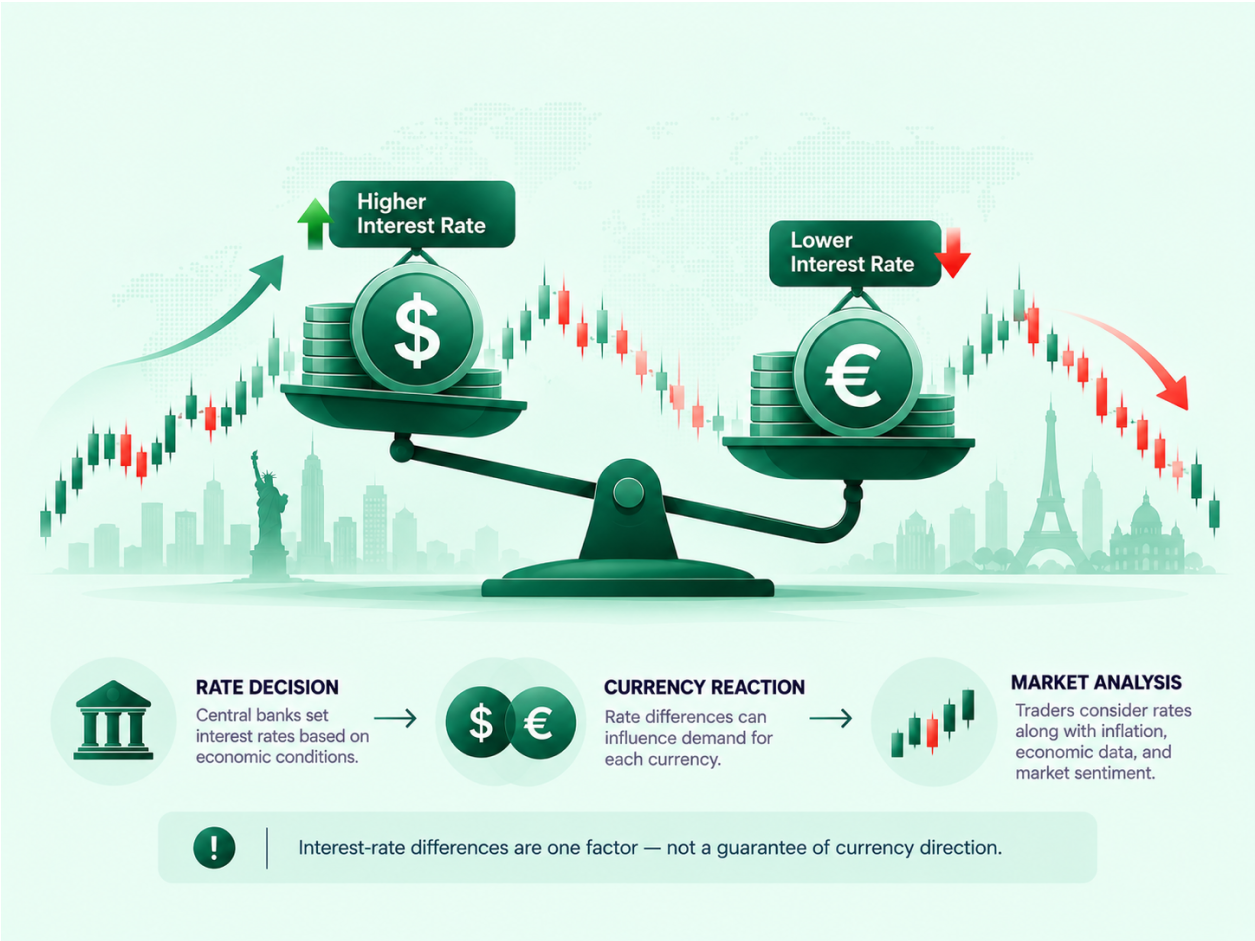
Higher interest rates offer the potential for greater returns on investments, such as government bonds or interest-bearing bank deposits. This acts like a magnet for international capital. When a country’s central bank raises interest rates, it makes that country’s assets more attractive to global investors seeking higher yields.
Consider a scenario where the U.S. Federal Reserve raises its benchmark interest rate while other major central banks maintain lower rates. Investors from Europe or Japan, seeking better returns, might sell their local currency (e.g., Euros or Japanese Yen) to buy U.S. Dollars, which they then invest in U.S. assets. This increased demand for the U.S. Dollar causes it to appreciate against other currencies. Conversely, if U.S. rates fall relative to others, capital might flow out, leading to Dollar depreciation.
In CFD forex trading, currency pairs reflect the relative value of two currencies. If you are trading the EUR/USD pair and interest rates in the U.S. are rising, the U.S. Dollar (the quote currency) will likely strengthen, causing the EUR/USD pair to fall (as it takes fewer Dollars to buy one Euro).
The Power of Expectations
Forex markets are inherently forward-looking. Currency prices don’t just reflect current interest rates but also expectations about future rate movements and inflation. Traders closely monitor economic data releases and central bank communications for clues about upcoming policy shifts.
The most significant currency movements often occur when central bank decisions surprise the market.
- Expected Rate Hike, Actual Hold: If the market anticipates a rate hike but the central bank holds rates steady, the currency might depreciate as investors are disappointed by the lack of higher returns.
- Expected Rate Hold, Actual Cut: If a rate cut occurs when a hold was expected, the currency would likely depreciate sharply, signaling weaker economic prospects or a more dovish central bank stance.
- Expected Rate Hold, Actual Hike: An unexpected rate hike would likely lead to currency appreciation as investors rush to capitalize on higher yields.
Bond markets, particularly yield curves, are often referenced by forex traders because they visualize the market’s collective expectations regarding future interest rates and inflation within an economy.
Trading with Interest Rate Differentials
A sophisticated approach to forex trading involves leveraging interest rate differentials.
Understanding Differentials
Interest rate differentials refer to the difference in interest rates between two economies. These differentials are a key driver of capital flows and, consequently, currency valuations. For instance, if the interest rate in Country A is 4% and in Country B is 1%, the differential is 3%. Traders look for widening or narrowing differentials as signals for potential currency movements.
The Carry Trade Strategy
One popular strategy built on interest rate differentials is the “carry trade.” This involves borrowing money in a currency with a low interest rate (the “funding currency“) and investing it in a currency with a higher interest rate (the “target currency”) to profit from the interest rate differential.
Example: A trader might borrow $100,000 in Japanese Yen (JPY), where interest rates are historically low (e.g., 0.1%), convert it to Australian Dollars (AUD), and invest in Australian government bonds yielding 4%. The annual interest rate differential profit would be approximately 3.9% (4% – 0.1%), plus any potential capital appreciation if the AUD strengthens against the JPY.
However, carry trades carry significant risks:
- Currency Depreciation: If the target currency (AUD in our example) depreciates against the funding currency (JPY), it can quickly erase interest rate gains and lead to substantial losses.
- Unexpected Policy Shifts: Sudden changes in central bank policy or macroeconomic conditions that narrow the interest rate differential can make the trade unprofitable.
Inflation’s Direct Influence on Currency Strength
Beyond its role in dictating central bank policy, inflation has a direct and profound impact on a currency’s strength.
Erosion of Purchasing Power
Inflation, defined as a sustained increase in the general price level of goods and services, directly reduces a currency’s purchasing power. If inflation runs at 5% annually, the same amount of money will buy 5% less goods and services a year later.
High and persistent inflation makes a currency less attractive to both domestic and international investors. Why hold a currency that is rapidly losing value? This leads to a decrease in demand for the currency on foreign exchanges, causing its value to fall. In extreme cases, unchecked hyperinflation can render a currency virtually worthless, forcing a country to abandon it, as seen in historical examples like Zimbabwe.
The Vicious Cycle
If high inflation goes unchecked, a dangerous cycle can ensue. Governments and central banks might be pressured to print more money to finance spending or offset rising prices. However, increasing the money supply further devalues the local currency, which in turn drives import costs and domestic prices even higher, necessitating more money printing. This feedback loop can spiral into hyperinflation, devastating an economy.
Strategies for Trading Interest Rate Decisions
For CFD traders, understanding how to incorporate interest rate decisions into their strategy is paramount.
Event-Driven Trading
Many traders attempt to capitalize on the immediate market reaction to central bank interest rate announcements. This involves placing trades just before or at the moment the decision is released, aiming to profit from the initial volatility. This strategy requires precise timing and robust risk management due to the potential for rapid and unpredictable price swings.
Anticipating Policy Shifts
More experienced traders often try to forecast central bank moves before they are announced. This involves:
- Monitoring Economic Indicators: Closely tracking key macroeconomic data points such as Consumer Price Index (CPI) for inflation, Gross Domestic Product (GDP) for economic growth, unemployment rates, and retail sales. Strong data might signal a potential rate hike, while weak data could point to a cut.
- Analyzing Central Bank Communications: Scrutinizing speeches, meeting minutes, and press conferences from central bank officials for “hawkish” (favoring tighter monetary policy/higher rates) or “dovish” (favoring looser monetary policy/lower rates) language. Even subtle changes in wording can signal a shift in policy direction.
Post-Announcement Pullbacks
Sometimes, after an initial sharp move following a rate decision, the market might experience a temporary reversal or “pullback.” For instance, if an unexpected rate hike causes a currency to surge, a trader might wait for a slight retracement before entering a long position, aiming for a more favorable entry price. This strategy aims to avoid the most volatile initial reaction while still participating in the sustained trend.
Risks and Best Practices for Traders
Trading based on central bank interest rates and inflation carries specific risks and requires diligent practices.
Key Risks
- Policy Surprises: Unforeseen changes in central bank policy, such as an unexpected pause in a hiking cycle or a sudden rate cut, can lead to significant and rapid market reversals.
- Nuance in Communication: Central bank statements are often carefully worded. Misinterpreting subtle language or omissions can lead to incorrect trading decisions.
- “Buy the Rumor, Sell the News”: Markets often price in expectations well in advance. When the actual announcement occurs, even if it matches expectations, the market might “sell off” as traders take profits, leading to counter-intuitive price action.
Best Practices
- Utilize an Economic Calendar: Always start your trading week with a clear understanding of upcoming central bank meetings, interest rate decisions, and key economic data releases.
- Understand Market Consensus: Be aware of what analysts and the broader market are expecting for each data release or policy decision. Market reactions are often driven by the surprise element, not just the data itself.
- Leverage Analytical Tools: Make use of freely available tools that track market expectations for future interest rate paths, such as those that aggregate probabilities for Fed rate changes.
- Continuous Learning: Deepen your understanding of macroeconomic concepts, monetary policy, and the interplay between interest rates and inflation. Analyze historical data to identify patterns and refine your forecasting abilities.
- Risk Management: Always employ strict risk management techniques, including setting stop-loss orders, to protect your capital, especially around high-impact news events.
Frequently Asked Questions
What is the primary mandate of most central banks regarding interest rates?
Most central banks are mandated to maintain price stability, typically by targeting a specific inflation rate (e.g., 2%), and to promote sustainable economic growth and full employment. They use interest rates as their primary tool to achieve these dual objectives by influencing borrowing, spending, and saving.
How do “real returns” differ from “nominal returns” in the context of interest rates and inflation?
Nominal return is the raw percentage return on an investment before accounting for inflation. Real return, conversely, is the nominal return adjusted for inflation, indicating the actual increase or decrease in purchasing power. A positive real return means your investment is growing faster than the cost of living.
Why might a currency depreciate even if its central bank holds interest rates steady?
A currency might depreciate if the market had expected a rate hike, and the central bank’s decision to hold rates steady is seen as a “dovish” surprise. This indicates a less aggressive stance on inflation or weaker economic outlook than anticipated, making the currency less attractive to investors seeking higher yields.
What is a “carry trade” and what is its main risk?
A carry trade involves borrowing money in a currency with a low interest rate and investing it in assets denominated in a currency with a higher interest rate, aiming to profit from the interest rate differential. The main risk is that the higher-yielding currency might depreciate against the borrowed currency, offsetting or exceeding the interest gains.
Knowledge Check
1. Central banks primarily use interest rates to manage:
- A) Government bond yields
- B) Monetary policy and economic stability
- C) Commercial bank profits
- D) Stock market valuations
2. If a central bank unexpectedly cuts interest rates when the market expected a hold, what is the likely immediate impact on the domestic currency?
- A) Appreciation
- B) Depreciation
- C) No significant change
- D) Increased volatility with unpredictable direction
3. What does a “positive real return” on an investment imply?
- A) The nominal interest rate is equal to the inflation rate.
- B) The inflation rate is higher than the nominal interest rate.
- C) The nominal interest rate is higher than the inflation rate.
- D) The investment is entirely risk-free.
Click to view the answers
1. **B)** – Central banks use interest rates as a key tool within their monetary policy framework to achieve economic stability and manage inflation.
2. **B)** – An unexpected rate cut signals a weaker economic outlook or a more dovish central bank, typically leading to depreciation as investors seek higher yields elsewhere.
3. **C)** – A positive real return means that the nominal interest earned on an investment exceeds the rate of inflation, preserving or increasing purchasing power.