


The financial landscape has undergone a profound transformation, evolving from bustling trading floors filled with shouting brokers to sophisticated digital platforms accessible from anywhere in the world. This evolution has democratized access to global markets, allowing individuals and institutions alike to participate in the dynamic exchange of financial assets. At the heart of this modern financial ecosystem lies online trading.
Online trading is the practice of buying and selling financial instruments through an internet-based platform, with the primary objective of generating profit from price fluctuations. It encompasses a wide array of assets and markets, enabling participants to speculate on their directional movements.
This masterclass will delve into the intricacies of online trading, exploring its historical roots, fundamental mechanics, diverse participants, and the array of instruments available. We will also distinguish it from traditional investing and highlight the critical importance of risk management in this fast-paced environment.
The Evolution of Trading: From Pits to Pixels
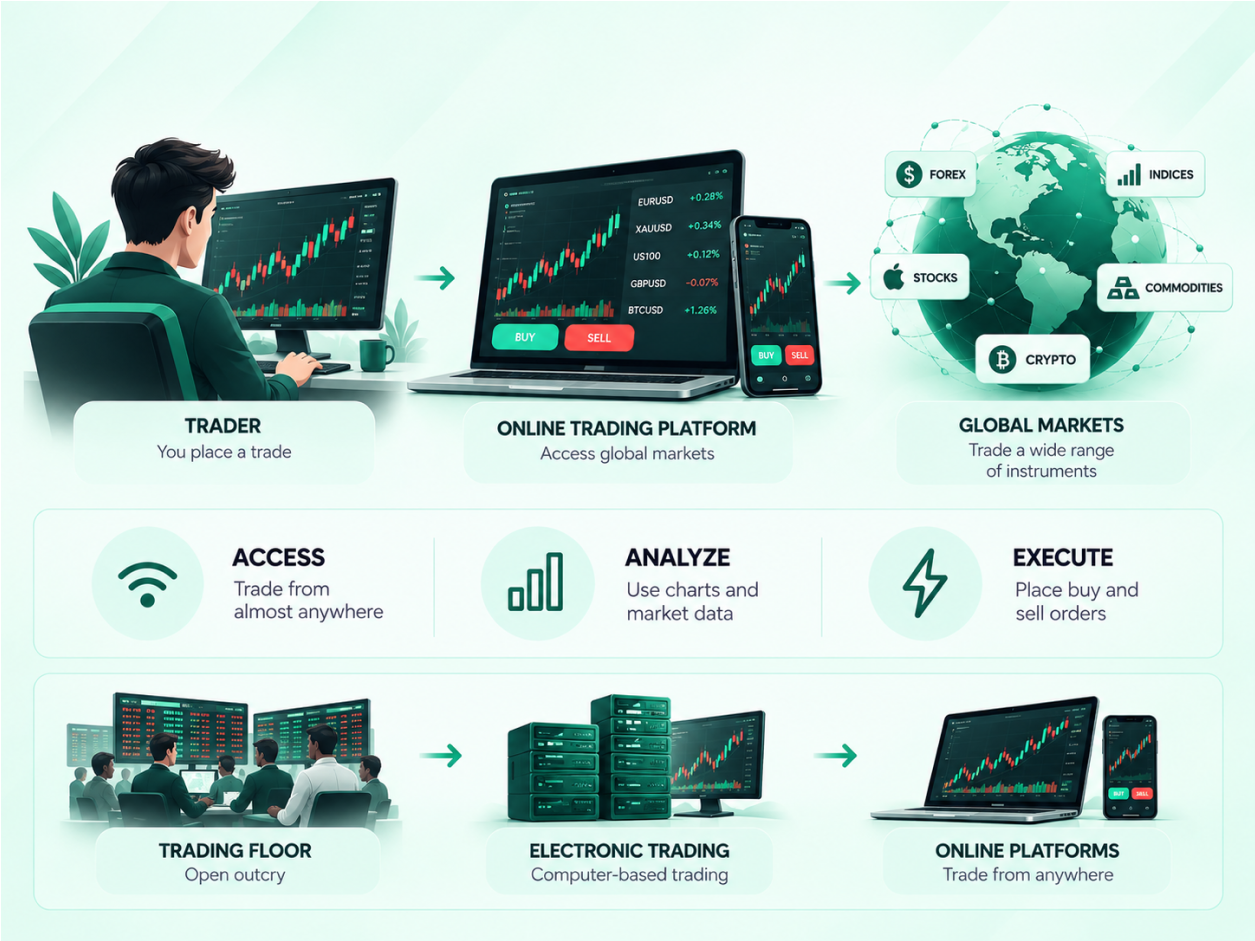
For centuries, financial trading was an exclusive domain, characterized by physical exchanges where brokers and traders converged to execute orders through a system known as “open outcry.” This method, involving hand signals and vocal commands, was the standard for price discovery and transaction execution. Iconic images of the New York Stock Exchange or the Chicago Mercantile Exchange floor epitomized this era, where proximity and human interaction were paramount.
The late 20th century, however, ushered in a technological revolution that fundamentally reshaped financial markets. The advent of powerful computers, robust telecommunications networks, and eventually the internet paved the way for electronic trading. Initially, this shift primarily benefited institutional players, offering faster execution and greater efficiency.
The true democratization of trading began in the late 1990s and early 2000s with the widespread adoption of the internet. Online brokers emerged, providing retail investors and traders with direct access to markets previously reserved for professionals. This seismic shift brought several transformative changes:
- Accessibility: Geographic barriers dissolved, allowing anyone with an internet connection to participate.
- Speed: Trades could be executed in milliseconds, a stark contrast to the minutes or hours of manual processing.
- Cost Efficiency: Brokerage fees and commissions significantly decreased due to automated processes and increased competition.
- Information Flow: Real-time market data, news, and analytical tools became readily available to the public.
Today, online trading platforms are highly advanced, offering sophisticated charting tools, algorithmic trading capabilities, and comprehensive risk management features, catering to a global audience of millions.
Core Concepts of Online Trading
At its essence, online trading revolves around predicting market movements and capitalizing on them. Whether buying an asset in anticipation of a price rise or selling in expectation of a fall, the goal remains profit generation.
Supply and Demand: The Fundamental Driver
The most basic principle governing asset prices in any market, online or otherwise, is the interplay of supply and demand.
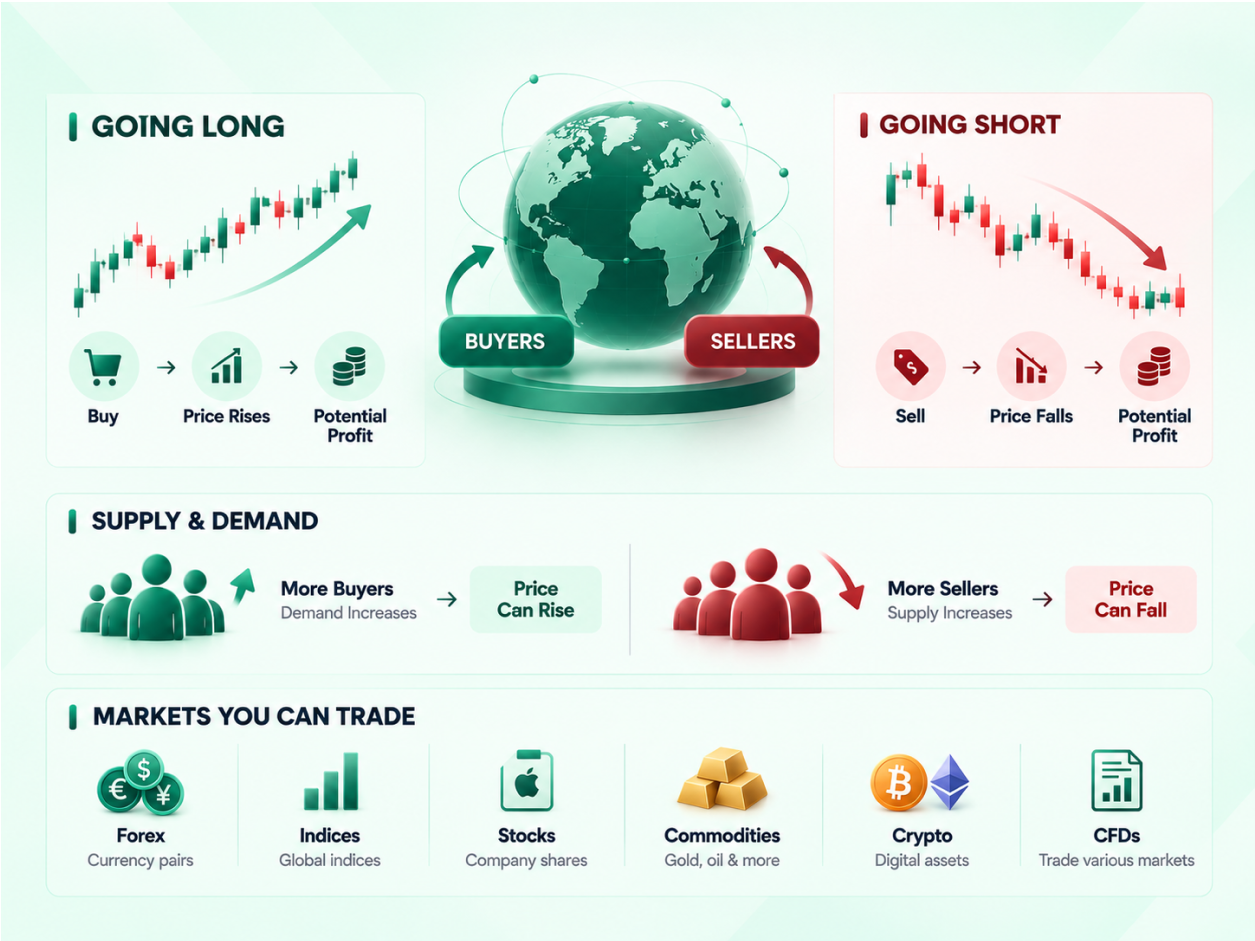
- Increased Demand: When there are more buyers than sellers for a particular asset, demand outstristrips supply. This scarcity pushes the price upwards as buyers compete for limited available assets.
- Increased Supply: Conversely, when there are more sellers than buyers, supply exceeds demand. The abundance of the asset drives its price downwards as sellers compete to offload their holdings.
Understanding this dynamic is crucial for any trader, as it forms the bedrock of price action across all financial markets.
Going Long vs. Going Short
Online trading offers flexibility that extends beyond simply buying low and selling high. Traders can profit from both rising and falling markets:
- Going Long (Buying): This is a bullish position, taken when a trader anticipates that the price of an asset will increase. The trader buys the asset (or a derivative of it) with the expectation of selling it later at a higher price.
- Going Short (Selling): This is a bearish position, taken when a trader anticipates that the price of an asset will decrease. In traditional markets, this involves borrowing an asset, selling it, and then buying it back at a lower price to return it to the lender, profiting from the difference. In derivative trading, it simply means opening a “sell” position. Short selling carries theoretically unlimited risk if the market moves significantly against the position, as there’s no cap on how high an asset’s price can rise.
Key Participants in Online Trading
The online trading arena is populated by a diverse group of entities, each with distinct motivations and impacts on market dynamics.
Retail Traders
These are individual traders who use their personal capital to trade financial instruments through online brokerage accounts. Their participation has surged, particularly with the rise of user-friendly platforms and increased access to market information. Retail traders often employ various strategies, from day trading (executing multiple trades within a single day) to swing trading (holding positions for a few days or weeks). While their individual impact might be smaller than institutional players, their collective activity can significantly influence market volatility and liquidity, especially in certain segments.
Institutional Traders
This category includes large entities such as commercial banks, hedge funds, mutual funds, pension funds, and corporations. They trade vast sums of capital, often executing “block trades” (transactions involving 10,000 shares or more). Institutional traders are major drivers of market liquidity and can cause substantial price movements due to the sheer volume of their transactions. Their trading decisions are often influenced by macroeconomic factors, corporate earnings, geopolitical events, and sophisticated quantitative models.
Market Makers and Brokers
Online brokers act as intermediaries, providing the platforms and infrastructure that connect retail traders to financial markets. They execute orders, provide market data, and often offer educational resources. Market makers, on the other hand, actively quote both buy (bid) and sell (ask) prices for financial instruments, facilitating trading by providing liquidity. They profit from the spread between these prices. In many online trading models, especially for derivatives, the broker may also act as the counterparty or facilitate access to liquidity providers who perform market-making functions.
Understanding Financial Instruments and Markets
The digital age has opened access to an unparalleled variety of financial instruments across global markets.
Traditional Assets
- Stocks (Shares): Represent ownership in a publicly traded company. Traders speculate on the company’s future performance and market sentiment.
- Forex (Foreign Exchange): The largest and most liquid financial market globally, involving the exchange of one currency for another. Traders speculate on the relative strength or weakness of currency pairs (e.g., EUR/USD, USD/JPY).
- Indices: A collection of stocks grouped together, representing a specific market, sector, or economy (e.g., S&P 500, Dow Jones Industrial Average). Trading an index allows speculation on the overall performance of that group of assets.
- Commodities: Tangible raw materials, often categorized as “hard” (e.g., gold, crude oil, natural gas) or “soft” (e.g., wheat, coffee, livestock). Traders speculate on supply and demand dynamics influenced by geopolitical events, weather patterns, and economic cycles.
- Exchange-Traded Funds (ETFs): Investment funds traded on stock exchanges, holding a basket of assets like stocks, bonds, or commodities. They offer diversification and can be traded like individual stocks.
- Bonds: Debt instruments issued by governments or corporations to raise capital. Traders may speculate on interest rate movements affecting bond prices.
Derivatives: Contracts for Difference (CFDs)
For many online traders, particularly those seeking flexibility and leverage, Contracts for Difference (CFDs) are a popular instrument. CFDs are financial derivatives that allow traders to speculate on the price movements of underlying assets without actually owning them.
How CFDs Work:
When you trade a CFD, you enter into a contract with a broker to exchange the difference in the price of an asset from the time the contract is opened until it is closed. If you predict correctly, you profit from the price difference; if not, you incur a loss.
Key Features of CFDs:
- No Asset Ownership: You do not own the underlying stock, commodity, or currency. This means you typically don’t receive dividends (though dividend adjustments may be applied to your account) or voting rights associated with shares.
- Leverage: This is a defining characteristic of CFDs. Leverage allows you to open a position much larger than your initial capital outlay. Instead of paying the full value of a trade upfront, you put down a fraction of its value as a deposit, known as “margin.”
- Example: If a stock CFD has a 10% margin requirement, you can control $1,000 worth of stock with just $100 of your capital.
- Benefits: Leverage can significantly magnify potential profits from even small price movements.
- Risks: Crucially, leverage also magnifies potential losses. Your profit or loss is calculated based on the full value of the position, not just your margin. While leverage can magnify losses, LQH Markets offers Negative Balance Protection, which limits a client’s losses on a given account so that the account balance does not fall below zero under normal trading conditions, subject to the prohibitions on abuse described in our Client Agreement.
- Going Long or Short: CFDs inherently allow you to speculate on both rising (buy) and falling (sell) markets with equal ease.
- Access to Diverse Markets: CFD brokers often offer a vast range of markets, from global stocks and indices to forex and commodities, all from a single trading account.
- Costs: Besides the potential for losses, trading CFDs involves costs such as the “spread” (the difference between the buy and sell price), “commissions” (on certain account types), and “overnight financing fees” (interest charged for holding leveraged positions overnight).
Trading vs. Investing: A Critical Distinction
While both trading and investing involve participating in financial markets, their objectives, time horizons, and methodologies differ significantly.
| Feature | Online Trading (e.g., CFDs) | Traditional Investing (e.g., Stocks) |
|---|---|---|
| Objective | Profit from short-to-medium-term price fluctuations. | Build wealth over the long term through capital appreciation. |
| Time Horizon | Days, weeks, or months (rarely years). | Years, decades. |
| Asset Ownership | No direct ownership; speculating via derivatives. | Direct ownership of the underlying asset. |
| Profit Source | Buying low/selling high or selling high/buying low. | Capital appreciation, dividends, interest. |
| Leverage | Commonly used to magnify returns (and risks). | Generally not used (or used with caution in specific contexts). |
| Risk Profile | Higher, due to leverage and short-term market volatility. | Moderate to high, depending on assets, but often diversified. |
| Strategy Focus | Technical analysis, market sentiment, short-term news. | Fundamental analysis, economic outlook, company growth. |
How Online Trading Works: A Step-by-Step Overview
Engaging in online trading typically follows a structured process, facilitated by your chosen broker and platform.
1. Choosing a Broker and Account Type
The first step is to select a reputable online broker that offers the markets and instruments you wish to trade. Brokers provide different account types, including:
- Demo Accounts: Funded with virtual money, these are invaluable for beginners to practice strategies and familiarize themselves with the platform without financial risk.
- Live Accounts: Used for actual trading with real capital.
2. Funding Your Account
Once a live account is opened, you will need to deposit funds. LQH Markets offers various deposit methods, including crypto and card options.
3. Selecting an Asset and Market
With funds in your account, you can explore the vast array of markets available. It’s often advisable to start with markets you understand or have researched thoroughly.
4. Market Analysis
Before placing a trade, traders typically conduct analysis to inform their decisions:
- Technical Analysis: Involves studying historical price charts, patterns, and technical indicators (e.g., moving averages, Relative Strength Index) to predict future price movements.
- Fundamental Analysis: Focuses on economic data, company news, industry trends, and geopolitical events that can impact an asset’s intrinsic value.
5. Placing a Trade
Once you’ve decided on a market and direction, you place an order through the trading platform. Key aspects of placing a trade include:
- Direction: “Buy” (go long) if you expect the price to rise, or “Sell” (go short) if you expect it to fall.
- Deal Size: The quantity of the asset or number of CFD contracts you wish to trade. This directly impacts your potential profit or loss.
- Order Type:
- Market Order: An order to buy or sell immediately at the best available current market price.
- Limit Order: An order to buy or sell at a specific price or better. A buy limit order is placed below the current market price, while a sell limit order is placed above.
- Stop Order (Stop-Loss): An order to buy or sell once a certain price (the “stop price”) is reached. Often used to limit potential losses on an open position. A buy stop order is placed above the current market price, and a sell stop order is placed below.
- Take-Profit Order: Similar to a limit order, but specifically used to close a profitable position once a target price is reached.
6. Monitoring and Managing Positions
After placing a trade, it’s crucial to monitor its performance. Market conditions can change rapidly, and effective risk management tools are vital.
- Stop-Loss Orders: Automatically close a position if the market moves against you to a predetermined loss level, helping to limit downside risk.
- Take-Profit Orders: Automatically close a position when it reaches a predetermined profit target, securing gains.
- Trailing Stops: A dynamic stop-loss order that adjusts automatically as the market moves in your favor, locking in profits while still protecting against reversals.
Trading Examples with CFDs (USD)
Let’s illustrate how CFD trading works with two hypothetical scenarios.
Example 1: Going Long on a Technology Stock CFD
Imagine a technology company, “InnovateTech,” whose shares are currently trading at $150.00. You believe that InnovateTech is poised for growth due to a new product launch and anticipate its stock price will rise. You decide to buy 100 InnovateTech CFDs.
- Current Price: $150.00 (Bid: $149.90, Ask: $150.10)
- Your Action: You open a “buy” position for 100 InnovateTech CFDs at the ask price of $150.10.
- Initial Position Value: 100 CFDs * $150.10 = $15,010.00
- Margin Requirement: If the margin is 5%, your initial deposit (margin) would be 5% of $15,010.00 = $750.50.
Scenario A: InnovateTech Price Rises
A few days later, InnovateTech’s product launch is successful, and its share price climbs.
- New Price: $155.00 (Bid: $154.90, Ask: $155.10)
- Your Action: You decide to close your profitable position by selling 100 InnovateTech CFDs at the new bid price of $154.90.
- Closing Value: 100 CFDs * $154.90 = $15,490.00
- Gross Profit: $15,490.00 (closing value) – $15,010.00 (opening value) = $480.00
- Note: This profit is calculated on the full position value, not just your initial margin. Any overnight financing fees would be deducted from this profit.
Scenario B: InnovateTech Price Falls
Alternatively, the product launch faces unexpected issues, and InnovateTech’s share price drops.
- New Price: $147.00 (Bid: $146.90, Ask: $147.10)
- Your Action: To limit further losses, you close your position by selling 100 InnovateTech CFDs at the new bid price of $146.90.
- Closing Value: 100 CFDs * $146.90 = $14,690.00
- Gross Loss: $15,010.00 (opening value) – $14,690.00 (closing value) = $320.00
- Note: This loss is also calculated on the full position value.
Example 2: Going Short on a Currency Pair CFD (Forex)
You observe that the economic outlook for Europe is weakening compared to the United States, leading you to believe the Euro will depreciate against the US Dollar. You decide to go short on the EUR/USD currency pair.
- Current Price: EUR/USD is trading at 1.0850 (Bid: 1.0848, Ask: 1.0852).
- Your Action: You open a “sell” position for 1 standard lot (100,000 units) of EUR/USD CFDs at the bid price of 1.0848.
- Initial Position Value: 100,000 EUR * 1.0848 USD/EUR = $108,480.00
- Margin Requirement: If the margin is 0.5%, your initial deposit would be 0.5% of $108,480.00 = $542.40.
Scenario A: EUR/USD Price Falls (as predicted)
As expected, economic data confirms your view, and the Euro weakens against the Dollar.
- New Price: EUR/USD falls to 1.0790 (Bid: 1.0788, Ask: 1.0792).
- Your Action: You close your profitable position by buying 1 standard lot of EUR/USD CFDs at the new ask price of 1.0792.
- Closing Value: 100,000 EUR * 1.0792 USD/EUR = $107,920.00
- Gross Profit: $108,480.00 (opening value) – $107,920.00 (closing value) = $560.00
- Note: In a short position, profit is made when the closing price is lower than the opening price.
Scenario B: EUR/USD Price Rises (against prediction)
Unexpected positive news from Europe causes the Euro to strengthen against the Dollar.
- New Price: EUR/USD rises to 1.0900 (Bid: 1.0898, Ask: 1.0902).
- Your Action: To avoid further losses, you close your position by buying 1 standard lot of EUR/USD CFDs at the new ask price of 1.0902.
- Closing Value: 100,000 EUR * 1.0902 USD/EUR = $109,020.00
- Gross Loss: $109,020.00 (closing value) – $108,480.00 (opening value) = $540.00
These examples highlight the mechanics of CFD trading and underscore the importance of both correct prediction and robust risk management.
The Importance of Risk Management
Given the leveraged nature of instruments like CFDs and the inherent volatility of financial markets, effective risk management is paramount for online traders. Without it, capital can be depleted rapidly.
Key risk management principles include:
- Position Sizing: Determining the appropriate amount of capital to allocate to each trade, ensuring that no single trade can cause catastrophic losses.
- Stop-Loss Orders: As demonstrated, these are crucial for automatically exiting a losing trade at a predetermined level, preventing further downside.
- Diversification: Spreading investments across different assets, markets, or strategies to reduce the impact of poor performance in any single area.
- Understanding Leverage: While leverage offers magnified profit potential, it also magnifies losses. Traders must be acutely aware of their leverage exposure and its implications.
- Capital Management: Only trading with capital you can afford to lose, and never risking your entire trading account on a single position.
- Emotional Discipline: Avoiding impulsive decisions driven by fear or greed, and sticking to a well-defined trading plan.
Getting Started with Online Trading
For those new to the world of online trading, a structured approach is recommended:
- Educate Yourself: Utilize the extensive educational resources provided by reputable brokers, online academies, and financial publications. Understand the fundamentals of markets, instruments, and trading strategies.
- Choose a Reputable Broker: Select a broker that is regulated, offers the markets you’re interested in, provides a robust trading platform, and has strong customer support.
- Practice with a Demo Account: This is perhaps the most critical step for beginners. A demo account allows you to apply theoretical knowledge in a real-time market environment using virtual funds, building confidence and refining your strategy without financial risk.
- Develop a Trading Plan: A comprehensive plan outlines your trading goals, risk tolerance, preferred markets, entry and exit strategies, and risk management rules.
- Start Small with a Live Account: When transitioning to a live account, begin with a modest amount of capital and small position sizes. Focus on consistent execution of your plan rather than large profits initially.
- Continuous Learning and Adaptation: Financial markets are constantly evolving. Successful traders commit to ongoing learning, adapting their strategies to changing market conditions and refining their skills.
Online trading offers unparalleled opportunities for individuals to engage with global financial markets. While the potential for profit is significant, it is equally important to approach it with a clear understanding of the risks, a commitment to continuous learning, and a disciplined approach to risk management. With the right knowledge and tools, online trading can be a rewarding endeavor.
Frequently Asked Questions
What is the primary difference between online trading and traditional investing?
Online trading typically involves speculating on short-to-medium-term price movements of financial instruments, often using derivatives like CFDs without direct asset ownership. Traditional investing, conversely, focuses on long-term wealth building through direct ownership of assets, aiming for capital appreciation and potential income from dividends over years or decades.
How does leverage impact online CFD trading?
Leverage allows traders to control a larger market position with a smaller initial capital outlay (margin). While this can significantly magnify potential profits from favorable price movements, it equally amplifies potential losses, meaning traders can lose substantially more than their initial margin deposit if the market moves against their position.
What are the essential tools for a beginner in online trading?
Beginners should prioritize a reliable online trading platform with robust charting capabilities, access to real-time market data, and comprehensive educational resources. A free demo account is an indispensable tool for practicing strategies and familiarizing oneself with the platform in a risk-free virtual environment.
Can I lose more than my initial deposit in online trading?
While trading leveraged products like CFDs carries significant risk, LQH Markets offers Negative Balance Protection, which limits a client’s losses on a given account so that the account balance does not fall below zero under normal trading conditions, subject to the prohibitions on abuse described in our Client Agreement.
What types of financial markets can I access through online trading?
Online trading platforms offer access to a vast array of global financial markets, including stocks (shares), foreign exchange (forex) currency pairs, stock indices, commodities (e.g., gold, oil), exchange-traded funds (ETFs), and bonds, often through derivative instruments like CFDs.
Knowledge Check
1. What is the primary objective of online trading?
- A) To gain direct ownership of physical assets for long-term holding.
- B) To generate profit from short-to-medium-term price fluctuations of financial instruments.
- C) To provide capital to companies in exchange for voting rights and dividends.
- D) To exclusively invest in government bonds for stable, guaranteed returns.
2. Which of the following best describes the concept of “leverage” in CFD trading?
- A) It allows traders to buy assets at a fixed price regardless of market movements.
- B) It enables traders to control a large market position with a relatively small initial capital deposit.
- C) It guarantees profits by minimizing market risk through automated trading.
- D) It refers to the interest charged on overnight positions, which always results in a profit.
3. If a trader anticipates that the price of an asset will decrease, what type of position would they typically open in online trading?
- A) A “long” position.
- B) A “buy” position.
- C) A “short” or “sell” position.
- D) A “hold” position, waiting for the price to recover.
Click to view the answers
1. B) – Online trading primarily aims to profit from the buying and selling of financial instruments based on their price movements over shorter timeframes.
2. B) – Leverage in CFD trading allows a trader to open a position with a value much greater than their initial margin deposit, magnifying both potential profits and losses.
3. C) – To profit from an anticipated price decrease, a trader would open a “short” or “sell” position, expecting to close it at a lower price.