


What Is A Stock CFD?
A Comprehensive Guide
The landscape of financial markets has evolved considerably, offering diverse instruments for investors and traders to gain exposure to various assets. Among these, Contracts for Difference (CFDs) have emerged as a popular choice, particularly for those looking to speculate on price movements without direct ownership of the underlying asset. Stock CFDs, specifically, provide a dynamic way to trade the price fluctuations of individual company shares.
This comprehensive guide will delve into the intricacies of Stock CFDs, exploring their mechanics, historical context, advantages, associated costs, and the critical risks involved. By the end, you will have a robust understanding of how Stock CFDs operate and what considerations are paramount for engaging with them.
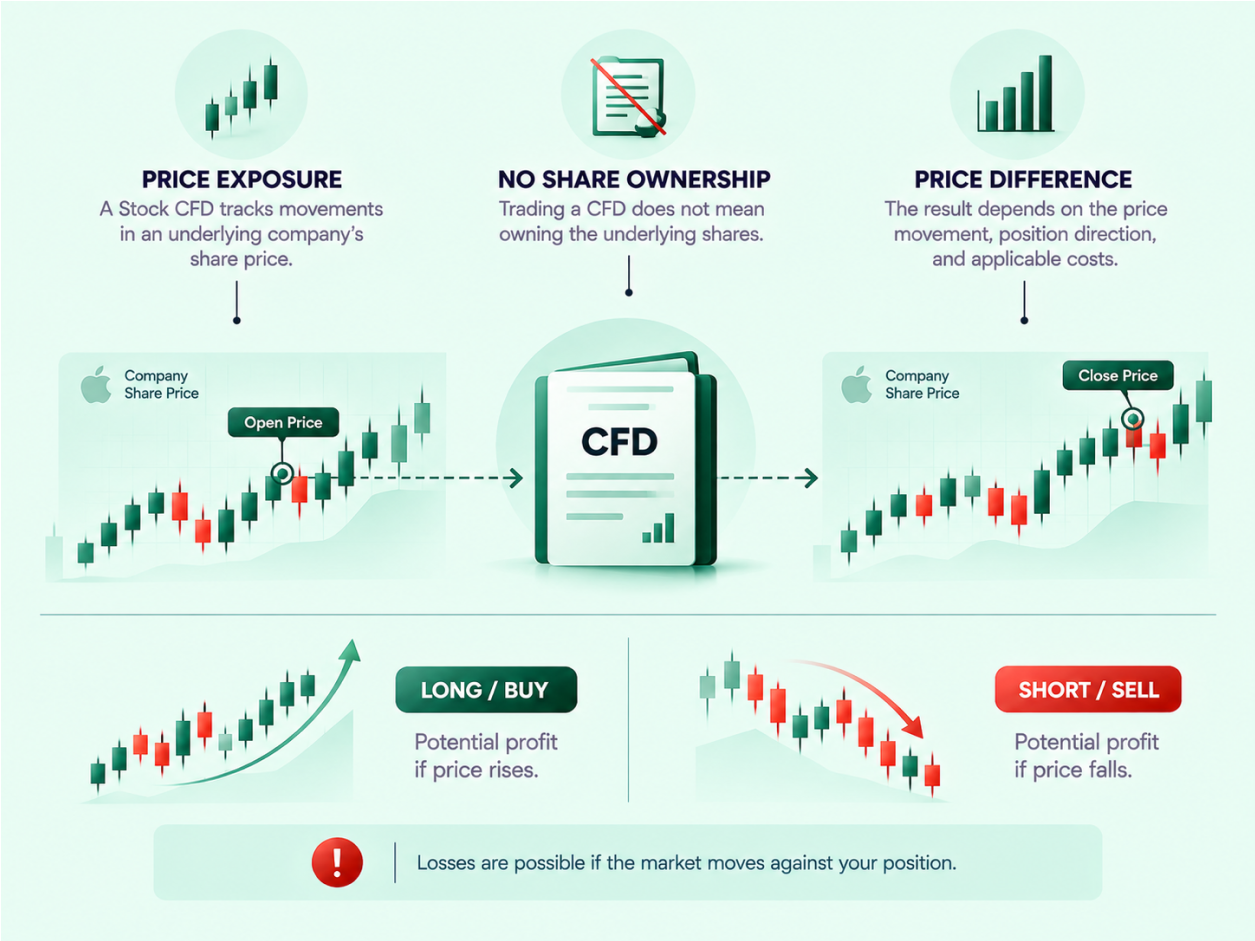
A Stock CFD, or Contract for Difference on a stock, is a financial derivative that allows traders to speculate on the price movements of individual company shares without actually owning the underlying stock. It is an agreement between a trader and a broker to exchange the difference in the price of a stock from the time the contract is opened until it is closed.
Understanding the Mechanics of Stock CFDs
At its core, a Stock CFD is a derivative product. This means its value is derived from the price of an underlying asset – in this case, a specific company’s share. Unlike traditional stock trading where you buy and sell actual shares, a Stock CFD involves entering into a contract with a CFD provider (broker). This contract stipulates that you and the broker will exchange the difference in the stock’s price from the moment you open the position to the moment you close it.
The “No Ownership” Principle:
The most fundamental distinction of a Stock CFD is that you do not own the actual shares. When you buy a traditional stock, you acquire a piece of ownership in that company, granting you certain rights, such as voting rights (for common stock) and potential dividends. With a Stock CFD, you are merely speculating on the price direction. This lack of ownership means you do not receive voting rights, nor do you typically receive dividends directly. Instead, dividend adjustments are usually made to your CFD position, either crediting your account for long positions or debiting for short positions, to reflect the economic impact of the dividend.
Standardized Contracts:
Stock CFDs are typically traded in standardized contracts, where one CFD contract usually represents one share of the underlying company. For instance, if you wish to mimic the exposure of buying 1,000 shares of a company like Microsoft, you would open a position to buy 1,000 Microsoft CFD contracts. This direct correlation simplifies the calculation of profit and loss, as each point movement in the underlying share price directly translates to a corresponding profit or loss per contract.
Pricing and Quotation:
The price of a Stock CFD directly mirrors the real-time buy and sell prices of the underlying stock on its primary exchange. If Apple stock is trading at $170.50 (bid) and $170.60 (ask) on the NASDAQ, your Apple CFD provider will typically quote very similar prices, often with a slight markup in the spread. The CFD trade will always be denominated in the same currency as the underlying asset. So, for a US-listed stock like Apple, the CFD price will be quoted in US dollars. If your trading account’s base currency is different from the CFD’s quoted currency, any profits or losses realized from the trade will be subject to a currency conversion.
A Brief History of CFDs
The concept of Contracts for Difference originated in the early 1990s in London, primarily as a tool for institutional investors and hedge funds. Initially, CFDs were developed to allow these sophisticated market participants to gain exposure to equity markets without incurring stamp duty tax, a tax levied on stock purchases in the UK. This tax efficiency, combined with the ability to easily go short and utilize leverage, made CFDs an attractive instrument for professional traders.
As technology advanced and online trading platforms became more prevalent in the late 1990s and early 2000s, CFDs began to transition from an institutional product to one accessible to retail traders. Brokers recognized the potential to offer these flexible instruments to a broader audience, allowing individual traders to speculate on a wide range of financial markets, including stocks, indices, commodities, and forex, with relative ease. This democratization of access to sophisticated trading tools significantly contributed to the global growth and popularity of CFDs.
How Stock CFDs Work: Going Long and Short
One of the significant advantages of Stock CFDs is the flexibility to profit from both rising and falling markets. This is achieved through “going long” or “going short.”
Going Long (Buying):
When you believe a company’s stock price will increase, you “go long” or “buy” Stock CFDs. If your prediction is correct and the price rises, you will profit from the difference between your opening and closing price.
- Example: Long Position
- Suppose you believe that Tech Innovations Inc. (TII), currently trading at $150 per share, is undervalued and its price will rise.
- You decide to “buy” 100 TII CFDs at $150.
- If TII’s share price rises to $155, you decide to close your position by “selling” 100 TII CFDs at $155.
- Your gross profit would be ($155 – $150) x 100 contracts = $500.
- From this, you would subtract any commissions, spreads, and overnight financing charges.
Going Short (Selling):
Conversely, if you anticipate a company’s stock price will fall, you can “go short” or “sell” Stock CFDs. This is significantly easier than traditional short selling, which typically involves borrowing shares from a broker and selling them, hoping to buy them back later at a lower price to return them. With CFDs, you simply open a “sell” position, just as easily as opening a “buy” position.
In contrast, traditional short selling involves a more complex multi-step process. To short a physical stock, a trader must first borrow shares from their broker (who, in turn, borrows them from another client or institution). These borrowed shares are then sold in the open market. The hope is that the stock price will fall, allowing the trader to buy back the same number of shares at a lower price. Finally, these repurchased shares are returned to the lender, and the difference between the initial selling price and the buy-back price (minus any fees) constitutes the profit or loss. This traditional method often incurs borrowing fees, can be subject to “buy-in” risks (where the lender demands their shares back unexpectedly), and may have limited availability of shares to borrow.
Despite these procedural differences, it is crucial to understand that the potential magnitude of loss when going short with CFDs is equivalent to that of traditional short selling. In both scenarios, losses are theoretically unlimited because a stock’s price can continue to rise indefinitely. The risk is driven by the market’s movement against your position, not by the specific mechanics of the instrument used. Therefore, robust risk management, including stop-loss orders, is equally vital for both CFD and traditional short selling.
- Example: Short Position
- Imagine you foresee a decline in the stock price of Global Manufacturing Co. (GMC), currently trading at $80 per share, due to a negative earnings outlook.
- You decide to “sell” 200 GMC CFDs at $80.
- If GMC’s share price falls to $75, you decide to close your position by “buying” 200 GMC CFDs at $75.
- Your gross profit would be ($80 – $75) x 200 contracts = $1,000.
- Again, commissions, spreads, and overnight financing would reduce this gross profit.
Key Advantages of Trading Stock CFDs
Stock CFDs offer several compelling advantages that attract traders, provided they are understood and managed appropriately.
1. Leverage:
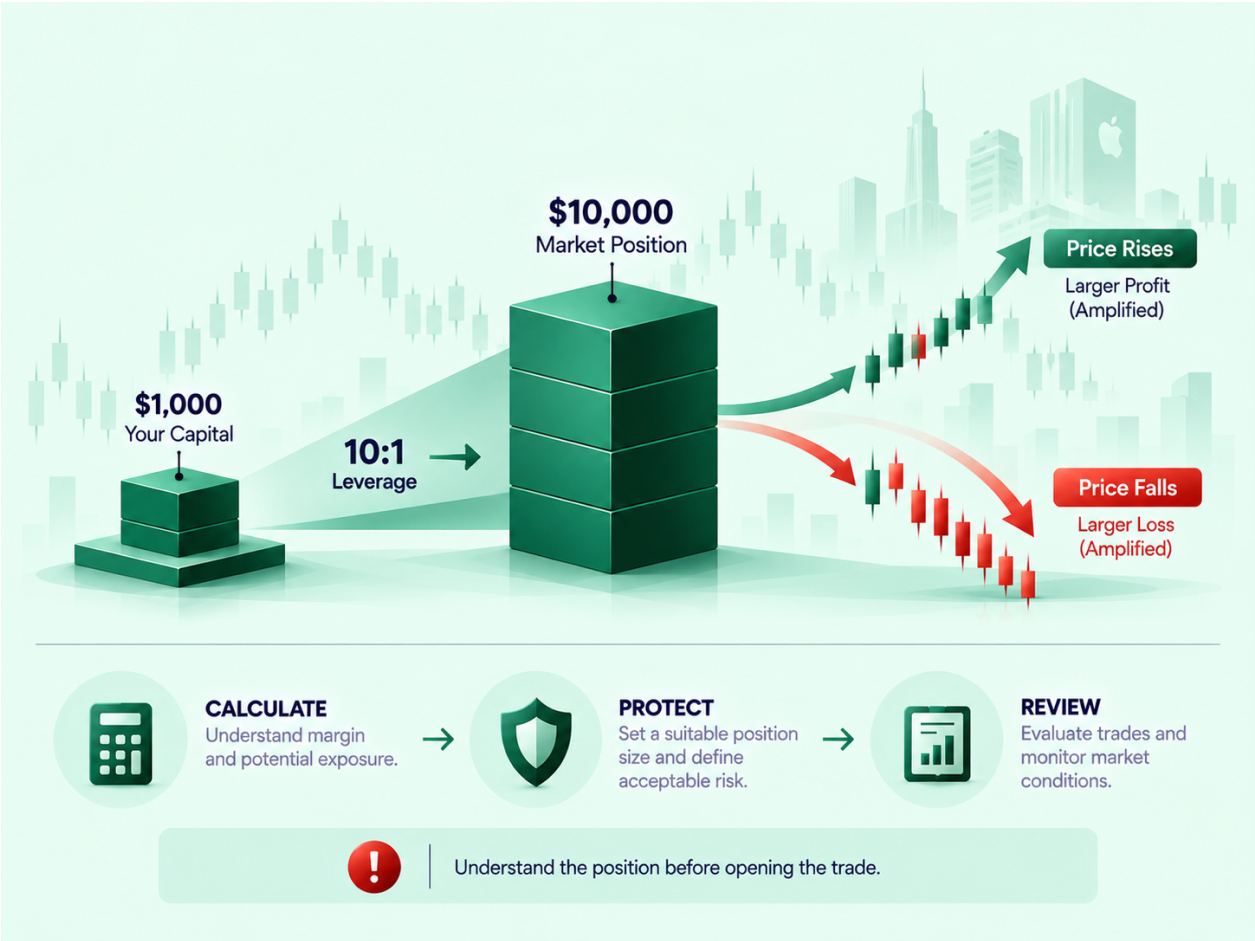
Leverage is a powerful feature of CFDs, allowing you to control a large position with a relatively small amount of capital. This initial capital is known as “margin.” For example, a leverage ratio of 1:20 means that for every $1 you put up as margin, you can control $20 worth of the underlying asset. If a stock costs $100 per share, and your broker offers 1:20 leverage (a 5% margin requirement), you would only need to deposit $5 (5% of $100) to open a CFD position equivalent to one share.
While leverage can amplify profits, it is crucial to understand that it also magnifies losses. A small adverse price movement can result in significant losses that may exceed your initial margin deposit.
2. Accessibility to Global Markets:
CFD brokers typically offer access to a vast array of global stock markets from a single trading account. LQH Markets does not currently offer Stock CFDs, but for those brokers that do, it can mean you may trade CFDs on shares listed on exchanges in the US, UK, Europe, Asia, and other regions, often outside of their local trading hours. This broad market access allows for diversification and the ability to capitalize on opportunities across different economies and sectors.
3. Ability to Go Short with Ease:
As discussed, the ability to easily open a “sell” position makes profiting from falling markets as straightforward as profiting from rising ones. This contrasts sharply with traditional short selling, which can be complex, involve borrowing fees, and may be subject to restrictions (like the “uptick rule” in some markets, though less common now).
4. Hedging Opportunities:
Stock CFDs can be an effective tool for hedging an existing physical stock portfolio. If you own a portfolio of physical shares and anticipate a short-term market downturn, you could open short CFD positions on those same shares or a relevant stock index. If the market falls, the profits from your short CFD positions could offset some of the losses in your physical portfolio, protecting your overall capital.
Practical Hedging Example:
Imagine you own 500 physical shares of “Innovate Tech Corp.” (ITC), which you bought at $100 per share, giving your portfolio a value of $50,000. You believe in ITC’s long-term potential but anticipate a short-term market correction or a negative news event that could temporarily drive down its price.
To protect your portfolio from this potential short-term dip, you decide to use Stock CFDs to hedge:
- Open a Short CFD Position: You open a “sell” position for 500 ITC CFDs at the current market price of $105 per share.
- Market Downturn: As anticipated, ITC’s share price falls to $95 per share over the next week.
- Physical Portfolio Loss: Your physical shares lose value: (500 shares * $105) – (500 shares * $95) = $5,250 – $4,750 = $500 loss.
- CFD Profit: Your short CFD position profits: ($105 – $95) * 500 contracts = $10 * 500 = $5,000 gross profit.
- Close CFD Position: You close your short CFD position by buying back 500 ITC CFDs at $95.
In this scenario, the $5,000 profit from your short CFD position would significantly offset the $5,000 loss in your physical share portfolio (before accounting for CFD trading costs like commissions and financing). This strategy allows you to maintain your long-term investment in ITC while mitigating short-term downside risk, effectively acting as a temporary insurance policy.
The Cost Structure of Stock CFDs
Understanding the costs associated with Stock CFD trading is essential for accurate profit and loss calculation and effective risk management.
1. Spread:
The spread is the difference between the buy (ask) and sell (bid) price of a CFD. It is a primary way brokers make money. When you open a long position, you buy at the ask price and sell at the bid price. When you open a short position, you sell at the bid price and buy back at the ask price. The wider the spread, the more the market needs to move in your favor before your position becomes profitable. For highly liquid stocks, spreads are typically very tight, often just a few cents.
2. Commission:
Many Stock CFD providers charge a commission fee when you open and close a trade. This commission is usually a small percentage of the total value of the trade or a fixed amount per share/contract, with a minimum charge. The commission structure is often designed to mimic the costs of trading in the underlying stock market.
The specific commission rates can vary significantly by broker and the region of the underlying stock. Typically, commissions are charged per side (when opening and closing a trade) and often include a minimum charge to ensure that very small trades still cover administrative costs.
Here’s a more detailed look at typical commission structures for Stock CFDs, drawing from common industry practices:
- US Stocks: Often charged as a fixed amount per share or contract, for example, $0.02 per share, with a minimum charge of $15 per side.
- UK Stocks: Typically a percentage of the total trade value, such as 0.10%, with a minimum charge of £10 (approximately $12.50 USD) per side.
- Australian Stocks: Similar to UK, a percentage of the trade value, for instance, 0.08%, with a minimum charge of $7 AUD (approximately $4.70 USD) per side.
- European Stocks: Also commonly a percentage of the trade value, e.g., 0.10%, with a minimum charge of €10 (approximately $10.80 USD) per side.
Commission Calculation Example:
Let’s consider a scenario where you want to buy 1,000 CFD contracts on “A plc” (an Australian stock) at a price of $20.17 per share. Your broker charges a 0.08% commission with a minimum of $7 AUD per side.
- Calculate the total value of the position: 1,000 contracts * $20.17/contract = $20,170.
- Calculate the percentage-based commission: $20,170 * 0.08% = $16.14.
- Apply the minimum charge: Since $16.14 is greater than the $7 AUD minimum, the commission for opening this side of the trade would be $16.14. A similar charge would apply when closing the position.
This example illustrates how both the percentage and minimum charges are considered, ensuring the broker covers their costs while providing competitive rates for larger trades.
- Example Commission Structure (Illustrative):
- For US stocks: $0.02 per share/contract, with a minimum charge of $15 per side (opening and closing).
- For European stocks: 0.10% of the trade value, with a minimum charge of $10 per side.
3. Overnight Financing (Holding Costs):
CFDs are leveraged products, and if you hold a position open overnight (i.e., past a certain cut-off time, typically 5 PM Eastern Time for US markets), you will incur an overnight financing charge or credit. This charge essentially reflects the cost of borrowing the funds used to maintain the leveraged position.
- Long Positions: For long positions, you typically pay an overnight financing charge, calculated based on the total value of your position and a benchmark interest rate (e.g., LIBOR or SOFR) plus a broker’s markup.
- Short Positions: For short positions, you might receive a small credit or pay a smaller charge, depending on the interest rate environment and the broker’s policy, as you are theoretically “borrowing” the asset to sell it.
These charges can accumulate, especially for positions held for extended periods, and can significantly impact profitability.
4. Currency Conversion Fees:
As mentioned, if your trading account’s base currency differs from the currency of the underlying stock (e.g., a USD-denominated stock CFD traded from an account based in Euros), any profits or losses will be converted, and a small currency conversion fee may be applied.
This fee arises when the CFD’s quoted currency (e.g., USD for a US stock) is different from the base currency of your trading account (e.g., EUR or AUD). When you close a profitable position, the profit is initially realized in the CFD’s quoted currency. To settle this profit into your account’s base currency, a conversion takes place, and the broker applies a conversion fee. This fee is typically a small percentage of the converted amount, often ranging from 0.3% to 0.7% of the total profit or loss being converted. Many brokers apply this conversion automatically, so traders should be aware of its impact on their net returns, especially when frequently trading international stocks.
Illustrative Trading Examples
Let’s walk through two detailed examples to solidify the understanding of profit, loss, and costs.
Example 1: Long Position Scenario (Profit)
- Asset: Tesla (TSLA) Stock CFD
- Current Price: Bid $250.00 / Ask $250.10
- Your Action: You believe TSLA will rise. You buy 100 TSLA CFDs at $250.10.
- Margin Requirement: Let’s assume 10% (1:10 leverage).
- Total position value: 100 contracts * $250.10 = $25,010
- Initial margin required: 10% of $25,010 = $2,501
- Commission: $0.02 per share, minimum $15.
- Opening commission: 100 shares * $0.02 = $2.00. Since this is less than the $15 minimum, you pay $15.
- Overnight Financing: Assume you hold for 3 nights. Daily financing rate for long positions is 0.01% of the total position value.
- Daily financing: $25,010 * 0.01% = $2.50
- Total financing (3 nights): $2.50 * 3 = $7.50
Scenario: TSLA price rises.
- New Price: Bid $260.00 / Ask $260.10
- Your Action: You decide to close your position by selling 100 TSLA CFDs at $260.00.
- Closing Commission: 100 shares * $0.02 = $2.00. Again, you pay the $15 minimum.
Calculation:
- Gross Profit: (Closing Price – Opening Price) * Number of Contracts
- ($260.00 – $250.10) * 100 = $9.90 * 100 = $990.00
- Total Commissions: Opening Commission + Closing Commission
- $15 + $15 = $30.00
- Total Overnight Financing: $7.50
- Net Profit: Gross Profit – Total Commissions – Total Overnight Financing
- $990.00 – $30.00 – $7.50 = $952.50
Example 2: Short Position Scenario (Loss)
- Asset: Global Tech Solutions (GTS) Stock CFD
- Current Price: Bid $75.00 / Ask $75.10
- Your Action: You believe GTS will fall. You sell 200 GTS CFDs at $75.00.
- Margin Requirement: Let’s assume 5% (1:20 leverage).
- Total position value: 200 contracts * $75.00 = $15,000
- Initial margin required: 5% of $15,000 = $750
- Commission: $0.02 per share, minimum $15.
- Opening commission: 200 shares * $0.02 = $4.00. You pay $15.
- Overnight Financing: Assume you hold for 2 nights. Daily financing rate for short positions is 0.005% of the total position value (a small credit or debit depending on rates). Let’s assume a small debit for simplicity.
- Daily financing: $15,000 * 0.005% = $0.75
- Total financing (2 nights): $0.75 * 2 = $1.50
Scenario: GTS price rises unexpectedly.
- New Price: Bid $78.00 / Ask $78.10
- Your Action: To limit losses, you decide to close your position by buying 200 GTS CFDs at $78.10.
- Closing Commission: 200 shares * $0.02 = $4.00. You pay $15.
Calculation:
- Gross Loss: (Opening Price – Closing Price) * Number of Contracts
- ($75.00 – $78.10) * 200 = -$3.10 * 200 = -$620.00
- Total Commissions: Opening Commission + Closing Commission
- $15 + $15 = $30.00
- Total Overnight Financing: $1.50
- Net Loss: Gross Loss – Total Commissions – Total Overnight Financing
- -$620.00 – $30.00 – $1.50 = -$651.50
Risks Associated with Stock CFDs
While Stock CFDs offer significant opportunities, they also carry substantial risks that traders must fully understand and manage.
1. Leverage Risk:
As highlighted, leverage can amplify profits, but it also magnifies losses. A small adverse price movement can lead to losses that exceed your initial deposit, potentially requiring you to deposit additional funds (a margin call) to maintain your position. If you fail to meet a margin call, your broker may automatically close your positions, often at a loss.
2. Market Risk:
CFD prices are directly tied to the underlying market. Volatility, sudden market shifts, economic news, or company-specific announcements can cause rapid and unpredictable price movements, leading to quick losses.
3. Liquidity Risk:
While major stocks are highly liquid, some smaller or less frequently traded stocks may have lower liquidity. This can result in wider spreads and difficulty in opening or closing positions at your desired price, especially during volatile periods.
4. Overnight Financing Costs:
Holding positions for extended periods can accumulate significant overnight financing charges, which can erode potential profits or deepen losses, especially if the market moves sideways or against your position.
5. Counterparty Risk:
When trading CFDs, you are entering into a contract with your broker. This introduces counterparty risk, meaning there is a theoretical risk that your broker might default on its obligations. Reputable, regulated brokers mitigate this risk significantly through robust financial practices and regulatory oversight.
Managing Risk in Stock CFD Trading
Effective risk management is paramount when trading Stock CFDs. Here are some key strategies:
1. Stop-Loss Orders:
A stop-loss order is an instruction to your broker to automatically close your position if the market price moves against you to a predetermined level. This helps to limit potential losses on a trade. While not guaranteed in all market conditions (e.g., during extreme volatility or gapping prices), they are a fundamental risk management tool.
2. Take-Profit Orders:
A take-profit order is an instruction to automatically close your position once the market reaches a specified profit level. This helps to lock in gains and prevents potential profits from eroding if the market reverses.
3. Position Sizing:
Never risk more capital than you can afford to lose. Carefully determine the size of your trade based on your risk tolerance and the amount of capital in your trading account. A common guideline is to risk only a small percentage (e.g., 1-2%) of your total trading capital on any single trade.
4. Diversification:
Avoid concentrating all your capital into a single stock or sector. Diversifying your CFD portfolio across different stocks, industries, or even asset classes can help spread risk.
5. Continuous Education:
The financial markets are dynamic. Continuously educate yourself on market dynamics, economic indicators, company fundamentals, and CFD trading strategies to make informed decisions.
Conclusion
Stock CFDs offer a flexible and accessible way to participate in equity markets, providing the ability to go long or short, utilize leverage, and access a wide range of global stocks. However, the power of leverage comes with amplified risk, and understanding the full cost structure—including spreads, commissions, and overnight financing—is crucial. For those who approach them with a solid understanding of their mechanics, a disciplined risk management strategy, and continuous learning, Stock CFDs can be a powerful instrument in a diversified trading toolkit. Always remember that CFDs are complex instruments and come with a high risk of losing money rapidly due to leverage.
Frequently Asked Questions
How do Stock CFDs differ from traditional stock trading in terms of ownership?
With traditional stock trading, you purchase and own actual shares of a company, which may grant you voting rights and dividend entitlements. In contrast, Stock CFDs are derivative contracts where you speculate on the price movement of a stock without ever owning the underlying shares or receiving shareholder rights.
Can I receive dividends when trading Stock CFDs?
While you do not directly receive dividends as a shareholder, CFD brokers typically make adjustments to your account to reflect the economic impact of dividends. For long positions, your account is usually credited with a dividend equivalent, while for short positions, your account is debited.
What is the primary risk associated with Stock CFD trading?
The primary risk is amplified losses due to leverage. While leverage allows you to control a large position with a small amount of capital, it also means that adverse price movements can lead to losses that exceed your initial margin deposit, potentially resulting in margin calls or forced liquidation of your positions.
Are Stock CFDs suitable for long-term investing?
Stock CFDs are generally more suited for short-to-medium-term speculation due to the compounding effect of overnight financing charges. These daily holding costs can significantly erode potential profits or deepen losses over extended periods, making them less ideal for long-term buy-and-hold investment strategies compared to owning physical shares.
How are Stock CFD prices determined?
Stock CFD prices are directly derived from and closely mirror the real-time bid and ask prices of the underlying physical stock on its primary exchange. Brokers typically add a small spread to these prices to cover their costs and generate revenue.
Knowledge Check
1. Which of the following is a key characteristic of trading Stock CFDs?
- A) Traders gain voting rights in the underlying company.
- B) Traders physically own the underlying shares.
- C) Traders speculate on price movements without owning the shares.
- D) Traders are exempt from all trading fees and commissions.
2. What is “leverage” in the context of Stock CFD trading?
- A) A guarantee of profit on every trade.
- B) The ability to control a large position with a relatively small amount of capital.
- C) A fixed daily interest payment received by the trader.
- D) A mechanism that eliminates all trading risks.
3. If you anticipate a company’s stock price will fall, what action would you typically take with Stock CFDs?
- A) Go long (buy) the Stock CFDs.
- B) Go short (sell) the Stock CFDs.
- C) Hold the Stock CFDs indefinitely.
- D) Convert the Stock CFDs into physical shares.
Click to view the answers
1. **C)** – Traders speculate on price movements without owning the shares, which is a fundamental aspect of Stock CFDs.
2. **B)** – Leverage allows traders to control a larger market position with a smaller initial capital outlay, known as margin.
3. **B)** – To profit from a falling market, a trader would typically open a “sell” or “short” position on the Stock CFDs.