



The financial landscape is constantly evolving, with digital assets like cryptocurrencies carving out a significant niche. For many investors and traders, the allure of cryptocurrencies lies in their innovative technology, decentralized nature, and often dramatic price movements. However, directly owning and managing cryptocurrencies can involve complexities such as setting up digital wallets, understanding blockchain mechanics, and navigating security concerns. This is where Crypto Contracts for Difference (CFDs) offer an alternative pathway, allowing participants to engage with the crypto market without direct ownership of the underlying digital assets.
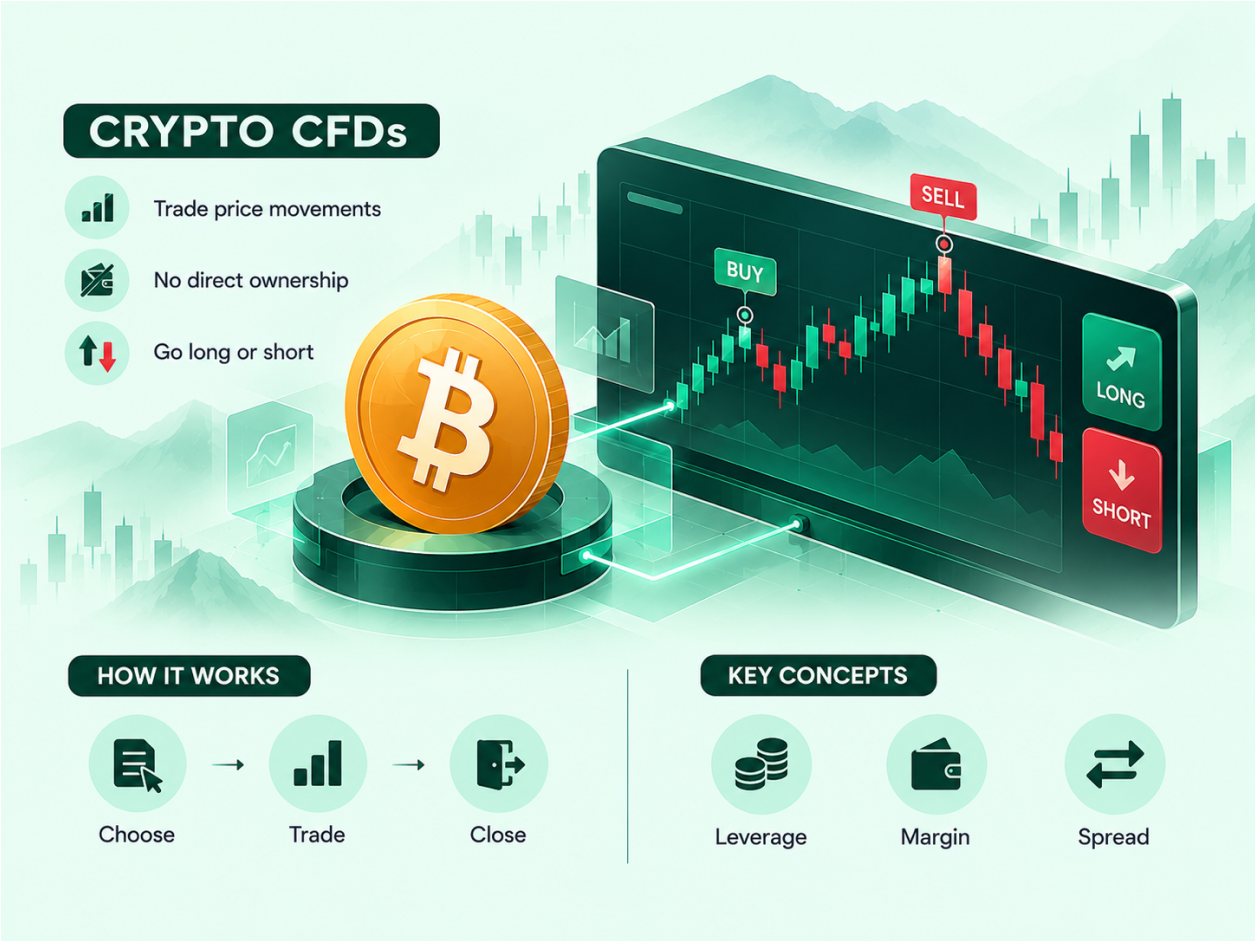
Crypto Contracts for Difference (CFDs) are financial derivatives that enable traders to speculate on the price movements of cryptocurrencies without owning the actual digital asset. Instead, traders enter into an agreement with a broker to exchange the difference in the value of a cryptocurrency from the point a position is opened to when it is closed.
This comprehensive guide will delve into the intricacies of Crypto CFDs, exploring their mechanics, the factors that influence their markets, and the benefits and risks associated with this dynamic trading instrument. Whether you are new to the world of derivatives or looking to expand your understanding of cryptocurrency exposure, this masterclass aims to provide a robust foundation.
Understanding Cryptocurrencies
Before diving into Crypto CFDs, it’s essential to grasp the fundamental nature of cryptocurrencies themselves. Cryptocurrencies are digital or virtual currencies secured by cryptography, making them nearly impossible to counterfeit or double-spend. A defining characteristic of cryptocurrencies is their decentralized nature; they are typically not issued by a central authority, rendering them theoretically immune to government interference or manipulation.
The backbone of most cryptocurrencies is blockchain technology, a distributed ledger system. Imagine a digital ledger where every transaction is recorded in “blocks,” and these blocks are linked together in a chronological “chain.” Once a transaction is recorded on the blockchain, it is immutable and transparent, visible to all participants on the network. This innovative technology facilitates secure, peer-to-peer transactions without the need for intermediaries like banks.
Bitcoin, launched in 2009, was the first mainstream cryptocurrency, envisioned as a “peer-to-peer electronic cash system.” Its success paved the way for thousands of other digital assets, often referred to as “altcoins” (alternative coins). Ethereum, for instance, introduced smart contract functionality, allowing developers to build decentralized applications (dApps) on its blockchain. Other cryptocurrencies offer unique features, ranging from enhanced scalability and privacy to specialized utility within specific ecosystems. While their functionalities vary, the core principles of decentralization, cryptography, and blockchain technology remain central to their operation.
What Are Contracts for Difference (CFDs)?
Contracts for Difference (CFDs) are a popular form of derivative trading that originated in the United Kingdom in the early 1990s. Initially developed to allow institutional investors to gain exposure to equity markets without paying stamp duty tax, CFDs quickly gained traction among retail traders due to their flexibility and accessibility.
At its core, a CFD is an agreement between a trader and a broker to exchange the difference in the price of an underlying asset from the time the contract is opened until it is closed. When you trade a CFD, you are not buying or selling the actual asset – whether it’s a stock, commodity, currency pair, or cryptocurrency. Instead, you are speculating on its price movement. If you believe the price of an asset will rise, you “buy” (go long) a CFD. If you believe it will fall, you “sell” (go short) a CFD. Your profit or loss is determined by the accuracy of your prediction and the magnitude of the price change, multiplied by the size of your position.
CFDs offer several distinct advantages, including the ability to trade on margin (using leverage), the flexibility to profit from both rising and falling markets, and access to a wide range of global financial instruments from a single trading account. However, these benefits come with inherent risks, particularly the amplified potential for losses due to leverage.
The Synergy: Crypto CFDs Explained
Crypto CFDs represent a powerful convergence of these two financial innovations: the speculative nature of CFDs applied to the volatile world of cryptocurrencies. By trading Crypto CFDs, you gain exposure to the price fluctuations of digital assets like Bitcoin or Ethereum without ever having to own the actual coins. This means you avoid the complexities of setting up and securing a digital wallet, managing private keys, or dealing with the technical aspects of blockchain transactions.
The appeal of Crypto CFDs stems from several key features:
- Leverage: Traders can open larger positions with a relatively small amount of capital, amplifying potential returns (and losses).
- Short Selling: The ability to “sell” a cryptocurrency CFD allows traders to potentially profit from declining market prices, offering flexibility in various market conditions.
- Diversification: Crypto CFDs can be traded alongside other asset classes like forex, commodities, and indices within a single trading platform, enabling broader portfolio diversification.
- Accessibility: They often provide 24/7 access to the cryptocurrency markets, reflecting the always-on nature of digital assets.
This instrument allows traders to focus purely on price action, making it an attractive option for those who want to capitalize on cryptocurrency volatility without the operational overhead of direct asset ownership.
Deep Dive into Crypto CFD Mechanics
Understanding the operational mechanics of Crypto CFDs is crucial for effective trading. These derivatives involve several key concepts that directly impact potential profits and losses.
Leverage and Margin
One of the most significant features of CFD trading is leverage. Leverage allows you to control a larger position in the market with a smaller initial capital outlay, known as the “margin.” It’s often expressed as a ratio, such as 1:5 or 1:20. For example, with 1:5 leverage, a $1,000 deposit could allow you to control a position worth $5,000.
- Deposit Margin (Initial Margin): This is the percentage of the total trade value that you must deposit from your own capital to open a leveraged position. If a Bitcoin CFD has a 20% margin requirement, to open a position equivalent to $10,000 worth of Bitcoin, you would need to deposit $2,000 ($10,000 * 20%).
- Maintenance Margin: Once a position is open, you need to maintain a certain amount of capital in your account to cover potential losses. If your account equity falls below this maintenance margin level, you may receive a “margin call,” requiring you to deposit additional funds or close positions to bring your account back above the required level. Failure to meet a margin call can lead to the broker automatically closing your positions to prevent further losses, a process known as liquidation.
While leverage can significantly amplify potential profits, it equally magnifies potential losses. A small adverse price movement can result in substantial losses, potentially exceeding your initial deposit.
Practical Example: Calculating Margin and P/L
To illustrate how leverage and margin work in practice, let’s consider a hypothetical Crypto CFD trade:
Scenario:
- You want to trade Bitcoin (BTC) CFDs.
- Current BTC price: $60,000.
- Your broker offers 1:5 leverage (meaning a 20% margin requirement).
- You decide to open a position equivalent to 0.5 BTC.
Step 1: Calculate Total Position Value
The total value of your desired position is 0.5 BTC * $60,000/BTC = $30,000.
Step 2: Calculate Initial Margin Required
With a 20% margin requirement, you need to deposit 20% of the total position value:
Initial Margin = 20% * $30,000 = $6,000.
This means with just $6,000 of your own capital, you control a $30,000 position.
Step 3: Calculate Profit or Loss (P/L) with Price Movement
-
Scenario A: Price Increases (Profit)
Suppose BTC’s price rises to $61,000. You decide to close your long position.
Profit = (Closing Price – Opening Price) * Position Size
Profit = ($61,000 – $60,000) * 0.5 BTC = $1,000 * 0.5 = $500.
Your initial $6,000 margin yielded a $500 profit, representing an 8.33% return on your margin ($500/$6,000), even though the underlying asset only moved by 1.67% ($1,000/$60,000). This demonstrates the amplification of leverage. -
Scenario B: Price Decreases (Loss)
Suppose BTC’s price falls to $59,000. You decide to close your long position to limit losses.
Loss = (Opening Price – Closing Price) * Position Size
Loss = ($60,000 – $59,000) * 0.5 BTC = $1,000 * 0.5 = $500.
Your initial $6,000 margin resulted in a $500 loss, which is also an 8.33% loss on your margin. This highlights how leverage equally amplifies losses.
This example clearly shows how a relatively small price movement in the underlying asset can lead to a magnified profit or loss on your initial margin due to the effect of leverage.
Going Long vs. Going Short
The flexibility to trade in both rising and falling markets is a core advantage of CFDs.
-
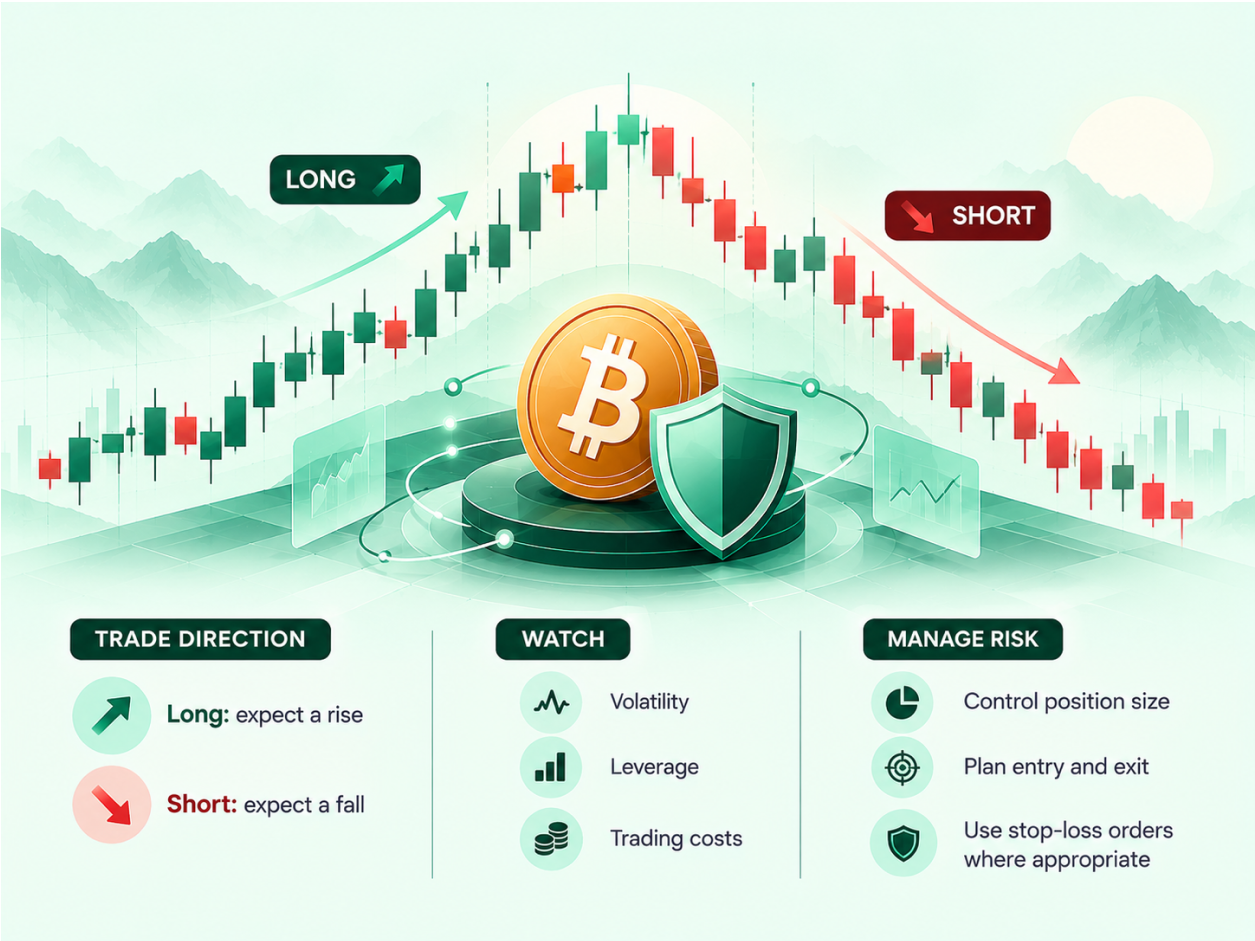
Going Long (Buy): When you “go long” on a Crypto CFD, you are speculating that the price of the underlying cryptocurrency will increase. You open a position by “buying” the CFD, anticipating that you can “sell” it later at a higher price to realize a profit.
- Example: Suppose Ethereum (ETH) is trading at $3,500. You believe ETH will rise, so you open a long CFD position for 1 ETH. If ETH’s price climbs to $3,700, you close your position. Your profit would be $200 ($3,700 – $3,500), minus any trading costs. Conversely, if ETH falls to $3,300, you would incur a $200 loss.
-
Going Short (Sell): When you “go short” on a Crypto CFD, you are speculating that the price of the underlying cryptocurrency will decrease. You open a position by “selling” the CFD, anticipating that you can “buy” it back later at a lower price to realize a profit.
- Example: Imagine Solana (SOL) is priced at $150. You foresee a market downturn for SOL, so you open a short CFD position for 10 SOL. If SOL’s price drops to $140, you close your position. Your profit would be $100 (10 SOL * ($150 – $140)), minus trading costs. However, if SOL unexpectedly rises to $160, you would face a $100 loss.
Spreads
The “spread” is the difference between the buy (ask) price and the sell (bid) price of a cryptocurrency CFD. It represents the primary cost of opening a trade. When you open a long position, you buy at the ask price, and when you close it, you sell at the bid price. The opposite applies to short positions. A tighter spread generally indicates better liquidity and lower trading costs. For instance, if Bitcoin’s bid price is $60,000 and its ask price is $60,005, the spread is $5. This $5 is effectively the cost you pay to enter and exit the trade.
Lot Sizes
A “lot” refers to the standardized unit size of a trading position. For cryptocurrencies, lot sizes can vary significantly between brokers and specific assets. Some brokers might offer a standard lot as one full Bitcoin, while others might allow trading in smaller units like 0.01 or 0.001 of a Bitcoin. Understanding the lot size is crucial for calculating your position exposure, potential profit/loss, and margin requirements. For example, if a standard lot for Bitcoin is 1 BTC and you trade 0.1 lots, your exposure is to 0.1 BTC.
Pips
A “pip” (percentage in point) is the smallest unit of price movement in a financial instrument. For most traditional forex pairs, a pip is 0.0001. However, in the highly volatile cryptocurrency market, pips are often less standardized and can refer to a specific dollar increment (e.g., $1 for Bitcoin) or a percentage change, depending on the broker’s pricing model. It’s essential to clarify how pips are defined for the specific crypto CFD you are trading to accurately calculate potential gains or losses.
Order Types
Effective risk management and trade execution in Crypto CFDs often involve utilizing various order types:
- Market Order: An order to buy or sell immediately at the best available current market price.
- Limit Order: An order to buy or sell at a specific price or better. For example, a buy limit order is placed below the current market price, while a sell limit order is placed above.
- Stop-Loss Order: An order to automatically close a position when the price reaches a predefined level, helping to limit potential losses.
- Take-Profit Order: An order to automatically close a position when the price reaches a predefined profit target, helping to secure gains.
What Drives Crypto CFD Markets?
Cryptocurrency markets are renowned for their volatility, and understanding the factors that influence their prices is key to navigating Crypto CFD trading.
- Supply and Demand Dynamics: Like any asset, cryptocurrency prices are fundamentally driven by supply and demand. Limited supply, such as Bitcoin’s fixed cap of 21 million coins, can create scarcity. Increased demand, fueled by adoption or speculation, can push prices higher. Conversely, an oversupply or waning interest can lead to price declines.
- Regulatory Landscape: Government policies and regulations play a significant role. Positive regulatory clarity, such as the approval of spot Bitcoin ETFs, can boost market sentiment and institutional investment. Conversely, news of stricter regulations, bans, or increased taxation can trigger widespread sell-offs and uncertainty.
- Technological Developments: Advancements within blockchain ecosystems, such as major network upgrades (e.g., Ethereum’s transition to Proof-of-Stake), new protocol launches, or improvements in scalability and security, can significantly influence a cryptocurrency’s valuation and market sentiment.
- Market Sentiment and News: The cryptocurrency market is heavily influenced by news, social media trends, and public perception. Major announcements, celebrity endorsements, institutional adoption news, or even widespread FUD (Fear, Uncertainty, Doubt) can lead to rapid price swings.
- Macroeconomic Factors: Broader economic conditions, such as inflation rates, interest rate decisions by central banks, and global economic stability, can impact investor appetite for risk assets like cryptocurrencies. During periods of high inflation, some view Bitcoin as a hedge, while rising interest rates might make traditional investments more attractive, diverting capital from crypto.
- Security Issues and Hacks: The nascent nature of the crypto industry means it is susceptible to security breaches, hacks on exchanges, or vulnerabilities in smart contracts. Such incidents can severely erode investor confidence and lead to sharp price drops for affected cryptocurrencies or the market as a whole.
- Expanded Adoption and Utility: The increasing real-world use cases of cryptocurrencies and blockchain technology, whether for payments, decentralized finance (DeFi), NFTs, or enterprise solutions, can drive fundamental value and long-term demand.
Popular Cryptocurrencies for CFD Trading
While thousands of cryptocurrencies exist, a select few dominate the market capitalization and trading volume, making them popular choices for CFD traders due to their liquidity and established presence.
- Bitcoin (BTC): As the original and largest cryptocurrency by market cap, Bitcoin is often seen as “digital gold.” Its price movements frequently set the tone for the broader crypto market, and it remains a cornerstone for many CFD traders.
- Ethereum (ETH): The second-largest cryptocurrency, Ethereum is renowned for its smart contract capabilities, which power a vast ecosystem of decentralized applications (dApps), DeFi protocols, and NFTs. Its technological advancements and widespread utility make it a highly liquid and actively traded asset.
- Solana (SOL): Known for its high transaction speeds and low fees, Solana has emerged as a strong competitor in the blockchain space, attracting developers and users to its ecosystem.
- Cardano (ADA): Emphasizing research-driven development and peer-reviewed academic rigor, Cardano focuses on sustainability, scalability, and interoperability for decentralized applications.
- XRP (XRP): Developed by Ripple, XRP aims to facilitate fast and low-cost cross-border payments for financial institutions.
- Litecoin (LTC): Often referred to as “digital silver,” Litecoin was created as a faster and lighter alternative to Bitcoin, with quicker transaction confirmation times.
- Dogecoin (DOGE): Initially a meme coin, Dogecoin gained significant popularity and a strong community, demonstrating the power of social sentiment in crypto markets.
These cryptocurrencies offer diverse characteristics and market dynamics, providing various opportunities for CFD traders to speculate on their price movements.
Trading Crypto Indices
Beyond individual cryptocurrency CFDs, some brokers also offer the ability to trade Crypto Indices as CFDs. A crypto index is a financial instrument designed to track the performance of a basket of cryptocurrencies, similar to how stock market indices (like the S&P 500) track a group of stocks. These indices are typically weighted by market capitalization, meaning larger cryptocurrencies have a greater impact on the index’s value.
Trading crypto indices CFDs offers several distinct advantages:
- Broader Market Exposure: Instead of speculating on a single cryptocurrency, an index CFD allows you to gain exposure to the overall performance of a segment of the crypto market (e.g., major cryptocurrencies, emerging altcoins, or the entire market).
- Diversification: By trading an index, you inherently diversify your exposure across multiple assets. This can help mitigate the risk associated with the volatile price movements of any single cryptocurrency. If one coin in the index performs poorly, its impact might be offset by others performing well.
- Simplified Trading: Rather than managing multiple individual CFD positions, you can take a single position on an index, simplifying your trading strategy and portfolio management.
Common types of crypto indices include “All Crypto Indices” (tracking a broad range of available cryptocurrencies), “Major Crypto Indices” (focusing on the largest and most liquid assets like Bitcoin and Ethereum), and “Emerging Crypto Indices” (comprising smaller-cap or newer cryptocurrencies). These instruments provide a convenient way to participate in the broader crypto market trends.
Advanced Trading Considerations and Tools
As traders become more experienced with Crypto CFDs, they often explore advanced strategies and leverage sophisticated tools to enhance their trading.
Hedging Spot Holdings with CFDs
One powerful application of Crypto CFDs, particularly for those who directly own cryptocurrencies (spot holdings), is hedging. Hedging involves opening a CFD position to offset potential losses in an existing investment. Given the high volatility of the crypto market, a trader holding actual Bitcoin or Ethereum might be concerned about a short-term price downturn.
In such a scenario, they could open a short (sell) Crypto CFD position for the equivalent amount of their spot holdings. If the market price of the cryptocurrency falls, the loss in value of their spot holdings would be offset by the profit generated from their short CFD position. This strategy effectively “insures” their portfolio against temporary declines without requiring them to sell their actual assets. Once the perceived downturn passes, the trader can close their short CFD position, locking in the hedge’s profit (or loss, if the market unexpectedly rises) and maintaining their long-term spot holdings. This provides flexibility and risk management, allowing traders to protect their capital during uncertain market conditions.
Common Trading Platforms and Tools
Successful Crypto CFD trading relies heavily on robust and feature-rich trading platforms. While brokers often provide their proprietary platforms, several industry-standard platforms are widely used:
- MetaTrader 4 (MT4) and MetaTrader 5 (MT5): These are arguably the most popular platforms for CFD and forex trading. They offer extensive charting capabilities, a wide array of technical indicators, and support for automated trading through Expert Advisors (EAs). MT5 builds upon MT4 with additional features like more timeframes, analytical tools, and asset classes.
- TradingView: While not a direct trading platform for all brokers, TradingView is an extremely popular charting and social trading platform. Many brokers integrate with TradingView, allowing traders to execute orders directly from its advanced charts, which boast a vast community, custom indicators, and powerful analytical tools.
- cTrader: Known for its advanced order types, fast execution, and modern interface, cTrader is favored by many algorithmic traders and those seeking a more sophisticated trading environment. It offers deep liquidity access and transparent pricing.
These platforms typically come equipped with essential tools such as real-time price feeds, customizable charts, various technical analysis indicators (e.g., moving averages, RSI, MACD), and risk management features like stop-loss and take-profit orders. Many also offer mobile trading apps, allowing traders to monitor and manage their positions on the go.
Benefits of Trading Crypto CFDs
Trading Crypto CFDs offers several compelling advantages for market participants:
- Leveraged Exposure: CFDs allow you to gain significant exposure to cryptocurrency price movements with a relatively small capital outlay. This means potential profits can be amplified, offering a capital-efficient way to participate in the market.
- Ability to Profit from Falling Prices (Short Selling): Unlike direct ownership, which typically profits only when prices rise, Crypto CFDs enable you to “go short.” This means you can speculate on and potentially profit from bearish market conditions, providing flexibility regardless of market direction.
- 24/7 Trading Opportunities: The decentralized nature of cryptocurrencies means their markets operate continuously, often 24 hours a day, 7 days a week. Crypto CFDs allow traders to capitalize on these round-the-clock price movements, adjusting positions and reacting to news at any time.
- No Direct Asset Ownership: Trading CFDs means you don’t own the underlying cryptocurrency. This eliminates the need for managing digital wallets, understanding complex blockchain addresses, or worrying about the security risks associated with storing digital assets yourself.
- Portfolio Diversification: Crypto CFDs can be integrated into a broader trading portfolio alongside other asset classes like forex, stocks, and commodities. This allows for diversification strategies, potentially hedging against traditional asset movements or capturing opportunities in different market segments.
- Enhanced Liquidity: Major cryptocurrency CFDs often benefit from high liquidity, allowing for quick entry and exit from positions with minimal price impact, especially during periods of high market activity.
Risks of Trading Crypto CFDs
Despite the attractive benefits, trading Crypto CFDs carries significant risks that every trader must understand and manage carefully.
- High Market Volatility: Cryptocurrencies are notoriously volatile, experiencing rapid and often unpredictable price swings. This extreme volatility can lead to substantial and sudden losses, especially when combined with leverage. What might be a minor fluctuation in a traditional market can be a dramatic price shift in crypto.
- Leverage Risk: While leverage amplifies potential profits, it equally magnifies potential losses. A small adverse movement in the market can quickly deplete your trading capital, potentially leading to substantial losses up to your account balance. Margin calls and forced liquidations are common occurrences in highly leveraged positions during volatile periods.
- Regulatory Uncertainties: The regulatory landscape for cryptocurrencies and Crypto CFDs is still evolving globally. Sudden changes in government policies, new regulations, or outright bans in certain jurisdictions can significantly impact market sentiment, liquidity, and prices. This uncertainty adds an additional layer of risk.
- Market Gaps and Slippage: During periods of extreme volatility or low liquidity, prices can “gap,” meaning they jump from one level to another without trading at intervening prices. This can lead to “slippage,” where stop-loss orders are executed at a price less favorable than intended, resulting in larger-than-expected losses.
- Overnight Funding Costs: Holding CFD positions overnight typically incurs a financing charge (or credit, depending on the position and interest rates). These costs can accumulate, especially for long-term positions, impacting overall profitability.
- Impact of Forks or Discontinuation: Cryptocurrencies can undergo “hard forks,” which are significant changes to their underlying blockchain protocol, potentially creating new versions of a coin. While some forks can be beneficial, they can also cause price volatility or, in rare cases, lead to the discontinuation of a cryptocurrency, severely impacting CFD values.
- Counterparty Risk: When trading CFDs, you are entering into a contract with your broker. This introduces counterparty risk, meaning you are reliant on the broker’s solvency and ability to honor their obligations. Choosing a reputable and regulated broker is essential to mitigate this risk.
Effective Risk Management Strategies
Given the inherent risks, particularly the high volatility and leverage associated with Crypto CFDs, robust risk management is paramount.
- Utilize Stop-Loss Orders: Always implement stop-loss orders to automatically close a position if the market moves against your prediction, limiting potential losses to a predefined acceptable level. While not guaranteed against slippage, they are a critical tool.
- Set Take-Profit Orders: Just as important as limiting losses is securing profits. Take-profit orders automatically close a position once a target profit level is reached, preventing potential reversals from eroding your gains.
- Manage Leverage Prudently: Avoid using excessive leverage, especially as a beginner. Start with lower leverage ratios to gain experience and understand market dynamics. Remember that higher leverage means higher risk.
- Appropriate Position Sizing: Never risk more capital than you can afford to lose on a single trade. Calculate your position size based on your overall account balance, risk tolerance, and the volatility of the asset being traded. A common rule is to risk only a small percentage (e.g., 1-2%) of your total capital per trade.
- Diversify Your Portfolio: While Crypto CFDs offer diversification within the crypto market, consider diversifying your overall investment portfolio across different asset classes. This can help mitigate the impact of adverse movements in any single market.
- Continuous Education and Market Analysis: Stay informed about market news, regulatory developments, and technological advancements in the crypto space. Combine technical analysis (chart patterns, indicators) with fundamental analysis (project utility, team, adoption) to make informed trading decisions.
- Start with a Demo Account: Before committing real capital, practice trading Crypto CFDs on a demo account. This allows you to test strategies, understand platform mechanics, and gain confidence in a risk-free environment.
Conclusion
Crypto CFD trading offers an accessible and dynamic way to engage with the volatile cryptocurrency markets without the complexities of direct asset ownership. The ability to utilize leverage, profit from both rising and falling markets, and access 24/7 trading opportunities makes them an attractive instrument for many traders.
However, the inherent risks associated with high volatility, amplified losses due to leverage, and an evolving regulatory landscape cannot be overstated. Successful Crypto CFD trading demands a thorough understanding of market mechanics, diligent risk management, and continuous education. By approaching this market with a disciplined strategy and a clear awareness of both opportunities and dangers, traders can navigate the exciting world of Crypto CFDs more effectively.
Frequently Asked Questions
What is the primary difference between trading Crypto CFDs and buying actual cryptocurrencies?
The main difference is ownership. When trading Crypto CFDs, you speculate on price movements without owning the underlying digital asset, avoiding wallet management. Buying actual cryptocurrencies means you own the asset, store it in a digital wallet, and can use it for transactions.
Can I lose more money than I initially deposited when trading Crypto CFDs?
No, LQH Markets offers Negative Balance Protection, which limits a client’s losses on a given account so that the account balance does not fall below zero under normal trading conditions. While leverage amplifies both profits and losses, your potential losses are capped at your account balance, subject to the prohibitions on abuse described in the Client Agreement.
How do I manage the high volatility associated with cryptocurrency markets when trading CFDs?
Managing high volatility involves employing robust risk management strategies, such as setting strict stop-loss orders to limit potential losses, carefully managing your leverage, and sizing your positions appropriately relative to your account balance and risk tolerance. Continuous market analysis and staying informed are also crucial.
Are Crypto CFDs regulated?
The regulation of Crypto CFDs varies significantly by jurisdiction. While CFDs themselves are regulated in many regions, the underlying cryptocurrency market often operates under evolving or less stringent regulatory frameworks. It is essential to choose a broker that is regulated in your region to ensure compliance and protection.
What is a “margin call” in Crypto CFD trading?
A margin call occurs when the equity in your trading account falls below the required maintenance margin level for your open leveraged positions. Your broker will request additional funds to be deposited to cover potential losses, or they may automatically close some or all of your positions to prevent further losses.
Knowledge Check
1. Which of the following is a primary characteristic of trading Crypto CFDs?
- A) Direct ownership of the underlying cryptocurrency asset.
- B) The ability to speculate on price movements without owning the asset.
- C) Trading is only possible during standard stock market hours.
- D) Guaranteed profits due to leverage.
2. What does “going short” mean in the context of Crypto CFD trading?
- A) Predicting the price of the cryptocurrency will increase.
- B) Buying the underlying cryptocurrency asset directly.
- C) Speculating that the price of the cryptocurrency will decrease.
- D) Closing a profitable position quickly.
3. Which of the following is a significant risk associated with Crypto CFD trading?
- A) Guaranteed returns regardless of market conditions.
- B) Low market volatility, leading to minimal price changes.
- C) Leverage amplifying both potential profits and potential losses.
- D) The necessity of managing complex digital wallets.
Click to view the answers
1. **B)** – Crypto CFDs allow traders to speculate on cryptocurrency price movements without taking direct ownership of the digital asset.
2. **C)** – Going short means a trader predicts the price of the cryptocurrency will decrease and aims to profit from that decline.
3. **C)** – Leverage is a double-edged sword in Crypto CFD trading, amplifying both potential gains and losses.