


Navigating the financial markets presents a diverse array of instruments for participating in company performance. Among the most popular are traditional shares and Stock Contracts for Difference (CFDs). While both allow exposure to stock price movements, their fundamental mechanics, associated risks, and strategic applications differ significantly. Understanding these distinctions is crucial for investors and traders to align their market participation with their financial objectives and risk tolerance.
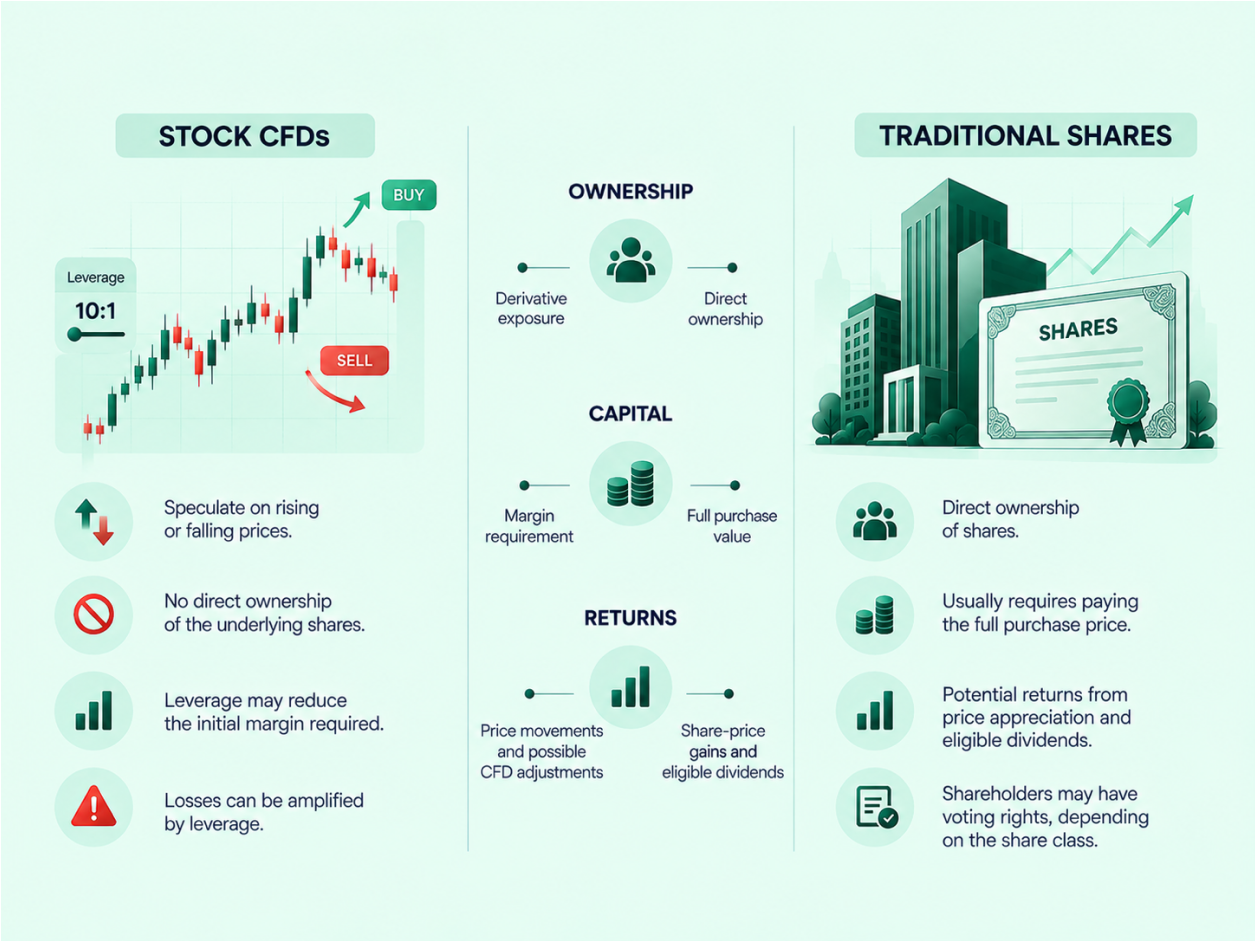
Stock CFDs are leveraged derivative products that allow speculation on the price movements of an underlying stock without actually owning the shares. Traditional Shares, conversely, represent direct ownership of a portion of a company, granting shareholders specific rights and potential long-term capital appreciation.
Understanding Stock CFDs
A Stock CFD is an agreement between a trader and a broker to exchange the difference in the price of a stock from the time the contract is opened until it is closed. This means you are speculating on whether a stock’s price will rise or fall, rather than purchasing the actual equity.
Key Characteristics of Stock CFDs
- No Ownership: When trading Stock CFDs, you do not own the underlying shares. Consequently, you do not receive voting rights or direct dividend payments. However, CFD positions are typically adjusted to reflect the economic impact of dividends. If you hold a long (buy) CFD position, your account may be credited for the dividend amount; if you hold a short (sell) position, your account may be debited.
- Leverage: One of the most defining features of CFDs is leverage. This allows you to control a large position with a relatively small amount of capital, known as margin. For instance, with a 10:1 leverage ratio, a $1,000 margin deposit could control a $10,000 position in a stock CFD. While leverage can amplify potential profits, it equally magnifies potential losses, calculated on the full value of the position, not just your margin.
- Ability to Go Long or Short: CFDs offer the flexibility to profit from both rising and falling markets. If you anticipate a stock’s price will increase, you can “go long” (buy). If you expect it to fall, you can “go short” (sell). This contrasts with traditional share investing, where profiting from a falling market typically involves more complex short-selling mechanisms.
- Costs: Trading CFDs typically involves a spread (the difference between the buy and sell price) and sometimes a commission per trade, particularly for stock CFDs. Additionally, if you hold a CFD position overnight, you may incur overnight funding charges, which are essentially interest payments for the leveraged capital.
- Extended Trading Hours: Many CFD brokers offer extended trading hours, sometimes even 24/5 for major markets, allowing traders to react to news and events outside standard exchange hours.
Understanding Traditional Shares
Traditional share trading involves buying and selling actual shares of a company on a stock exchange. When you invest in shares, you become a part-owner of that company.
Key Characteristics of Traditional Shares
- Direct Ownership: Purchasing traditional shares means you acquire a piece of the company. This ownership comes with certain rights and responsibilities.
- No Leverage (Typically): When buying traditional shares, you generally pay the full market value upfront. For example, to buy 100 shares of a company priced at $50 each, you would need $5,000. This caps your maximum potential loss at the total amount invested, assuming the stock price falls to zero.
- Profit from Price Appreciation: The primary way to profit from traditional shares is through capital appreciation, where the share price increases above your purchase price.
- Shareholder Rights and Dividends: As a shareholder, you may receive dividend payments (a portion of the company’s profits distributed to shareholders) and gain voting rights on company matters at annual general meetings (AGMs). These benefits are inherent to ownership.
- Costs: Traditional share trading typically involves a commission fee per trade. Additionally, profits from selling shares may be subject to capital gains tax, and dividends may be taxed as income, depending on your jurisdiction.
- Standard Exchange Hours: Traditional shares are traded during the operating hours of the respective stock exchanges (e.g., NYSE, NASDAQ). While some brokers offer after-hours trading, it’s generally more limited than CFD trading.
Stock CFDs vs. Traditional Shares: A Comparative Analysis
Let’s illustrate the core differences with a practical example:
Imagine you believe “Tech Innovations Inc.” stock, currently trading at $100 per share, is poised for growth.
Scenario 1: Trading a Stock CFD
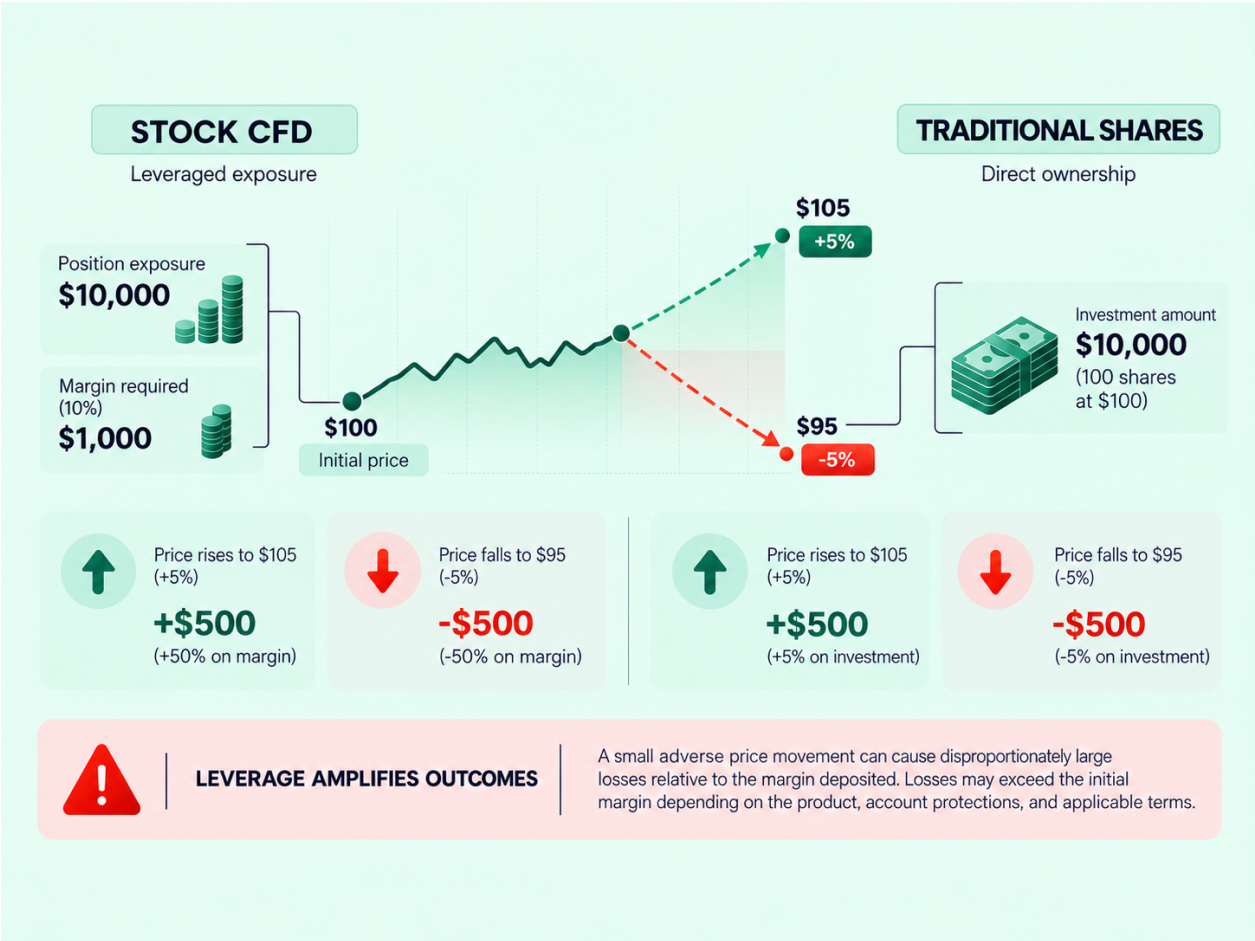
You decide to open a CFD position equivalent to 100 shares. With a leverage of 10:1, you would only need to commit $1,000 (10% of the $10,000 total position value) as margin.
- Outcome A (Price Rises): If Tech Innovations Inc. rises to $105 per share, your profit would be $500 (100 shares * $5 price increase). This represents a 50% return on your initial $1,000 margin.
- Outcome B (Price Falls): If Tech Innovations Inc. falls to $95 per share, your loss would be $500 (100 shares * $5 price decrease). This represents a 50% loss on your initial $1,000 margin, potentially leading to a margin call if your account balance falls below the required maintenance margin.
Scenario 2: Buying Traditional Shares
You purchase 100 shares of Tech Innovations Inc. at $100 each, requiring an initial outlay of $10,000.
- Outcome A (Price Rises): If Tech Innovations Inc. rises to $105 per share, your profit would be $500 (100 shares * $5 price increase). This represents a 5% return on your $10,000 investment.
- Outcome B (Price Falls): If Tech Innovations Inc. falls to $95 per share, your loss would be $500 (100 shares * $5 price decrease). This represents a 5% loss on your $10,000 investment. Your maximum loss is capped at your initial $10,000 investment.
This example clearly highlights the amplified gains and losses associated with leverage in CFD trading, alongside the lower capital requirement.
Key Differentiators Summarized:
| Feature | Stock CFDs | Traditional Shares |
|---|---|---|
| Ownership | No ownership of the underlying asset | Direct ownership of company shares |
| Leverage | Available, amplifying both gains and losses | Typically none, full capital required |
| Capital Required | Lower initial margin deposit | Full value of shares upfront |
| Profit Potential | From rising (long) or falling (short) markets | Primarily from rising prices (capital appreciation) |
| Shareholder Rights | No voting rights, dividend adjustments | Voting rights, direct dividend payments |
| Trading Costs | Spreads, commissions, overnight funding charges | Commissions, potential capital gains tax |
| Trading Hours | Often extended, sometimes 24/5 | Standard exchange hours, limited after-hours |
| Risk Profile | Higher risk due to leverage, amplified losses | Generally lower risk, maximum loss capped at investment |
Strategic Considerations: When to Choose Which
The choice between Stock CFDs and traditional shares largely depends on your investment horizon, risk appetite, and financial goals.
Why Choose Stock CFDs?
- Short-Term Trading & Speculation: CFDs are well-suited for short-term strategies focused on capitalizing on rapid price movements due to their leverage and ability to go short.
- Hedging Existing Portfolios: Traders can use CFDs to hedge against potential losses in their physical share holdings. For example, if you own shares in a company but anticipate a temporary downturn, you could open a short CFD position to offset potential losses without selling your actual shares.
- Capital Efficiency: For traders with limited capital who wish to gain exposure to larger market positions, CFDs offer a way to do so through leverage.
- Falling Markets: The ability to easily go short makes CFDs attractive for profiting in bearish market conditions.
Why Choose Traditional Shares?
- Long-Term Investment & Growth: For investors seeking to build wealth over many years, direct share ownership aligns with a long-term buy-and-hold strategy, benefiting from compound growth and company success.
- Income Generation: Investors focused on receiving regular income may prefer dividend-paying shares, as they directly receive the dividend payments.
- Shareholder Participation: For those who value having a say in company governance through voting rights, traditional shares are the only option.
- Lower Risk Tolerance for Capital: While all market participation carries risk, the absence of leverage in traditional share buying means your maximum loss is limited to your initial investment, making it generally less volatile for your capital than leveraged CFD positions.
Navigating Risk in Both Instruments
Both Stock CFDs and traditional shares involve market risk, but their risk profiles differ significantly.
- CFDs and Leverage Risk: The primary risk with CFDs is leverage. While it can amplify profits, with many brokers, it can also lead to losses that exceed your initial margin deposit. LQH Markets offer Negative Balance Protection (NBP) to ensure that losses on a given account do not fall below zero under normal trading conditions, preventing clients from owing more than their account balance. Effective risk management strategies, such as setting stop-loss orders, understanding margin requirements, and proper position sizing, are paramount. A premium CFD broker will provide tools and educational resources to help manage these risks.
- Traditional Share Risks: For traditional shares, the main risks include market volatility, where the overall market declines, and company-specific risk, where a company’s performance deteriorates. While your maximum loss is capped at your investment, significant capital can still be lost if a stock’s value plummets.
Conclusion
The decision between trading Stock CFDs and investing in traditional shares boils down to your individual financial goals, time horizon, and risk tolerance. Stock CFDs offer flexibility, leverage, and the ability to profit from both rising and falling markets, making them suitable for active traders and short-term speculation. Traditional shares, on the other hand, provide direct ownership, shareholder rights, and are generally preferred for long-term investment strategies focused on capital appreciation and dividend income. By thoroughly understanding the unique characteristics of each, you can make informed decisions that best suit your approach to the financial markets.
Frequently Asked Questions
Can I receive dividends if I trade Stock CFDs?
While you don’t directly receive dividends as a shareholder, your CFD position will typically be adjusted to reflect the economic impact of the dividend. If you hold a long CFD, your account may be credited; if short, it may be debited.
Is it possible to lose more than my initial investment with Stock CFDs?
Not with LQH Markets and our Negative Balance Protection (NBP) which limits a client’s losses on a given account so that the account balance does not fall below zero under normal trading conditions. This means you cannot lose more than the funds available in your account. This highlights the critical importance of robust risk management strategies, such as using stop-loss orders.
What are the main advantages of traditional shares for a long-term investor?
Traditional shares offer direct ownership, which can lead to long-term capital appreciation, eligibility for dividend payments, and voting rights in company decisions. They are generally considered less risky for initial capital than leveraged instruments like CFDs.
How do trading hours differ between CFDs and traditional shares?
CFDs often provide extended trading hours, sometimes 24/5 for major markets, allowing for greater flexibility. Traditional shares are typically limited to the operating hours of the underlying stock exchanges, with some limited after-hours trading options.
Knowledge Check
1. Which of the following is a primary characteristic of Stock CFDs but NOT traditional shares?
- A) Direct ownership of a company’s equity
- B) Eligibility for voting rights in company decisions
- C) The ability to utilize leverage to control a larger position
- D) Profit generation solely from long-term capital appreciation
2. If you expect a stock’s price to fall, which instrument offers a more straightforward way to potentially profit from this movement?
- A) Buying traditional shares
- B) Opening a long Stock CFD position
- C) Opening a short Stock CFD position
- D) Investing in a mutual fund
3. What is a significant risk associated with trading Stock CFDs due to their inherent structure?
- A) The inability to trade outside standard exchange hours
- B) Losses that can exceed the initial margin deposit
- C) Missing out on direct dividend payments
- D) Limited market access compared to traditional shares
Click to view the answers
1. **C)** – Leverage is a defining feature of Stock CFDs, allowing traders to control larger positions with a smaller capital outlay, which is not typically available with traditional shares.
2. **C)** – Stock CFDs allow traders to easily “go short,” meaning they can open a sell position to potentially profit if the underlying stock’s price declines.
3. **B)** – Due to the leveraged nature of CFDs, market movements against a position can lead to losses that are greater than the initial margin committed.