

Understanding CFD Trading Risks for Beginners
Contracts for Difference (CFDs) have gained significant popularity among traders due to their flexibility and accessibility to various financial markets. However, for beginners, navigating the complexities and inherent risks of CFD trading can be challenging. A thorough understanding of these risks and effective mitigation strategies is paramount for sustainable trading.
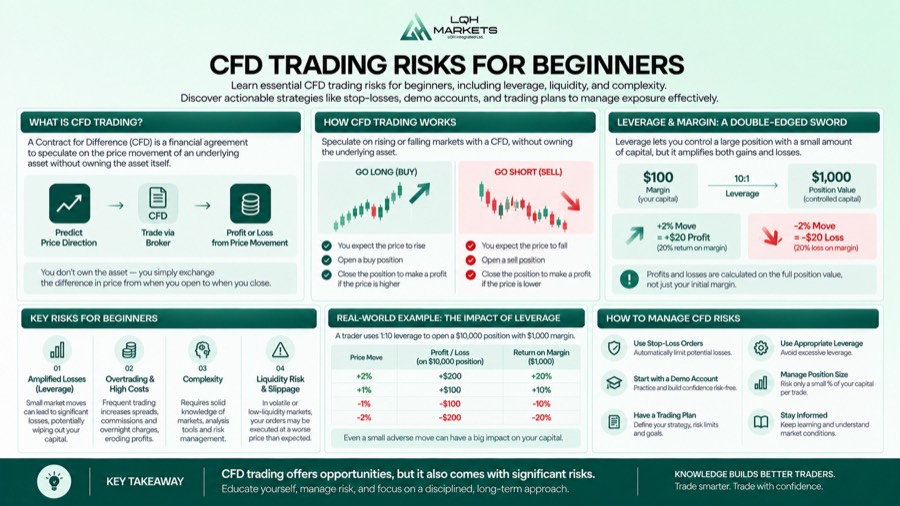
A Contract for Difference (CFD) is a financial agreement between two parties to speculate on the price movement of an underlying asset without owning the asset itself. Traders profit if their prediction of the asset’s price direction is correct, and incur losses if the market moves against their position.
How CFD Trading Operates
In CFD trading, you do not physically buy or sell the underlying asset, such as company shares or commodities. Instead, you enter into a contract with a broker to exchange the difference in the asset’s price from the time the contract is opened until it is closed.
For instance, if you anticipate a technology company’s stock price to rise, you might “buy” (go long) a CFD on that stock. If the price increases as predicted, you would close your position by “selling” the CFD, earning a profit based on the price difference. Conversely, if the stock price falls, closing the position would result in a loss. The magnitude of profit or loss is directly tied to your position size.
The Dynamics of Leverage and Margin
A core characteristic of CFDs is leverage, which allows traders to control a large position with a relatively small amount of capital. This initial capital is known as “margin.” For example, with a 10% margin requirement, a trader could open a $1,000 position on a commodity by committing only $100 of their own funds, effectively borrowing the remaining $900 from the broker.
While leverage amplifies potential profits, it equally magnifies potential losses. Crucially, profits and losses are calculated based on the full value of the leveraged position, not just the initial margin. This means that even a small adverse market movement can lead to losses that exceed the initial margin amount. If an account’s equity falls below a certain threshold, a “margin call” may be issued, requiring additional funds. Failure to meet a margin call can result in positions being automatically closed out by the broker to prevent further losses, often at unfavorable prices.
Primary Risks in CFD Trading for Beginners
CFDs are complex financial instruments, and beginners must be acutely aware of the specific risks involved.
1. Amplified Losses Due to Leverage
As discussed, leverage is a double-edged sword. While it offers the potential for significant gains from minimal capital outlay, it also means that losses can accumulate rapidly and substantially. A minor price fluctuation against your position can quickly deplete your trading capital, potentially leading to losses up to the total funds available in your account, as your account is protected by Negative Balance Protection (NBP). This inherent amplification makes CFDs significantly riskier than direct investment in unleveraged assets.
- Example: A trader uses 1:10 leverage to open a $10,000 CFD position on a stock with $1,000 margin. If the stock price drops by just 2%, the trader incurs a $200 loss (2% of $10,000). This represents 20% of their initial $1,000 margin, demonstrating how a small market move can have a disproportionate impact on invested capital.
2. Overtrading and Escalating Transaction Costs
The ease of opening and closing CFD positions, coupled with the allure of leverage, can tempt beginners into overtrading. Each trade typically incurs transaction costs, such as spreads (the difference between the buy and sell price), commissions (on certain account types), and potentially overnight financing charges for positions held open longer than a day. Frequent trading, especially with small profits or accumulating losses, can lead to these costs eroding capital quickly, making it harder to achieve overall profitability. A lack of discipline in position sizing relative to account balance exacerbates this risk.
3. Complexity and Steep Learning Curve
CFDs are not straightforward. They demand a solid grasp of market dynamics, price action, fundamental economic principles, and technical analysis. Understanding how leverage, margin, spreads, and overnight financing charges interact requires dedicated study. New traders often face a steep learning curve in identifying reliable market indicators, avoiding common trading pitfalls, and developing a balanced, big-picture view of financial markets. The psychological aspect of managing emotions during volatile market conditions also adds to this complexity.
4. Liquidity Risk and Slippage
Liquidity refers to how easily an asset can be bought or sold without significantly impacting its price. In CFD trading, liquidity risk arises when there are insufficient buyers or sellers in the market for a particular asset.
- Slippage: In a low-liquidity environment, your order may not be executed at the anticipated price. This difference between the expected price of a trade and the price at which it is actually executed is known as slippage. Slippage can occur during periods of high volatility, rapid price changes, or when markets “gap” (move sharply up or down with no trading in between, often overnight or due to unexpected news). When slippage occurs, a stop-loss order, intended to limit losses, might be executed at a worse price than specified, leading to larger-than-expected losses.
Strategies for Mitigating CFD Trading Risks
While CFD trading carries inherent risks, beginners can adopt several strategies to manage their exposure and enhance their chances of success.
1. Develop and Adhere to a Comprehensive Trading Plan
A well-defined trading plan is your roadmap. It should outline your financial goals, risk tolerance, preferred markets, entry and exit criteria, position sizing rules, and maximum allowable loss per trade and per day. Sticking to this plan, especially during periods of market volatility or emotional stress, is crucial for disciplined trading.
2. Start Slowly and Build Expertise
For those new to leveraged products, it is advisable to begin with small trade sizes. This allows you to become comfortable with how leverage works and observe market behavior without risking substantial capital. Gradually increase position sizes only as your understanding, skills, and confidence grow.
3. Understand Market Fundamentals and Technical Analysis
Informed trading decisions stem from a deep understanding of the markets.
- Fundamental Analysis involves evaluating economic data, geopolitical events, and company-specific news to gauge an asset’s intrinsic value and potential future price direction.
- Technical Analysis focuses on studying historical price charts, patterns, and indicators to identify trends and predict future price movements. Combining both approaches can provide a more holistic market view.
4. Diligently Monitor Open Positions
Markets are dynamic and can change rapidly. While constant monitoring might not always be feasible, it is important to stay informed about your open positions. Many trading platforms offer mobile applications and price alerts that can notify you when specific price levels are reached, enabling timely reactions to market movements.
5. Utilize Robust Risk Management Tools
Trading platforms offer tools designed to help manage risk:
- Stop-Loss Orders: These orders automatically close a trade when the market price reaches a predetermined level, limiting potential losses. While not guaranteed against slippage in volatile markets, they are essential for defining your maximum acceptable risk per trade.
- Limit Orders: Used to lock in profits, a limit order automatically closes a trade when the market price reaches a specified profit target.
- Trailing Stops: A more dynamic form of stop-loss, a trailing stop moves with the market price as it becomes favorable, but remains fixed if the market turns against your position, helping to protect accumulated profits.
6. Explore Automated and Algorithmic Trading
For traders who cannot constantly monitor markets, automated trading solutions can be beneficial. These systems allow you to pre-set specific parameters for opening and closing positions based on defined market criteria. Algorithmic trading takes this further, employing complex algorithms to execute trades automatically. These tools require careful setup and backtesting to ensure they align with your risk appetite and strategy.
7. Practice with a Demo Account
Before committing real capital, utilize a demo account. These accounts simulate live trading environments with virtual funds, allowing you to practice strategies, familiarize yourself with the trading platform, and understand market dynamics without any financial risk. It’s an invaluable tool for honing skills and building confidence.
8. Commit to Continuous Learning
The financial markets are constantly evolving. Successful traders commit to ongoing education, staying updated on market news, refining their strategies, and learning from both successes and failures. Building a strong knowledge base is an ongoing process that significantly contributes to long-term trading proficiency.
CFD trading presents opportunities but also significant risks, particularly for beginners. By understanding the mechanisms of leverage, recognizing the amplified nature of losses, being aware of liquidity issues, and diligently applying risk management strategies, new traders can approach the CFD market with greater prudence and a more informed perspective.
Frequently Asked Questions
Can I lose more money than I initially deposit when trading CFDs?
No, due to Negative Balance Protection (NBP) offered by LQH Markets, your losses on a given account are limited so that the account balance does not fall below zero under normal trading conditions. While leverage amplifies potential losses, you cannot lose more than the funds available in your account.
Are CFDs inherently riskier than traditional stock investing?
CFDs are generally considered riskier than traditional stock investing primarily due to the use of leverage. While traditional stock investing involves the risk of the asset’s value falling, CFD trading amplifies both potential gains and losses, making the capital at risk much higher relative to the initial outlay.
Why do many new CFD traders experience losses?
Many new CFD traders experience losses due to a combination of factors, including a lack of understanding of leverage, insufficient risk management, emotional decision-making, overtrading, and failing to adequately research market dynamics and trading strategies. The complexity of CFDs requires significant education and discipline.
How can a demo account help a beginner manage CFD trading risks?
A demo account provides a risk-free environment to practice trading strategies, understand how leverage and margin work in real-time, and become familiar with a trading platform’s features using virtual funds. This allows beginners to learn from mistakes without incurring actual financial losses.
Knowledge Check
1. What is the primary reason why CFDs are considered high-risk, especially for beginners?
- A) They have very high transaction fees.
- B) They require physical delivery of the underlying asset.
- C) Leverage can amplify both profits and losses significantly.
- D) They can only be traded during specific market hours.
2. What is “slippage” in the context of CFD trading?
- A) The fee charged for holding a position overnight.
- B) The difference between the expected price of a trade and its actual execution price.
- C) The minimum amount of capital required to open a CFD position.
- D) A tool used to automatically close profitable trades.
3. Which of the following is NOT a recommended strategy for mitigating CFD trading risks for beginners?
- A) Practicing with a demo account before using real capital.
- B) Developing and strictly following a comprehensive trading plan.
- C) Consistently increasing trade sizes to maximize potential profits quickly.
- D) Utilizing risk management tools like stop-loss and limit orders.
Click to view the answers
1. **C)** – Leverage allows traders to control large positions with small capital, but it magnifies both potential gains and losses.
2. **B)** – Slippage occurs when an order is executed at a price different from the anticipated price, often due to low liquidity or high volatility.
3. **C)** – Consistently increasing trade sizes quickly, especially for beginners, is not a recommended [risk mitigation](/learn/trading-glossary/#risk-mitigation) strategy and can lead to amplified losses.