

Short selling is a sophisticated trading strategy that allows participants to potentially profit from a decline in a security’s price. While often associated with traditional stock markets, Contracts for Difference (CFDs) offer a streamlined and accessible method for retail traders to implement short-selling strategies. This guide will demystify short selling, focusing on its application through CFDs, outlining the mechanics, strategies, benefits, and crucial risks involved.
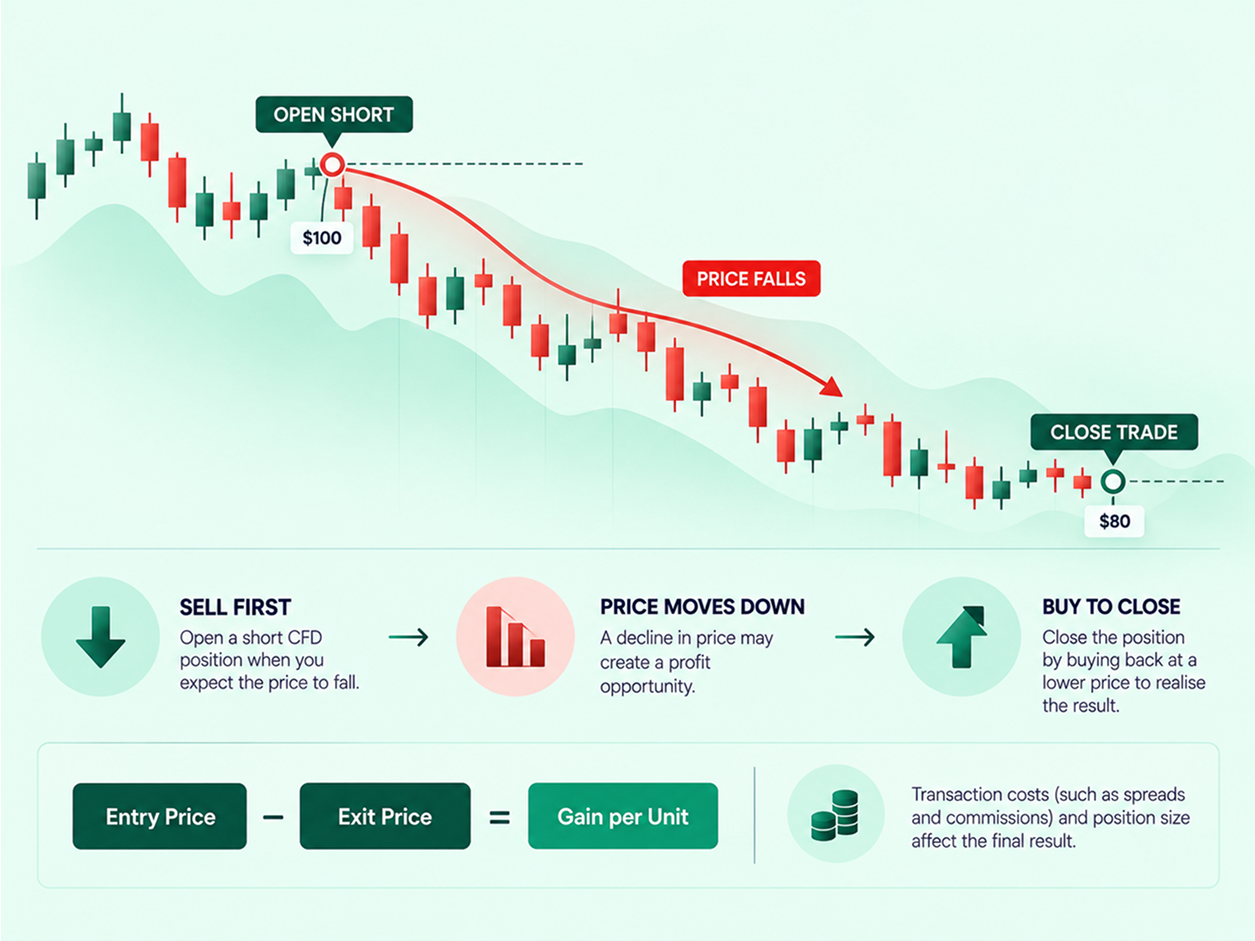
Short selling is a trading strategy where an investor aims to profit from an anticipated decline in a security’s price. It involves opening a “sell” position on an asset, expecting to close it later by “buying” it back at a lower price.
Understanding Short Selling: The Core Concept
In conventional investing, traders “go long” by buying an asset with the expectation that its price will rise. Short selling, conversely, involves taking a “short” position, anticipating a price decrease. This allows traders to capitalize on bearish market sentiment or a company’s deteriorating prospects.
Historically, traditional short selling involved borrowing shares from a broker, selling them on the open market, and then repurchasing them later at a lower price to return to the lender. The profit would be the difference between the initial selling price and the repurchase price, minus any borrowing fees or dividends owed. This method often requires a margin account and can be complex, particularly for individual investors.
Short Selling with Contracts for Difference (CFDs)
For many retail traders, CFDs provide a more direct and flexible way to short sell. When trading CFDs, you do not physically own the underlying asset (like a stock). Instead, you enter into a contract with a broker to exchange the difference in the asset’s price between the time the contract is opened and when it is closed.
How CFD Short Selling Works
The process of short selling with CFDs is straightforward:
- Identify an Opportunity: You research a stock (or other asset) that you believe is likely to decline in value.
- Open a “Sell” Position: On your trading platform, you select the asset and choose to “sell” a certain number of CFD units. This opens your short position at the current market price.
- Leverage and Margin: CFDs are leveraged products. This means you only need to deposit a small percentage of the total trade value (known as margin) to open a position. While leverage can magnify potential profits, it also magnifies potential losses.
- Monitor the Market: You observe the asset’s price movements.
- Close the Position: If the price falls as predicted, you “buy” back the same number of CFD units. The difference between your initial selling price and the lower buying price, multiplied by the number of units, is your gross profit. If the price rises, you would buy back at a higher price, resulting in a loss.
Example Scenario: Shorting “GrowthTech Corp.” with CFDs
Imagine “GrowthTech Corp.” stock is currently trading at $150 per share. You believe the company’s upcoming earnings report will disappoint the market, causing its stock price to fall.
- Action: You decide to open a short position by “selling” 100 GrowthTech Corp. CFDs at $150.
- Exposure: Your total market exposure is 100 shares * $150/share = $15,000.
- Margin: If your broker requires a 20% margin for stock CFDs, your initial deposit to open this position would be 20% of $15,000 = $3,000.
Scenario A: Price Falls (Profitable Outcome)
The earnings report is indeed poor, and GrowthTech Corp.’s stock drops to $130. You decide to close your position by “buying” 100 CFDs at $130.
- Profit Calculation: ($150 – $130) * 100 units = $20 * 100 = $2,000.
- This profit is calculated on the full exposure of $15,000, illustrating the magnifying effect of leverage.
Scenario B: Price Rises (Loss-Making Outcome)
Contrary to your prediction, GrowthTech Corp. announces a surprise new product, and its stock price jumps to $165. You decide to close your position to limit further losses by “buying” 100 CFDs at $165.
- Loss Calculation: ($150 – $165) * 100 units = -$15 * 100 = -$1,500.
- Your loss is $1,500, plus any trading costs.
Identifying Prime Short-Selling Candidates
Successful short selling requires diligent research and analysis. Traders typically look for specific fundamental and technical signals:
Fundamental Weaknesses
- Obsolete Business Models: Companies whose products or services are losing relevance due to technological shifts, new competitors, or changing consumer preferences.
- Poor Management or Governance: A history of questionable decision-making, accounting irregularities, or a management team with a poor track record can signal future struggles. Aggressive earnings management might also be a red flag.
- Declining Industry Trends: Entire sectors can face headwinds from economic shifts, regulatory changes, or disruptive innovation, leading to a general downtrend for companies within them.
- Missed Earnings or Revenue Guidance: Repeatedly failing to meet analyst expectations can erode investor confidence and drive down stock prices.
- High Valuations: When a stock’s price appears disproportionately high compared to its intrinsic value, earnings, or industry peers, it may be “priced for perfection” and vulnerable to a correction.
Technical Signals
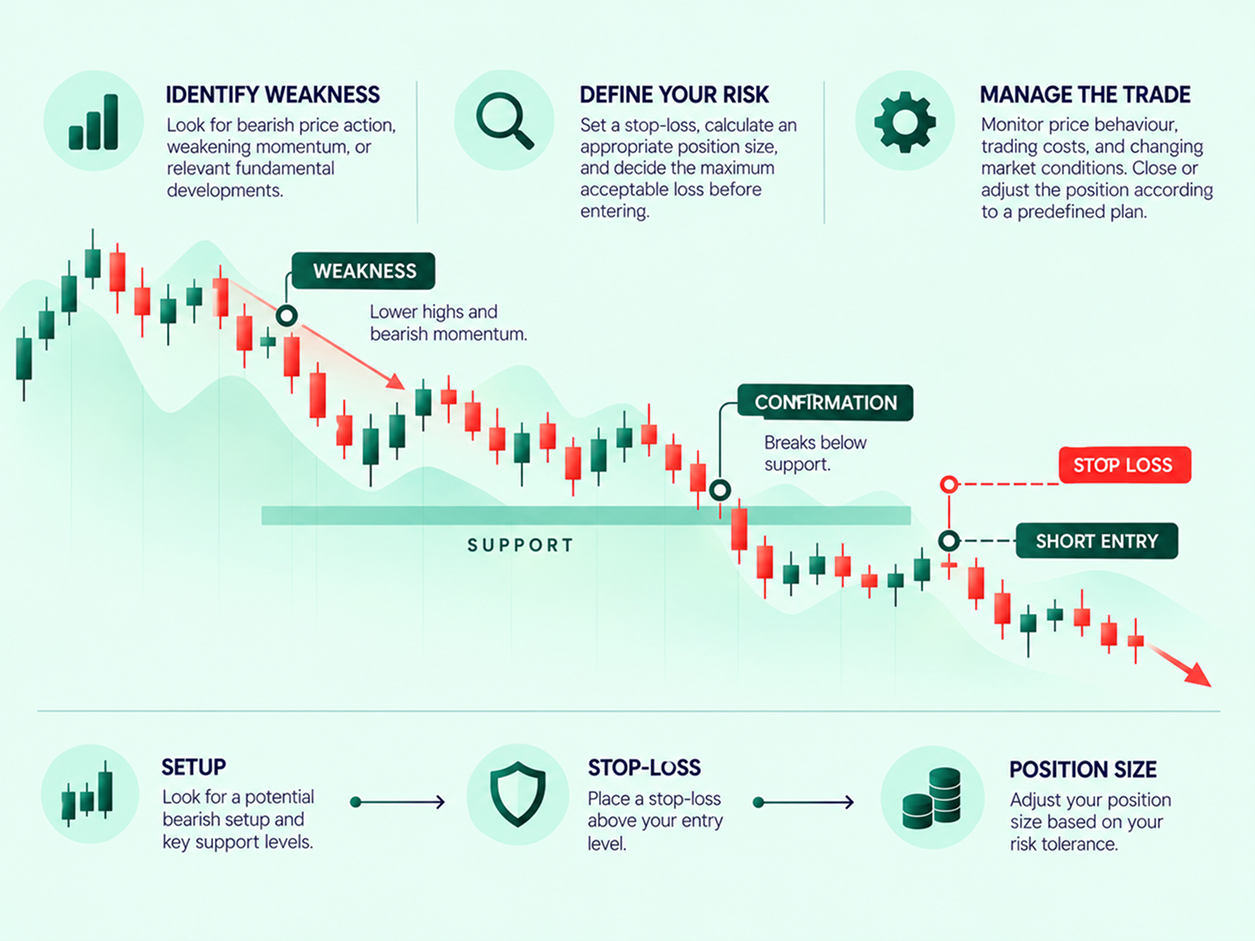
- Bearish Price Trends: Stocks consistently making lower highs and lower lows, indicating a strong downtrend.
- Breakdowns Below Support Levels: When a stock’s price falls below a previously established support level, it can signal further declines.
- Moving Average Crossovers: A “death cross,” where a shorter-term moving average (e.g., 50-day) crosses below a longer-term moving average (e.g., 200-day), is often considered a bearish signal.
- Decreasing Volume on Rallies: If a stock attempts to recover but does so on low trading volume, it suggests a lack of conviction from buyers, making the rally potentially unsustainable.
The Strategic Advantages of Short Selling
Short selling offers several compelling benefits for a well-rounded trading strategy:
- Profit in Declining Markets: Unlike traditional long-only investing, short selling provides the opportunity to generate returns even when the broader market or specific assets are falling. This expands the range of market conditions in which a trader can be active.
- Portfolio Hedging: Short positions can be used to offset potential losses in an existing long-only portfolio. For instance, if you hold a long position in a tech stock but anticipate a short-term sector-wide correction, you could short an ETF tracking that sector or a related individual stock to mitigate overall portfolio risk.
- Increased Trading Flexibility: By enabling traders to take positions on both sides of the market, short selling enhances strategic flexibility and allows for a more dynamic approach to capital allocation.
Navigating the Risks of Short Selling
While potentially lucrative, short selling carries significant risks, which are amplified when using leveraged products like CFDs.
- Theoretically Unlimited Loss: In a traditional short sale, if a stock’s price rises indefinitely, your potential loss is theoretically unlimited because there’s no ceiling to how high a stock can go. With CFDs, while the underlying principle of unlimited loss exists, robust risk management tools like stop-loss orders can help cap potential losses at a predetermined level.
- The Short Squeeze: This occurs when a stock’s price unexpectedly rises sharply, forcing short sellers to buy back shares to close their positions and limit losses. This sudden buying pressure further drives up the price, creating a cascade effect where more short sellers are “squeezed” out, exacerbating the rally. This can lead to rapid and substantial losses.
- Margin Calls: Because CFDs are leveraged, you trade with borrowed funds. If the market moves against your short position and your account equity falls below the required maintenance margin, your broker will issue a margin call, demanding additional funds. Failure to meet a margin call can result in your positions being automatically closed by the broker, often at a loss.
- Costs of Holding Positions: While CFDs avoid traditional stock borrowing fees, they incur other costs. These include the spread (the difference between the buy and sell price), commissions (which apply to certain account types and instruments), and overnight financing charges (also known as swap fees) for positions held open longer than a single trading day. These costs can erode profits or deepen losses over time.
- Market Manipulation and Regulatory Scrutiny: Short selling has sometimes been associated with manipulative practices, leading to increased regulatory oversight. While illegal activities like “naked short selling” (selling shares without first borrowing them) are prohibited, the practice itself can attract public and regulatory scrutiny, especially during periods of market volatility.
Regulatory Landscape
Short selling is a regulated activity in most financial markets. While LQH Markets is registered as an International Business Company in Saint Lucia, it’s important to note that all transactions are executed Over-the-Counter (OTC) through our MT5 platform and not on a recognised exchange or regulated trading venue. This means you may be subject to greater counterparty risk than if trading on a regulated exchange. Traders should be aware of the specific regulatory framework applicable to LQH Markets, as detailed in the Client Agreement, which aims to maintain market integrity and protect investors.
Conclusion
Short selling, particularly through CFDs, offers a powerful tool for traders seeking to capitalize on downward price movements or to hedge existing portfolios. It opens up opportunities in all market conditions, moving beyond the limitations of a long-only strategy. However, the inherent risks, especially the potential for magnified losses due to leverage and the threat of a short squeeze, necessitate a rigorous approach to research, risk management, and the disciplined use of tools like stop-loss orders. A thorough understanding of these dynamics is paramount for any trader considering incorporating short selling into their strategy.
Frequently Asked Questions
What is the primary difference between traditional short selling and short selling with CFDs?
Traditional short selling involves borrowing actual shares, selling them, and then buying them back to return to the lender. With CFDs, you don’t borrow or own the underlying shares; instead, you speculate on the price difference through a contract with your broker, making it more accessible and removing the complexities of share borrowing.
Can I lose more money than my initial investment when short selling CFDs?
While leverage means losses can exceed your initial margin deposit, LQH Markets offers Negative Balance Protection to ensure your account balance does not fall below zero under normal trading conditions. Additionally, you can use risk management tools like stop-loss orders to help cap potential losses at a predetermined level.
What is a “short squeeze” and why is it a risk for short sellers?
A short squeeze occurs when a stock’s price rises sharply, forcing short sellers to buy back shares to close their positions and limit losses. This sudden surge in buying activity further drives up the price, creating a feedback loop that can lead to rapid and substantial losses for short sellers caught in the squeeze.
How do I identify a good candidate for short selling?
Look for stocks with fundamental weaknesses such as obsolete business models, poor management, or declining industry trends. Additionally, technical signals like bearish price trends, breakdowns below key support levels, or bearish moving average crossovers can indicate potential short-selling opportunities.
Knowledge Check
1. What is the primary goal of short selling?
- A) To profit from an asset’s price increase.
- B) To profit from an asset’s price decline.
- C) To earn dividends from borrowed shares.
- D) To take physical ownership of an asset at a lower price.
2. Which of the following is a key characteristic of short selling using CFDs?
- A) It requires physically borrowing shares from a lender.
- B) It involves taking physical ownership of the underlying asset.
- C) It allows speculation on price movements without owning the asset, often with leverage.
- D) It guarantees profits regardless of market direction.
3. What is a “short squeeze” in the context of short selling?
- A) A situation where a stock’s price falls rapidly, leading to quick profits for short sellers.
- B) A regulatory action that temporarily bans short selling on certain stocks.
- C) A rapid increase in a stock’s price that forces short sellers to buy back shares, further driving the price up.
- D) A strategy used by companies to defend against short sellers by issuing more shares.
Click to view the answers
1. **B)** – Short selling aims to profit from an anticipated decline in a security’s price.
2. **C)** – Short selling with CFDs allows speculation on price movements without owning the asset, typically utilizing leverage.
3. **C)** – A short squeeze is a rapid increase in a stock’s price that compels short sellers to buy back shares, which in turn pushes the price even higher.