


Navigating the equity market often presents investors with a fundamental choice: prioritize stability and income, or chase rapid expansion and capital appreciation? This dilemma lies at the heart of understanding the distinction between blue chip stocks and growth stocks. Both categories offer distinct advantages and disadvantages, catering to different investment objectives, risk tolerances, and time horizons.
A clear grasp of these two stock types is crucial for constructing a well-diversified portfolio that aligns with your financial aspirations. This guide will delve into the defining characteristics, inherent risks, and strategic considerations for incorporating both blue chip and growth stocks into your trading approach.
Blue chip stocks are shares of large, financially robust companies with a long history of stable performance, often paying consistent dividends (which are reflected as adjustments in CFD trading). When trading CFDs on stocks, it’s important to remember that you’re trading a derivative on the stock and don’t actually own the stock.
Growth stocks, conversely, are issued by companies expected to expand their revenues and earnings at an above-average rate, typically reinvesting profits for future development.
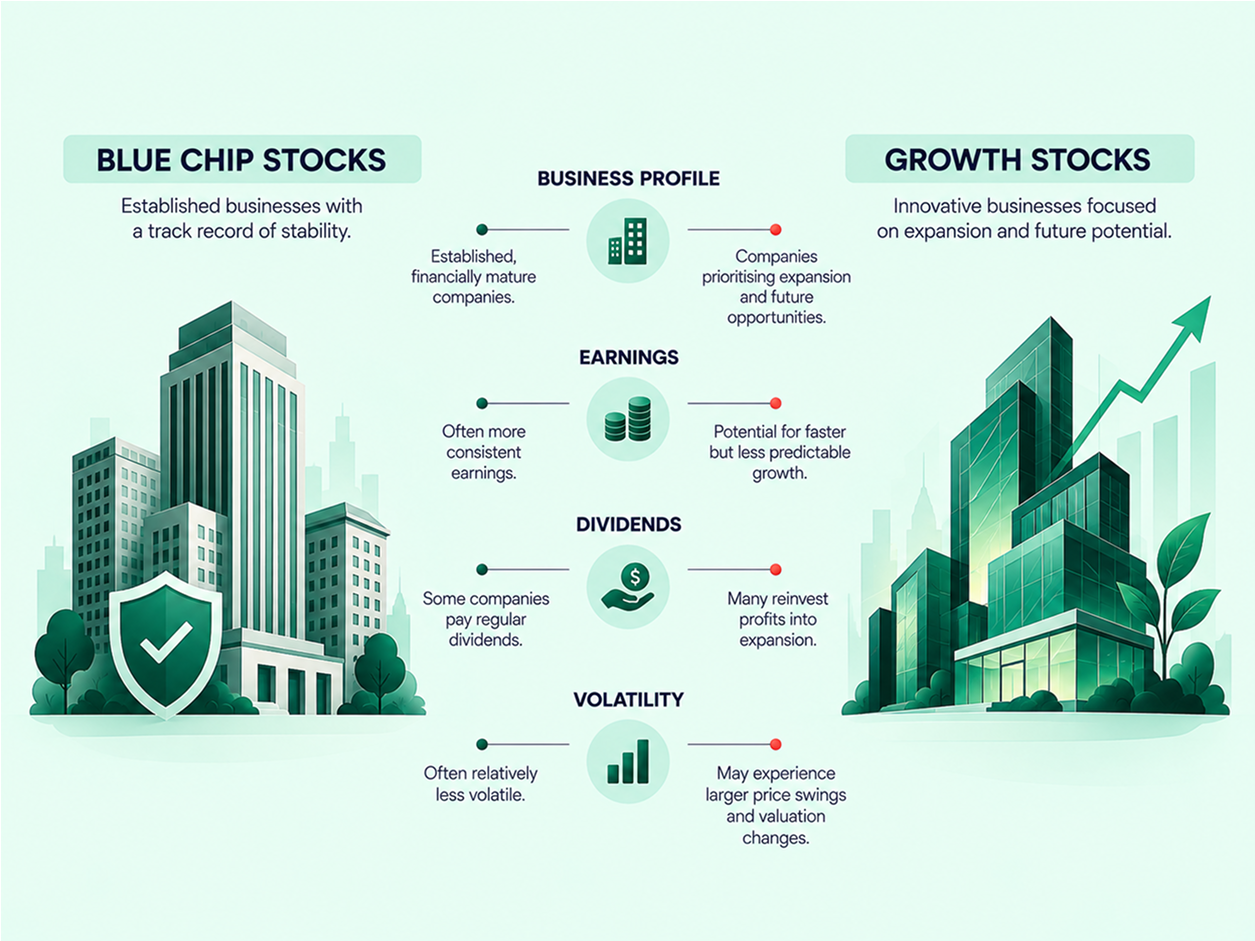
What Are Blue Chip Stocks?
The term “blue chip” originated from poker, where blue chips are typically the highest-value chips. This historical context perfectly encapsulates the essence of blue chip stocks: companies of the highest quality and value. These companies are almost always components of major market indices, such as the Dow Jones Industrial Average, S&P 500, Nasdaq-100, and international indices like the FTSE 100, serving as a clear indicator of their established status. While there’s no strict rule, blue chip companies generally boast a market capitalization exceeding $10 billion, though market leadership and consistent performance can qualify companies of varying sizes within their specific sectors. Blue chip stocks represent shares in large, highly reputable corporations that have demonstrated consistent financial stability and a proven track record of performance over many years. These companies are typically leaders in their respective industries, boasting strong brand recognition and often operating on a global scale. Think of them as the seasoned veterans of the stock market – reliable, resilient, and time-tested.
Key Characteristics of Blue Chip Stocks:
- Market Dominance: They often hold significant market share and are industry leaders.
- Consistent Earnings: Blue chips generate predictable and stable revenue and earnings growth, even during economic fluctuations.
- Regular Dividends: Many blue chip companies have a long history of paying regular, and often increasing, dividends, making them attractive to income-focused investors.
- Lower Volatility: Due to their established nature and financial strength, blue chip stocks tend to exhibit lower price volatility compared to smaller, less mature companies.
- Strong Balance Sheets: These companies typically maintain robust financial health with manageable debt levels.
- Defensive Qualities: During economic downturns or periods of market uncertainty, blue chips are often considered “defensive investments” because their stable earnings and essential products/services can buffer against severe declines.
Examples: Companies like Apple, Microsoft, and Johnson & Johnson exemplify blue chip characteristics, known for their enduring presence and financial fortitude. Imagine a blue chip stock as a well-rooted, mature oak tree in a forest. It grows steadily, provides consistent shade (dividends), and can withstand most storms, offering stability to the ecosystem around it.
What Are Growth Stocks?
In contrast, growth stocks belong to companies projected to expand their revenues and earnings at a pace significantly exceeding the overall market average. These companies are often innovative, operating in emerging or rapidly expanding industries. Rather than distributing profits as dividends, growth companies typically reinvest their earnings back into the business to fuel further expansion, research, and development.
Key Characteristics of Growth Stocks:
- High Growth Rates: The defining feature is their expectation of rapid revenue and earnings growth.
- Reinvestment of Profits: Growth companies prioritize reinvesting capital into expansion, innovation, and market penetration over paying dividends.
- Higher Valuations: Investors often assign higher price-to-earnings (P/E) ratios and other valuation multiples to growth stocks, anticipating substantial future earnings.
- Greater Volatility: Their dependence on future growth expectations makes them more susceptible to market sentiment, economic shifts, and earnings disappointments, leading to higher price swings.
- Innovation Focus: Many growth companies are at the forefront of technological advancements or disruptive business models.
Examples: Companies such as Tesla, NVIDIA, and Amazon have historically been considered growth stocks, demonstrating periods of explosive expansion driven by innovation and market capture. Picture a growth stock as a fast-growing sapling. It may not offer immediate fruit (dividends), but its potential for rapid vertical expansion and canopy spread is immense, though it’s more vulnerable to strong winds and changing soil conditions.
Core Distinctions: Blue Chip vs. Growth
Understanding the fundamental differences between these two stock categories is paramount for strategic portfolio construction.
Company Maturity and Size
Blue chip companies are typically large-cap, established enterprises with decades of operation, often reaching market capitalization in the hundreds of billions or even trillions of dollars. They have matured, solidified their market position, and often dominate their sectors. Growth companies, while some can be large, are generally in earlier stages of their lifecycle, focusing on aggressive expansion. Their size can range from mid-cap to large-cap, but their defining trait is their potential for future growth rather than current market dominance.
Earnings Profile and Dividends
Blue chips are characterized by consistent, predictable earnings. Their growth, while steady, may not be as explosive as a growth stock because they’ve already achieved significant scale. This stability often allows them to distribute a portion of their profits as dividends, providing a regular income stream to shareholders. Growth stocks, on the other hand, exhibit rapid, but often less predictable, earnings growth. They typically forgo dividends, preferring to reinvest every dollar back into the business to accelerate expansion, believing that this will generate greater capital appreciation for shareholders in the long run.
Risk and Volatility
Blue chip stocks are generally perceived as lower-risk investments due to their financial stability, market leadership, and proven resilience. Their prices tend to be less volatile, offering a degree of safety during turbulent market conditions. However, While blue chip stocks are often lauded for their stability and are generally considered lower-risk investments, it’s crucial to understand that they are not entirely risk-free or immune to economic downturns. Their established nature can sometimes lead to slower growth during periods of rapid economic expansion, as they may lack the agility of smaller, more innovative companies. Furthermore, even market leaders are vulnerable to industry disruption, particularly from technological shifts or evolving consumer preferences that can challenge their long-held dominance. Large companies can also struggle to maintain rapid innovation, potentially falling behind more nimble competitors.
History offers stark reminders that even seemingly invincible blue chips can face significant struggles or even collapse. General Motors (GM), once a quintessential blue chip, filed for bankruptcy in 2009 amidst the financial crisis, highlighting how even industrial giants can be severely impacted by economic forces and mismanagement. Similarly, the collapse of Lehman Brothers in 2008, a long-standing financial institution, underscored that no company, regardless of its history or size, is entirely immune to systemic risks or catastrophic events. These examples emphasize the importance of continuous due diligence, even with the most established companies. Growth stocks carry a higher risk profile. Their valuations are often based on future expectations, making them highly sensitive to any news that might temper those projections. This can lead to significant price swings and greater potential for losses if growth targets are not met.
Valuation Metrics
Blue chip stocks typically trade at moderate valuation multiples (e.g., Price-to-Earnings, P/E) because their growth is more predictable and already factored into their current price. Growth stocks, conversely, often command premium valuations. Investors are willing to pay a higher multiple for their shares, betting on substantial future expansion and earnings. This higher valuation makes them particularly sensitive to changes in interest rates or shifts in investor sentiment.
Investment Horizon and Goals
Investors seeking stability, consistent income, and capital preservation often gravitate towards blue chip stocks. They are suitable for long-term, conservative portfolios, or for individuals nearing retirement who prioritize steady returns. Growth stocks appeal to investors with a higher risk tolerance and a longer investment horizon, who are primarily focused on maximizing capital appreciation. These investors are willing to endure greater volatility in pursuit of potentially outsized returns.
Performance Across Economic Cycles
The interplay between blue chip and growth stocks often shifts depending on the prevailing economic climate and monetary policy.
During Economic Expansion
In periods of robust economic growth, low interest rates, and strong consumer confidence, growth stocks often outperform. Investors are more willing to take on higher risk, favoring companies with innovative products and services that can capitalize on expanding markets. The promise of future earnings in a thriving economy makes their premium valuations seem more justifiable.
During Economic Slowdowns or Recessions
When the economy tightens, or uncertainty looms, blue chip stocks tend to perform better. Their stable earnings, essential products, and reliable dividends act as a buffer against market downturns. Investors typically flock to these “safe haven” assets, prioritizing capital preservation and consistent income over aggressive growth.
The Role of Interest Rates
Interest rates significantly influence the relative attractiveness of blue chip versus growth stocks. Growth stocks are particularly sensitive to rising interest rates. This is because a large portion of their value is derived from future earnings, which are discounted more heavily in a higher interest rate environment. Higher borrowing costs can also impede their expansion plans. Blue chip stocks, with their more immediate and predictable earnings, tend to be less affected by moderate interest rate fluctuations. Conversely, falling interest rates can make growth stocks more appealing, as future earnings become more valuable in present terms.
Strategic Portfolio Integration
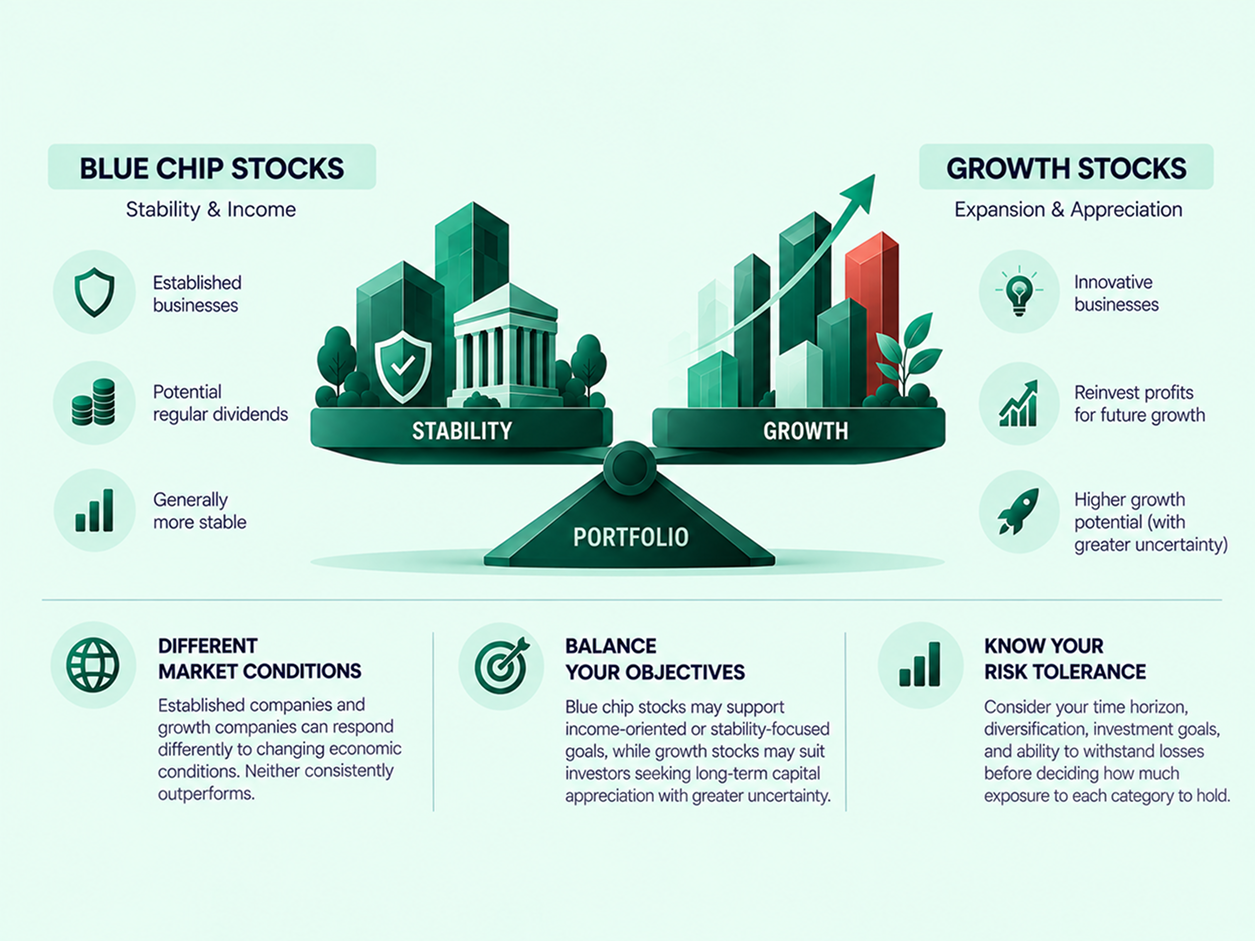
Rather than viewing blue chip and growth stocks as mutually exclusive choices, savvy investors often integrate both into a diversified portfolio.
- Diversification: Combining both types can help balance risk and return. Blue chips provide a stable foundation, potentially mitigating losses during market downturns, while growth stocks offer the potential for significant upside.
- Aligning with Goals:
- Conservative Investors: May allocate a larger portion to blue chips for stability and income, with a smaller allocation to growth for modest appreciation.
- Aggressive Investors: Might lean heavily towards growth stocks, accepting higher risk for greater potential returns, while still holding some blue chips for foundational stability.
- Balanced Investors: Often seek an equilibrium, using blue chips as core holdings and growth stocks for strategic capital appreciation.
- Avoiding Common Pitfalls:
- Chasing Hype: Over-concentrating in popular growth stocks at peak valuations can lead to significant losses if expectations aren’t met.
- Ignoring Blue Chips: Neglecting blue chips during bull markets can mean missing out on stable, compounding returns and defensive strength.
- Emotional Reactions: Making impulsive decisions based on short-term market volatility rather than a disciplined, long-term strategy.
How to Invest in Blue Chips
Gaining exposure to blue chip stocks doesn’t solely mean purchasing individual shares. Investors can also achieve diversification and access to these established companies through various investment vehicles. Mutual funds and Exchange-Traded Funds (ETFs) that focus on large-cap companies or specifically track major market indices like the Dow Jones Industrial Average or the S&P 500 are excellent options. These funds offer instant diversification across a basket of blue chip companies, reducing the risk associated with individual stock picking while still providing the stability and income potential characteristic of blue chips.
Historical Context: The Nifty Fifty and Growth Stock Risks
A crucial historical lesson for growth stock investors comes from the “Nifty Fifty” era of the late 1960s and early 1970s. This period saw a group of 50 highly favored, large-cap growth stocks—companies like IBM, Xerox, and Coca-Cola—become immensely popular. Investors were willing to pay exceptionally high valuations for these stocks, believing their growth was unstoppable. However, when economic conditions deteriorated and interest rates rose, many of these “one-decision” stocks experienced significant corrections, with some losing 50% or more of their value. The Nifty Fifty serves as a cautionary tale, underscoring the risks of chasing hype, overpaying for growth, and neglecting disciplined valuation, even for seemingly robust companies. It highlights that even the most promising growth stories can falter if valuations become detached from fundamental reality.
Ultimately, the optimal allocation depends entirely on your individual risk tolerance, investment horizon, and specific financial objectives. A well-constructed portfolio leverages the complementary strengths of both blue chip and growth stocks to navigate various market conditions effectively.
Frequently Asked Questions
1. What is the primary difference in how blue chip and growth stocks use their profits?
Blue chip stocks typically distribute a portion of their profits as regular dividends to shareholders, reflecting their stable earnings. Growth stocks, in contrast, usually reinvest nearly all their profits back into the company to fund aggressive expansion, innovation, and market penetration, prioritizing future capital appreciation over current income.
2. Which type of stock is generally considered safer during economic downturns?
Blue chip stocks are generally considered safer during economic downturns due to their established market position, consistent earnings, and strong balance sheets. Their defensive characteristics and essential products/services often provide more resilience compared to growth stocks, which are more sensitive to economic uncertainty and future growth expectations.
3. How do interest rates affect blue chip and growth stocks differently?
Rising interest rates tend to impact growth stocks more negatively because their high valuations are heavily reliant on discounted future earnings, which appear less attractive in a higher rate environment. Blue chip stocks, with their more immediate and predictable earnings, are generally less sensitive to moderate shifts in interest rates.
4. Can a company transition from being a growth stock to a blue chip stock?
Yes, it is possible for a successful growth company to mature over time, establish market dominance, and develop consistent earnings and dividend policies, eventually earning blue chip status. This transition signifies a shift from rapid expansion to sustained stability and market leadership.
5. Why might an investor choose to include both blue chip and growth stocks in their portfolio?
Investors often combine both blue chip and growth stocks to achieve diversification and balance risk with return potential. Blue chips provide a stable foundation, consistent income, and defensive qualities, while growth stocks offer the potential for higher capital appreciation and innovation-driven returns, creating a more robust and adaptable portfolio.
Knowledge Check
1. Which of the following is a typical characteristic of a blue chip stock?
- A) Rapidly increasing share prices due to reinvested profits.
- B) High price-to-earnings (P/E) ratios reflecting future growth potential.
- C) A long history of consistent earnings and regular dividend payments.
- D) Operating primarily in emerging, highly volatile industries.
2. Why are growth stocks generally more sensitive to rising interest rates than blue chip stocks?
- A) Growth stocks rely more on current dividends, which are devalued by higher rates.
- B) The value of growth stocks is heavily tied to future earnings, which are discounted more significantly at higher rates.
- C) Blue chip companies are too large to be affected by interest rate changes.
- D) Growth stocks primarily fund operations through short-term, variable-rate loans.
3. An investor primarily seeking stability and consistent income for a conservative, long-term portfolio would most likely favor:
- A) Companies with high revenue growth but no dividend history.
- B) Stocks with high volatility but significant capital appreciation potential.
- C) Blue chip stocks known for their market dominance and reliable dividends.
- D) Companies operating in highly speculative, innovative sectors.
Click to view the answers
1. **C)** – Blue chip stocks are defined by their consistent financial stability, proven track record, and often a history of paying regular dividends.
2. **B)** – Growth stocks’ valuations are largely based on anticipated future earnings, which are discounted more heavily in a higher interest rate environment, making them more sensitive.
3. **C)** – Blue chip stocks offer stability, market dominance, and reliable dividends, aligning well with conservative investment goals focused on income and capital preservation.