


Commodities form the bedrock of the global economy, from the energy that powers industries to the food that sustains populations. For traders, these raw materials offer unique opportunities to speculate on fundamental supply and demand dynamics, often influenced by geopolitical events, economic shifts, and even weather patterns. Trading commodities through Contracts for Difference (CFDs) provides a flexible and accessible pathway to engage with these vital markets without the complexities of physical ownership or direct futures trading.
This guide will demystify commodity CFDs, explaining their mechanics, the factors that drive commodity prices, and the practical steps to incorporate them into your trading strategy.
Commodity CFDs allow traders to speculate on the price movements of underlying raw materials like crude oil, gold, or sugar without owning the physical asset. They offer leveraged exposure, enabling traders to potentially magnify returns from relatively small capital outlays.
What Are Commodities?
Commodities are fundamental raw materials or primary agricultural products that can be bought and sold. They are typically standardized, meaning one unit of a commodity is interchangeable with another of the same type, regardless of its origin. This standardization facilitates their trading on global exchanges.
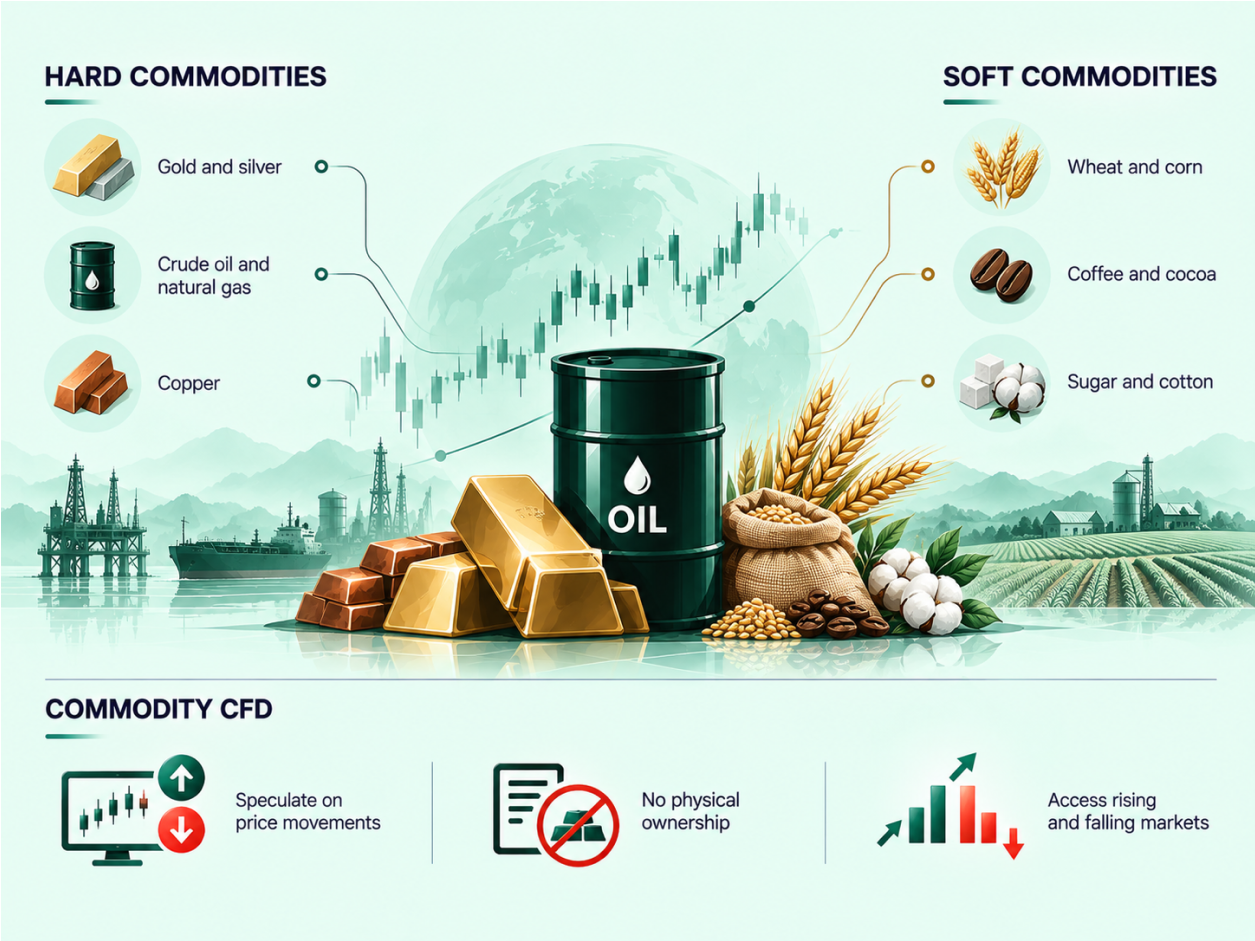
Commodities are broadly categorized into two main types:
Hard vs. Soft Commodities: A Fundamental Distinction
The distinction between hard and soft commodities primarily lies in their origin and characteristics:
-
Hard Commodities: These are natural resources that are mined or extracted from the earth. They are typically non-renewable and often serve as industrial inputs or stores of value.
- Origin: Mined or drilled from finite deposits.
- Examples: Metals (gold, silver, copper, platinum) and energy products (crude oil, natural gas, gasoline).
- Influencing Factors: Geopolitical stability, industrial demand, global economic growth, mining output, OPEC decisions.
- Storage & Shelf-life: Generally non-perishable and can be stored indefinitely, though storage costs can be a factor.
- Usage: Industrial manufacturing, energy production, jewelry, investment hedging.
-
Soft Commodities: These are agricultural products that are cultivated or grown. They are renewable resources, though their supply can be highly susceptible to natural forces.
- Origin: Grown on farms, plantations, or ranches.
- Examples: Grains (wheat, corn, soybeans, rice), livestock (cattle, hogs), and tropical/beverage crops (coffee, cocoa, sugar, cotton, orange juice).
- Influencing Factors: Weather patterns (droughts, floods), crop diseases, planting and harvesting cycles, government agricultural policies, consumer trends.
- Storage & Shelf-life: Often perishable or bulky, requiring specific storage conditions and incurring costs, with limited shelf lives.
- Usage: Food, beverages, textiles, animal feed.
Understanding these differences is crucial as it informs the unique supply and demand drivers that affect each commodity’s price.
Why Trade Commodities with CFDs?
Trading commodities via CFDs offers several compelling advantages for retail traders:
1. Accessibility
Traditional commodity markets, particularly futures, often involve large contract sizes and significant capital requirements, making them inaccessible for many individual traders. CFDs break down these barriers by allowing trading in much smaller, fractional contract sizes. For example, instead of needing capital for 100 troy ounces of gold, a CFD trader might open a position equivalent to 1 or 0.1 troy ounces.
2. Leverage
CFDs are leveraged products, meaning you only need to deposit a small percentage of the total trade value (known as margin) to open a position. This allows traders to gain significant market exposure with relatively modest capital. For instance, with 1:20 leverage, a $500 margin could control a $10,000 position in crude oil. While leverage can amplify potential profits, it equally magnifies potential losses, making robust risk management essential.
3. Flexibility: Go Long or Short
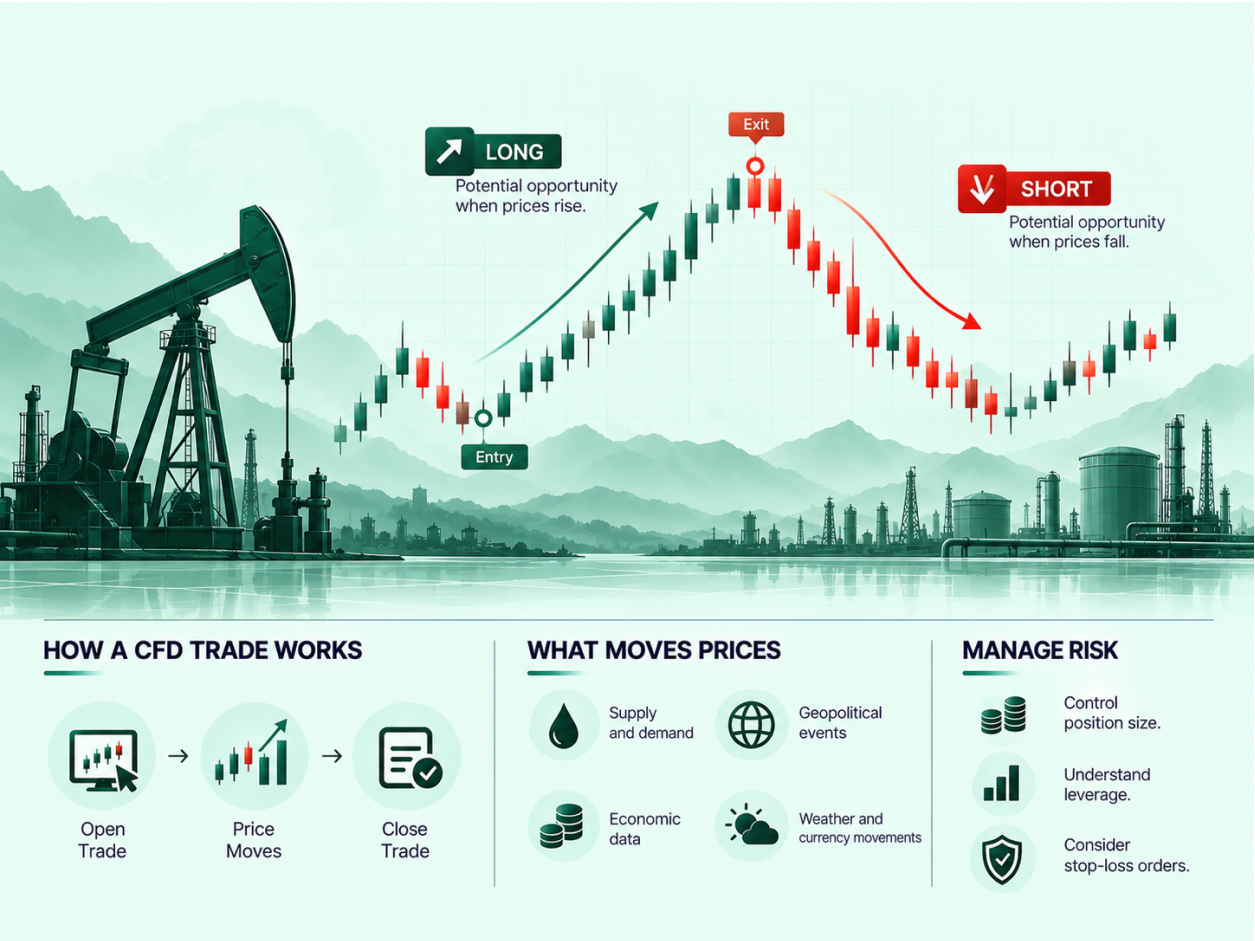
With commodity CFDs, you can profit from both rising and falling prices. If you anticipate a price increase (e.g., due to supply disruptions), you can “go long” (buy). Conversely, if you expect a price decrease (e.g., due to oversupply), you can “go short” (sell). This flexibility allows traders to capitalize on various market conditions.
4. Diversification
Adding commodities to a trading portfolio can offer diversification benefits. Commodity prices often react differently to economic events compared to equities or bonds, sometimes acting as a hedge against inflation or currency devaluation. For example, gold is traditionally seen as a safe-haven asset during economic uncertainty.
5. No Physical Ownership or Logistics
When trading commodity CFDs, you are speculating purely on price movements. There is no need to worry about the logistics of storing, transporting, or taking delivery of physical assets like barrels of oil or tons of sugar. This simplifies the trading process significantly.
How Commodity CFDs Work
A Contract for Difference is an agreement between a trader and a broker to exchange the difference in the price of an asset from the time the contract is opened until it is closed.
The Contract for Difference Mechanism
When you trade a commodity CFD, you are not buying or selling the actual commodity. Instead, you are entering into a contract based on the commodity’s price. If you buy a crude oil CFD at $80 per barrel and sell it at $82 per barrel, you profit from the $2 difference multiplied by your contract size. If you sell at $78, you incur a $2 loss per barrel.
Leverage and Margin
Leverage is a core feature of CFDs. To open a position, you only need to put up a fraction of the total trade value as initial margin. For example, if a gold CFD has a margin requirement of 5%, you would need $500 to open a position worth $10,000. While this can amplify returns, it also means that losses can exceed your initial deposit. Brokers typically provide a “margin call” if your account equity falls below a certain level, requiring you to deposit more funds or face automatic liquidation of your positions.
Pricing and Spreads
Commodity CFDs are priced based on the underlying futures or spot market prices. Brokers quote a two-way price: a bid (sell) price and an ask (buy) price. The difference between these two prices is the “spread.” Depending on the chosen account type, a commission may also apply for facilitating the trade. Spreads can be fixed or variable, widening during periods of high volatility or low liquidity.
For example, if crude oil is quoted at $80.00 (bid) / $80.03 (ask), the spread is $0.03. To open a buy position, you’d trade at $80.03, and to close it, you’d sell at $80.00.
Overnight Financing (Swaps) & Rollovers
The Nuance of Commodity CFD Pricing: Futures, Spot, and Rollovers
While commodity CFDs offer the convenience of not dealing with physical delivery, their pricing is often intricately linked to the underlying futures markets. Futures contracts, unlike spot prices, have specific expiry dates. When a CFD is based on a futures contract, brokers handle the expiry in different ways. Some brokers “roll over” open positions from the expiring contract to the next available contract month. This process typically involves a roll cost or credit, which is adjusted to the trader’s account to reflect the price difference between the two futures contracts.
However, as per LQH Markets’ policy, commodity CFD positions with fixed expiry dates are automatically closed at the end of the applicable trading period, rather than being rolled over. This means traders must manually reopen a position in the new contract if they wish to maintain exposure.
The relationship between futures prices across different contract months is crucial. When later-dated futures contracts are more expensive than nearer-dated ones, it’s known as contango. Conversely, when later-dated contracts are cheaper, it’s called backwardation. These dynamics can impact the effective cost or benefit of holding a CFD position over time, even if positions are automatically closed, as the price you re-enter at for the next contract month will reflect these market structures. Understanding these nuances is key for managing long-term exposure and costs in commodity CFD trading.
If you hold a CFD position open overnight, you will typically incur an overnight financing charge, also known as a swap fee. This charge reflects the cost of borrowing to maintain the leveraged position. For commodity CFDs with fixed expiry dates, open positions will be automatically closed at the end of the applicable trading period, as per LQH Markets’ policy, rather than being rolled over.
Contract Specifications
Each commodity CFD has specific contract details, including the minimum trade size (e.g., 0.1 lots), the value per point movement, and the margin requirement. Understanding these specifications is vital for accurate position sizing and risk assessment.
These specifications are directly tied to how the underlying physical commodity is measured and traded. For example, crude oil is typically measured in barrels, gold in troy ounces, cocoa in tonnes, and lumber in board feet. The “value per point” for a CFD contract translates these physical units into monetary terms for each price increment.
Consider these common examples:
- Crude Oil (e.g., Brent or WTI): A standard CFD contract often represents 1,000 barrels. If the price moves by $0.01 (one cent) per barrel, the value of a single contract changes by $10 (1,000 barrels * $0.01). Therefore, a $1 price movement would equate to a $1,000 change in the contract’s value.
- Cocoa: For a soft commodity like cocoa, a contract might represent 10 tonnes. A $1 movement per tonne would then result in a $10 change in the contract’s value.
Understanding these precise values is critical for calculating potential profits and losses and for effective position sizing, ensuring your trades align with your risk tolerance.
For instance, a gold CFD might be valued at $100 per 1-point movement in the underlying price, meaning a $1 price change could result in a $100 profit or loss for a single contract.
Key Factors Influencing Commodity Prices
Commodity prices are influenced by a complex interplay of global factors:
- Supply and Demand Dynamics: This is the most fundamental driver. Factors like production levels (e.g., oil output by OPEC+, agricultural harvests), inventory levels, and consumption trends (e.g., industrial growth, consumer spending) directly impact prices.
- Geopolitical Events: Conflicts, trade wars, sanctions, and political instability in major producing or consuming regions can significantly disrupt supply chains and influence prices. For example, tensions in the Middle East can send oil prices soaring.
- Economic Data: Global economic health, inflation rates, interest rate decisions by central banks, and manufacturing output reports can affect demand for industrial commodities and investor sentiment towards safe-haven assets like gold.
- Weather Patterns: Particularly critical for soft commodities, adverse weather events like droughts, floods, or severe storms can devastate crops or livestock, leading to supply shortages and price spikes.
- Currency Fluctuations: Most commodities are priced in U.S. dollars. A stronger dollar makes commodities more expensive for buyers using other currencies, potentially dampening demand, and vice-versa.
- Speculative Activity: Large institutional traders and hedge funds can influence prices through their buying and selling activities, driven by market sentiment, technical analysis, and macroeconomic outlooks.
Practical Steps to Trading Commodity CFDs
Embarking on commodity CFD trading requires a structured approach:
1. Conduct Thorough Research
Before trading, immerse yourself in the chosen commodity market. Understand its unique supply and demand drivers, historical price volatility, and the impact of seasonal patterns or geopolitical events. Combine fundamental analysis (economic reports, weather forecasts, production data) with technical analysis (chart patterns, indicators) to identify potential trading opportunities.
2. Choose a Reputable CFD Broker
Select a broker that offers a wide range of commodity CFDs, competitive spreads, reliable trading platforms (e.g., MetaTrader), and transparent regulatory status. Ensure they provide transparent pricing and clear contract specifications.
3. Open and Fund Your Account
Start by opening a demo account to practice trading with virtual funds. This allows you to familiarize yourself with the platform, market dynamics, and order types without financial risk. Once confident, open a live trading account and fund it according to your risk capital.
4. Develop a Trading Strategy
Define your entry and exit criteria. Will you use trend-following strategies, breakout patterns, or fundamental catalysts? Determine your preferred timeframes and how you will identify potential price movements. A well-defined strategy provides discipline and consistency.
5. Implement Robust Risk Management
This is paramount. For every trade, define your maximum acceptable loss and set a stop-loss order to automatically close a position if the price moves against you beyond a certain point. Similarly, consider a take-profit order to lock in gains. Never risk more than a small percentage (e.g., 1-3%) of your trading capital on a single trade.
Risk Management in Commodity CFD Trading
Other Ways to Gain Commodity Exposure
While commodity CFDs offer a dynamic and leveraged way to trade raw materials, they are not the only method to gain exposure to these markets. For traders and investors seeking less leverage, broader diversification, or a simpler approach, Exchange-Traded Funds (ETFs) present a popular alternative.
Commodity ETFs are investment funds that trade on stock exchanges, much like individual stocks. They can be structured to track the price performance of a single commodity (e.g., a gold ETF), a diversified basket of commodities (e.g., an agricultural ETF), or even a group of companies involved in commodity production or extraction.
Advantages of Commodity ETFs:
- Diversification: Many ETFs offer exposure to multiple commodities, spreading risk.
- Lower Leverage: Compared to highly leveraged CFDs, ETFs typically involve less or no leverage, reducing the potential for magnified losses.
- No Expiry Issues: Unlike futures-based CFDs, ETFs generally do not have expiry dates or direct rollover costs, making them more suitable for longer-term holding.
- Accessibility: They are easily bought and sold through standard brokerage accounts.
Considerations:
- Expense Ratios: ETFs charge annual management fees.
- Tracking Error: The ETF’s performance may not perfectly mirror the underlying commodity’s price due to various factors.
While commodity CFDs offer significant opportunities, they also carry inherent risks that must be managed diligently:
- Leverage Risk: As discussed, leverage magnifies both profits and losses. A small adverse price movement can lead to substantial losses up to your entire account balance. However, LQH Markets offers Negative Balance Protection to ensure your account balance does not fall below zero under normal trading conditions.
- Volatility: Commodity markets can be highly volatile, especially during periods of geopolitical tension or unexpected supply/demand shocks. Rapid price swings can lead to quick losses if not managed properly.
- Market Gaps: Prices can “gap” overnight or over weekends, meaning they open significantly higher or lower than their previous close. This can cause stop-loss orders to execute at a less favorable price than intended.
- Overnight Financing Costs: Holding positions for extended periods incurs swap fees, which can accumulate and erode potential profits.
- Position Sizing: Incorrect position sizing is a common pitfall. Always calculate your position size based on your risk tolerance and the commodity’s volatility, ensuring that even a worst-case scenario loss remains within acceptable limits.
Trading commodity CFDs offers a dynamic way to participate in global markets. By understanding the underlying assets, leveraging the flexibility of CFDs, and rigorously applying risk management principles, traders can navigate these markets with greater confidence and potentially capitalize on diverse opportunities.
Frequently Asked Questions
What is the primary difference between hard and soft commodity CFDs?
The primary difference lies in the underlying asset’s origin and characteristics. Hard commodity CFDs track resources extracted from the earth (e.g., oil, gold), while soft commodity CFDs track agricultural products that are grown (e.g., coffee, sugar). This distinction influences their price drivers, with hard commodities often affected by geopolitics and industrial demand, and softs by weather and harvest cycles.
How does leverage impact commodity CFD trading?
Leverage allows traders to control a larger position with a smaller initial capital outlay (margin). While it can amplify potential profits from favorable price movements, it also significantly magnifies potential losses if the market moves against the trader, highlighting the critical need for strict risk management.
Are commodity CFDs suitable for long-term investment?
Commodity CFDs are generally more suited for short to medium-term speculation due to factors like overnight financing costs (swap fees) and the automatic closure of futures-based CFDs at their expiry. These costs and closures can accumulate over time, making them less ideal for very long-term buy-and-hold strategies compared to direct investment in physical commodities or commodity-tracking ETFs. These costs can accumulate over time, making them less ideal for very long-term buy-and-hold strategies compared to direct investment in physical commodities or commodity-tracking ETFs.
How can I stay informed about commodity market news?
To stay informed, traders should regularly consult reputable financial news outlets, economic calendars, and specialized commodity reports (e.g., USDA reports for agricultural goods, EIA reports for energy). Many CFD brokers also offer integrated news feeds and market analysis tools within their trading platforms.
Knowledge Check
1. Which of the following is a characteristic of soft commodities?
- A) They are primarily influenced by industrial demand and geopolitical stability.
- B) They are extracted from the earth and are generally non-perishable.
- C) Their prices are highly susceptible to weather patterns and harvest cycles.
- D) They are typically used as a safe-haven asset during economic uncertainty.
2. A key advantage of trading commodity CFDs compared to traditional futures contracts is:
- A) CFDs always have lower spreads than futures.
- B) CFDs allow for physical delivery of the underlying commodity.
- C) CFDs offer greater accessibility through smaller, fractional contract sizes.
- D) CFDs are not affected by leverage, making them less risky.
3. If you anticipate a significant drop in crude oil prices due to an expected global oversupply, what action would you likely take with a crude oil CFD?
- A) Go long (buy) to profit from the anticipated price increase.
- B) Go short (sell) to profit from the anticipated price decrease.
- C) Hold a neutral position, as CFDs only profit from rising markets.
- D) Purchase the physical crude oil to store it.
Click to view the answers
1. **C)** – Soft commodity prices are highly susceptible to factors like weather patterns and harvest cycles because they are agricultural products.
2. **C)** – CFDs provide greater accessibility by allowing traders to speculate on commodity prices using much smaller, fractional contract sizes compared to the large standardized contracts of futures.
3. **B)** – To profit from an anticipated price drop in a commodity CFD, a trader would “go short” or sell the CFD.