


In the dynamic world of financial markets, periods of stability can quickly give way to uncertainty, driven by economic shifts, geopolitical events, or unexpected crises. During such turbulent times, investors and traders often seek refuge in assets traditionally known for their resilience. These are referred to as safe haven assets.
Safe haven assets are financial instruments anticipated to retain or even increase in value during periods of significant market volatility or economic distress. They serve as a protective measure, helping investors mitigate potential losses when other asset classes experience sharp declines.
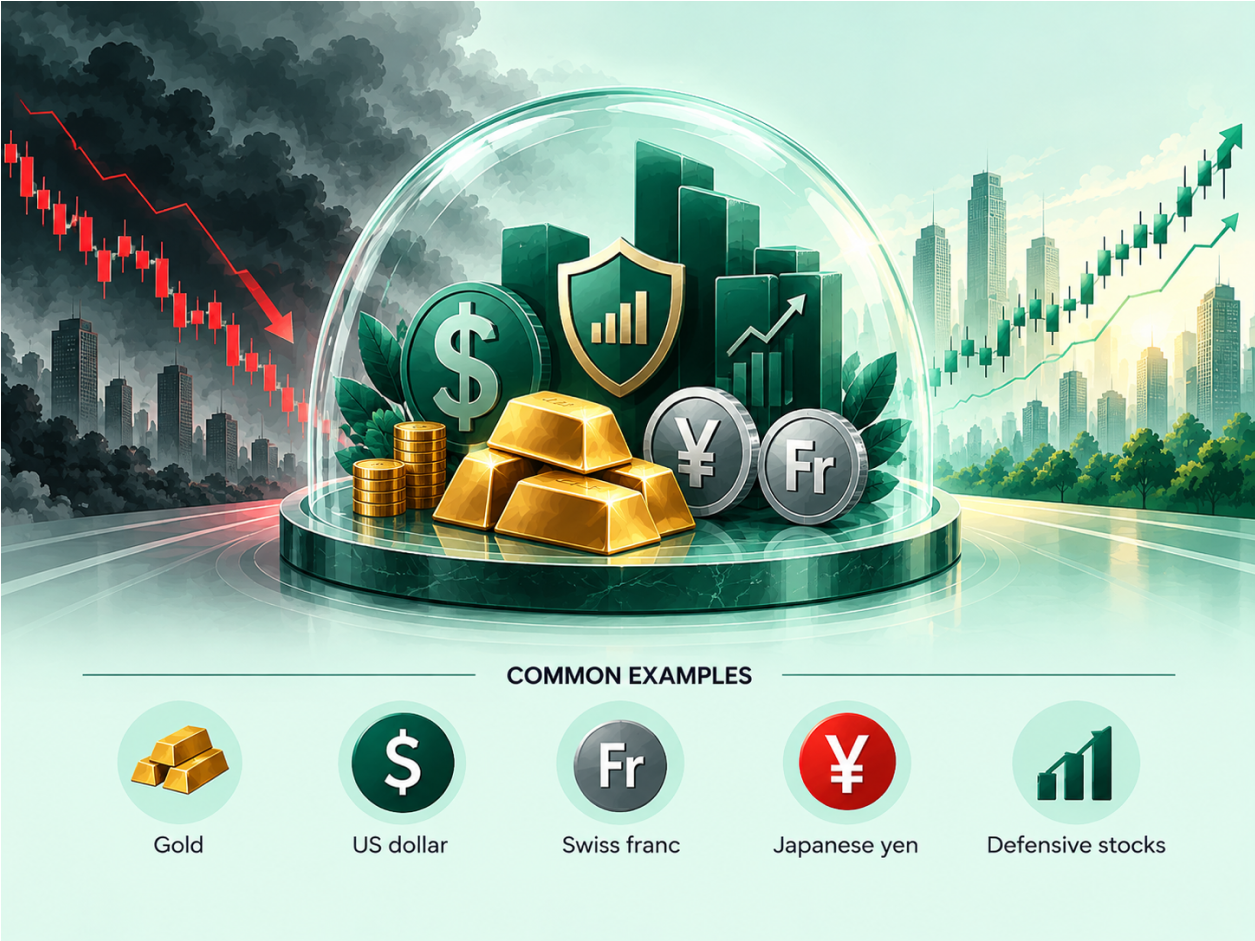
Understanding safe haven assets is crucial for developing robust risk management strategies and potentially identifying trading opportunities in challenging market conditions. This guide delves into their characteristics, popular examples, and how they can be integrated into a comprehensive trading approach.
What Defines a Safe Haven Asset?
While the specific assets considered “safe havens” can evolve with market dynamics, they generally share several core characteristics that contribute to their appeal during downturns:
Functionality
The asset needs to have a practical use that will continually provide long-term demand, ensuring its relevance beyond speculative interest.
Certainty of Demand
The asset is unlikely to be replaced or become outdated, guaranteeing its enduring desirability even as technologies or economic paradigms shift.
Uncorrelated or Negatively Correlated Performance
A primary attribute of a safe haven is its tendency to move independently or in the opposite direction to the broader market. When equities or riskier assets fall, a true safe haven should either hold its value or appreciate, offering a counterbalance to portfolio declines. For instance, if a global economic slowdown impacts corporate earnings and stock prices, a safe haven might see increased demand as capital flows out of riskier investments.
Limited Supply and Intrinsic Value
Assets with limited supply are often resistant to devaluation, particularly from inflationary pressures or excessive government printing. Precious metals, for example, are finite resources, giving them an inherent value that is not easily manipulated by monetary policy. This scarcity contributes to their long-term appeal as stores of value.
Consistent Demand and Permanence
Safe havens typically enjoy a consistent level of demand that endures across different economic conditions. They are also characterized by permanence, meaning they are not easily destroyed, perishable, or rendered obsolete. This ensures their utility and desirability persist, even during crises.
High Liquidity
The ability to easily convert an asset into cash without significantly impacting its market price is vital for a safe haven. High liquidity ensures that investors can quickly move into or out of these assets when market sentiment shifts, providing flexibility and responsiveness during volatile periods.
Why Traders and Investors Turn to Safe Havens
The primary motivation for utilizing safe haven assets is risk mitigation. During periods of heightened uncertainty, these assets can act as a buffer, preserving capital when other investments are under pressure. This makes them a key component of a diversification strategy, as their distinct behavior helps balance a portfolio’s overall risk exposure.
For CFD traders, understanding safe haven dynamics offers unique opportunities. While the core purpose is capital preservation, the increased demand for safe havens during crises can lead to significant price appreciation. This allows traders to potentially profit from these upward price movements by taking long positions on identified safe haven assets, even as broader markets decline. Conversely, recognizing a shift away from safe havens (e.g., as risk appetite returns) can signal potential downward pressure on their prices, opening up short-selling opportunities.
When Do Safe Havens Shine Brightest?
Safe haven assets typically gain prominence leading up to and during periods of market corrections, economic recessions, or geopolitical instability. Consider a scenario where an unexpected global health crisis emerges, causing widespread panic. Investors, fearing a severe economic downturn, might rapidly sell off growth stocks and high-yield bonds. This capital then seeks safety, flowing into assets perceived as more stable, driving up their prices.
Examples of events that historically trigger a flight to safety include:
- Major economic crises: Such as the 2008 Global Financial Crisis.
- Geopolitical conflicts: Regional wars or significant international tensions.
- High inflation or deflationary spirals: Eroding purchasing power.
- Central bank policy shifts: Unexpected interest rate hikes or quantitative tightening.
- Political instability: Domestic unrest or government defaults.
The perceived severity and duration of such events directly influence the demand for safe havens.
Historical Triggers and Market Reactions
Historically, several events have underscored the flight-to-safety phenomenon. During the 2008 Global Financial Crisis, for instance, gold emerged as a primary safe haven, with its price surging by nearly 24% in 2009 alone as investors sought refuge from collapsing equity markets. Similarly, in February 2018, a sharp plunge in global stocks, triggered by rising bond yields, paradoxically sent investors flocking to U.S. Treasury bonds, reinforcing their safe haven status. More recently, announcements by President Donald Trump regarding global trade tariffs led to increased stock market volatility, with the S&P 500 alone losing as much as $5 trillion in just two days of sell-offs, prompting a significant redirection of capital into perceived safe haven assets.
Popular Safe Haven Assets for Consideration
Several asset classes have historically demonstrated safe haven characteristics:
1. Precious Metals: Gold and Silver
Gold (XAU) stands as the quintessential safe haven. Its appeal stems from its finite supply, historical role as a store of value, and its independence from any single government’s monetary policy. While central bank decisions don’t directly set gold’s price, macroeconomic conditions and investor sentiment heavily influence its supply and demand. During periods of high inflation or geopolitical tension, gold often sees increased demand, driving its price higher.
Gold: Central Bank Buying & Self-Fulfilling Prophecy
This demand is not solely from individual investors; central banks globally have also been significant buyers. In 2024, for example, continued global uncertainty and persistent high inflation prompted central banks to extend their gold buying spree, exceeding 1,000 tonnes for the third consecutive year. Furthermore, gold’s status as a safe haven often becomes a self-fulfilling prophecy, driven by behavioral biases where its historical performance during crises reinforces investor confidence and demand.
- Example: Imagine a sudden escalation of tensions in a major oil-producing region. The uncertainty could trigger a sharp sell-off in global equities and a surge in crude oil prices. Simultaneously, investors might flock to gold, viewing it as a reliable store of value amidst the turmoil, causing its price to climb.
- Other Metals: Silver (XAG), Platinum (PL), and Palladium (PA) can also exhibit safe haven qualities, often moving in tandem with gold, though their industrial uses can introduce additional volatility.
2. Government Bonds: U.S. Treasuries
While government bonds like U.S. Treasuries are widely regarded as safe havens, LQH Markets does not offer these instruments for trading. Traders can explore other safe haven assets available on our platform, such as certain currency pairs or precious metals. They are backed by the “full faith and credit” of the U.S. government, making them virtually risk-free in terms of default. During market downturns, investors often reallocate funds into these debt securities for their perceived safety and predictable returns.
- Mechanism: When economic growth slows or a recession looms, central banks might lower interest rates to stimulate the economy. This makes existing bonds with higher fixed interest payments more attractive, driving up their prices.
- Example: If a major economic report indicates a significant slowdown in GDP growth, investors might sell off corporate bonds and stocks, and buy U.S. Treasuries, pushing their prices up and yields down, as they seek a secure place for their capital.
3. Safe Haven Currencies: USD, CHF, JPY
Certain national currencies are favored during times of global uncertainty due to the perceived stability of their issuing countries.
- U.S. Dollar (USD): The USD holds its status as the world’s primary reserve currency and the denomination for a vast array of international trade and commodities. Despite domestic economic fluctuations, its deep liquidity and global acceptance often make it a default choice for capital seeking safety.The U.S. dollar’s pre-eminence as the world’s primary reserve currency was solidified by the 1944 Bretton Woods agreement. Its role as a safe haven is consistently observed; for example, Morgan Stanley noted in 2022 that the USD effectively diversified portfolios due to its negative correlation with global equities during turbulent times.
- Swiss Franc (CHF): Switzerland’s long-standing political neutrality, robust financial system, and economic stability have cemented the Swiss franc’s reputation as a safe haven. Its independence from the European Union also insulates it from regional economic or political shocks. The Swiss National Bank (SNB) has, at times, intervened to manage the franc’s strength, such as during the Eurozone crisis when it temporarily pegged the CHF to the Euro to prevent excessive appreciation that could harm Swiss exports.
-
Japanese Yen (JPY): The Japanese yen often appreciates against other major currencies during “risk-off” periods. This is partly due to Japan’s status as a major creditor nation and its large current account surplus. When global markets become volatile, Japanese investors tend to repatriate foreign assets, strengthening the yen. This repatriation mechanism, combined with Japan’s consistent current account surplus, underpins the yen’s safe haven appeal. Like gold, the yen’s reputation as a safe haven can also become a self-fulfilling prophecy, as its historical performance during “risk-off” periods encourages further inflows.
-
Example: Should a major banking crisis erupt in Europe, traders might sell off the Euro and buy Swiss Francs, anticipating that Switzerland’s stable banking sector and political neutrality will offer a safer environment for capital.
4. Defensive Stocks
Unlike growth stocks, defensive stocks belong to companies that provide essential goods and services, for which demand remains relatively stable regardless of the economic climate. These include sectors like:
- Consumer Staples: Food, beverages, household products (e.g., a major grocery chain).
- Utilities: Electricity, gas, water providers (e.g., a regional power company).
- Healthcare: Pharmaceuticals, medical devices, biotechnology (e.g., a leading drug manufacturer).
-
Communication Services: Essential internet and mobile providers.
-
Example: During a recession, consumers might cut back on luxury goods, but they will still buy groceries, pay for electricity, and seek medical care. Companies in these sectors tend to have more stable earnings and cash flows, making their stocks less volatile than the broader market.
- Defensive stocks: These stocks belong to companies that provide essential goods and services, for which demand remains relatively stable regardless of the economic climate, offering diversified exposure to resilient sectors. Examples of defensive ETFs include the iShares MSCI USA Min Vol Factor ETF (USMV), Fidelity MSCI Utilities Index ETF (FUTY), and Vanguard Consumer Staples ETF (VDC). It’s crucial to distinguish “defensive stocks” from “defence stocks,” which refer to companies in the military and aerospace industry; while some defence stocks may exhibit stability, their primary driver is government spending rather than broad economic resilience.
5. Cash
While offering no yield and susceptible to inflation, cash (or highly liquid cash equivalents) is arguably the simplest and most direct safe haven. In extreme market dislocations, the ability to hold cash and avoid any market exposure can be invaluable, allowing investors to wait out the storm and deploy capital when opportunities arise.
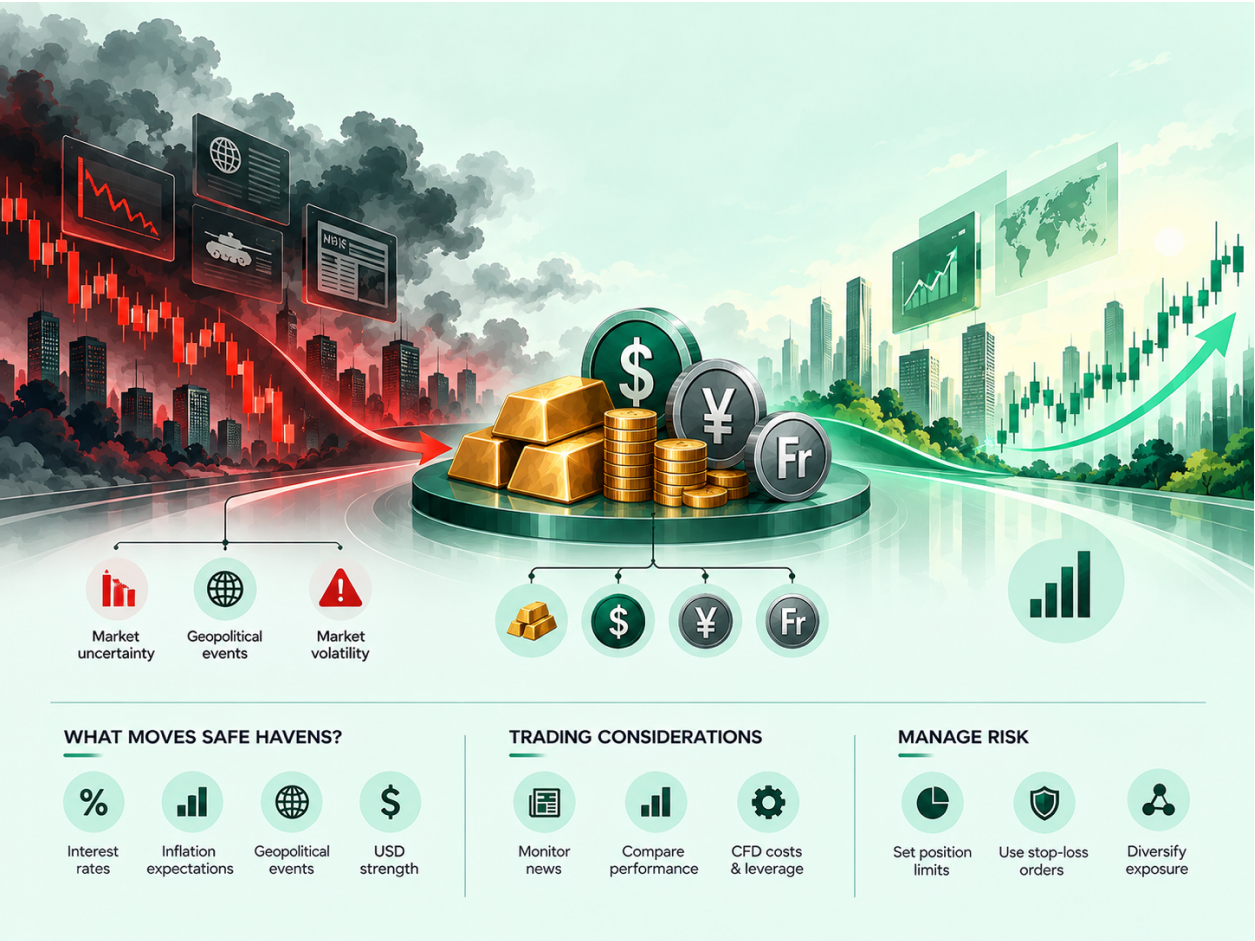
Key Considerations for Trading Safe Haven Assets
While safe havens offer protection, they are not immune to price fluctuations and require careful consideration:
- Dynamic Nature: What constitutes a safe haven can shift. An asset considered safe in one crisis (e.g., a regional conflict) might not perform as expected in another (e.g., a liquidity crunch). Continuous market analysis is essential.
- Inflation Risk: Even safe havens can suffer from inflation, which erodes purchasing power. While gold often hedges against inflation, cash and bonds can be particularly vulnerable if inflation outpaces their yield.
- Overvaluation Risk: During severe downturns, a rush into safe havens can push their prices to unsustainable levels. Entering the market when an asset is significantly overvalued can lead to losses if risk appetite returns and prices normalize.
- CFD Trading Nuances: When trading safe haven assets via CFDs, remember that these are leveraged products. While leverage can amplify gains from price movements, it also magnifies potential losses. Implement robust risk management, including stop-loss orders, to protect capital.
- Diversification: No single asset is a guaranteed safe haven in all scenarios. A well-diversified portfolio, incorporating a mix of traditional and alternative safe havens, along with other asset classes, remains the most prudent approach.
- Behavioral Biases and Self-Fulfilling Prophecies: For some safe haven assets, particularly gold and the Japanese Yen, their status is reinforced by psychological factors. A “self-fulfilling prophecy” occurs when the widespread belief in an asset’s safe haven status during crises drives actual capital flows into it, thereby validating and strengthening its perceived role, irrespective of underlying fundamentals.
Conclusion
Safe haven assets play a critical role in navigating the unpredictable landscape of financial markets. By understanding their characteristics and identifying key examples like gold, the U.S. dollar, Swiss franc, Japanese yen, government bonds, and defensive stocks, traders and investors can better position themselves to preserve capital during periods of volatility. While their primary function is risk mitigation, the dynamic price action of safe havens also presents potential trading opportunities for those who can accurately gauge market sentiment and global developments. Integrating safe haven analysis into your trading strategy can enhance resilience and adaptability in an ever-changing market environment.
Frequently Asked Questions
How do safe haven assets differ from other investments during market downturns?
Safe haven assets are expected to retain or increase in value during market downturns, unlike most other investments (like growth stocks) which typically decline. They often exhibit a negative or uncorrelated relationship with the broader economy, providing a protective buffer for portfolios.
Can the status of a safe haven asset change over time?
Yes, the status of an asset as a safe haven is not absolute and can evolve. Market conditions, geopolitical shifts, and changing investor sentiment can influence which assets are perceived as safe, necessitating continuous analysis and adaptation of strategies.
What role does inflation play when considering safe haven assets?
Inflation can erode the purchasing power of any investment, including safe havens. While assets like gold are often considered an inflation hedge, cash and certain bonds can be particularly vulnerable if inflation rates are high and exceed their returns, diminishing their real value.
Are safe haven assets always a good investment?
Not necessarily. While they offer stability during turbulent times, safe haven assets typically provide lower returns in strong, risk-on markets compared to growth-oriented investments. Their value is primarily in risk mitigation and diversification, not necessarily maximizing returns in all market conditions.
How can CFD traders utilize safe haven assets?
CFD traders can utilize safe haven assets to hedge existing positions or to speculate on their price appreciation during market uncertainty. By taking long positions on safe havens when risk aversion is high, traders can potentially profit from increased demand, though the use of leverage requires careful risk management.
Knowledge Check
1. Which of the following is NOT a typical characteristic of a safe haven asset?
- A) High liquidity
- B) Uncorrelated or negatively correlated performance
- C) Unlimited supply
- D) Consistent demand
2. Which currency is traditionally considered a safe haven due to its country’s political neutrality and stable financial system?
- A) Euro (EUR)
- B) British Pound (GBP)
- C) Swiss Franc (CHF)
- D) Canadian Dollar (CAD)
3. During a period of high inflation and geopolitical tension, which asset is most likely to see increased demand as a safe haven?
- A) High-growth technology stocks
- B) Corporate junk bonds
- C) Gold
- D) Emerging market equities
Click to view the answers
1. **C)** – Safe haven assets typically have a limited supply, making them resistant to devaluation and contributing to their intrinsic value.
2. **C)** – The Swiss Franc (CHF) benefits from Switzerland’s long-standing political neutrality and robust financial stability, making it a favored safe haven currency.
3. **C)** – Gold is historically considered a strong hedge against inflation and a reliable store of value during geopolitical tensions, leading to increased demand in such scenarios.