


The burgeoning cryptocurrency market presents a myriad of opportunities for investors and traders alike. As digital assets like Bitcoin and Ethereum gain mainstream acceptance, understanding the various avenues for market exposure becomes paramount. Two primary methods stand out: buying and holding cryptocurrencies directly, known as spot crypto trading, and speculating on their price movements through Contracts for Difference (CFDs).
While both approaches aim to capitalize on crypto market fluctuations, they differ fundamentally in terms of ownership, risk, cost structures, and strategic application. This guide delves into the nuances of Crypto CFDs versus Spot Crypto, equipping you with the knowledge to make informed decisions tailored to your trading objectives.
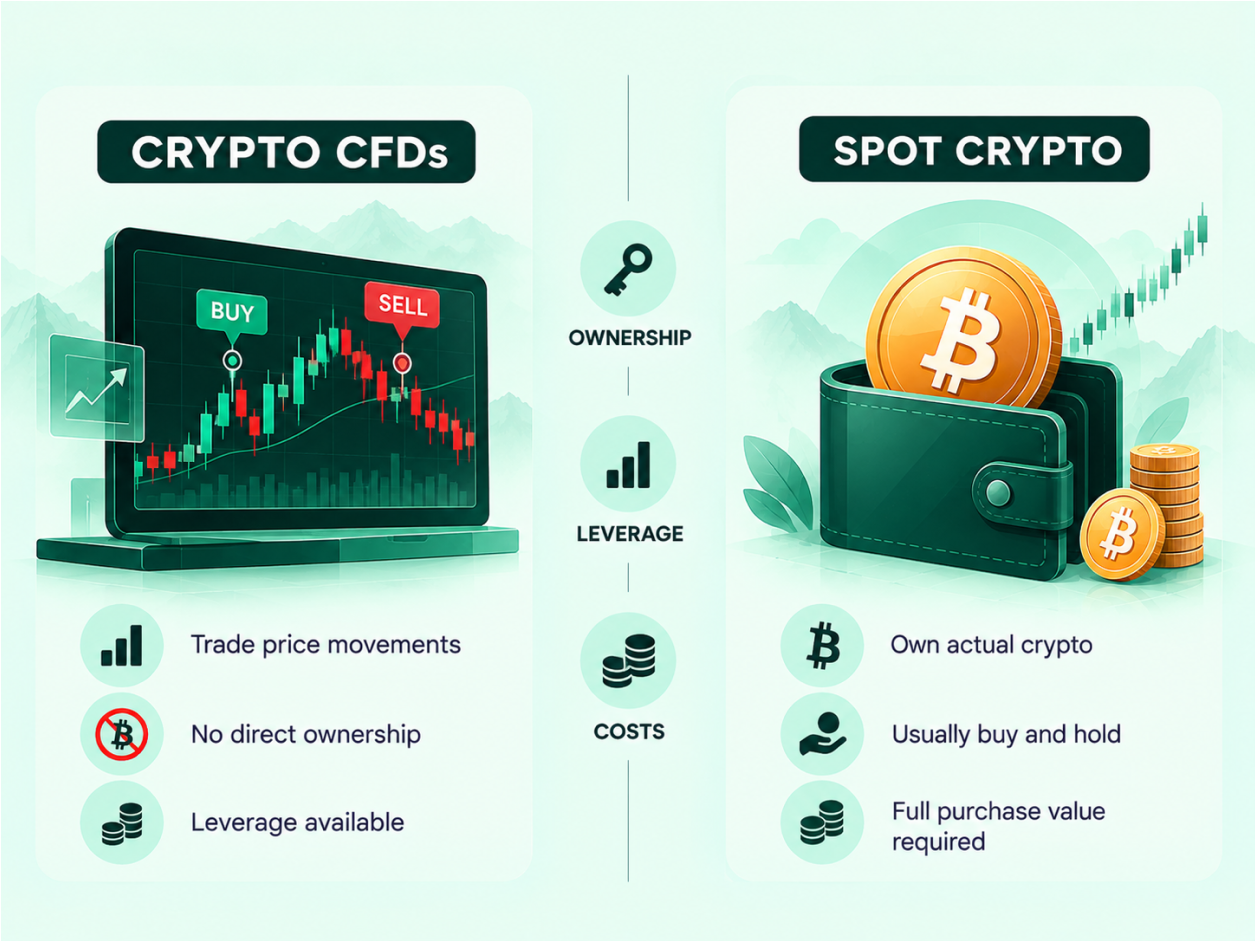
Crypto CFDs are derivative instruments that allow traders to speculate on the price movements of cryptocurrencies without actually owning the underlying digital asset. In contrast, Spot Crypto trading involves the direct purchase and ownership of cryptocurrencies on an exchange, with the asset typically held in a digital wallet.
What is Spot Crypto Trading?
Spot crypto trading is the most direct way to engage with the cryptocurrency market. When you buy spot crypto, you are purchasing the actual digital asset, such as Bitcoin (BTC) or Ethereum (ETH), at its current market price. This transaction typically occurs on a cryptocurrency exchange, where you exchange fiat currency (like USD) or another cryptocurrency for your desired digital asset.
Direct Ownership and Custody: The defining characteristic of spot crypto trading is direct ownership. Once purchased, the cryptocurrency becomes yours. This means you have the option to keep it on the exchange (exchange custody) or transfer it to a personal digital wallet (self-custody). Self-custody, often involving hardware wallets, grants you complete control over your assets and the associated private keys, but also places the full responsibility for security squarely on your shoulders. Losing private keys or falling victim to a phishing scam can result in irreversible loss of funds.
Profit Mechanism: The primary way to profit from spot crypto is by buying low and selling high. For instance, if you buy 1 ETH for $3,000 and its price later rises to $3,500, you could sell it for a $500 profit (minus any exchange fees). Spot trading is generally favored by investors with a longer-term horizon, often referred to as “HODLers,” who believe in the sustained growth potential of cryptocurrencies.
Limited Short-Selling: While some advanced crypto exchanges offer margin trading or futures contracts that allow for short-selling, the fundamental nature of spot trading is typically geared towards profiting from rising prices. Directly shorting a spot asset is not a standard feature.
Cost Structure: Costs in spot crypto trading typically include:
- Trading Fees: A percentage of the transaction value charged by the exchange (e.g., 0.1% to 0.5%).
- Spreads: The difference between the bid and ask price, which can vary.
- Withdrawal Fees: Charged when transferring crypto out of the exchange to a personal wallet.
- Network Fees (Gas Fees): Paid to blockchain miners/validators to process your transaction on the network, especially for transfers.
What are Crypto CFDs?
A Crypto CFD (Contract for Difference) is a financial derivative that enables traders to speculate on the price fluctuations of cryptocurrencies without ever owning the underlying asset. Instead of buying actual Bitcoin, for example, you enter into a contract with a CFD broker to exchange the difference in its price from the time the contract is opened until it is closed.
No Ownership, No Custody: With CFDs, you do not take physical possession of any cryptocurrency. This eliminates the need for a digital wallet, private key management, or concerns about exchange hacks or lost credentials. Your exposure is purely financial, tied to the price movement of the underlying crypto.
Profit from Both Rising and Falling Prices: A significant advantage of Crypto CFDs is the ability to trade in both directions. If you anticipate a cryptocurrency’s price will rise, you open a “buy” (long) position. If you expect it to fall, you open a “sell” (short) position. This flexibility allows traders to potentially profit in various market conditions. For example, if you believe Bitcoin will drop from $70,000, you could open a short CFD position. If it falls to $68,000, you could close your position for a profit (before costs).
Leverage: CFDs are leveraged products, meaning you can control a larger position with a relatively small amount of capital, known as trading margin. For instance, with 2:1 leverage, a $1,000 margin deposit could control a $2,000 position in a crypto CFD. While leverage can magnify potential profits, it equally magnifies potential losses, making CFDs a higher-risk instrument. Regulatory bodies often impose limits on the leverage available to retail clients for crypto CFDs (e.g., 2:1 in some jurisdictions).
Holding Period and Overnight Funding: Crypto CFDs are generally suited for short-to-medium-term trading strategies rather than long-term investing. Positions held overnight typically incur “overnight funding” or “swap” fees. These are interest adjustments that reflect the cost of holding the leveraged position, and they can either be debited or credited to your account depending on the direction of your trade and the underlying interest rates.
Cost Structure: The main costs associated with Crypto CFDs include:
- Spreads: The difference between the buy and sell price, which is the broker’s primary charge.
- Overnight Funding (Swap Fees): Charged daily for positions held past a specific cut-off time.
- Commissions: Some brokers may charge a separate commission per trade, though many offer spread-only pricing. LQH Markets offers commission-free trading on Crypto CFDs for Standard, Pro, and Zero Commission accounts. For Institutional and Deposit Bonus accounts, a commission of 0.003% of the notional value applies to Crypto CFDs.
Head-to-Head Comparison: Key Differentiators
Understanding the core differences between Crypto CFDs and Spot Crypto is crucial for aligning your trading strategy with the right instrument.
Ownership and Custody
- Spot Crypto: You own the actual cryptocurrency. This necessitates managing a digital wallet, either on an exchange or a personal device. Ownership brings the responsibility of securing your assets from hacks, theft, or loss of private keys.
- Crypto CFDs: You do not own the underlying cryptocurrency. Your position is a contract with a broker based on the asset’s price. This eliminates the need for wallet management and the associated security concerns of direct crypto custody.
Trading Direction
- Spot Crypto: Primarily designed for “long” positions, profiting when the asset’s price increases. While some exchanges offer margin or futures for shorting, it’s not the default mechanism for spot trading.
- Crypto CFDs: Offer inherent flexibility to go “long” (buy) if you expect prices to rise, or “short” (sell) if you expect prices to fall. This allows traders to capitalize on both bullish and bearish market trends.
Leverage
- Spot Crypto: Typically traded without leverage, meaning you must fund the full value of your purchase. Some platforms offer margin trading, but this is a separate feature from basic spot buying.
- Crypto CFDs: Are leveraged products. This means you can open a position worth more than your initial capital outlay, amplifying both potential profits and losses. Regulatory limits often apply to retail leverage for crypto CFDs.
Costs
- Spot Crypto: Involves trading fees (commissions), spreads, and potentially withdrawal and blockchain network fees. These costs are generally incurred per transaction and transfer.
- Crypto CFDs: Primarily involve spreads and overnight funding costs for positions held open beyond a trading day. Some brokers may also charge commissions. The absence of network fees and withdrawal fees can make CFDs seem more streamlined for frequent trading.
Regulation
- Spot Crypto Exchanges: The regulatory landscape for cryptocurrency exchanges varies significantly across jurisdictions, with some being highly regulated and others operating with minimal oversight. This can impact investor protection and recourse in case of issues.
- CFD Brokers: Reputable CFD brokers operate under various regulatory frameworks depending on their jurisdiction. Reputable CFD brokers operate under various regulatory frameworks depending on their jurisdiction. LQH Markets is registered as an International Business Company in Saint Lucia and operates in compliance with the laws of that jurisdiction, offering segregated client funds and adhering to its operational standards.
Regulatory Frameworks and Leverage Limits: A Deeper Look
The regulatory environment plays a crucial role in shaping the trading experience for both Crypto CFDs and spot crypto. For Crypto CFDs, established jurisdictions often impose strict rules to protect retail investors. For example, in Australia, the Australian Securities and Investments Commission (ASIC) mandates a maximum leverage ratio of 2:1 for retail crypto CFDs. This limit is designed to mitigate the magnified losses that can arise from high leverage, ensuring that traders are not exposed to excessive risk. Such regulations directly impact a trader’s capital requirements, as a larger margin is needed to open a position compared to unregulated offshore platforms.
In contrast, the regulatory landscape for spot crypto exchanges can be more fragmented and less mature. While some major exchanges operate under robust licenses, others may have minimal oversight, leading to varying levels of investor protection, transparency, and recourse in case of disputes or security breaches. Reputable CFD brokers, by operating under specific financial licenses, often provide a more standardized and regulated trading environment, offering safeguards such as segregated client funds and dispute resolution mechanisms that might be less consistently available across all spot crypto exchanges.
Market Access
- Spot Crypto Exchanges: Primarily offer access to cryptocurrencies, though some larger exchanges may list a vast array of altcoins.
- CFD Brokers: Often provide access to a broad range of financial instruments from a single account, including forex, commodities, indices, and shares, alongside crypto CFDs. This allows for portfolio diversification and trading various markets without needing multiple accounts.
Transaction Workflow & Capital Flow
The practicalities of moving capital and executing trades differ significantly between spot crypto and Crypto CFDs. For spot crypto, the process often involves several steps: depositing fiat currency into an exchange, potentially converting it into a stablecoin (like USDT or USDC), and then using that stablecoin to purchase the desired cryptocurrency. Each of these steps can incur various costs, including exchange fees, spreads on conversions, and blockchain network fees (gas fees) if you transfer assets between wallets or off the exchange. This multi-stage workflow can sometimes be less efficient and more costly, especially for frequent traders or those dealing with smaller transaction sizes.
In contrast, trading Crypto CFDs streamlines the capital flow. Your trading capital remains with the CFD broker, and trades are executed directly against the broker’s liquidity. This eliminates the need for multiple currency conversions, the complexities of managing stablecoins, and the payment of blockchain network fees for asset transfers. The primary costs are typically the spread and overnight funding, making the operational aspect of trading potentially smoother and more direct, as funds are managed within a single brokerage account.
Strategic Considerations: When to Use Which?
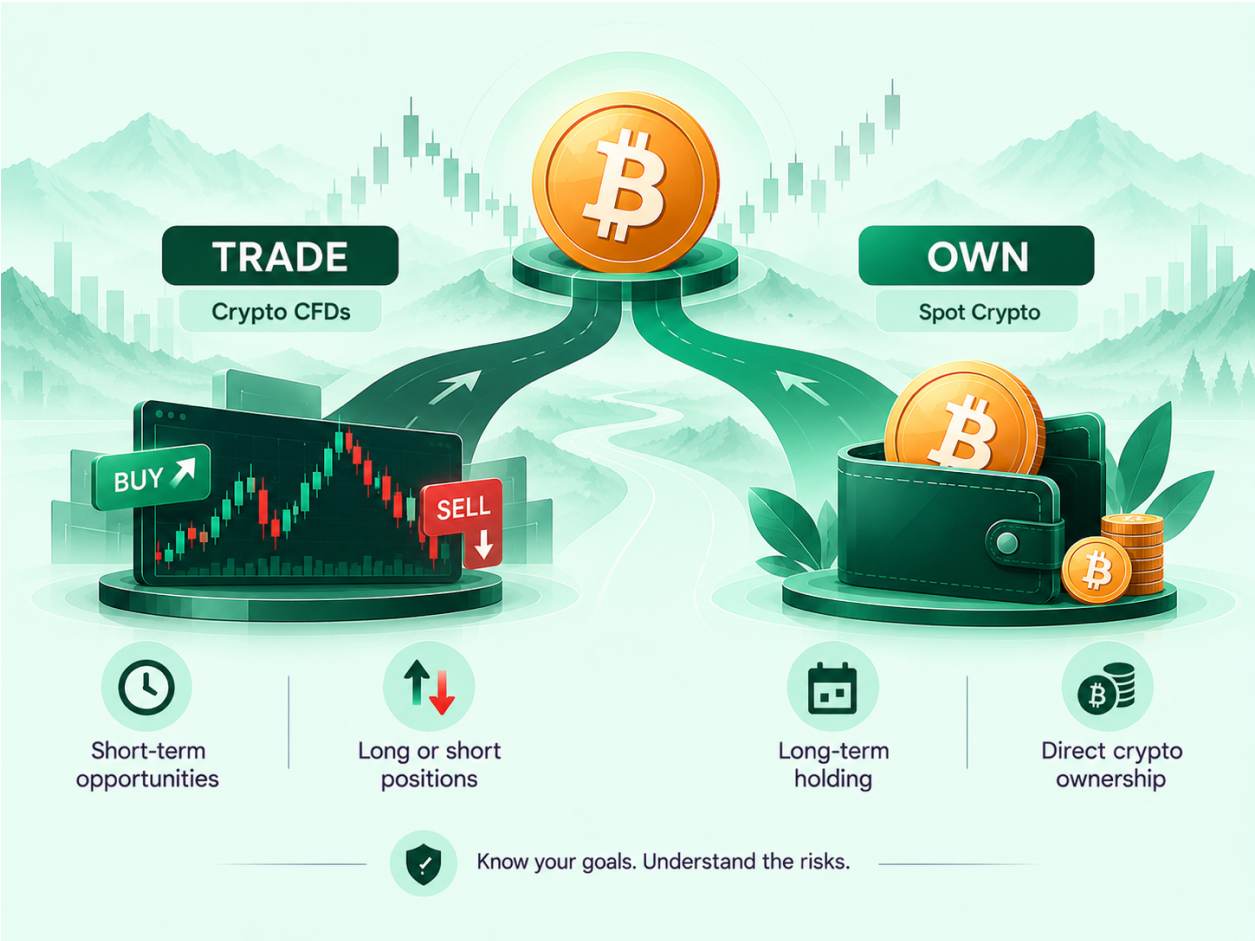
The choice between Crypto CFDs and Spot Crypto largely depends on your investment goals, risk tolerance, and trading style.
For Long-Term Investment (HODLing)
If your objective is to acquire and hold cryptocurrencies for an extended period, believing in their long-term value appreciation, spot crypto trading is generally the more appropriate choice. Direct ownership aligns with a buy-and-hold strategy, allowing you to benefit from potential staking rewards or participation in decentralized finance (DeFi) ecosystems, which are not typically available with CFDs.
Beyond Price: The Ecosystem Benefits of Spot Crypto Ownership
Beyond mere price appreciation, direct ownership of spot cryptocurrencies unlocks a vibrant ecosystem of opportunities within the broader Web3 space. When you hold actual digital assets, you gain the ability to actively participate in and benefit from various decentralized applications and protocols. For instance, staking involves locking up your cryptocurrencies to support the operations of a blockchain network, in return for earning passive rewards, similar to earning interest. Similarly, yield farming allows you to provide liquidity to decentralized finance (DeFi) protocols, earning fees and governance tokens for your contribution.
Furthermore, direct ownership often grants you governance rights within Decentralized Autonomous Organizations (DAOs), enabling you to vote on key proposals and influence the future direction of a project. It also provides direct access to the burgeoning world of Non-Fungible Tokens (NFTs), allowing you to collect, create, and trade unique digital assets. These forms of engagement and potential income generation are exclusive to holding the underlying crypto assets and are not available when trading Crypto CFDs, which offer purely financial exposure to price movements.
For Short-Term Speculation and Active Trading
For traders looking to capitalize on rapid price movements, execute frequent trades, or speculate on both rising and falling markets, Crypto CFDs offer distinct advantages. The ability to go long or short, coupled with leverage, makes CFDs a powerful tool for active trading strategies like day trading or swing trading. The absence of direct custody also simplifies the trading process by removing wallet management complexities.
For Hedging Existing Spot Positions
CFDs can be an effective tool for hedging. If you hold a substantial amount of spot Bitcoin and anticipate a temporary market downturn, you could open a short Bitcoin CFD position. A loss on your spot holdings might be offset by a gain on your short CFD position, protecting the overall value of your portfolio without having to sell your underlying assets.
Capital Efficiency and Diversification
Leverage in CFDs can offer capital efficiency, allowing you to control a larger position with less upfront capital. This can free up capital for diversifying across other markets offered by CFD brokers, such as forex or commodities, from a single trading account. However, this efficiency comes with amplified risk.
Risks and Important Considerations
Both Crypto CFDs and Spot Crypto trading involve significant risks, primarily due to the inherent volatility of the cryptocurrency market.
- Market Volatility: Cryptocurrencies are notoriously volatile. Prices can swing dramatically in short periods, leading to substantial gains or losses in both spot and CFD trading.
- Leverage Risk (CFDs): While leverage can magnify profits, it also magnifies losses. A small adverse price movement can result in significant capital loss, potentially exceeding your initial deposit. It’s crucial to employ robust risk management strategies, such as stop-loss orders.
- Custody and Security Risk (Spot Crypto): Holding actual cryptocurrencies, especially in self-custody, means you are responsible for their security. Exchange hacks, phishing scams, or losing private keys can lead to irreversible loss of funds.
- Overnight Funding Costs (CFDs): Holding CFD positions overnight incurs funding fees, which can accumulate over time and erode potential profits, especially for longer-term CFD trades.
- Regulatory Landscape: The regulatory environment for cryptocurrencies and derivatives is continuously evolving. Traders should be aware of the specific rules and protections (or lack thereof) in their jurisdiction.
Conclusion
The decision between trading Crypto CFDs and buying Spot Crypto boils down to your individual financial objectives, risk appetite, and preferred trading methodology.
If your goal is to own the underlying digital asset for long-term investment, potential staking rewards, or full control over your crypto, then spot crypto trading on a reputable exchange is your path. You embrace direct ownership and its associated responsibilities, including wallet management and security.
Conversely, if you are an active trader primarily interested in speculating on price movements, seeking the flexibility to go long or short, and potentially utilizing leverage without the complexities of direct asset custody, then Crypto CFDs offer a compelling alternative. This approach shifts the focus from ownership to price speculation, with the broker operating under the regulatory framework of its jurisdiction.
Regardless of your choice, a thorough understanding of the product, its associated costs, and the inherent risks of the cryptocurrency market is essential. Always ensure you are trading with a regulated provider and employ sound risk management practices.
Frequently Asked Questions
Is it better to buy Crypto or trade Crypto CFDs?
The “better” option depends on your goals. Buying spot crypto is suitable for long-term holding and direct ownership. Trading crypto CFDs is often preferred by active traders who want to speculate on price movements, including falling prices, without owning the underlying asset.
Do I own cryptocurrency when trading a Crypto CFD?
No, when trading a Crypto CFD, you do not own the underlying cryptocurrency. A CFD is a derivative contract that tracks the asset’s price, allowing you to profit from price changes without taking physical possession or needing a digital wallet.
Can I short cryptocurrencies with CFDs?
Yes, a significant advantage of Crypto CFDs is the ability to open “sell” (short) positions, allowing you to potentially profit if the cryptocurrency’s price declines. This contrasts with basic spot crypto trading, which is primarily focused on profiting from rising prices.
Are Crypto CFDs cheaper than spot crypto?
Not necessarily. Crypto CFDs typically involve spreads and overnight funding fees. For LQH Markets, Standard, Pro, and Zero Commission accounts trade Crypto CFDs commission-free, while Institutional and Deposit Bonus accounts incur a 0.003% notional value commission. Spot crypto trading incurs trading commissions, spreads, and potentially withdrawal and network fees. The overall cost depends on your trading frequency, position size, and holding period.
Do I need a crypto wallet to trade Crypto CFDs?
No, you do not need a crypto wallet to trade Crypto CFDs. Since you do not own the underlying cryptocurrency, there is no need to store or manage digital assets, simplifying the trading process.
Knowledge Check
1. Which of the following is a primary characteristic of spot crypto trading?
- A) The ability to easily short sell the asset without additional derivatives.
- B) Direct ownership of the underlying cryptocurrency.
- C) Mandatory use of leverage for all transactions.
- D) No associated fees for transactions or transfers.
2. What is a key risk associated with using leverage in Crypto CFD trading?
- A) The need for a secure digital wallet to store the leveraged assets.
- B) The potential for magnified profits, but also magnified losses.
- C) The inability to trade in both rising and falling markets.
- D) High blockchain network fees for every trade.
3. If a trader wants to speculate on a cryptocurrency’s price decline without owning the asset, which instrument would be more suitable?
- A) Buying spot crypto on an exchange.
- B) Holding the cryptocurrency in a hardware wallet.
- C) Opening a short position with a Crypto CFD.
- D) Participating in a staking pool.
Click to view the answers
1. **B)** – Spot crypto trading involves the direct purchase and ownership of the underlying cryptocurrency.
2. **B)** – Leverage in CFDs amplifies both potential profits and potential losses, making it a higher-risk instrument.
3. **C)** – Crypto CFDs allow traders to open short positions, enabling them to speculate on and potentially profit from a cryptocurrency’s price decline without owning the asset.