

The digital asset landscape, often simply referred to as “crypto,” has expanded dramatically since Bitcoin’s inception. For traders navigating this dynamic market, understanding the fundamental distinctions between Bitcoin and the myriad of “altcoins” is crucial for informed decision-making and strategic portfolio construction. While both operate on blockchain technology, their purposes, underlying mechanisms, and risk profiles often diverge significantly.
Altcoins, short for “alternative coins,” encompass all cryptocurrencies other than Bitcoin. While Bitcoin pioneered decentralized digital money, altcoins introduce diverse features, technologies, and use cases to the broader digital asset ecosystem.
Understanding Bitcoin: The Digital Foundation
Launched in 2009 by the pseudonymous Satoshi Nakamoto, Bitcoin (BTC) was conceived as a decentralized digital currency, enabling peer-to-peer transactions without the need for traditional financial intermediaries like banks. It introduced the world to blockchain technology, a distributed ledger system that ensures transparency, security, and resistance to tampering.
Bitcoin’s emergence was not coincidental; it was born in the wake of the 2008 global financial crisis, a period that severely eroded public trust in traditional banks and state-controlled financial institutions worldwide. Satoshi Nakamoto’s innovation offered a radical alternative: a mathematically-driven system with fixed, transparent rules, designed to operate without central intermediaries. This decentralized nature, immune to unilateral manipulation or bailouts, positioned Bitcoin as a direct response to the era’s financial instability, providing a blueprint for a new, trustless monetary paradigm.
Bitcoin’s core characteristics make it unique:
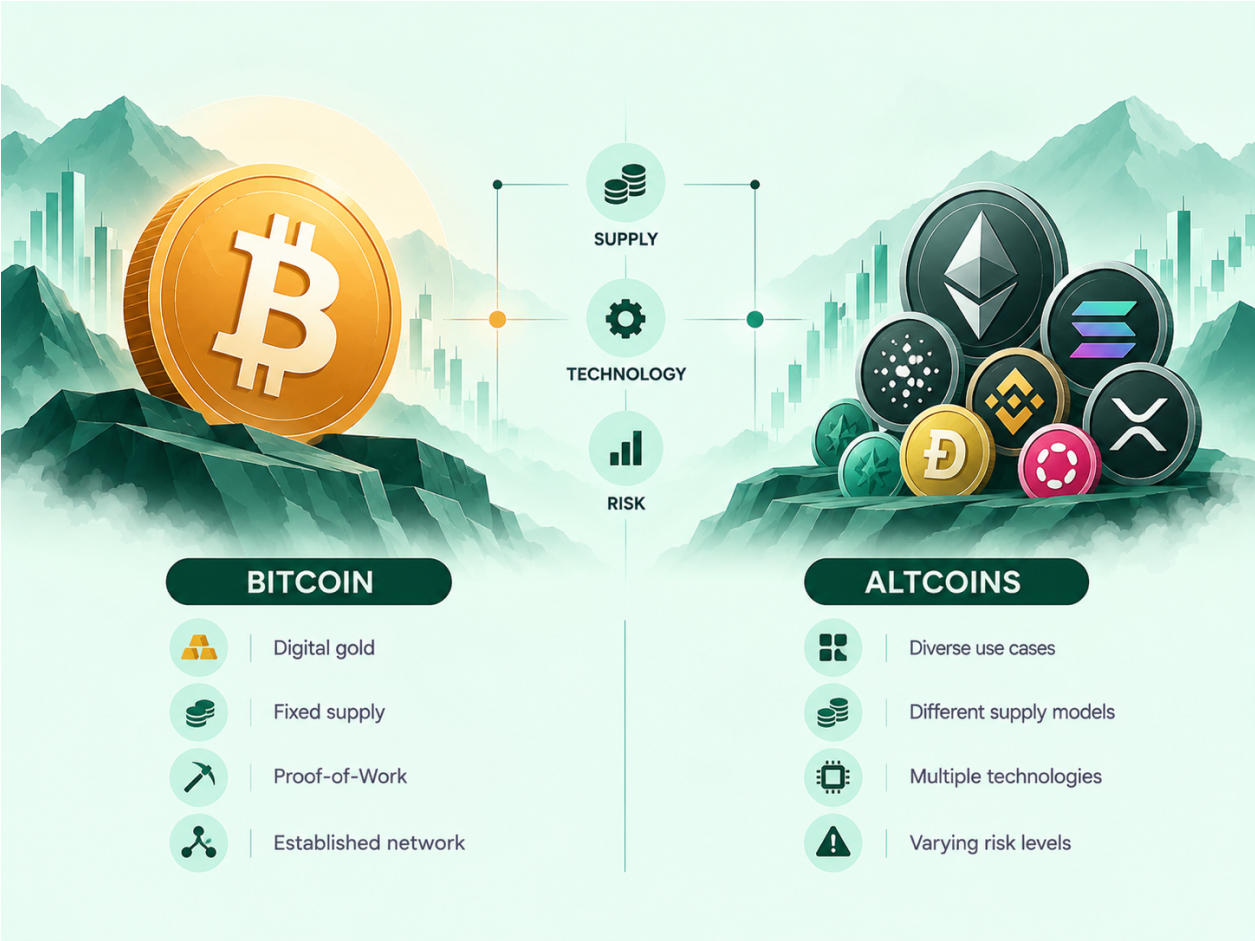
- Fixed Supply: A fundamental principle of Bitcoin is its hard-coded scarcity. Only 21 million BTC will ever be created, making it a deflationary asset by design. This finite supply is often compared to precious metals like gold, earning Bitcoin the moniker “digital gold” and positioning it as a potential store of value, especially during periods of economic uncertainty.
- Proof-of-Work (PoW) Security: Bitcoin’s network is secured by a Proof-of-Work consensus mechanism. Miners compete to solve complex mathematical puzzles, and the first to succeed validates a block of transactions, adding it to the blockchain. This energy-intensive process makes the network incredibly robust and resistant to attacks, establishing Bitcoin as the most secure and decentralized blockchain network.
- Decentralization: Bitcoin operates without a central authority, CEO, or governing body. It is an open, global protocol maintained by thousands of independent participants worldwide, ensuring its neutrality and resistance to unilateral manipulation.
- Purpose as a Store of Value: While initially designed for peer-to-peer payments, Bitcoin has largely evolved into a primary store of value for many investors. Its conservative code, stability-focused development, and long track record contribute to this perception, making it a foundational asset in many digital asset portfolios.
Exploring Altcoins: Innovation and Specialization
The term “altcoin” is a catch-all for any cryptocurrency that is not Bitcoin. Since Bitcoin laid the groundwork, developers have created thousands of altcoins, each aiming to improve upon Bitcoin’s design or fulfill entirely different functions. These range from large, well-established networks to highly specialized tokens, collectively accounting for a substantial share of the digital asset ecosystem’s total value and activity.
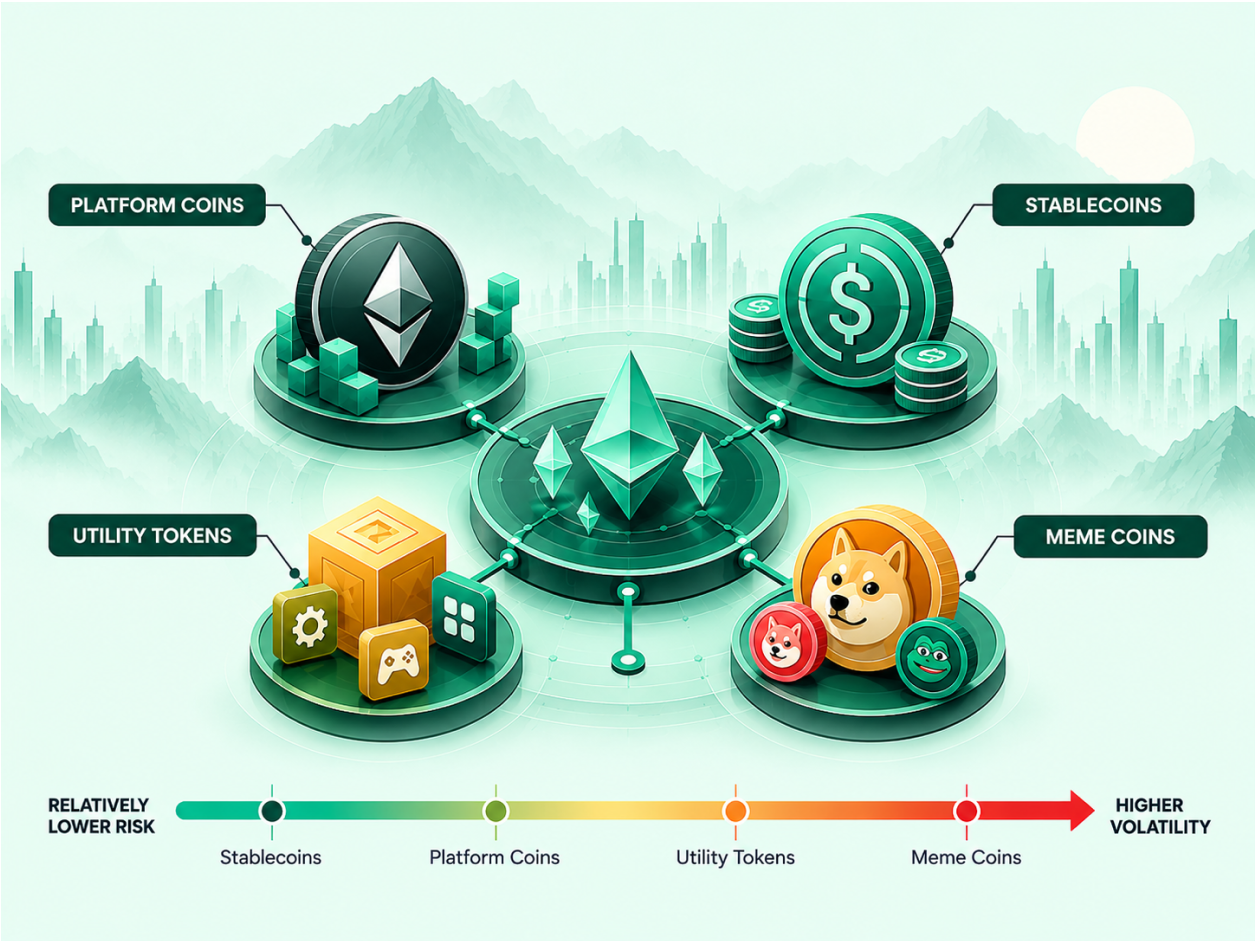
Altcoins can be broadly categorized by their primary function and technology:
Platform Coins (Layer 1s)
These cryptocurrencies power their own independent blockchains, serving as the foundational infrastructure for decentralized applications (dApps) and smart contracts. They are the “operating systems” of Web3.
- Examples: Ethereum (ETH), Solana (SOL), Cardano (ADA), Polkadot (DOT).
- Significance for Traders: These assets often represent investments in the underlying technology and ecosystem growth. Their performance can be tied to the adoption and development of dApps, DeFi protocols, and NFTs built on their respective networks.
Stablecoins
Designed to minimize price volatility, stablecoins are typically pegged to a stable asset, most commonly fiat currencies like the U.S. Dollar, on a 1:1 basis.
- Examples: Tether (USDT), USD Coin (USDC).
- Significance for Traders: Stablecoins are essential for hedging against market volatility, facilitating quick transfers between digital asset platforms, and engaging in decentralized finance (DeFi) activities without converting back to traditional fiat currency. They offer a stable medium of exchange within the often-turbulent crypto market.
Utility Tokens
Utility tokens provide access to specific services or functions within a blockchain project or ecosystem. They are not primarily designed as currencies but as tools to interact with a network.
- Examples: Chainlink (LINK) for oracle services, Render Token (RENDER) for decentralized GPU rendering, The Graph (GRT) for indexing blockchain data.
- Significance for Traders: The value of utility tokens is often tied to the demand for the services they enable. Traders assess the real-world utility and adoption of the underlying project.
Governance Tokens
These tokens grant holders the right to vote on proposals and decisions concerning the future development, upgrades, and funding allocations of a decentralized protocol or project. They are key to Decentralized Autonomous Organizations (DAOs).
- Example: Uniswap (UNI).
- Significance for Traders: Holding governance tokens implies participation in a project’s future. Their value can reflect the health and activity of the protocol and the community’s engagement.
Meme Coins
Often born from internet culture, social media trends, or community humor, meme coins are typically highly speculative and community-driven. While some may evolve into more serious projects, many lack substantial underlying utility.
- Examples: Dogecoin (DOGE), Shiba Inu (SHIB), PEPE.
- Significance for Traders: Meme coins can exhibit extreme volatility and attract significant trading volumes, often driven by sentiment and social media hype. They represent a higher-risk, higher-reward trading opportunity.
Altcoins: The Tech Startups of Web3
Unlike Bitcoin’s conservative, stability-focused development, altcoins often function as the “tech startups” of the Web3 ecosystem. They are characterized by rapid innovation, specialization, and a dependence on active development teams and strategic roadmaps. Many altcoins aim to solve specific challenges within the blockchain space, often addressing aspects of the “blockchain trilemma”—the inherent difficulty in simultaneously achieving decentralization, security, and scalability.
To tackle these trade-offs, altcoins employ diverse architectural designs and specialized consensus mechanisms beyond just Proof-of-Work (PoW) and Proof-of-Stake (PoS). Examples include Proof of History (PoH) for high-throughput, Delegated Proof of Stake (DPoS) for efficiency, or Proof of Authority (PoA) for permissioned networks. This constant experimentation highlights their role as competitive, evolving projects pushing the boundaries of blockchain technology.
Key Differences: Bitcoin vs. Altcoins
While both Bitcoin and altcoins inhabit the digital asset space, their fundamental characteristics create distinct investment and trading propositions.
| Feature | Bitcoin (BTC) | Altcoins (General) |
|---|---|---|
| Primary Use Case | Digital gold, store of value, peer-to-peer payments | Varies widely: smart contracts, privacy, governance, stable payments, DeFi, gaming, etc. |
| Technology/Consensus | Proof-of-Work (PoW) | Often Proof-of-Stake (PoS) or other modified mechanisms (e.g., PoH, DPoS, PoA) |
| Supply | Fixed cap: 21 million BTC | Fixed or flexible supply, can be inflationary or deflationary depending on the project |
| Development | Conservative, slow to change, neutral protocol | Rapid innovation, dependent on development teams, roadmaps, and strategic goals |
| Volatility | Volatile, but generally less so than most altcoins | Generally more volatile, especially low-cap or niche tokens, prone to rapid swings |
| Adoption | Globally recognized, institutional integration | Growing, but use cases and regulatory clarity vary significantly by project |
| Decentralization | High degree, no central authority | Varies; some highly decentralized, others more centralized around a core team |
Consensus Mechanisms: PoW vs. PoS
A significant technical divergence lies in their consensus mechanisms. Bitcoin’s Proof-of-Work (PoW) prioritizes maximum security through computational effort and energy expenditure. In contrast, many modern altcoins, particularly Layer 1 platforms, utilize Proof-of-Stake (PoS) or its variants. PoS systems are generally more energy-efficient and can offer faster transaction speeds by having validators “stake” (lock up) their assets to secure the network. This difference reflects a philosophical divide: security via energy versus efficiency via capital participation.
Risk and Volatility
Bitcoin, as the largest and oldest cryptocurrency, typically exhibits lower volatility compared to the broader altcoin market. While still a volatile asset, its deeper liquidity and broader institutional participation tend to cushion extreme price swings. Altcoins, especially those with smaller market capitalizations or experimental use cases, are often far more volatile. They can experience rapid price increases (often during “altcoin seasons” when capital flows from Bitcoin into alternative assets) but are also susceptible to severe drawdowns, with many failing to recover previous highs.
Strategic Considerations Before Trading Altcoins
For traders considering altcoins, thorough due diligence is paramount. The speculative nature and diverse functionalities demand a more nuanced approach than trading Bitcoin.
- Understand the Use Case: Clearly identify the problem the project aims to solve. Does it offer genuine innovation or real-world utility? Is it a platform, a DeFi protocol, a stablecoin, or a niche service? A strong use case underpins long-term potential.
- Research the Team and Roadmap: Legitimate projects typically have transparent, experienced development teams, a clearly defined roadmap, and open-source code. Regular updates and community engagement are positive indicators.
- Analyze Tokenomics: Examine the token’s economic model. Factors like total supply vs. circulating supply, inflation/deflation mechanisms, staking rewards, burning mechanisms, and the distribution of tokens (e.g., holdings by venture capitalists or insiders) can significantly impact future price action.
- Choose a Trusted Platform: Always trade on reputable and regulated platforms that offer transparent fee structures, competitive pricing, and robust security measures.
- Stay Informed on Regulatory Risks: The regulatory landscape for digital assets is evolving. Some altcoins may face scrutiny due to their classification as securities, privacy features, or historical Initial Coin Offering (ICO) activities. Regulatory actions can significantly impact a project’s viability and market value.
Navigating Altcoin Complexity: A Practical View
Acquiring Bitcoin is often a straightforward process for new traders. Typically, it involves direct fiat currency purchases (e.g., USD) on major, regulated cryptocurrency exchanges. The user experience is streamlined, with clear interfaces and minimal steps.
In contrast, acquiring certain smaller or highly specialized altcoins can be a multi-stage process that introduces significant technical complexity. A common scenario involves: first purchasing a major cryptocurrency like Ethereum (ETH) on a centralized exchange, then transferring that ETH to a browser-based Web3 wallet (e.g., MetaMask). From there, the wallet must be connected to a decentralized exchange (DEX) like Uniswap, where the ETH can be swapped for the desired altcoin. Each step incurs transaction fees (often called “gas fees,” paid in ETH or the native token of the network), and each transfer or swap presents a potential point of error. This multi-layered approach underscores why Bitcoin is frequently recommended as a simpler entry point for those new to digital asset trading.
The “Coin” vs. “Token” Distinction
It’s important to differentiate between a “coin” and a “token.” A coin operates on its own independent blockchain (e.g., Bitcoin, Ethereum, Solana). A token, however, is built on top of an existing blockchain, leveraging that network’s underlying security and infrastructure (e.g., an ERC-20 token built on the Ethereum blockchain). While all tokens are altcoins, not all altcoins are tokens (some are coins).
Conclusion: Diverse Tools for Diverse Strategies
Bitcoin and altcoins represent two distinct facets of the digital asset market. Bitcoin stands as the foundational, conservative “digital gold,” valued for its scarcity, security, and decentralization. Altcoins, conversely, embody innovation, specialization, and experimentation, offering a vast array of functionalities from powering decentralized applications to facilitating stable payments.
For traders, understanding these differences is not about choosing one over the other, but rather recognizing their distinct roles within a comprehensive trading strategy. Bitcoin often serves as a primary entry point and a less volatile anchor, while altcoins offer opportunities for higher growth potential alongside increased risk and complexity. A well-informed approach involves thorough research, risk management, and a clear understanding of each asset’s unique value proposition and technological underpinnings.
Frequently Asked Questions
Do I always need Bitcoin to acquire altcoins?
Not necessarily. Many reputable trading platforms allow you to purchase a wide range of altcoins directly with fiat currencies like the U.S. Dollar. However, some smaller or newer altcoins might only be available by first acquiring a major cryptocurrency like Bitcoin or Ethereum and then exchanging it.
Are stablecoins classified as altcoins?
Yes, stablecoins are technically considered altcoins because they are cryptocurrencies other than Bitcoin. While their primary design goal is price stability, typically pegged to a fiat currency, they operate on blockchain technology and fall under the broad “alternative coin” umbrella.
What are the primary risks associated with trading altcoins?
Altcoins generally carry higher risks due to increased volatility, lower liquidity, and often greater dependence on specific development teams or community sentiment. Risks include pump-and-dump schemes, project abandonment, and the potential for significant, permanent drawdowns in value.
What distinguishes a “coin” from a “token” in the crypto world?
A “coin” refers to a cryptocurrency that operates on its own independent blockchain, such as Bitcoin or Ethereum. A “token,” conversely, is a digital asset built on top of an existing blockchain, utilizing that network’s security and infrastructure rather than having its own native blockchain.
Is Ethereum considered an altcoin?
Yes, Ethereum (ETH) is definitively an altcoin. As any cryptocurrency other than Bitcoin is classified as an altcoin, Ethereum, despite being the second-largest cryptocurrency by market capitalization and a pioneering platform for smart contracts, falls into this category.
Knowledge Check
1. What is a primary characteristic of Bitcoin’s supply?
- A) It is inflationary, with new coins continuously minted.
- B) It has an unlimited supply, similar to fiat currencies.
- C) It has a fixed maximum supply of 21 million coins.
- D) Its supply is controlled by a central banking authority.
2. Which altcoin category is specifically designed to maintain a stable value, often pegged to a fiat currency?
- A) Utility Tokens
- B) Stablecoins
- C) Governance Tokens
- D) Meme Coins
3. What is a key difference in consensus mechanisms between Bitcoin and many modern altcoins?
- A) Bitcoin uses Proof-of-Stake (PoS), while many altcoins use Proof-of-Work (PoW).
- B) Bitcoin relies on Proof-of-Work (PoW), while many altcoins utilize Proof-of-Stake (PoS).
- C) Both Bitcoin and all altcoins exclusively use Proof-of-Work.
- D) Both Bitcoin and all altcoins exclusively use Proof-of-Stake.
Click to view the answers
1. **C)** – Bitcoin has a hard-coded, fixed maximum supply of 21 million coins, contributing to its scarcity.
2. **B)** – Stablecoins are specifically designed to minimize price volatility by pegging their value to stable assets, such as the U.S. Dollar.
3. **B)** – Bitcoin primarily uses the Proof-of-Work (PoW) consensus mechanism, whereas many modern altcoins, especially Layer 1 platforms, have adopted Proof-of-Stake (PoS) for efficiency.