


In the dynamic world of Contracts for Difference (CFD) trading, understanding the fundamental mechanics of how prices are quoted is paramount to informed decision-making. At the core of every trade lies the interplay of bid and ask prices, their difference forming the spread, and the measurement of price movement in pips. Grasping these concepts is not merely academic; it directly impacts your entry and exit points, transaction costs, and ultimately, your potential profitability.
The bid-ask spread represents the difference between the highest price a buyer is willing to pay (bid) and the lowest price a seller is willing to accept (ask) for a financial asset. This spread is effectively the cost of executing a trade, reflecting the compensation for the market maker or broker.
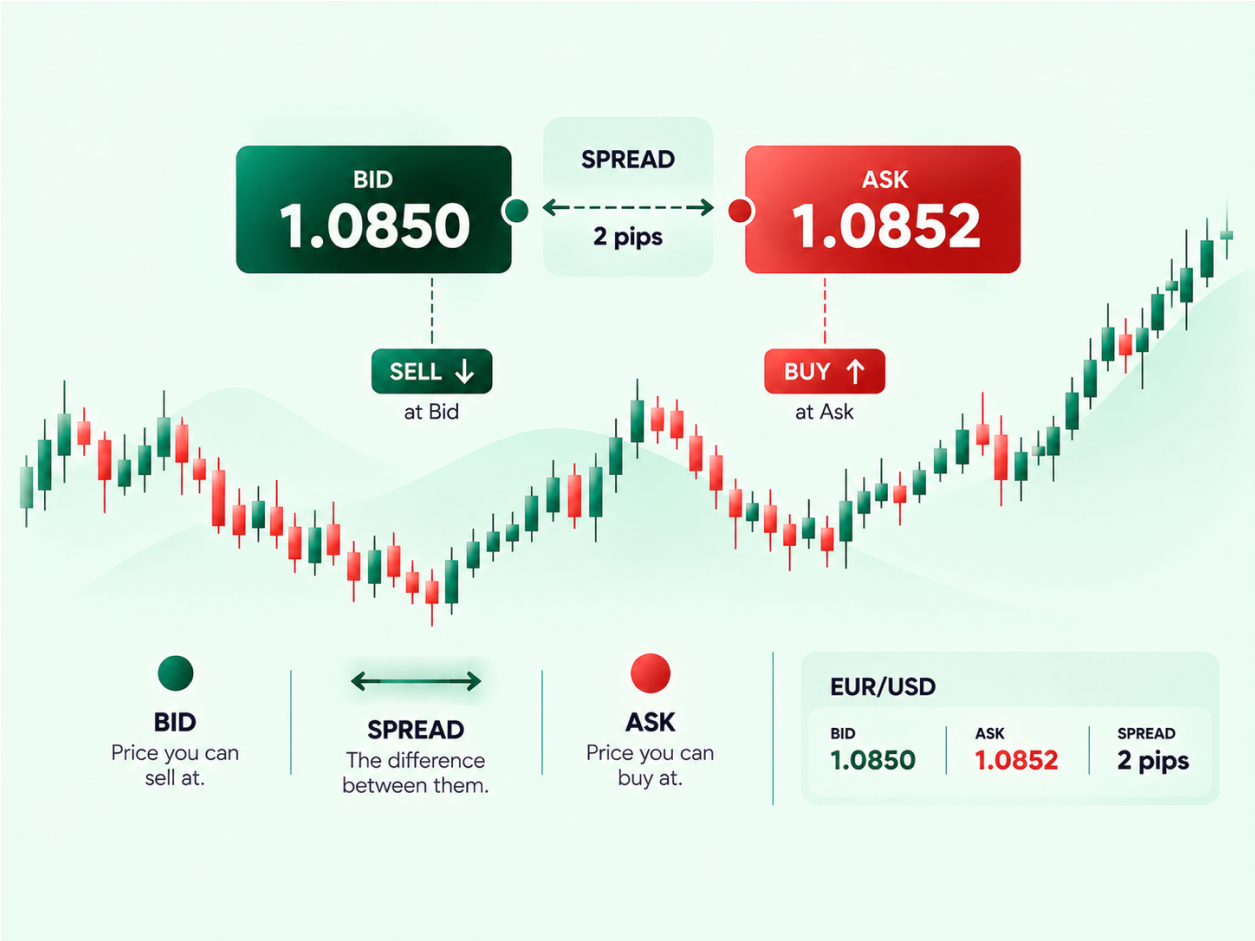
This guide will demystify these essential components, providing a clear framework for how they operate within the CFD market and how traders can leverage this knowledge.
The Bid Price: Your Selling Point
The bid price is the maximum price a buyer is willing to pay for an asset at a given time. From a trader’s perspective, the bid price is the price at which you can sell an underlying asset to a broker or market maker. Conversely, from the market maker’s perspective, it is the price at which they are willing to buy the asset from you.
The bid price will always be slightly lower than the prevailing market price. When you initiate a “sell” or “short” position in a CFD, you will execute your trade at the current bid price. When you close a “buy” or “long” position, you will also sell at the bid price to exit the trade.
Bid Price Example: Shorting a Stock CFD
Imagine you believe shares of “Tech Innovations Inc.” are overvalued and their price will decline. The current market quote for a Tech Innovations Inc. CFD is displayed as: Bid $185.20 / Ask $185.35.
If you decide to open a short position for 100 CFDs, you would sell at the bid price of $185.20. Your initial position is now short 100 CFDs at $185.20.
A few days later, your prediction proves correct, and the share price has fallen. The new quote is Bid $182.10 / Ask $182.25. To close your profitable short position, you would buy back 100 CFDs at the current ask price of $182.25. (Note: This example implicitly shows the ask price for closing a short, which is covered next, but highlights the bid for opening the short).
The Ask Price (Offer Price): Your Buying Point
The ask price, also known as the offer price, is the minimum price a seller is willing to accept for an asset. For a trader, the ask price is the price at which you can buy an underlying asset from a broker or market maker. From the market maker’s view, it is the price at which they are willing to sell the asset to you.
The ask price will always be slightly higher than the prevailing market price. When you initiate a “buy” or “long” position in a CFD, you will execute your trade at the current ask price. When you close a “sell” or “short” position, you will buy back at the ask price to exit the trade.
Ask Price Example: Going Long on a Commodity CFD
Suppose you anticipate a rise in the price of Crude Oil. The current quote for a Crude Oil CFD is: Bid $78.50 / Ask $78.55.
If you decide to open a long position for 50 CFDs, you would buy at the ask price of $78.55. Your initial position is now long 50 CFDs at $78.55.
Later, the price of Crude Oil rises. The new quote is Bid $79.80 / Ask $79.85. To close your profitable long position, you would sell 50 CFDs at the current bid price of $79.80.
The Bid-Ask Spread: Your Transaction Cost
The bid-ask spread is the difference between the ask price and the bid price. It is a fundamental component of trading costs and represents the market maker’s or broker’s compensation for facilitating the trade. Essentially, it’s the cost you incur to open a position.
Spread = Ask Price – Bid Price
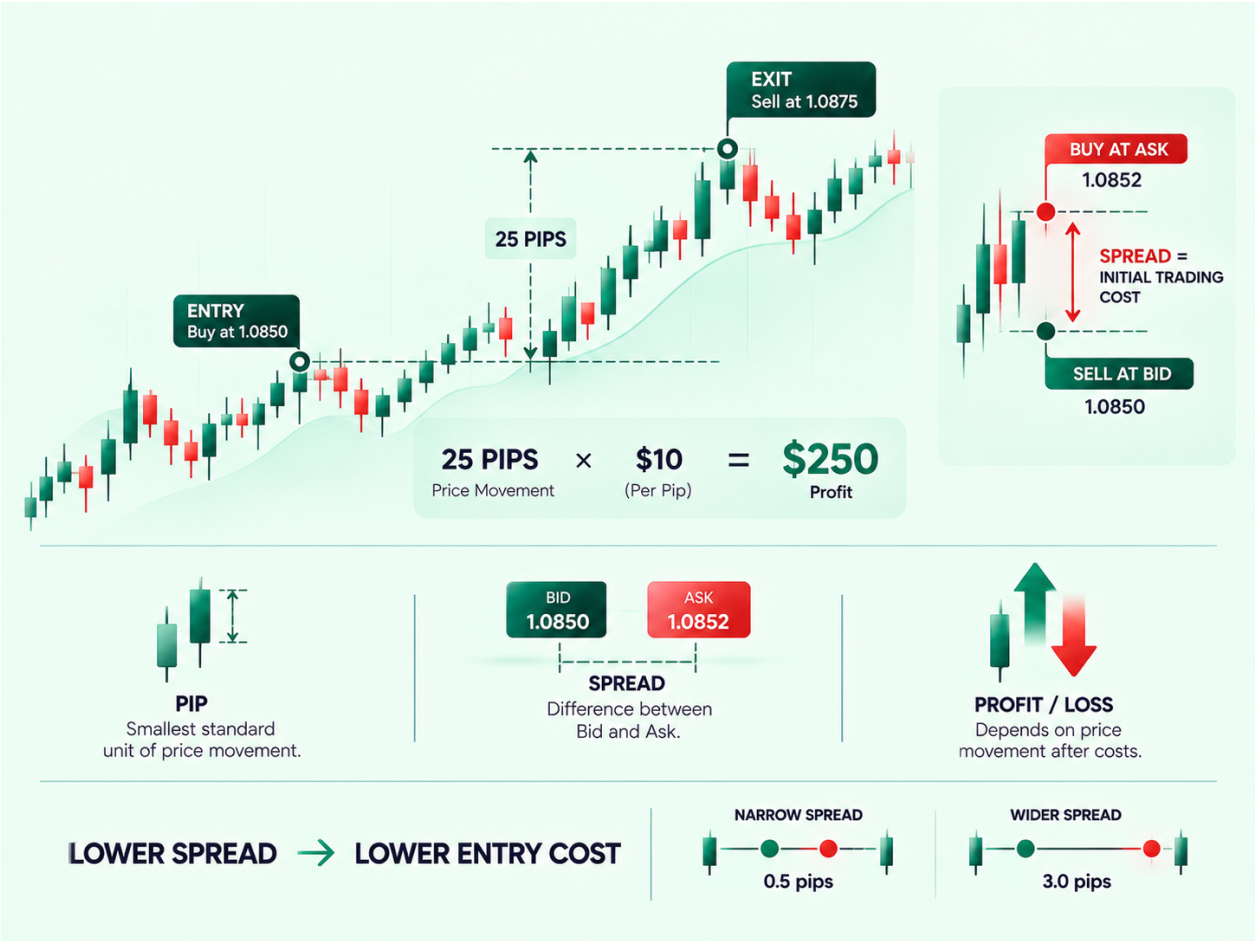
For instance, if a currency pair like EUR/USD is quoted at 1.0850 (bid) / 1.0852 (ask), the spread is 0.0002, or 2 pips.
How the Spread Impacts Your Trade
The spread means that a trade must move in your favor by at least the size of the spread just for you to break even. If you buy an asset at the ask price and immediately sell it at the bid price, you would incur a loss equal to the spread.
Consider the Crude Oil CFD example:
- You bought at the ask price of $78.55.
- If you were to immediately close the trade, you would sell at the bid price of $78.50.
- Your immediate loss would be $0.05 per CFD ($78.55 – $78.50).
- For your trade to become profitable, the bid price must rise above your initial buying price of $78.55.
A tighter (narrower) bid-ask spread is generally more favorable for traders, as it reduces the initial cost of entering a position and allows the trade to reach profitability more quickly if the market moves in the desired direction.
Understanding Pips: Measuring Price Movement
A pip, an acronym for “Point In Percentage,” is the smallest standardized unit of measurement for the change in value between two financial assets, most commonly used in forex trading. Pips are crucial for:
- Quantifying price movements: A 1-pip move is a precise, universally understood increment.
- Calculating spreads: Spreads are often quoted in pips.
- Determining profit and loss: The value of a pip, multiplied by the number of lots or contracts, dictates the monetary gain or loss of a trade.
Pip Values in Forex and Other Markets
For most major currency pairs, a pip is equivalent to the fourth decimal place (0.0001). For example, if EUR/USD moves from 1.0850 to 1.0851, that’s a 1-pip increase.
A notable exception is currency pairs involving the Japanese Yen (JPY), where a pip is typically the second decimal place (0.01). If USD/JPY moves from 145.20 to 145.21, that’s a 1-pip increase.
While a pip represents the smallest standardized unit of price movement, many brokers, including LQH Markets, offer even greater precision by quoting prices with an additional decimal place. These smaller units are known as pipettes or fractional pips. For most currency pairs, a pipette is the fifth decimal place (e.g., 0.00001), while for JPY pairs, it’s the third decimal place (e.g., 0.001). This granular pricing allows for more precise execution, potentially tighter bid-ask spreads, and the ability to capture even the slightest market fluctuations. For example, if EUR/USD moves from 1.08500 to 1.08501, that’s a 1-pipette increase, representing one-tenth of a standard pip.
While traditionally a forex term, the concept of a “point” or “tick” in other markets (like indices or commodities) serves a similar purpose, representing the smallest price increment. For LQH Markets, spreads are consistently quoted in ‘pips’ across all available asset classes.
Pip Example: Calculating Profit/Loss in Forex CFD
Let’s use the EUR/USD pair.
- You open a long position for 1 standard lot (100,000 units) of EUR/USD at an ask price of 1.0852.
- The market moves in your favor, and you close the position by selling at a bid price of 1.0877.
To calculate your profit:
- Calculate the pip movement: 1.0877 (exit bid) – 1.0852 (entry ask) = 0.0025.
- Convert to pips: 0.0025 / 0.0001 (value of one pip) = 25 pips.
- Calculate monetary value per pip: For a standard lot of EUR/USD, one pip (0.0001) is typically worth $10 (0.0001 * 100,000 units = $10).
- Total Profit: 25 pips * $10/pip = $250.
Conversely, if the market moved against you and you closed at 1.0832, you would have lost 20 pips (1.0852 – 1.0832 = 0.0020, or 20 pips), resulting in a $200 loss.
Factors Affecting the Bid-Ask Spread
The width of the bid-ask spread is not static; it fluctuates based on several market conditions:
1. Market Liquidity
This is the primary determinant of spread width. Liquidity refers to the ease with which an asset can be bought or sold without significantly impacting its price.
- High Liquidity: Assets with high trading volumes and many active buyers and sellers (e.g., major forex pairs like EUR/USD, highly traded stock CFDs) tend to have narrower spreads. This is because there’s a constant stream of orders, increasing the likelihood that the lowest selling price (ask) and the highest buying price (bid) will converge.
- Low Liquidity: Assets with fewer participants or lower trading volumes (e.g., exotic currency pairs, less popular stock CFDs, certain commodities outside peak hours) tend to have wider spreads. Market makers face higher risk when dealing in illiquid assets, as it might be harder to offset their positions quickly, so they widen the spread to compensate.
2. Market Volatility
While closely related to liquidity, high volatility can also independently impact spreads. During periods of significant news events, economic data releases, or geopolitical tensions, markets can become highly volatile. This uncertainty often leads to wider spreads as market makers adjust their pricing to account for increased risk and potentially rapid price swings.
3. Dealing Fees and Broker Models
The spread often incorporates the broker’s or market maker’s compensation. Some broker models operate with a “spread-only” model, where all costs are embedded in the spread. Others might offer tighter spreads but charge a separate commission per trade. In Over-The-Counter (OTC) markets, such as forex and CFDs, different brokers may offer slightly different bid/ask prices, fostering competition that can benefit traders by keeping spreads keen.
The Decentralized Nature of OTC Markets and Price Discovery
Unlike centralized exchanges where a single, uniform price is typically available for a given asset (like a stock exchange for equities), Contracts for Difference (CFDs) and Forex are primarily traded in Over-The-Counter (OTC) markets. This decentralized structure means there isn’t one universal, consolidated price for an asset at any given moment. Instead, a vast network of market makers and brokers independently quote their own bid and ask prices, creating a dynamic and competitive pricing environment.
This unique characteristic of OTC markets has significant implications for traders. Because multiple market makers are constantly competing for order flow, an array of different bid/ask prices are usually available for a given asset at any particular time. This competition is a key benefit for traders, as it empowers them to “shop around” among different brokers to find the most favorable spreads and execution prices. For example, if you’re looking to trade a major currency pair like GBP/USD, you might find slightly different bid/ask quotes from various CFD providers. This ability to compare offerings can directly impact your transaction costs and potential profitability.
Market makers play a crucial role in this decentralized environment by providing essential liquidity. They continuously stand ready to buy from traders at their bid price and sell to traders at their ask price, ensuring that there is always a counterparty for a trade, even in fast-moving markets. Their quoted prices reflect not only current market conditions and supply/demand dynamics but also their individual risk assessment, the size of their inventory, and their specific business model. A market maker’s pricing strategy will factor in the volatility of the asset, the depth of their own liquidity pools, and their desired profit margin. This dynamic interplay between numerous market makers ensures a competitive landscape, which generally leads to tighter spreads and more efficient price discovery for traders in the CFD and Forex markets, ultimately benefiting those who seek out the best available terms.
Why These Concepts are Crucial for CFD Traders
A thorough understanding of bid, ask, spreads, and pips is indispensable for any CFD trader:
- Accurate Cost Assessment: Knowing the spread allows you to accurately calculate the immediate cost of your trade and understand how much the market needs to move before you can break even.
- Entry and Exit Strategy: Your entry price is always the ask (for long positions) or bid (for short positions), and your exit price is the inverse. This impacts your profit and loss calculations significantly.
- Risk Management: Wider spreads mean higher transaction costs, which can erode profits on smaller moves or increase losses if a trade goes against you. Traders should be aware that scalping and high-frequency trading strategies inconsistent with fair use of the platform are prohibited under the Client Agreement.
- Market Analysis: Observing spread fluctuations can provide insights into market liquidity and volatility. A sudden widening of the spread might signal impending volatility or reduced liquidity.
By mastering these foundational elements, CFD traders can approach the market with greater clarity, refine their trading strategies, and manage their capital more effectively.
Frequently Asked Questions
What is the primary difference between the bid and ask price?
The bid price is the price at which you can sell an asset, and it’s what a market maker is willing to pay. The ask price is the price at which you can buy an asset, and it’s what a market maker is willing to sell for. The ask price is always higher than the bid price.
How does a tight bid-ask spread benefit a CFD trader?
A tight (narrow) bid-ask spread means lower transaction costs for the trader. It allows a trade to reach its break-even point and move into profitability more quickly, as the market doesn’t need to move as much to cover the initial cost.
Why are pips important in forex trading, especially for calculating profit/loss?
Pips provide a standardized unit to measure price movements in forex, making it easy to quantify changes across different currency pairs. By knowing the pip value for a specific trade size, traders can precisely calculate their potential profit or loss in monetary terms.
Does high market liquidity always guarantee a narrow spread?
Generally, yes. High market liquidity, characterized by a large volume of active buyers and sellers, typically leads to narrower bid-ask spreads because there are more participants willing to trade at competitive prices. However, extreme volatility, even in liquid markets, can sometimes cause temporary spread widening.
Knowledge Check
1. When a CFD trader wants to open a “buy” or “long” position, which price will they execute their trade at?
- A) The Bid Price
- B) The Ask Price
- C) The Mid Price
- D) The Closing Price
2. If the EUR/USD currency pair is quoted at 1.0925 (Bid) / 1.0928 (Ask), what is the spread in pips?
- A) 1 pip
- B) 2 pips
- C) 3 pips
- D) 4 pips
3. Which of the following factors typically leads to a wider bid-ask spread for a financial asset?
- A) High market liquidity
- B) Low market volatility
- C) Low trading volume
- D) A major economic news release resulting in calm market conditions
Click to view the answers
1. B) The Ask Price – Traders buy at the ask price, which is the price the market maker is willing to sell the asset for.
2. C) 3 pips – The spread is the difference between the ask (1.0928) and the bid (1.0925), which is 0.0003, or 3 pips for most currency pairs.
3. C) Low trading volume – Low trading volume indicates low market liquidity, which typically results in wider bid-ask spreads as market makers face higher risk.