


The global foreign exchange (forex) market is the largest and most liquid financial market, offering diverse strategies for traders. Among these, the forex carry trade stands out as a strategy that seeks to capitalize on the interest rate differentials between two currencies. This approach can be particularly appealing to those looking for potential income generation beyond mere price speculation, though it comes with its own set of risks and considerations.
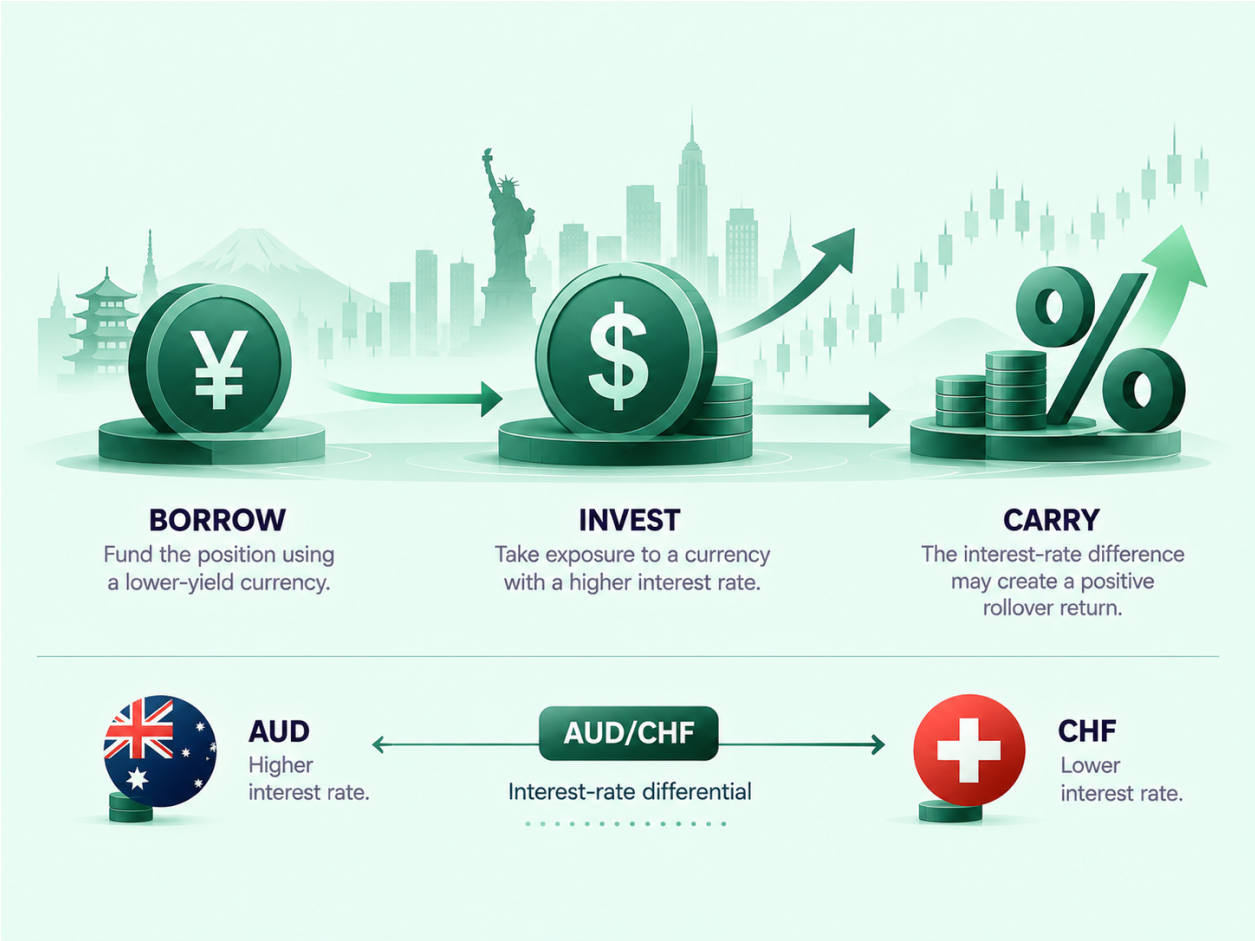
The forex carry trade is a trading strategy that involves borrowing a currency with a relatively low interest rate (the “funding currency”) and simultaneously investing in a currency with a relatively high interest rate (the “target currency”) to profit from the interest rate differential. This differential, often referred to as “carry,” is typically paid or received daily through a process known as rollover or swap.
Understanding the Forex Carry Trade Mechanism
At its core, a carry trade is an arbitrage strategy based on interest rates. When you trade a currency pair, you are simultaneously buying one currency and selling another. Each currency has an associated overnight interbank interest rate set by its respective central bank. When you hold a forex position overnight, your broker adjusts your account to reflect the interest rate differential between the two currencies in the pair. This adjustment is known as a “rollover” or “swap” fee/credit.
How Rollover (Swap) Works
For any position held past a specific daily cutoff time (often 5 PM ET for USD pairs), a rollover adjustment is applied.
- Positive Carry: If you are long (buying) the currency with the higher interest rate and short (selling) the currency with the lower interest rate, you will generally receive a positive rollover credit. This is your “carry” profit.
- Negative Carry: Conversely, if you are long the lower-interest-rate currency and short the higher-interest-rate currency, you will pay a negative rollover debit.
It’s important to note that while central bank rates are target rates, the actual rollover rates applied by brokers are market-driven and include a spread. They also account for weekend and holiday interest. For Forex and Metals positions, a triple swap is charged on Wednesdays to account for the weekend settlement period.
The triple swap on Wednesdays specifically accounts for the weekend settlement period, as most forex trades settle two business days after execution. This means a position opened on Wednesday would typically settle on Friday, and one opened on Thursday would settle on Monday. To ensure interest for Friday, Saturday, and Sunday is covered, the triple swap is applied on Wednesday. Similarly, for public holidays, an extra day’s worth of rollover is applied two business days prior to the holiday. For instance, if a holiday occurs on a Tuesday, the additional rollover is applied on the preceding Friday. If the holiday is on a Monday, it’s applied on the Thursday before.
For all other instruments, triple swaps are applied on Fridays.
Components of Potential Profit
A successful carry trade strategy aims to generate profit from two main components:
- Interest Rate Differential (Carry): This is the primary driver. The larger the positive difference between the interest rate of the currency you hold and the currency you borrow, the greater the potential daily interest income.
- Currency Appreciation: While not the primary focus, traders can also benefit if the high-interest-rate currency appreciates against the low-interest-rate currency. This provides additional capital gains when the position is eventually closed. However, this also introduces exchange rate risk.
An Illustrative Example
An Illustrative Example: Negative Carry
To provide a balanced perspective, let’s consider a scenario resulting in a negative carry.
Suppose:
- The Reserve Bank of Australia (RBA) sets its benchmark interest rate at 0.25%.
- The Federal Reserve (Fed) sets its benchmark interest rate at 1.75%.
A trader believes the Australian Dollar (AUD) will depreciate against the U.S. Dollar (USD) and decides to sell AUD/USD. This means they are effectively selling Australian Dollars (the lower-yielding currency) and buying U.S. Dollars (the higher-yielding currency).
Let’s assume a trader opens a short position of 100,000 units of AUD/USD when the exchange rate is 0.7000.
- Short AUD (paying interest): On AUD 100,000, the annual interest paid would be 0.25% of AUD 100,000 = AUD 250. Daily, this is approximately AUD 250 / 365 = AUD 0.68.
- Long USD (earning interest): To sell AUD 100,000 at 0.7000, the trader effectively buys USD 70,000. On USD 70,000, the annual interest earned would be 1.75% of USD 70,000 = USD 1,225. Daily, this is approximately USD 1,225 / 365 = USD 3.36.
Converting the AUD cost to USD (AUD 0.68 * 0.7000 = USD 0.48) and subtracting the USD earnings (USD 0.48 – USD 3.36 = -USD 2.88), the trader would incur a net negative rollover debit of approximately USD 2.88 per day (before any broker spreads). In this negative carry scenario, the trader would hope for significant depreciation of AUD against USD to offset the daily interest cost and generate a profit from the exchange rate movement.
Consider a hypothetical scenario:
- The Reserve Bank of Australia (RBA) sets its benchmark interest rate at 4.00%.
- The Swiss National Bank (SNB) sets its benchmark interest rate at 0.50%.
A trader identifies the AUD/CHF currency pair as a potential carry trade candidate due to the significant interest rate differential. To execute a positive carry trade, the trader would buy AUD/CHF, meaning they are effectively buying Australian Dollars (the higher-yielding currency) and selling Swiss Francs (the lower-yielding currency).
Let’s assume a trader opens a long position of 100,000 units (one standard lot) of AUD/CHF when the exchange rate is 0.6000.
- Long AUD (earning interest): On AUD 100,000, the annual interest earned would be 4.00% of AUD 100,000 = AUD 4,000. Daily, this is approximately AUD 4,000 / 365 = AUD 10.96.
- Short CHF (paying interest): To buy AUD 100,000 at 0.6000, the trader effectively sells CHF 60,000. On CHF 60,000, the annual interest paid would be 0.50% of CHF 60,000 = CHF 300. Daily, this is approximately CHF 300 / 365 = CHF 0.82.
Converting the AUD earnings to CHF (AUD 10.96 * 0.6000 = CHF 6.58) and subtracting the CHF cost (CHF 6.58 – CHF 0.82 = CHF 5.76), the trader would receive a net positive rollover credit of approximately CHF 5.76 per day (before any broker spreads on the swap rate).
If the AUD/CHF exchange rate remains stable or even appreciates, the trader benefits from both the daily interest payment and potential capital gains.
Implementing a Carry Trade Strategy with CFDs
For CFD traders, carry trades are executed by taking a long position on a currency pair where the base currency has a higher interest rate than the quote currency, or a short position where the quote currency has a higher interest rate than the base currency. The broker handles the interest rate differential by applying daily swap charges or credits to the trading account.
Steps for Implementation:
- Identify Interest Rate Differentials: Research global central bank interest rates. Look for countries with persistently high rates (potential target currencies) and those with persistently low rates (potential funding currencies). Common historical funding currencies include the Japanese Yen (JPY) and Swiss Franc (CHF), while target currencies often include the Australian Dollar (AUD), New Zealand Dollar (NZD), and certain emerging market currencies like the Mexican Peso (MXN) or South African Rand (ZAR).
It’s important to note that the roles of funding and target currencies are not static; they can shift based on global monetary policy and economic conditions, with even traditionally high-yield currencies like the U.S. Dollar occasionally serving as funding currencies during specific market cycles.
- Assess Economic and Political Stability: High-interest-rate currencies, especially from emerging markets, can be more volatile. A stable economic and political environment in the target currency’s country is crucial to minimize exchange rate risk. Look for strong economic growth, controlled inflation, and sound fiscal policy.
- Analyze Market Sentiment and Trends: Carry trades tend to perform best in “risk-on” environments where investors are confident and seeking higher yields, and during periods of low market volatility. Filtering carry trades in the direction of a strong, sustained trend can enhance profitability and reduce risk. Technical analysis, such as identifying higher highs and higher lows, can help confirm an uptrend for the target currency.
- Execute the Trade: Place a “buy” order for the currency pair where the base currency is the higher-yielding one (e.g., AUD/JPY, NZD/USD). If the quote currency is the higher-yielding one, you would “sell” the pair (e.g., EUR/MXN, where MXN is the quote and higher-yielding).
- Monitor and Manage: Continuously track interest rate changes, economic data releases, and currency pair movements. Be prepared to adjust or exit the trade if market conditions shift unfavorably.
Risks Associated with Carry Trades
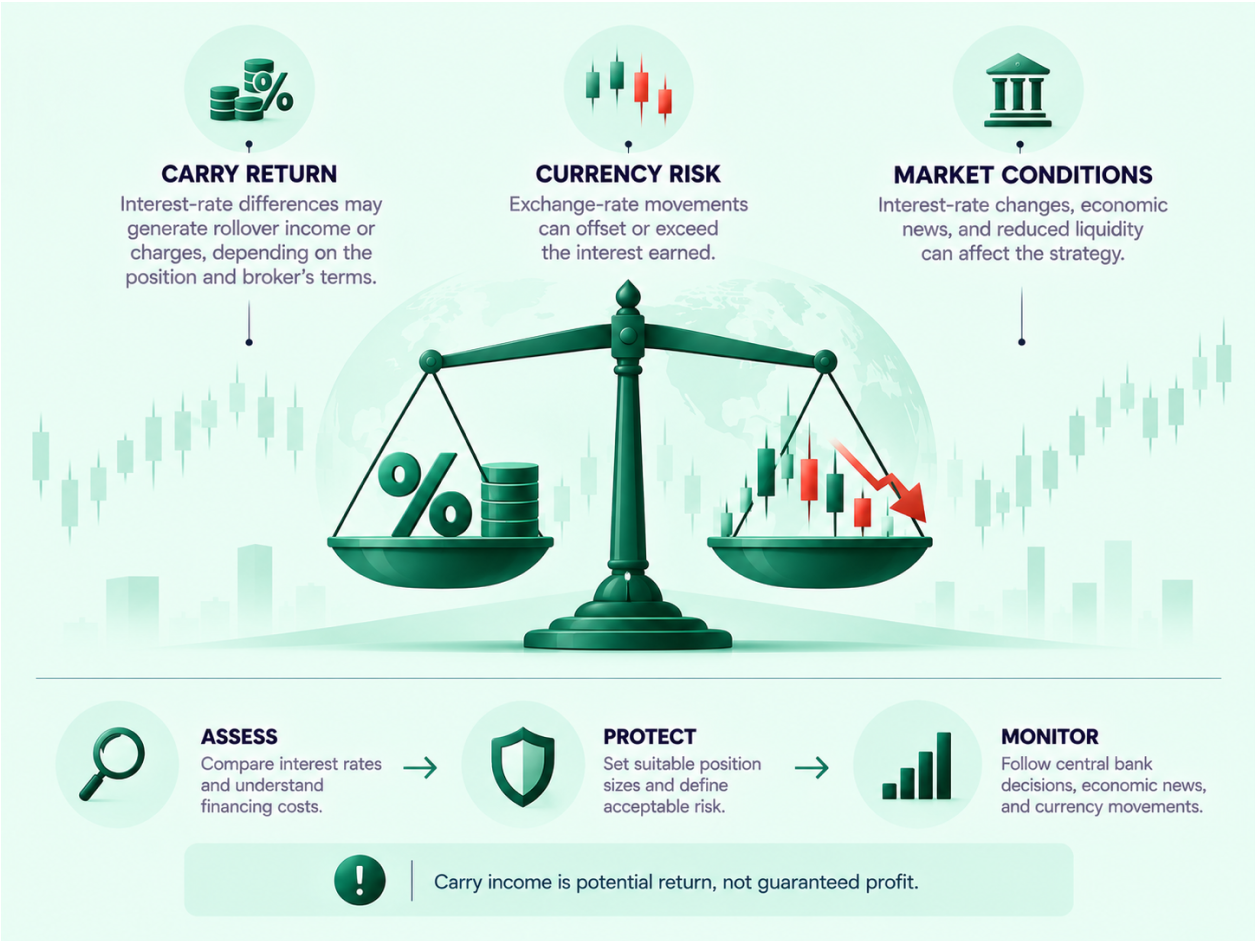
While carry trades offer an attractive income stream, they are not without significant risks:
- Exchange Rate Risk: This is the most substantial risk. If the high-interest-rate currency depreciates against the low-interest-rate currency, the capital loss from the exchange rate movement can easily outweigh the interest earned. For instance, a sudden shift in market sentiment from “risk-on” to “risk-off” can lead to rapid unwinding of carry trades, causing sharp depreciation in high-yield currencies.
Furthermore, the collective unwinding of large-scale carry trades, particularly during periods of heightened global uncertainty or “risk-off” events, can significantly amplify exchange rate movements. This can lead to rapid and substantial depreciation in high-yield currencies, as investors rush to exit positions, thereby increasing market volatility and potential losses for carry traders.
- Interest Rate Risk: Central banks can change interest rates. If the interest rate differential narrows (e.g., the target currency’s rate drops, or the funding currency’s rate rises), the profitability of the carry trade diminishes or even reverses. Economic calendars should be closely monitored for central bank meetings and announcements.
- Liquidity Risk: In times of extreme market stress, liquidity for certain currency pairs can dry up, making it difficult to exit positions at favorable prices. This can exacerbate losses during rapid market reversals.
- Uncovered Interest Parity (UIP) and the Forward Premium Puzzle: Economic theory suggests that interest rate differentials should be offset by expected future exchange rate movements, meaning carry trades shouldn’t consistently be profitable (Uncovered Interest Parity). However, empirical evidence often shows that UIP fails, particularly at short- to medium-term horizons. In many cases, high-interest-rate currencies tend to appreciate rather than depreciate, a phenomenon known as the “forward premium puzzle.” This failure of UIP is precisely why carry trades can be profitable, but it also highlights the inherent unpredictability of currency markets.
Mitigating Risks
Effective risk management is paramount for carry traders:
- Stop-Loss Orders: Always use stop-loss orders to limit potential losses from adverse exchange rate movements.
- Position Sizing: Adjust your optimal position size based on your risk tolerance and the volatility of the currency pair. Do not over-leverage.
- Diversification: Avoid concentrating all capital in a single carry trade. Diversify across different currency pairs and strategies.
- Economic Calendar Monitoring: Stay informed about central bank policy meetings, inflation data, GDP reports, and other economic indicators that could influence interest rates and currency valuations.
- Trend Following: As carry trades are often held for longer durations, aligning them with existing long-term currency trends can provide a buffer against short-term volatility.
Conclusion
The forex carry trade offers a unique opportunity to potentially earn income from interest rate differentials in the currency market. By carefully selecting currency pairs, understanding the mechanics of rollover, and diligently managing risks, traders can incorporate this strategy into their broader trading plan. However, the inherent volatility of currency markets and the potential for shifts in interest rates and market sentiment demand a disciplined approach and a thorough understanding of the underlying economic principles.
Frequently Asked Questions
What is a “funding currency” in a carry trade?
A funding currency is the low-interest-rate currency that a trader effectively “borrows” or sells to finance the purchase of a higher-interest-rate currency. Historically, currencies like the Japanese Yen (JPY) and Swiss Franc (CHF) have often served as funding currencies due to their typically low interest rates.
How do CFD brokers handle carry trade interest?
CFD brokers do not involve actual borrowing or lending. Instead, they apply daily “swap” or “rollover” charges or credits to a trader’s account based on the interest rate differential of the currency pair held overnight. A positive differential results in a credit, while a negative one results in a debit.
Is a carry trade always profitable?
No, a carry trade is not always profitable. While it aims to generate income from interest rate differentials, this can be offset or even outweighed by adverse movements in the exchange rate of the currency pair, or by changes in central bank interest rates that narrow the differential.
What is the “forward premium puzzle” in relation to carry trades?
The forward premium puzzle refers to the empirical observation that currencies with higher interest rates tend to appreciate, rather than depreciate as predicted by the Uncovered Interest Parity (UIP) theory. This phenomenon helps explain why carry trades can be profitable, as the interest earned is not consistently eroded by currency depreciation.
Knowledge Check
1. Which of the following best describes the primary objective of a forex carry trade?
- A) To profit solely from short-term currency price fluctuations.
- B) To capitalize on the interest rate differential between two currencies.
- C) To speculate on the future direction of a country’s stock market.
- D) To hedge against inflation in a single currency.
2. If a trader executes a positive carry trade, which action are they generally taking regarding interest rates?
- A) Borrowing a high-interest-rate currency and investing in a low-interest-rate currency.
- B) Investing in two currencies with identical interest rates.
- C) Borrowing a low-interest-rate currency and investing in a high-interest-rate currency.
- D) Avoiding any exposure to interest rate differentials.
3. What is the most significant risk associated with a forex carry trade?
- A) The broker charging excessive commission fees.
- B) The target currency appreciating too rapidly.
- C) The capital loss from adverse exchange rate movements outweighing interest earned.
- D) The funding currency becoming illiquid.
Click to view the answers
1. **B) To capitalize on the interest rate differential between two currencies.** – The core principle of a carry trade is to earn profit from the difference in interest rates between the funding and target currencies.
2. **C) Borrowing a low-interest-rate currency and investing in a high-interest-rate currency.** – This setup allows the trader to pay less interest on the borrowed currency and earn more interest on the invested currency, creating a positive differential.
3. **C) The capital loss from adverse exchange rate movements outweighing interest earned.** – Exchange rate risk is paramount, as a significant depreciation of the target currency can quickly erase any interest gains and lead to substantial losses.