


Sector rotation is a dynamic trading strategy that seeks to capitalize on the cyclical nature of the economy. For CFD traders, understanding and applying this approach offers a structured way to identify potential trading opportunities by aligning positions with prevailing economic trends. Instead of passively holding a diversified portfolio, sector rotation involves actively shifting capital between different industry sectors as the economic landscape evolves, aiming to outperform the broader market.
Sector rotation is a strategic approach where traders reallocate capital across various industry sectors based on their anticipation of the next stage of the economic cycle, aiming to align positions with sectors expected to outperform. This proactive strategy leverages the observation that different sectors thrive or languish depending on the broader economic environment.
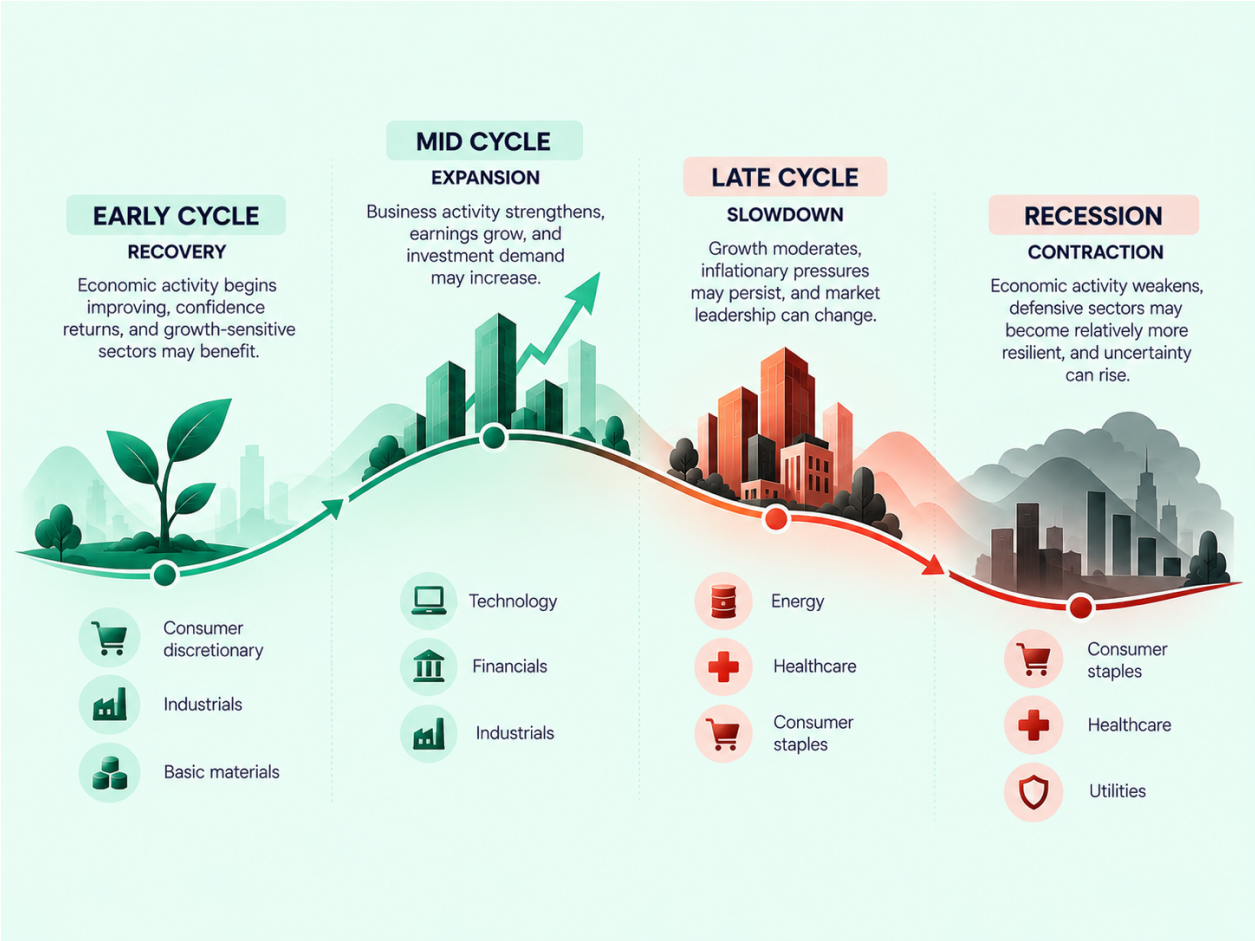
Understanding the Economic and Market Cycles
The economy does not grow in a straight line; it moves through identifiable phases, often described as a business cycle. Since the mid-19th century, economists have observed a consistent pattern of expansion, peak, contraction, and trough. While the duration of each phase can vary, their characteristics tend to be predictable.
The Four Phases of the Economic Cycle
While the four phases of the economic cycle describe the overall state of the economy, these fluctuations are driven by several interconnected underlying mechanisms. Understanding these fundamental drivers provides a deeper insight into why the economy moves as it does. Three key cycles are particularly influential:
- The Corporate Profit Cycle: This refers to the ebb and flow of company earnings. During recoveries, profits expand rapidly, fueling investment and hiring. As the economy matures, profit growth moderates, and eventually, during contractions, profits decline, leading to reduced investment and layoffs.
- The Credit Cycle: This involves the availability and cost of borrowing. Easy credit conditions and low interest rates stimulate economic activity during early phases. As the cycle progresses, credit tightens, and interest rates rise, eventually constraining growth and contributing to downturns.
- The Inventory Cycle: Businesses manage their stock of goods in anticipation of demand. During recoveries, low inventories and rising sales lead to increased production. As demand slows in late-cycle phases, inventories can build unexpectedly, prompting businesses to cut production, which further exacerbates economic slowdowns.
These cycles interact dynamically, influencing employment, monetary policy, and ultimately, the broader economic phases.
- Early-Cycle (Recovery): This phase marks a sharp rebound from recession, with GDP and industrial production accelerating. Accommodative monetary policy and easing credit fuel rapid corporate profit expansion, alongside low inventories and improving sales.
- Mid-Cycle (Expansion): Often the longest phase, the mid-cycle is characterized by sustained, positive, but more moderate economic growth. Credit growth remains strong, and corporate profitability is healthy. Monetary policy gradually becomes more neutral, moving away from extreme accommodation. Inventories and sales grow in equilibrium.
- Late-Cycle (Peak/Slowdown): The economy begins to “overheat,” often accompanied by above-trend inflation. Economic growth rates start to slow. Monetary policy typically becomes restrictive (e.g., rising interest rates), credit availability tightens, and corporate profit margins begin to deteriorate. Inventories may build unexpectedly as sales growth declines, often preceding a recession.
- Recession (Contraction): This is a period of significant decline in economic activity, marked by retracting GDP, falling industrial production, and deteriorating consumer expectations. Corporate profits decline sharply, and credit becomes scarce. Monetary policy often shifts back to accommodative measures to stimulate recovery, and inventories gradually fall despite low sales levels, setting the stage for the next recovery.
The Market’s Predictive Nature
Historical Context: NBER and Cycle Duration
The study of economic cycles has a long history, with the National Bureau of Economic Research (NBER) serving as the official authority for dating US business cycles. Since at least 1854, the NBER has meticulously tracked the start and end of expansions and contractions, providing a robust historical dataset that underpins theories like sector rotation. However, it’s crucial for traders to recognize that the NBER’s pronouncements are often made retrospectively, sometimes more than a year after a cycle phase has begun or ended. This highlights the significant challenge of identifying these shifts in real-time for trading purposes.
Historically, economic cycles exhibit consistent patterns, though their exact duration varies. Since 1945, the US economy has experienced 12 business cycles, with the average length of a complete cycle lasting approximately 6 years. Within these cycles, the average expansion has spanned 5 years and 4 months, while the average contraction (recession) has typically lasted a little over 10 months. This historical context provides a valuable perspective on the typical timeframes involved in economic fluctuations.
It is crucial for traders to understand that financial markets do not move in lockstep with the current economic reality. Instead, markets are forward-looking mechanisms, typically pricing in investor expectations for the economy three to six months into the future. This means the stock market cycle often leads the economic cycle. For instance, the market may begin to rally, signaling a “market bottom” and the start of a “bull market,” even while the economy is still deep in a recession. Conversely, a “market top” and the onset of a “bear market” can occur when economic data still appears robust but investors anticipate a slowdown.
Sector Performance Across the Cycle: A CFD Trader’s Guide
Different sectors exhibit varying sensitivities to economic conditions. By understanding these sensitivities, CFD traders can strategically adjust their positions, potentially benefiting from sector-specific trends.
Early-Cycle: The Dawn of Recovery
As the economy rebounds from recession, confidence returns, and spending picks up.
- Industrials: Businesses reinvest in equipment and infrastructure. CFD traders might open long positions on industrial sector ETFs or major industrial companies, anticipating increased manufacturing. For example, a long CFD on a large machinery manufacturer as factory orders begin to tick up.
- Basic Materials: Rising industrial activity drives demand for raw materials. Long CFD positions on mining companies or commodity-linked ETFs could be considered. Imagine taking a long position on a copper producer’s CFD as global manufacturing PMIs show expansion.
- Technology: As a growth sector, technology often rebounds strongly as businesses and consumers upgrade and invest in new solutions. Traders could target long CFDs on software or semiconductor firms.
- Consumer Discretionary: With improving employment and sentiment, consumers increase spending on non-essential goods. Long CFDs on retail chains or travel companies become attractive. For instance, a long CFD on an airline stock as travel bookings surge.
Historically, the early 2000s tech boom exemplifies this phase, with rapid development in new technologies fueling significant growth in the information technology industry. While energy is typically a late-cycle performer, it can show strength near the end of the early recovery as industrial demand begins to pick up.
Mid-Cycle: Sustained Growth
This phase sees steady, broad-based economic expansion.
- Information Technology: Innovation continues, and businesses invest in efficiency. Tech remains a strong performer. Traders might maintain or initiate long CFDs on established tech giants.
- Financials: Strengthening economic activity boosts lending, and gradually rising interest rates benefit banks and financial institutions. Long CFDs on major banks or investment firms are often considered. For example, a long CFD on a diversified bank as loan growth accelerates.
This phase is characterized by sustained, broad-based growth. Financials, for instance, benefit significantly from a healthy lending environment and gradually rising interest rates, leading to robust earnings. Technology continues its strong performance as businesses invest in innovation and efficiency.
- Real Estate: Strong growth and employment typically support housing and commercial property markets. Long CFDs on Real Estate Investment Trusts (REITs) or homebuilders could be viable.
Late-Cycle: Navigating the Peak
As growth matures and inflation concerns rise, the market becomes more discerning.
- Energy: High demand in a fully utilized economy, coupled with rising inflation, can push commodity prices higher. Long CFDs on oil and gas producers or energy sector ETFs could be favored. Consider a long CFD on an integrated oil company as crude oil prices trend upwards due to strong global demand.
- Consumer Staples: Demand for essential goods (food, household products) remains stable, offering defensive characteristics as discretionary spending slows. Traders might consider long CFDs on major food and beverage corporations, seeking stability.
- Healthcare: Demand for healthcare services is generally inelastic, providing resilience as the economy slows. Long CFDs on pharmaceutical or medical device manufacturers can offer stability.
- Utilities: Providing essential services, utilities are typically stable, dividend-paying companies, often favored for their defensive qualities. Long CFDs on utility providers for consistent, albeit slower, growth.
Energy often performs well near the beginning of this phase as commodity prices peak due to high demand. As the economy slows, defensive sectors like Consumer Staples and Healthcare become increasingly favored. For example, leading up to the 2008-2009 financial crisis, defensive sectors showed relative resilience while more cyclical sectors began to falter, signaling an impending downturn.
Recession: Seeking Stability
During an economic contraction, capital preservation and defensive plays become paramount.
- Consumer Staples & Utilities: These sectors offer consistent demand for necessities and essential services, making them traditional safe havens. Traders might maintain or initiate long CFDs on these companies.
- Healthcare & Communication Services: Similar to staples, demand for healthcare and essential communication services persists through downturns, offering defensive exposure.
- Precious Metals: While not a GICS sector, assets like gold are often considered defensive during recessions and market uncertainty. CFD traders might consider long positions on gold CFDs as a hedge.
During severe downturns, such as the 2008-2009 financial crisis, the financials sector experienced sharp declines, illustrating the vulnerability of cyclical industries. Conversely, the consistent demand for essential goods and services provided by Consumer Staples and Utilities offers crucial defensive exposure. While most sectors contract, some cyclical sectors might show early signs of life near the very end of a recession, anticipating the eventual recovery.
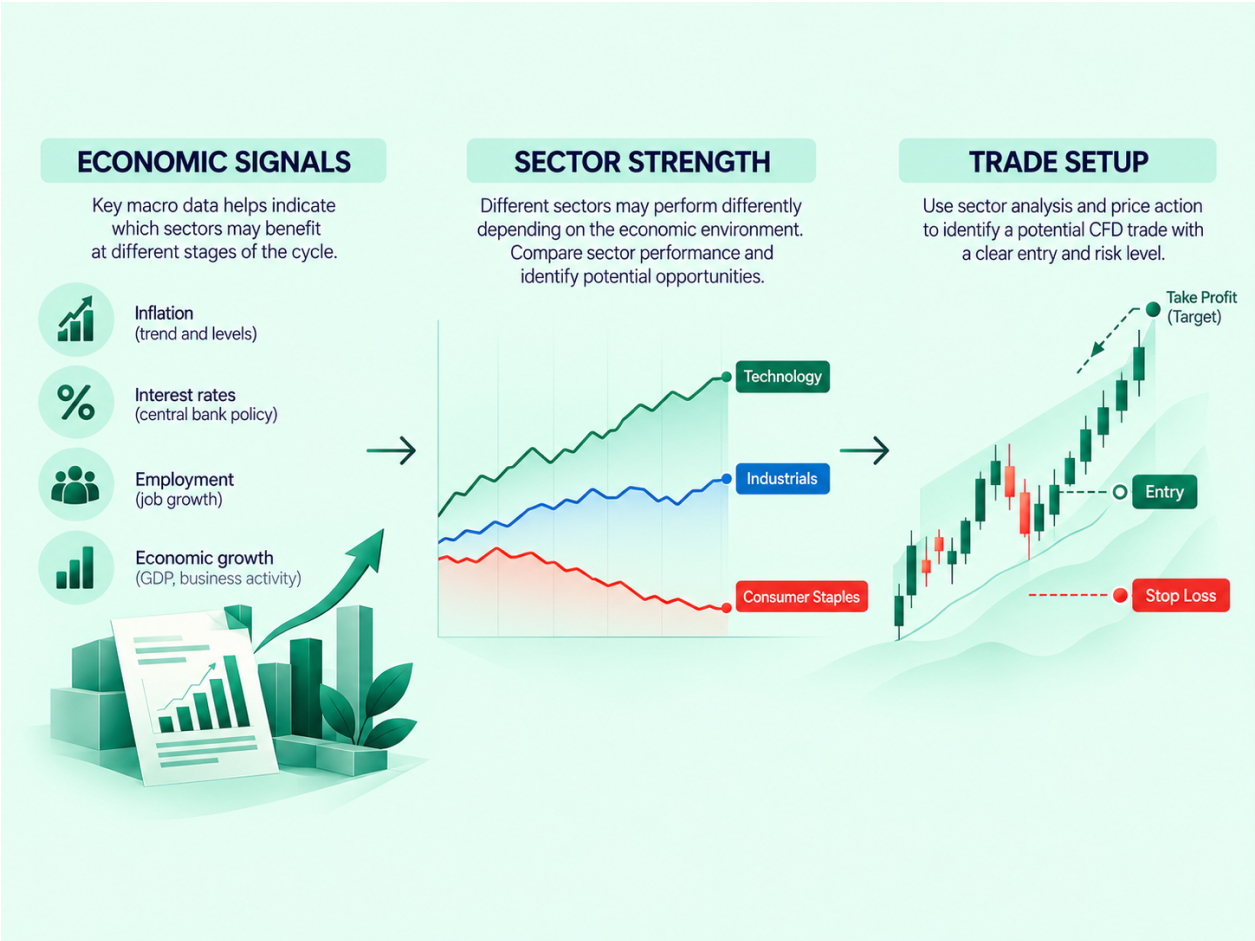
Implementing Sector Rotation with CFDs
Applying sector rotation effectively requires a disciplined approach, especially when utilizing Contracts for Difference (CFDs). CFDs allow traders to speculate on price movements without owning the underlying asset, offering leverage and the ability to go both long and short.
Top-Down Analysis: Reading the Economic Tea Leaves
Effective sector rotation hinges on robust top-down economic analysis.
- Macroeconomic Indicators: Monitor key data like GDP growth, inflation (CPI, PPI), central bank interest rates, unemployment, consumer confidence, and industrial production. These signal shifts in the economic cycle.
- Yield Curve Analysis: The shape of the yield curve (the difference between short-term and long-term government bond yields) is a powerful predictor. An inverted yield curve has historically preceded recessions, while a steepening curve often signals early recovery.
- Monetary Policy Stance: Pay close attention to central bank communications. An accommodative stance supports early-cycle growth, while a restrictive stance can signal a late-cycle or recessionary environment.
- Corporate Earnings Trends: Analyze aggregate corporate profit margins and earnings growth across sectors. Deteriorating margins can indicate a late-cycle slowdown, while a rebound signals recovery.
Choosing Your CFD Instruments
CFDs offer flexibility for sector rotation:
- Sector ETFs/Indices: Many brokers offer CFDs on sector-specific Exchange Traded Funds (ETFs) or indices (e.g., Technology Sector Index CFD, Energy Sector ETF CFD). These provide diversified exposure to an entire sector with a single trade, simplifying the rotation process.
- Individual Company CFDs: For a more granular approach, traders can select CFDs on individual companies within a favored sector. This allows for targeting specific strong performers or innovative players. For instance, if you anticipate a tech recovery, you might open long CFDs on specific software or cloud computing companies.
- Going Short: A key advantage of CFDs is the ability to easily take short positions. If you anticipate a sector will underperform (e.g., Consumer Discretionary during a recession), you can open a short CFD position on a relevant sector ETF or individual stocks, profiting from a decline in price.
Integrating Risk Management
Leverage, a hallmark of CFD trading, amplifies both potential gains and losses. Robust risk management is non-negotiable.
- Position Sizing: Determine appropriate position sizes based on your total capital and risk tolerance. Never risk more than a small percentage of your trading capital on any single trade.
- Stop-Loss Orders: Always implement stop-loss orders to limit potential losses if the market moves against your position. For sector rotation, this means setting stops based on technical analysis or a predetermined percentage drawdown.
- Take-Profit Orders: Define your profit targets and consider using take-profit orders to lock in gains, especially as a sector approaches what you perceive as the end of its favorable cycle phase.
- Diversification: While rotating sectors, avoid over-concentration in a single sector. Diversify across a few strong sectors to mitigate idiosyncratic risks.
Risks and Considerations
While potentially rewarding, sector rotation strategies carry inherent risks:
- Timing Challenges: Accurately predicting the exact turning points of economic and market cycles is extremely difficult. Being too early or too late can negate potential gains or lead to significant losses.
- Increased Volatility: Actively rotating sectors often involves higher trading frequency and exposure to specific, potentially volatile, sectors, which can lead to greater portfolio volatility compared to a broadly diversified, passive approach.
- Underperformance Risk: There’s no guarantee that a chosen sector will outperform, even if the economic signals seem clear. Unforeseen events or shifts in market sentiment can disrupt historical patterns.
- Leverage Amplification: For CFD traders, the use of leverage magnifies both profits and losses, making precise timing and stringent risk management even more critical.
- Transaction Costs: Frequent trading associated with active rotation can accumulate transaction costs (spreads, commissions, overnight financing fees), which can eat into profits.
Conclusion
Sector rotation offers a compelling framework for CFD traders seeking to align their strategies with the dynamic ebb and flow of the global economy. By diligently analyzing macroeconomic indicators, understanding the historical performance of different sectors across various economic phases, and employing rigorous risk management, traders can develop a more proactive and potentially profitable approach. However, success hinges on continuous learning, adaptability, and a deep appreciation for the inherent challenges of market timing.
Frequently Asked Questions
What is the primary goal of a sector rotation strategy?
The primary goal of sector rotation is to outperform the broader market by strategically allocating capital to industry sectors that are expected to thrive during specific phases of the economic cycle. It involves actively shifting investments to capitalize on changing economic conditions and sector sensitivities.
How does the stock market cycle relate to the economic cycle?
The stock market cycle is generally forward-looking and tends to anticipate the economic cycle by several months. This means the market may begin to rally (bull market) while the economy is still in recession, or decline (bear market) when economic data still appears strong, as it prices in future expectations.
What are the main risks associated with a sector rotation strategy for CFD traders?
Key risks include the difficulty of accurately timing economic and market turning points, increased portfolio volatility due to concentrated sector exposure, the potential for underperformance if predictions are incorrect, and the amplified losses associated with leverage in CFD trading. Transaction costs from frequent trading are also a consideration.
Can sector rotation be effectively applied to CFD trading?
Yes, sector rotation can be effectively applied to CFD trading. CFDs offer the flexibility to trade sector-specific ETFs or indices, as well as individual company stocks, allowing traders to easily take both long and short positions to align with anticipated sector performance across economic cycles.
What key economic indicators should I monitor for sector rotation?
Traders should monitor indicators such as Gross Domestic Product (GDP) growth, inflation rates (CPI, PPI), central bank interest rate decisions, unemployment figures, consumer confidence, industrial production data, and the shape of the yield curve to identify shifts in the economic cycle.
Knowledge Check
1. Which of the following best describes the relationship between the stock market cycle and the economic cycle?
- A) The stock market cycle always perfectly mirrors the current state of the economic cycle.
- B) The stock market cycle typically lags the economic cycle by several months.
- C) The stock market cycle is generally forward-looking, anticipating the economic cycle by 3-6 months.
- D) The two cycles are completely unrelated and move independently.
2. In which economic cycle phase are defensive sectors like Utilities and Consumer Staples typically favored?
- A) Early-Cycle (Recovery)
- B) Mid-Cycle (Expansion)
- C) Late-Cycle (Peak/Slowdown)
- D) Recession (Contraction)
3. What is a key advantage of using CFDs for implementing a sector rotation strategy?
- A) CFDs allow traders to take ownership of underlying sector assets.
- B) CFDs eliminate all trading risks and guarantee profits.
- C) CFDs offer leverage and the ability to easily take both long and short positions on sector-specific instruments.
- D) CFDs have no transaction costs, making frequent rotation highly economical.
Click to view the answers
1. **C)** – The article states that financial markets are forward-looking, typically pricing in investor expectations for the economy three to six months into the future.
2. **D)** – The article explains that during a Recession, defensive sectors like Utilities and Consumer Staples are favored for their stability and consistent demand.
3. **C)** – The article highlights that CFDs offer flexibility through leverage and the ability to easily go both long and short on sector-specific ETFs or individual companies.