


Trading Contracts for Difference (CFDs) offers a flexible way to speculate on price movements across a vast array of financial markets without owning the underlying asset. A critical component of CFD trading, particularly for positions held beyond a single trading day, is understanding overnight financing swap rates. These charges, or sometimes credits, represent the cost of maintaining a leveraged position overnight and are a fundamental consideration for any CFD trader.
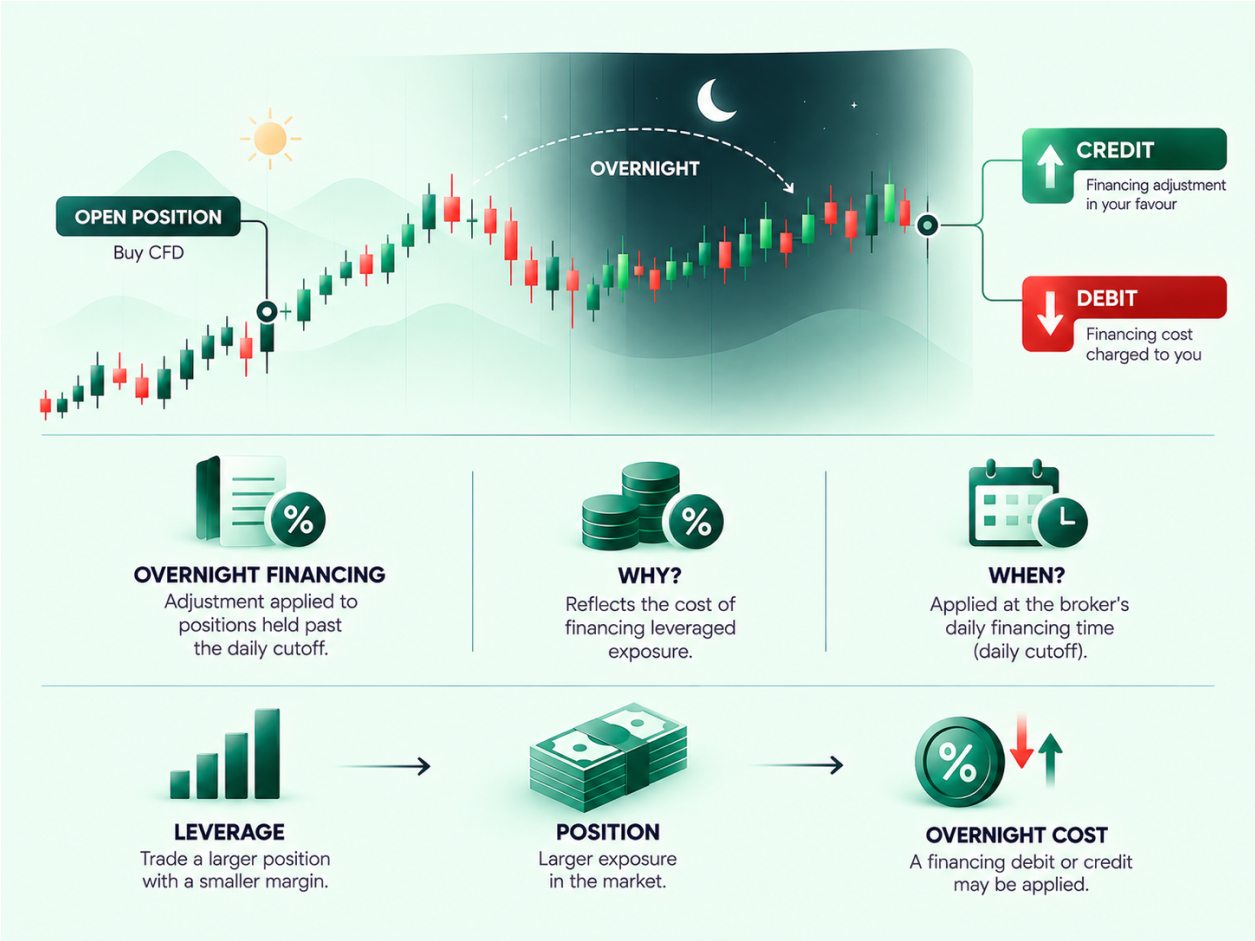
Overnight financing swap rates are daily interest adjustments applied to CFD positions held open past a specified daily cut-off time. They reflect the cost of funding the leveraged portion of a trade, plus an administration fee, and can be either a debit or a credit to a trader’s account.
What Are Overnight Financing Swap Rates and Why Are They Charged?
When you trade CFDs, you are typically engaging in leveraged trading. This means you only put up a fraction of the total trade value as margin, while your broker effectively lends you the remaining capital to open a larger position. This borrowed capital incurs an interest cost, similar to any loan. Overnight financing swap rates are the mechanism through which this interest cost, along with a small broker administration fee, is applied to your account for positions that remain open past the daily market close or a specific broker cut-off time.
This charge ensures that the broker is compensated for the capital they provide to facilitate your leveraged trade. It’s important to note that these charges are applied to “cash” or “spot” CFD positions. Futures and forward CFDs, designed for longer-term speculation, typically incorporate these funding costs into their wider spreads and do not incur separate overnight financing charges.
Key Principles of Overnight Funding
- Daily Application: Charges are typically applied once per day for positions held through the daily cut-off time, which is 23:59 Server Time for LQH Markets. This cut-off time can vary by market and broker.
For instance, while a general server time applies, specific instruments often have cut-off times aligned with their underlying market’s close. For stock index CFDs, those denominated in AUD and NZD might have a daily adjustment applied for positions open past 4:50 PM Sydney time, whereas non-AUD/NZD indices typically use 10:00 PM London time. Similarly, US share CFDs often follow an 8:00 PM New York time cut-off from Monday to Thursday, but switch to 10:00 PM London time on Fridays. Non-US shares generally adhere to the 10:00 PM London time cut-off throughout the week. Being aware of these instrument-specific timings is crucial for managing overnight funding costs effectively.
- Separate Transaction: Overnight funding charges appear as distinct entries on your trading statement and do not directly impact the running profit or loss displayed for your open position.
- Weekend Charges: To account for the weekend, three days’ worth of funding adjustments are generally applied on Fridays for most asset classes. For Forex and spot metals, due to their T+2 (trade date plus two business days) settlement convention, three days’ worth of funding is typically applied on Wednesdays to cover settlement over the weekend.
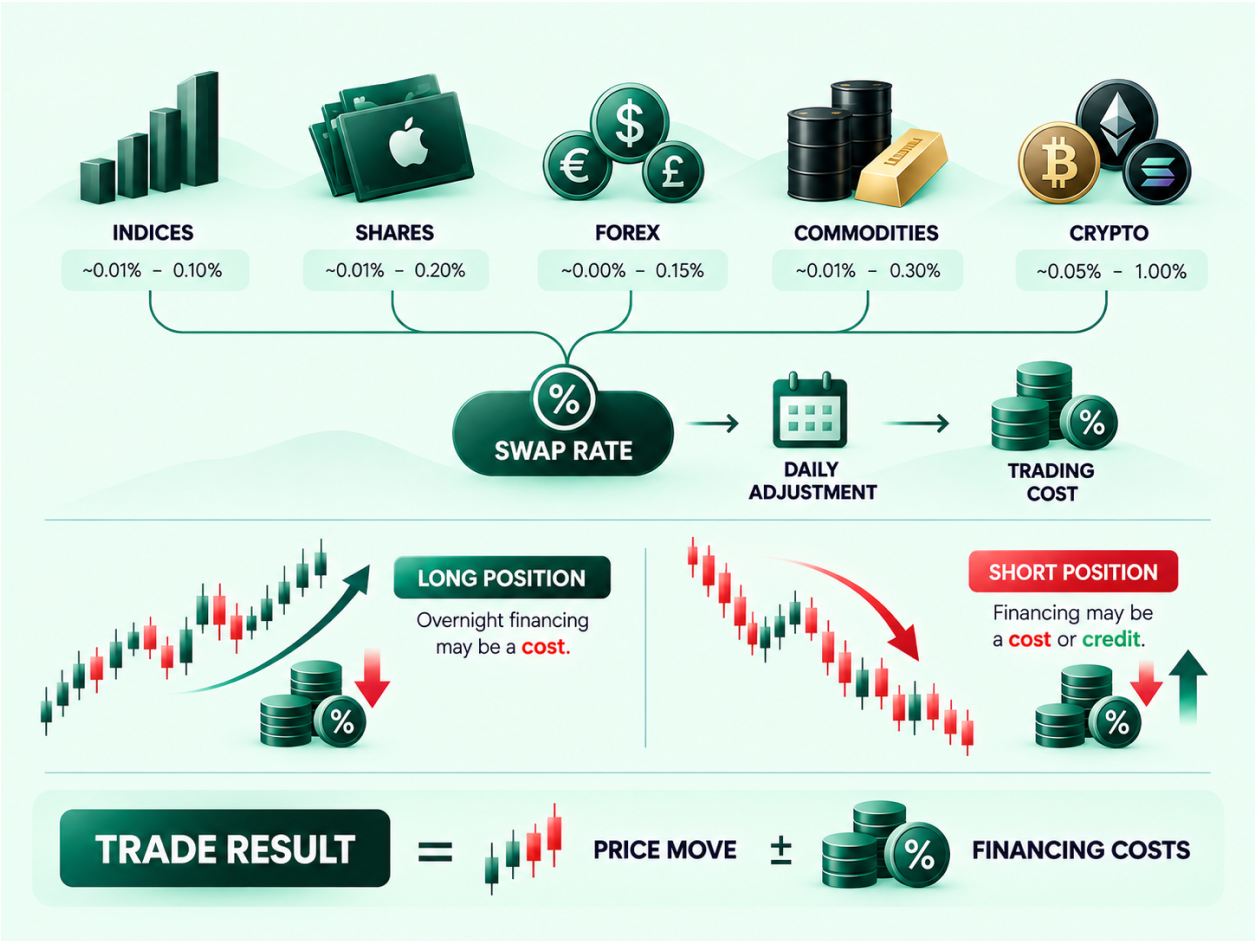
- Debit or Credit: While often referred to as a “charge,” overnight financing can sometimes result in a credit to your account, especially for short positions on certain instruments or when interest rate differentials are favorable.
How Overnight Financing is Calculated Across Different Markets
The calculation methodology for overnight financing swap rates varies significantly depending on the type of CFD instrument. Understanding these distinctions is crucial for accurate cost management.
Indices, Shares, and ETFs
For cash CFDs on stock indices, individual shares, and Exchange Traded Funds (ETFs), adjustments reflect the effect of interest rates and, where applicable, dividends. The cost currency and the relevant interest rate benchmark (e.g., Secured Overnight Financing Rate (SOFR) for USD-denominated assets) are determined by the underlying instrument.
A broker administration fee is typically added to or subtracted from the benchmark interest rate. Specific rates for each instrument are available on our Website and within the MT5 platform.
Formula:
Number of Contracts x Value per Contract x Closing Price x (Broker Admin Fee +/- Relevant Interest Rate Benchmark%) ÷ Divisor
- Closing Price: The price of the underlying asset at the daily cut-off time.
- Divisor: Typically 360 days for most markets, though 365 days may be used for specific currencies like GBP, SGD, and ZAR.
- +/-: For long positions, the benchmark rate is usually added to the admin fee. For short positions, it’s typically subtracted.
Special Consideration for Shares:
When shorting shares via a CFD, you may incur an additional “borrow charge.” This charge compensates the broker for the cost of borrowing the underlying shares to facilitate your short sale and can vary based on the stock’s availability and demand.
The borrow charge is highly variable, depending on the specific stock, its liquidity, and market demand for shorting. It is typically determined by the broker’s agents or liquidity providers and often includes an administration fee, such as 0.5%. It’s crucial for traders to note that both the borrow charge itself and the ability to maintain a short position can be changed at short notice, reflecting dynamic market conditions. Traders should consult their broker or platform for the most current borrow charges before initiating a short share CFD position.
Example: Shorting a US Stock Index
Suppose you are short one contract on the US Tech 100 index.
- Number of contracts: 1
- Value per contract: $1
- Closing price at 5 PM ET: 18,500 points
- SOFR rate (benchmark): 5.30%
- Broker administration fee: 3%
- Divisor: 360 days (for USD-denominated index)
Cost = 1 x $1 x 18,500 x (3% - 5.30%) ÷ 360
Cost = $18,500 x (-2.30%) ÷ 360
Cost = $18,500 x (-0.023) ÷ 360
Cost = -$425.50 ÷ 360
Cost = -$1.18 (This would be a credit of $1.18 to your account, as the benchmark rate is higher than the admin fee for a short position).
Forex and Spot Metals
For currency pairs and spot metals (like Gold or Silver), overnight funding is based on the “tom-next” (tomorrow-next) rate, which reflects the interest rate differential between the two currencies in the pair, along with any applicable broker adjustments.
Tom-Next Rate: This is the interest rate paid or received for rolling an open spot foreign exchange position from one trading day to the next. It’s essentially the cost of borrowing one currency and lending another for a single day.
Weekend Rule: Forex positions held through Wednesday’s daily cut-off time will incur three days’ worth of funding adjustments. This is because FX trades settle on a T+2 basis, meaning a position opened on Wednesday would normally settle on Friday. Holding it past Wednesday’s cut-off effectively carries it over the weekend for settlement purposes.
The easiest way to determine the cost is often directly from the trading platform, which displays the bid/offer swap rates for each pair.
Simplified Platform Formula:
- Long:
Number of Contracts x Value of Contract x Offer Swap Rate - Short:
Number of Contracts x Value of Contract x Bid Swap Rate
Example: Long EUR/USD
You are long 5 contracts of EUR/USD, where 1 contract = $10,000 notional.
- Number of contracts: 5
- Value per contract: $10,000
- EUR/USD Swap Offer Rate (from platform): -0.85 (meaning a debit)
Cost = 5 x $10,000 x (-0.85)
Cost = -$42,500 (This would be a debit of $42,500, but swap rates are usually quoted per standard lot or per point, so this example needs adjustment for typical platform display)
Let’s use a more realistic platform display:
You are long 5 standard lots of EUR/USD.
- Number of contracts: 5
- Swap Offer Rate (per standard lot): -0.85 USD
Cost = 5 x (-0.85 USD)
Cost = -$4.25 (A debit of $4.25 for holding 5 standard lots long overnight)
While the platform’s displayed swap rates offer a quick reference, the underlying calculation involves a more granular, three-step process to derive the final funding cost. This base calculation considers the spot price, the tom-next rate, and an administrative component.
Base Calculation for FX Funding:
- Value:
Price in points x Broker Admin Fee% ÷ Divisor- This step calculates a daily administrative component based on the instrument’s price.
- Swap Rate:
- For Short Positions:
Tom-next Bid Rate – Value - For Long Positions:
Tom-next Offer Rate + Value - This combines the market’s tom-next rate with the administrative component to determine the effective daily swap rate.
- For Short Positions:
- Cost:
Number of Contracts x Value per Contract x Swap Rate- The final daily funding cost is then calculated by multiplying the number of contracts, their value, and the derived swap rate.
Example: Shorting EUR/USD
Suppose you are short one EUR/USD lot.
- Contract value: $1 (representing the value per point or unit, as defined by the broker)
- Tom-next Bid Rate: 0.34
- Tom-next Offer Rate: 0.39
- Closing spot price (e.g., 1.0650 expressed as 10650 points): 10650
- Broker Admin Fee: 1.5% (specific to FX funding)
- Divisor: 360 days
- Value:
10650 x 1.5% ÷ 360 = 0.44375 - Swap Rate (Short):
0.34 – 0.44375 = -0.10375(often rounded to -0.10 for display) - Cost:
1 x $1 x (-0.10375) = -$0.10(A debit of $0.10 for holding one lot short overnight)
This detailed calculation provides insight into the components that contribute to the final swap rate displayed on trading platforms.
Commodities and Other Markets (e.g., Volatility Index, Bonds)
For cash CFDs on commodities (like Crude Oil, Gold) and certain other instruments (e.g., Volatility Index, US Treasury Bonds), prices are often synthetically created using the two most liquid futures contracts. Overnight funding in these markets reflects the “cost of carry” – the natural movement along the futures curve – along with any applicable broker adjustments.
This means you might be debited or credited depending on whether you are long or short, and whether the next futures contract price is higher or lower than the front (nearest-expiry) contract price.
Formula (Three Steps):
- Basis (Daily movement along the futures curve):
(P3 – P2) ÷ (T2 – T1)P2: Price of the front (nearest-expiry) futures contractP3: Price of the next futures contractT1: Expiry date of the previous front futureT2: Expiry date of the front future (T2-T1 = days between expiries)
- Broker Administration Charge:
Closing Price x Broker Admin Fee% ÷ Divisor - Total Adjustment:
(Number of Contracts x Value per Contract) x (Basis +/- Broker Administration Charge)- The
+/-depends on whether you are long or short and the relationship between P2 and P3.
- The
Example: Long US Crude Oil
You are long 2 contracts on US Crude Oil.
- Value per contract: $10 per point
- Days between front and next futures expiries (T2-T1): 30 days
- Front futures contract price (P2): $80.00
- Next futures contract price (P3): $80.50
- Closing price for calculation: $80.00
- Broker administration fee: 3%
- Divisor: 360 days
- Basis:
($80.50 - $80.00) ÷ 30 = $0.50 ÷ 30 = $0.0167per day - Broker Administration Charge:
$80.00 x 3% ÷ 360 = $2.40 ÷ 360 = $0.0067per day - Total Adjustment:
(2 x $10) x ($0.0167 + $0.0067)(assuming long position and positive basis adds to cost)
$20 x ($0.0234)
$0.468(A debit of $0.468 to your account)
Cryptocurrencies
Cryptocurrency CFDs often have distinct, fixed daily overnight funding rates, usually expressed as a percentage per annum, which are then converted to a daily rate. These rates can differ significantly between long and short positions and across various cryptocurrencies.
For long positions, rates can vary significantly: for example, Bitcoin might incur a daily charge of 0.0694% (25% per annum), while Ether/Bitcoin and Crypto 10 might be 0.0625% (22.5% per annum), and other cryptocurrencies could be 0.0764% (27.5% per annum). Conversely, short positions can sometimes result in a credit or a lower debit. For instance, short Bitcoin positions might receive a daily credit of 0.0139% (5% per annum), and Crypto 10 short positions could also receive a credit of 0.0208% (7.5% per annum). However, other short crypto positions, like Ether/Bitcoin, might still incur a debit, such as 0.0208% (7.5% per annum). These specific rates highlight the importance of checking individual instrument details.
Formula for Long Position:
Number of Contracts x Value per Contract x Closing Price x (Broker Fee + Overnight Funding Rate)
Formula for Short Position:
Number of Contracts x Value per Contract x Closing Price x (Broker Fee - Overnight Funding Rate)
Example: Long Bitcoin CFD
You are long 0.5 contracts on Bitcoin.
- Closing price: $65,000
- Broker fee (embedded in rate, or separate): Let’s assume a combined daily long rate of 0.07% (25.55% per annum).
Cost = 0.5 x $1 x 65,000 x 0.07%
Cost = $32,500 x 0.0007
Cost = $22.75 (A debit of $22.75 for holding a long Bitcoin CFD overnight).
Example: Short Bitcoin CFD
You are short 0.5 contracts on Bitcoin.
- Closing price: $65,000
- Broker fee (embedded in rate, or separate): Let’s assume a combined daily short rate of 0.015% (5.475% per annum).
Cost = 0.5 x $1 x 65,000 x 0.015%
Cost = $32,500 x 0.00015
Cost = $4.88 (A debit of $4.88, or potentially a credit if the rate was negative for short positions). In many cases, short crypto positions still incur a debit, but at a lower rate than long positions, or may even receive a credit depending on market dynamics and broker policy.
Impact on Trading Strategy
Overnight financing swap rates are a crucial factor for traders, particularly those employing swing trading or position trading strategies where trades are held for multiple days or weeks. For day traders, who typically close all positions before the daily cut-off, these charges are usually irrelevant.
- Cost of Holding: These rates represent a recurring cost that can erode profits or exacerbate losses if not managed properly. A small daily charge can accumulate significantly over extended periods.
- Strategy Adjustment: Traders might adjust their strategies to avoid or minimize these costs. For instance, they might prefer to trade futures CFDs for longer-term positions or be more selective about which positions they hold overnight.
- Interest Rate Environment: The prevailing interest rate environment significantly influences swap rates. In a high-interest rate environment, long positions become more expensive to hold, while short positions might become more attractive (or less costly).
- Market Dynamics: For commodities and other markets based on futures curves, the contango (where futures prices are higher than the spot price) or backwardation (where futures prices are lower than the spot price) can impact whether you receive a credit or incur a debit for holding positions overnight.
Understanding and factoring in overnight financing swap rates is essential for comprehensive risk management and accurate profit/loss projections in CFD trading. Always consult your broker’s specific rates and calculation methodologies for the instruments you trade.
Frequently Asked Questions
Why do I get charged three days’ worth of funding on Fridays for most CFDs?
Most CFDs incur three days’ worth of funding on Fridays to cover the weekend period when markets are closed. This ensures that the cost of borrowing capital for the leveraged position is accounted for over Saturday and Sunday, in addition to Friday.
Why are Forex CFDs charged three days’ worth of funding on Wednesdays instead of Fridays?
Forex and spot metal CFDs typically settle on a T+2 basis (trade date plus two business days). A position held through Wednesday’s daily cut-off effectively carries over to settle on Friday, thus bridging the weekend. Therefore, Wednesday’s charge covers the funding for Thursday, Friday, Saturday, and Sunday, making it a three-day adjustment.
Do all CFD instruments incur overnight financing charges?
No. While cash CFDs (or spot CFDs) are subject to overnight financing, futures and forward CFDs typically do not incur separate overnight funding charges. Instead, the cost of carry is usually integrated into their wider spreads and the contract price itself.
Can I ever receive a credit instead of a charge for overnight funding?
Yes, it is possible to receive a credit. This often occurs with short positions, especially when the underlying interest rate benchmark for the currency you are effectively lending is higher than the rate for the currency you are borrowing, or when the futures curve for commodities is in backwardation.
How can I find the specific overnight financing rates for my trades?
Your CFD broker will typically publish their specific overnight financing rates and methodologies on their website or within their trading platform. It is crucial to check these details for each instrument you plan to trade, as rates can vary and are subject to change.
Knowledge Check
1. What is the primary reason overnight financing swap rates are charged on CFD positions?
- A) To cover the broker’s administrative costs for processing trades.
- B) To reflect the cost of borrowing the capital used for leveraged CFD positions.
- C) To compensate for potential market volatility during off-market hours.
- D) To fund the broker’s liquidity providers.
2. For which CFD asset class are three days’ worth of overnight funding typically applied on Wednesdays?
- A) Stock Indices
- B) Individual Shares
- C) Forex and Spot Metals
- D) Cryptocurrencies
3. If you are shorting a stock via a CFD, what additional charge might you incur besides the standard overnight financing?
- A) A dividend adjustment fee
- B) A borrow charge
- C) A market data fee
- D) A spread widening fee
Click to view the answers
1. **B) To reflect the cost of borrowing the capital used for leveraged CFD positions.** – Overnight financing covers the interest cost of the leveraged capital provided by the broker.
2. **C) Forex and Spot Metals** – Due to their T+2 settlement cycle, Forex and spot metal CFDs incur three days of funding on Wednesdays to cover the weekend.
3. **B) A borrow charge** – Shorting shares often involves an additional borrow charge to cover the cost of borrowing the underlying shares.