


Mastering Trading Psychology Discipline for Consistent Success
In the dynamic world of CFD trading, where market movements can be swift and unpredictable, technical analysis and robust strategies are undoubtedly important. However, an often-overlooked yet equally critical component of long-term success is trading psychology discipline. It’s the “inner game” that dictates how effectively a trader executes their strategy, manages risk, and navigates the emotional rollercoaster of the markets.
Trading psychology discipline refers to a trader’s ability to manage their emotions, adhere strictly to a predefined trading plan, and make rational decisions even under pressure. It is indispensable for maintaining consistent performance and protecting capital in volatile markets.
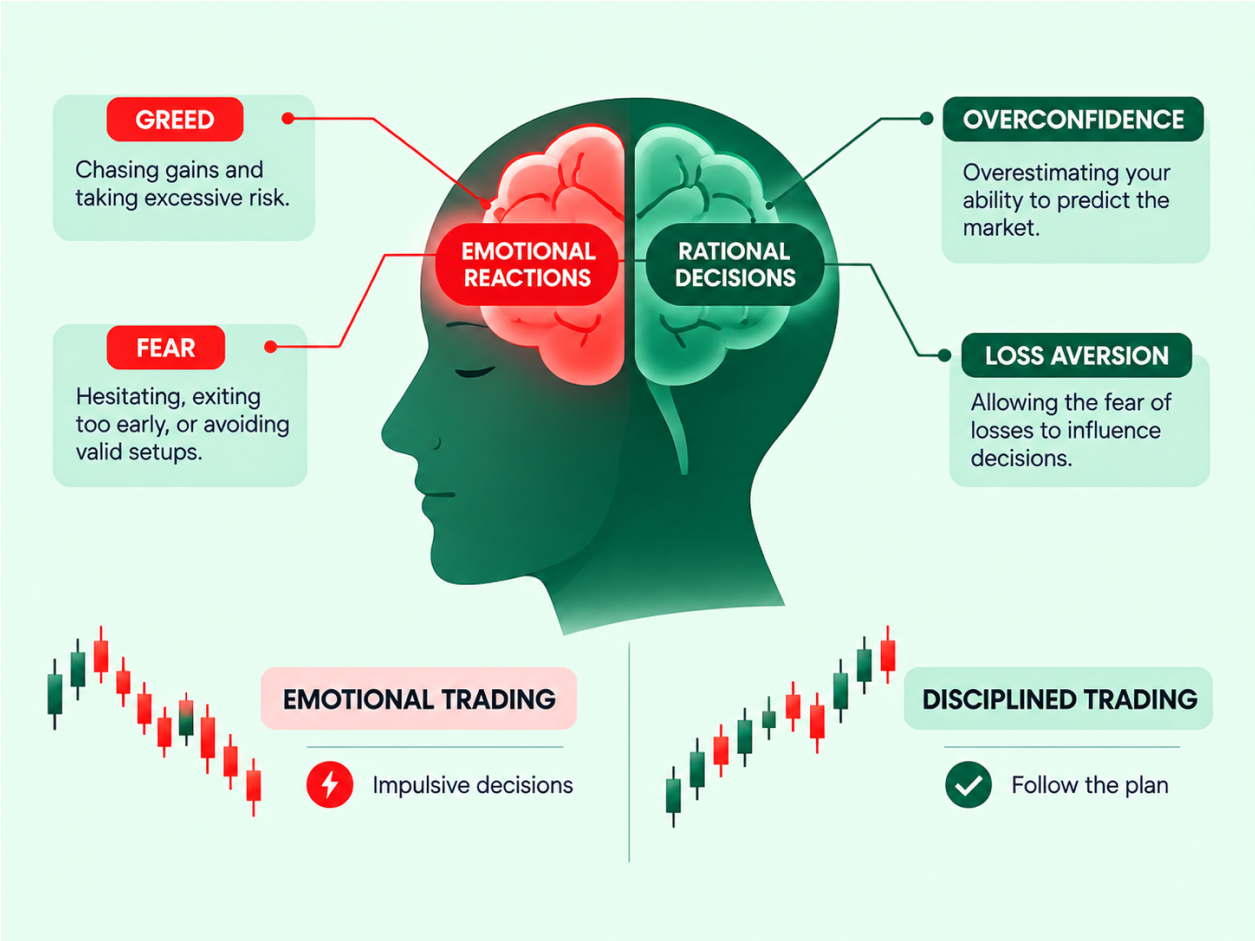
Research consistently indicates that a significant majority of retail traders fail to achieve consistent profitability. This isn’t solely due to a lack of market knowledge or poor strategies; it’s predominantly a psychological issue. Emotions like fear, greed, overconfidence, and denial can easily derail even the most meticulously crafted trading plans, turning potential gains into significant losses. Developing strong psychological discipline is the cornerstone of effective risk management and sustainable trading.
The Core Emotional Drivers: Fear and Greed
At the heart of trading psychology are two fundamental human emotions: fear and greed. While natural in daily life, their unchecked influence in financial markets can be profoundly detrimental.
- Greed: This emotion pushes traders to take on excessive risk, disregard predetermined stop-loss orders, and overtrade in the relentless pursuit of quick, outsized gains. It clouds judgment, leading to hasty decisions and a breakdown of risk management protocols. For instance, a trader might experience a string of profitable trades on a stock index CFD and, fueled by greed, double their position size on the next trade, ignoring a clear resistance level, only to see the market reverse sharply.
- Fear: Conversely, fear manifests as the anxiety of losing money, the worry of making mistakes, or the dread of missing out (FOMO). This can lead traders to second-guess their well-researched analysis, pass up solid opportunities, or prematurely exit profitable positions, thereby missing out on substantial potential profits. Imagine a trader who has identified a strong bullish trend in a crude oil CFD but hesitates to enter due to a minor pullback, fearing a reversal, only to watch the price surge higher without them.
These two emotions often work interchangeably, creating a sense of losing control over one’s decisions, which is a dangerous pitfall for any trader.
Beyond Fear and Greed: Other Emotional Pitfalls
While fear and greed are often cited as the primary emotional pitfalls, several other psychological states can subtly, yet significantly, derail a trader’s discipline and profitability. Recognizing these nuanced emotions is key to developing a comprehensive psychological defense.
- Impatience: This manifests as a rush to enter a trade before a setup is fully confirmed or exiting a profitable position prematurely out of anxiety. Impatient traders often chase market movements, leading to suboptimal entry points, or cut winning trades short, limiting their potential gains. It’s the urge to “do something” rather than waiting for the market to present a clear, high-probability opportunity.
- Pride/Happiness: After a series of successful trades, a natural feeling of pride or happiness can quickly morph into overconfidence. This “winning streak” fallacy can lead traders to believe they are infallible, encouraging them to take on excessive risk, increase position sizes beyond their established limits, or deviate from their proven strategy. This often precedes significant losses, as the market has a way of humbling overconfident participants.
- Temptation: The allure of “hot tips,” unverified news, or enticing but unvetted opportunities can tempt traders to abandon their meticulously crafted trading plan. This deviation, often fueled by the desire for quick profits or the fear of missing out on a perceived easy gain, can lead to trades based on emotion rather than objective analysis, exposing capital to unnecessary risk.
Cognitive Biases Undermining Rational Decision-Making
Beyond overt fear and greed, several cognitive biases subtly influence traders, leading to predictable patterns of behavior that can be detrimental. Recognizing and mitigating these biases is crucial for maintaining a grounded and realistic approach to trading.
- Overconfidence Bias: Traders often overestimate their ability to predict market movements or their own trading skill, especially after a series of wins. This can lead to taking oversized positions, ignoring established risk limits, and trading without adequate analysis. A trader might believe their “hot streak” on a cryptocurrency CFD makes them infallible, leading them to ignore fundamental news or technical indicators that suggest caution.
- Confirmation Bias: This bias involves seeking out and interpreting information in a way that confirms one’s existing beliefs or hypotheses, while ignoring contradictory evidence. If a trader is convinced a particular currency pair CFD will rise, they will primarily focus on news articles and analyst reports that support this view, dismissing any bearish signals. This reinforces poor decisions and can lead to holding losing positions far longer than necessary, hoping for a market reversal to validate their initial conviction.
- Loss Aversion: Humans generally feel the pain of a loss more intensely than the pleasure of an equivalent gain. In trading, this can lead to overly cautious behavior, causing traders to miss out on numerous potentially profitable opportunities. It can also cause traders to hold onto losing positions for too long, unwilling to realize a loss, or to exit profitable positions too early to “lock in” a small gain, thereby capping their upside.
- Recency Bias: Recent events tend to have an outsized influence on decision-making. A string of recent losses can make traders overly cautious, causing them to abandon a perfectly valid strategy prematurely. Conversely, a recent winning streak can foster overconfidence. Traders might place too much weight on the previous day’s market news, assuming its impact will continue, even if underlying market conditions have shifted.
The Impact of Stress and Psychological Fatigue
Trading is an inherently demanding activity, requiring intense focus, rapid decision-making under pressure, and the ability to handle losses without emotional capitulation. Over time, this environment can lead to chronic stress and mental exhaustion, which are significant contributors to poor risk management and trading setbacks.
Unlike many other professions, trading involves unpredictable outcomes where a well-researched decision can still result in a loss, while a reckless one might unexpectedly pay off. This unpredictability strains the nervous system, chipping away at confidence and clouding judgment. Stress skews the perception of risk, leading to reckless decisions or excessive caution. A mentally fatigued trader is more prone to impulsive actions, such as revenge trading after a loss, panic selling, or deviating from their carefully constructed trading plan.
To combat this, successful traders develop routines that help reduce stress and maintain mental balance. Establishing healthy routines, incorporating physical activity, and ensuring adequate rest can significantly improve mental resilience and decision-making clarity.
Psychological Traps: Illusion of Control and Gambler’s Fallacy
Two specific psychological traps that can severely impact a trader’s discipline are the illusion of control and the gambler’s fallacy.
- Illusion of Control: This bias gives traders a false sense that they can somehow influence market performance or are in control of inherently random events. A trader might experience a winning streak and attribute it solely to their skill, rather than acknowledging an element of luck or favorable market conditions. This fosters overconfidence and greed, leading to taking on larger, riskier trades based on a misplaced belief in their own predictive power.
- Gambler’s Fallacy: This is the mistaken belief that past outcomes influence future probabilities. For example, after a series of losing trades, a trader might succumb to the gambler’s fallacy, believing that a winning trade is “due.” This often leads to overtrading or increasing position sizes to “recuperate” previous losses, a behavior known as revenge trading, which typically exacerbates losses.
Overcoming these fallacies requires a deep understanding of probability and randomness in markets, meticulous record-keeping to differentiate skill from luck, and a disciplined acceptance of short-term trading outcomes.
The Pillars of Discipline and Routine
Discipline and routine are the cornerstones of effective risk management and psychological fortitude. While many traders obsess over finding the “perfect” strategy, consistent success often hinges on managing risk daily without succumbing to emotions, overconfidence, or fatigue.
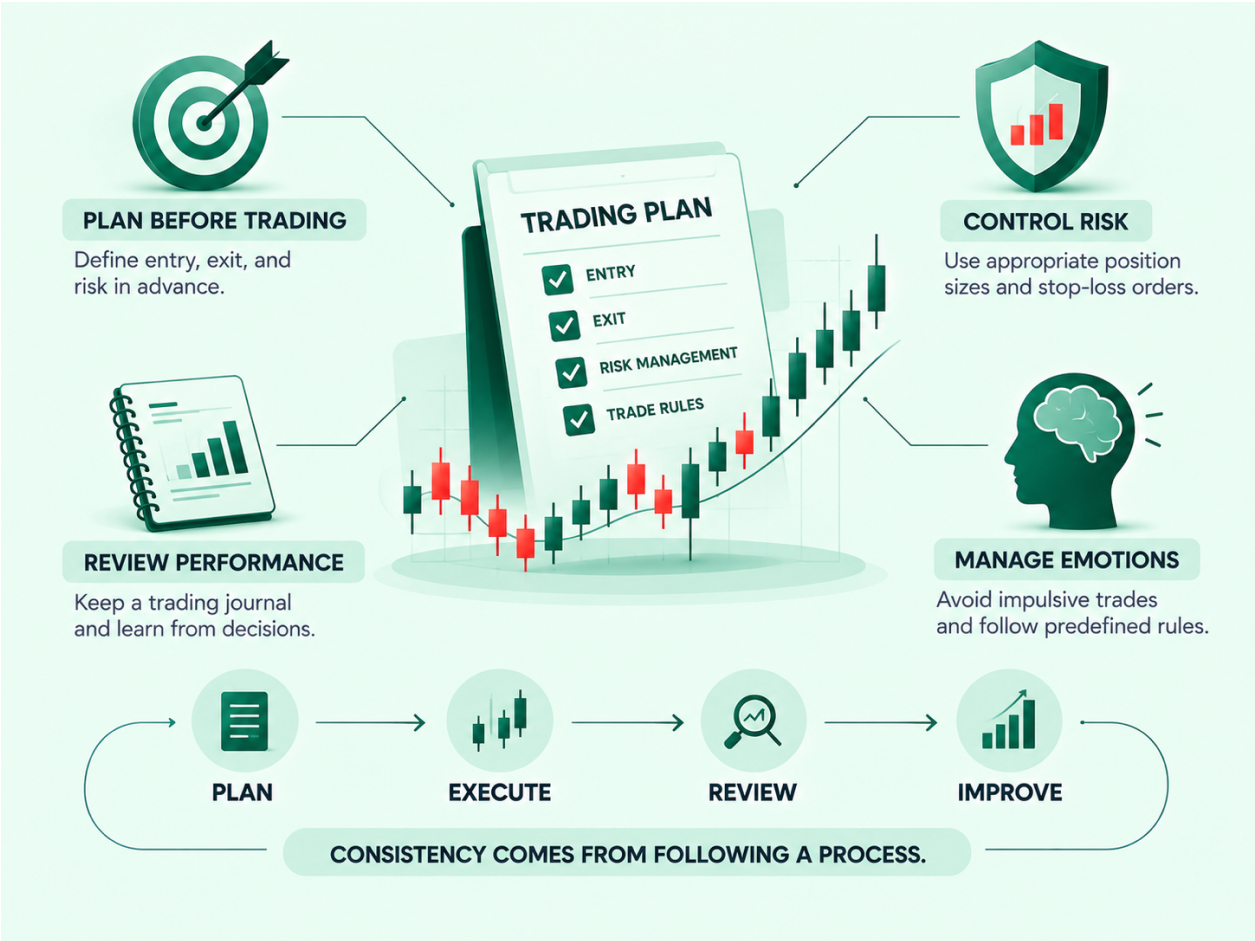
Discipline is the unwavering commitment to a set of predefined rules. This includes:
- Always setting stop-loss and take-profit orders.
- Adhering to strict position sizing guidelines (e.g., the 1% or 2% rule).
- Stepping away from the screen after hitting a daily loss limit.
- Avoiding impulsive trades not aligned with the trading plan.
These rules are simple in theory but incredibly challenging to follow in the heat of the moment, especially when capital is at stake.
Routine reinforces discipline by reducing decision fatigue and emotional volatility. Professional traders often start their day with a consistent pre-market routine: reviewing economic calendars, analyzing key price levels, and revisiting their trading plan. This structured approach sharpens mental clarity and trains the brain to handle uncertainty calmly. A robust routine also incorporates post-market reviews, journaling trades, and reflecting on mistakes not as failures, but as opportunities for growth and improvement.
Advanced Risk Management Application: Position Sizing and Risk-Reward Ratio
Beyond the fundamental principles of discipline, applying advanced risk management techniques like precise position sizing and evaluating the risk-reward ratio are crucial for long-term survival and profitability in trading. These practical tools translate psychological discipline into actionable steps.
Position Sizing (e.g., The 2% Rule)
Position sizing determines how many units of an asset you should trade based on your capital and risk tolerance. The widely adopted “2% Rule” suggests that a trader should risk no more than 2% of their total trading capital on any single trade. This rule is vital for protecting your account from a string of losses.
To calculate your position size:
- Determine your maximum risk per trade: If you have a $10,000 trading account, 2% risk means you’re willing to lose a maximum of $200 per trade ($10,000 * 0.02).
- Identify your stop-loss distance: This is the difference between your entry price and your stop-loss price. For example, if you buy a stock CFD at $50 and set your stop-loss at $49, your stop-loss distance is $1.
- Calculate the number of units: Divide your maximum risk per trade by your stop-loss distance. In this example, $200 / $1 = 200 units. You would trade 200 units of the stock CFD.
This systematic approach ensures that even if you experience several consecutive losses, your capital remains largely intact, allowing you to continue trading.
Risk-Reward Ratio
The risk-reward ratio evaluates the potential profit of a trade against its potential loss. It’s calculated by dividing the distance to your take-profit target by the distance to your stop-loss. A favorable risk-reward ratio (e.g., 1:2 or 1:3) means you stand to gain at least twice or thrice as much as you risk.
For instance, if you risk $100 on a trade (stop-loss distance) but aim for a $300 profit (take-profit distance), your risk-reward ratio is 1:3. This is crucial because it means you don’t need a high win rate to be profitable. With a 1:3 risk-reward ratio, you could win only 30% of your trades and still be profitable:
- 10 trades: 3 wins * $300 = $900 profit
- 7 losses * $100 = $700 loss
- Net profit = $200
By consistently seeking trades with a favorable risk-reward ratio, traders can build long-term profitability even with a moderate win rate, reinforcing the importance of patience and discipline over chasing every opportunity.
Why Most Traders Struggle: Key Psychological Factors
Even with access to advanced tools and education, most traders find consistent profitability elusive. The primary reasons often lie in the psychological realm:
- Lack of Emotional Discipline: The inability to control fear, greed, excitement, or anxiety leads to impulsive decisions, revenge trading after losses, or excessive risk-taking after wins.
- Overtrading and the Need for Action: A byproduct of overconfidence or impatience, leading to taking too many trades, often on low-quality setups, racking up transaction costs and mistakes.
- Lack of a Defined Trading Plan: Without a structured, backtested strategy and clear metrics, traders operate without a compass, leading to inconsistent approaches and returns.
- Inability to Accept Losses: Losses are an inevitable part of trading. The refusal to accept them often triggers revenge trading, which spirals into even heavier losses.
Strategies to Enhance Psychological Risk Management
Developing robust psychological discipline is an ongoing process. Here are several actionable approaches:
- Predefined Risk Limits: Before entering any trade, define your maximum acceptable loss per trade (e.g., 1-2% of capital), comfortable position sizes, and leverage usage. This removes emotional decision-making during active trading.
- Utilize Stop-Loss and Take-Profit Orders: These are essential tools for automating risk management. Stop-loss orders limit potential downside, while take-profit orders help secure gains, preventing greed from holding a position too long.
- Maintain a Trading Journal: Document every trade: entry/exit points, reasons for the trade, emotions felt, and outcomes. Reviewing this journal regularly helps identify behavioral patterns, psychological weaknesses, and strategic flaws.
- Practice Mindfulness and Emotional Awareness: Learn to recognize your emotional state before and during trading. If feeling overwhelmed, irritable, or overly confident, step away from the screen. Taking short breaks can stabilize your mental state.
- Set Realistic Expectations: Understand that trading is not a get-rich-quick scheme. Most traders do not achieve overnight millions. Modest, consistent gains are the goal, keeping ego in check to avoid overextensions and revenge trading.
- Establish a Consistent Routine: A stable pre- and post-market routine provides structure, reduces stress, and fosters a sense of control in an unpredictable environment.
- Continuous Education and Mentorship: Engage with educational resources and consider coaching from seasoned professionals. Learning from others’ experiences and perspectives can provide invaluable insights into managing the psychological aspects of trading.
Ultimately, trading psychology discipline is what often separates consistently successful traders from the rest. Two individuals might possess identical technical analysis skills, but it is their execution—driven by discipline and self-management—that determines their long-term profitability. Risk management is your safety harness, the “boring” but vital element that keeps you in the game long enough to capitalize on opportunities. Embrace losses as part of the process, learn from them, and always return to a balanced, disciplined mindset.
Frequently Asked Questions
Why is emotional discipline critical for CFD traders?
Emotional discipline is critical because CFD markets are highly leveraged and volatile, amplifying the impact of emotions like fear and greed. Unchecked emotions can lead to impulsive decisions, overtrading, ignoring risk management rules, and ultimately significant capital losses, regardless of a trader’s technical skills.
How can a trading journal improve psychological risk management?
A trading journal allows traders to document their trades, including entry/exit points, rationale, and emotional state. By regularly reviewing this record, traders can identify recurring psychological biases or behavioral patterns that lead to mistakes, enabling them to make targeted adjustments to their discipline and strategy.
What are common psychological traps to avoid in trading?
Common psychological traps include the illusion of control (believing one can influence market outcomes), gambler’s fallacy (mistakenly thinking past outcomes affect future probabilities), and cognitive biases like overconfidence, confirmation bias, loss aversion, and recency bias. Avoiding these requires self-awareness, adherence to a plan, and an understanding of market randomness.
How does stress impact a trader’s decision-making and discipline?
Stress can severely impair a trader’s decision-making by skewing risk perception, leading to either excessive caution or reckless aggression. It also erodes discipline, making traders more prone to impulsive actions like revenge trading, deviating from their plan, and making errors that result in significant financial losses.
Knowledge Check
1. Which two core emotions are most commonly identified as driving detrimental trading behaviors?
- A) Joy and Sadness
- B) Fear and Greed
- C) Excitement and Boredom
- D) Confidence and Doubt
2. What is the primary purpose of maintaining a trading journal for psychological discipline?
- A) To calculate daily profits and losses
- B) To track market news and economic indicators
- C) To identify personal behavioral patterns and emotional triggers
- D) To share trading strategies with other traders
3. A trader who holds onto a losing position for an extended period, refusing to sell in the hope it will eventually turn profitable, is most likely exhibiting which cognitive bias?
- A) Overconfidence bias
- B) Confirmation bias
- C) Loss aversion
- D) Recency bias
Click to view the answers
1. **B) Fear and Greed** – These two emotions are fundamental drivers that can lead to impulsive and irrational trading decisions, undermining discipline.
2. **C) To identify personal behavioral patterns and emotional triggers** – A trading journal helps traders reflect on their decisions and emotional states, allowing them to recognize and address psychological weaknesses.
3. **C) Loss aversion** – This bias causes traders to feel the pain of a loss more intensely than the joy of a gain, leading them to avoid realizing losses by holding onto losing positions.