


Trading Contracts for Difference (CFDs) offers investors the potential to amplify returns through leverage, allowing control over a larger position with a relatively smaller capital outlay. However, this amplification cuts both ways, magnifying potential losses just as effectively as gains. Central to managing this inherent risk in leveraged trading is a clear understanding of margin calls – a critical mechanism designed to protect both the trader and the broker.
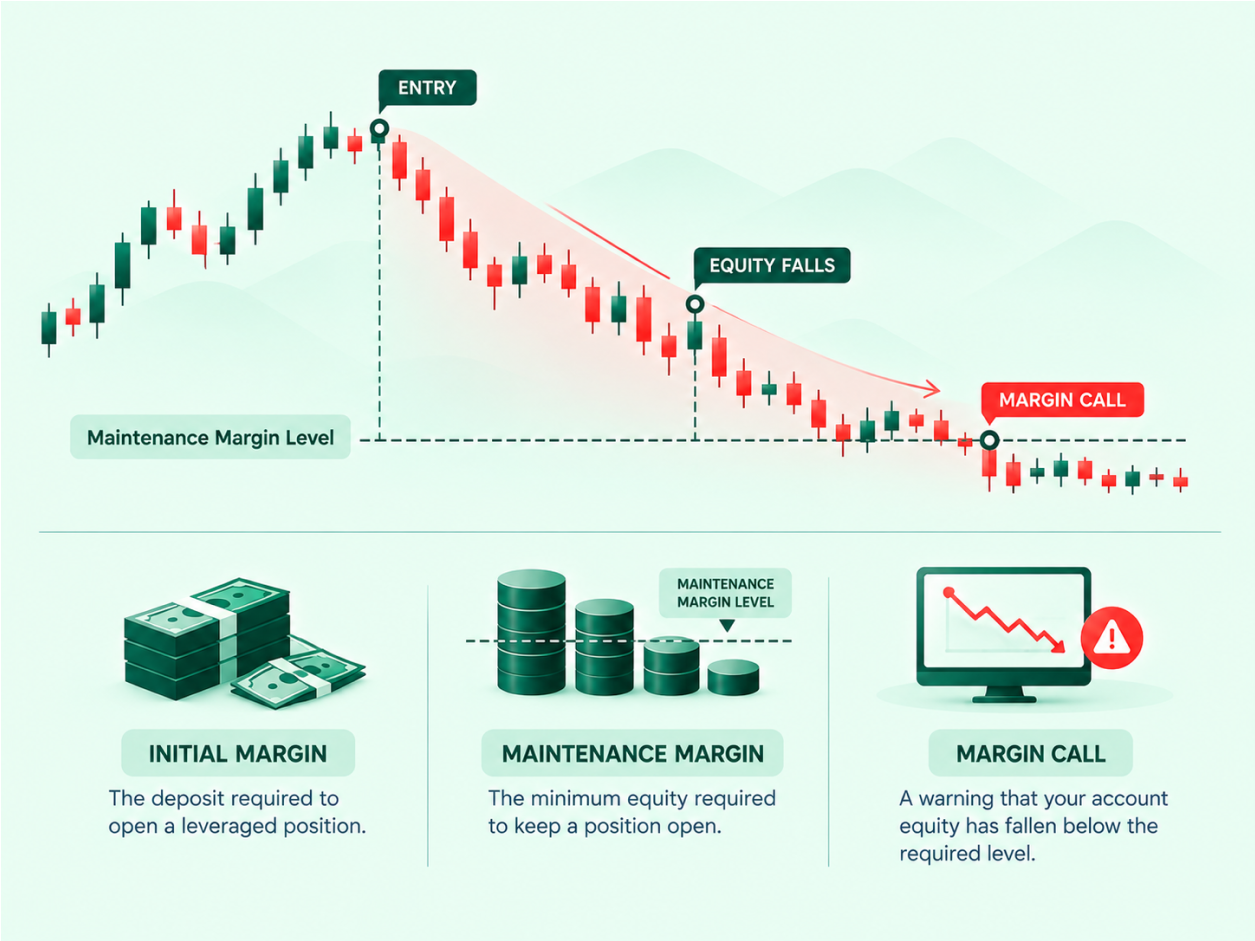
A margin call is a formal demand from a broker requiring an investor to deposit additional funds or securities into their margin account. This demand is triggered when the account’s equity falls below the broker’s minimum required maintenance level.
This guide will demystify margin calls, explaining their triggers, the implications for your trading account, and outlining actionable strategies to both respond to and proactively prevent them.
Understanding Margin Trading Fundamentals
To grasp margin calls, one must first understand these fundamental trading concepts. When you trade on margin, you are essentially borrowing money from your broker to open or maintain a position. This borrowed capital allows you to take on a larger market exposure than your own available funds would permit.
Your equity in the investment is the current market value of your securities minus the amount you have borrowed from the broker. For instance, if you purchase $20,000 worth of assets with $10,000 of your own capital and $10,000 borrowed, your initial equity is $10,000.
Two crucial margin levels govern leveraged accounts:
- Initial Margin: This is the percentage of the total trade value that you must deposit from your own funds to open a new leveraged position. It acts as a down payment.
- Maintenance Margin: This is the minimum percentage of equity you must maintain in your margin account relative to the total market value of your open positions. It’s a safety net, ensuring there’s always enough capital to cover potential losses before they impact the broker’s loan. Regulatory bodies often mandate minimum maintenance margin levels, though these requirements can vary significantly by jurisdiction and broker. Many brokers, especially for CFDs, set their own requirements to enhance risk management.
While regulatory bodies like the New York Stock Exchange (NYSE) and the Financial Industry Regulatory Authority (FINRA) typically mandate a minimum maintenance margin of 25% for traditional securities, brokers often exercise discretion to set higher thresholds. For instance, some firms may require 30% or even 50% for certain instruments, particularly volatile CFDs. These elevated requirements serve as an additional layer of risk management, protecting both the broker’s capital and the client from rapid market movements that could lead to substantial losses. This proactive approach helps ensure that sufficient equity is available to absorb potential adverse price swings, reducing the likelihood of a sudden margin call.
Think of the initial margin as the deposit you make to get the car, and the maintenance margin as the minimum fuel level you need to keep it running smoothly. If the fuel drops too low, you get a warning – that’s your margin call.
The Dynamic Nature of Maintenance Margin
It’s crucial to distinguish between the calculation of initial margin and maintenance margin. While the initial margin is typically a fixed percentage of the initial trade value, representing a specific dollar amount you deposit to open a position, the dollar amount required for maintenance margin is dynamic. This is because it is calculated as a percentage of the current market value of your open positions, not their initial purchase price.
As the market price of your leveraged assets fluctuates, so too does the absolute cash value needed to satisfy the maintenance margin requirement. This means the target you need to maintain in your account equity is a moving one, constantly adjusting with market movements. Traders must therefore continuously monitor their account equity against this fluctuating maintenance margin requirement, as even small price changes can quickly alter the required capital to keep positions open.
What Triggers a Margin Call?
A margin call is primarily triggered when the equity in your margin account falls below the broker’s required maintenance margin level. This usually occurs due to adverse price movements in your open positions. As the market value of your leveraged assets declines, your equity (market value minus borrowed amount) also decreases. If this decline pushes your equity below the maintenance threshold, your broker will issue a margin call.
Periods of high market volatility are particularly prone to triggering margin calls, as rapid price swings can quickly erode account equity.
Margin Call Scenario: An Illustrative Example
Let’s consider a scenario with a CFD trader, Sarah, who opens a position on a hypothetical tech stock CFD, “InnovateCo.”
Margin Call Scenario for CFDs:
- Initial Position: Sarah buys 1,000 InnovateCo CFDs at $50 per share, totaling a notional value of $50,000.
- Margin Requirements: Her broker requires an initial margin (e.g., 20% or $10,000 for this example) and a maintenance margin (e.g., 10% of the current notional value for this example). Please note that actual margin requirements vary by instrument and account type with LQH Markets. Sarah deposits $10,000.
- Market Movement: InnovateCo’s price drops from $50 to $42 per share due to unexpected market news.
- Account Value Reassessment:
- Initial Equity: $10,000 (the amount Sarah deposited).
- Current Profit/Loss: (Current Price – Entry Price) * Quantity = ($42 – $50) * 1,000 = -$8,000.
- Current Account Equity: Initial Equity + P/L = $10,000 – $8,000 = $2,000.
- Current Notional Value of Position: $42 * 1,000 = $42,000.
- Required Maintenance Margin: 10% of Current Notional Value = 10% of $42,000 = $4,200.
- Margin Call Triggered: Sarah’s Current Account Equity ($2,000) is below the Required Maintenance Margin ($4,200).
- Margin Call Amount: The amount needed to bring equity back to the maintenance level is $4,200 – $2,000 = $2,200. Sarah receives a margin call for $2,200.
This example illustrates how a relatively small price movement can significantly impact your account equity, triggering a demand for additional funds.
The Anatomy of a Margin Call
Upon a margin call trigger, your broker will typically attempt to notify you. However, it is crucial to understand that brokers are generally not obligated to inform you, and market conditions can change rapidly, making timely notification impossible. The responsibility for monitoring your account equity and margin levels rests solely with the trader.
Timeframe and Consequences
While some brokers may offer a grace period (often 2 to 5 business days) to meet a margin call, the fine print of most margin agreements grants the broker the right to liquidate any or all of your positions at their discretion and without prior notice to cover the shortfall.
This critical clause is not merely a formality; it is a fundamental protection for the broker’s capital, especially in the highly leveraged and fast-moving CFD market. Brokers lend capital, and they must safeguard that loan against rapid market shifts that could quickly turn a manageable deficit into a substantial loss for them. The broker’s right to liquidate without notice is essential for managing their own risk exposure and preventing potential losses that could impact their solvency. Therefore, while brokers typically attempt to notify clients of a margin call as a courtesy, it is crucial to understand that such notifications are not guaranteed. The fine print of most margin agreements explicitly states that the broker is under no obligation to keep you informed, and any attempt to contact you will be as a courtesy only. Market conditions can deteriorate so rapidly that timely communication becomes impossible. For example, in extremely volatile scenarios where account equity drops from above 100% of margin to below 50% in less than five seconds, positions may be automatically liquidated even before a trader can be informed or react. The onus remains entirely on the trader to continuously monitor their account equity and margin levels, as the broker’s primary obligation is to manage their own risk exposure. This forced liquidation can occur at unfavorable market prices, locking in losses and potentially exacerbating them.
Failure to meet a margin call can lead to:
- Forced Liquidation: Your broker sells your assets to cover the margin deficiency.
- Losses Exceeding Initial Investment: Because you are trading with borrowed capital, it is possible to lose more than your initial deposit, especially in fast-moving markets.
- Broker Charges: You may incur commissions or fees for the forced liquidation.
- Negative Account Balance: While trading on margin carries the risk of significant losses, LQH Markets offers Negative Balance Protection (NBP), which limits a client’s losses on a given account so that the account balance does not fall below zero under normal trading conditions, subject to the prohibitions on abuse described in the Client Agreement.
Strategies to Respond to a Margin Call
If you receive a margin call, immediate and decisive action is required. Here are the primary ways to address it:
- Deposit Additional Funds: The most straightforward method is to deposit enough cash into your account to bring your equity back above the maintenance margin requirement. In Sarah’s example, she would deposit $2,200.
- Deposit Marginable Securities: You can also deposit additional fully paid-for, marginable securities into your account. The value of these securities will contribute to your account equity. The amount of securities required might be higher than the cash equivalent, as they are typically valued at a discount for margin purposes. For instance, if the maintenance margin is 30%, to cover a $2,200 cash shortfall, you might need to deposit securities worth approximately $2,200 / (1 – 0.30) = $3,143. Note that LQH Markets does not currently offer this service.
- Close Existing Positions: You can choose to partially or fully close some of your open positions. This reduces your overall margin requirement, thereby increasing your equity relative to the new, lower requirement. For example, Sarah could close half of her InnovateCo CFD position, reducing her exposure and freeing up some of the initial margin, which would then reduce the total margin required on her account.
A combination of these strategies can also be employed. The key is to act promptly to avoid forced liquidation.
Proactive Risk Management: Preventing Margin Calls
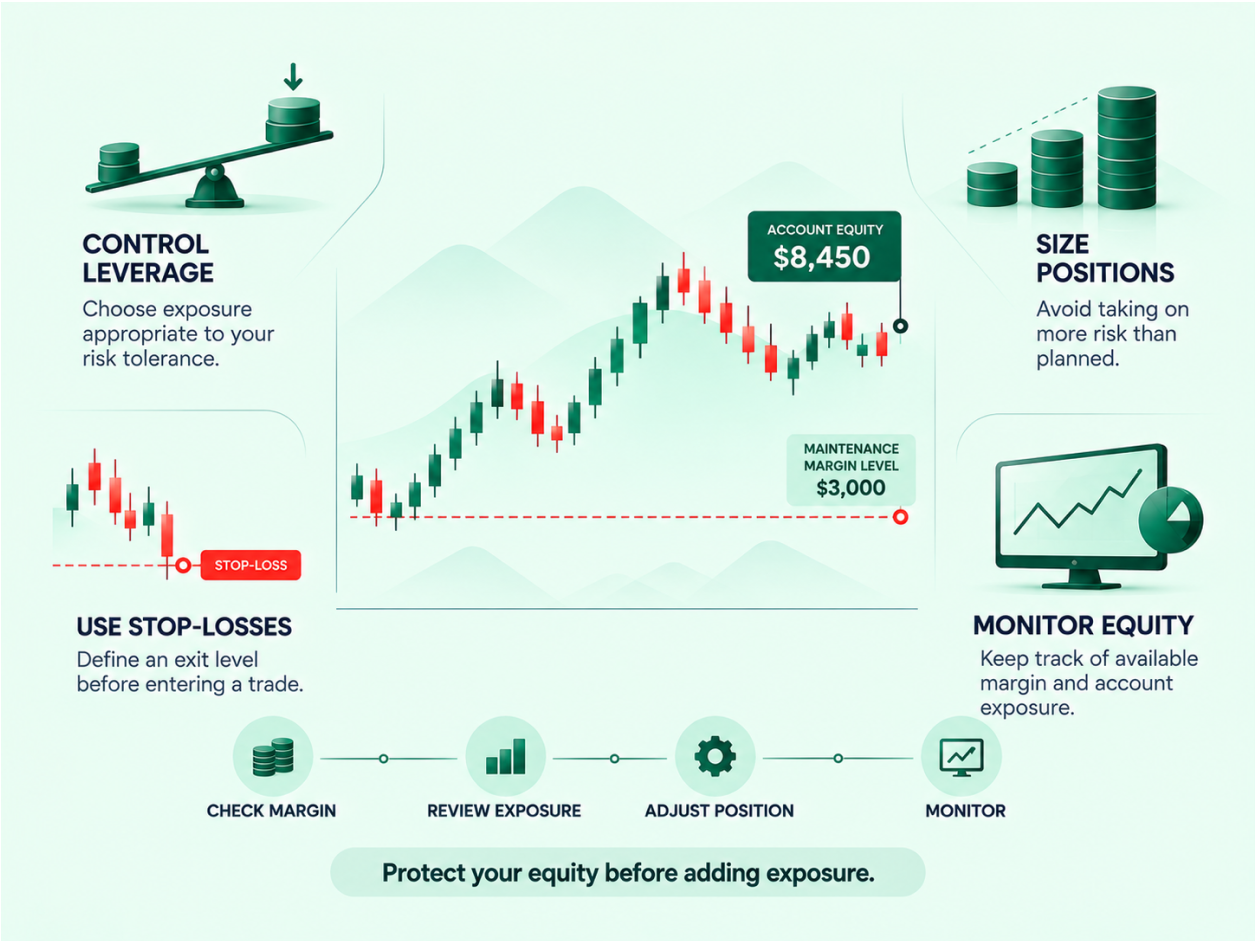
The best defense against a margin call is robust risk management. By implementing proactive strategies, you can significantly reduce your exposure to this risk:
- Maintain Sufficient Capital: Always ensure you have a healthy cash buffer in your trading account, well above the minimum margin requirements. Consider keeping readily accessible funds in your trading account.
- Monitor Your Positions Diligently: Regularly, even daily, review your open positions, account equity, and current margin levels. Many trading platforms offer real-time updates and margin usage indicators.
- Utilize Stop-Loss Orders: Implement protective stop-loss orders on all your leveraged positions. These orders automatically close a trade if the price moves against you by a predetermined amount, limiting potential losses and preventing equity from falling too low.
- Practice Diversification: A well-diversified portfolio can help mitigate the impact of a significant price drop in a single asset. If one position moves adversely, others might remain stable or even gain, cushioning the overall account equity.
- Manage Leverage Prudently: While leverage can amplify gains, it also amplifies losses. Avoid over-leveraging your account. Understand the maximum potential loss on any given trade and ensure it aligns with your risk tolerance.
- Set Custom Alerts: Configure alerts on your trading platform to notify you when your account equity approaches a predefined percentage above the maintenance margin level. This provides an early warning, giving you time to take action before a formal margin call is issued.
- Understand Broker-Specific Rules: CFD brokers often have specific rules regarding margin calls and forced liquidation, including thresholds at which positions may be automatically closed. Familiarize yourself with LQH Markets’ policies, which state that margin requirements vary by instrument and account type, and the broker reserves the right to modify them and close open positions as considered appropriate.
The Broader Market Impact of Margin Debt
Beyond individual accounts, the aggregate level of margin debt in the market can have broader implications. During periods of significant market downturns, widespread margin calls can create a “vicious circle.” As investors are forced to sell assets to meet margin calls, this selling pressure can further drive down asset prices, triggering even more margin calls, and intensifying market volatility. This highlights the systemic importance of prudent margin usage across the trading community.
Conclusion
Margin calls are an integral, albeit often unwelcome, aspect of leveraged trading, particularly with CFDs. They serve as a critical risk management tool, protecting both traders and brokers from excessive losses. While they can be daunting, a thorough understanding of their triggers, the available response strategies, and, most importantly, proactive prevention measures, empowers traders to navigate the complexities of leveraged markets more effectively. By prioritizing vigilant monitoring, disciplined risk management, and conservative leverage, traders can harness the power of CFDs while safeguarding their capital.
Frequently Asked Questions
What is the primary purpose of a margin call?
The primary purpose of a margin call is to ensure that a trader’s account maintains sufficient equity to cover potential losses on leveraged positions. It acts as a safety mechanism, requiring additional funds to prevent the account’s equity from falling below a predetermined maintenance level.
How quickly must a margin call be met?
While some brokers may offer a grace period of 2 to 5 business days, standard margin agreements typically allow the broker to liquidate positions immediately and without prior notice. It is always best practice to meet a margin call as promptly as possible to avoid forced liquidation.
Can I lose more than my initial investment when trading on margin?
Yes, trading on margin carries the significant risk of losing more than your initial investment. However, LQH Markets offers Negative Balance Protection (NBP), which limits a client’s losses on a given account so that the account balance does not fall below zero under normal trading conditions, subject to the prohibitions on abuse described in the Client Agreement.
What are some effective strategies to prevent a margin call?
Effective prevention strategies include maintaining a substantial cash buffer in your account, diligently monitoring your open positions and equity levels, using stop-loss orders to limit potential losses, diversifying your portfolio, and managing your leverage prudently to avoid overextension.
Knowledge Check
1. What is the primary trigger for a margin call?
- A) A significant increase in the value of your assets.
- B) Your account equity falling below the initial margin requirement.
- C) Your account equity falling below the maintenance margin requirement.
- D) The broker deciding to close your account.
2. Which of the following is NOT a valid way to meet a margin call?
- A) Depositing additional cash into your trading account.
- B) Depositing fully paid-for, marginable securities.
- C) Ignoring the margin call and hoping the market recovers.
- D) Closing some of your existing open positions.
3. What is a key risk associated with trading on margin that a margin call highlights?
- A) The inability to open new positions.
- B) The potential to lose more than your initial investment.
- C) The requirement to pay interest on borrowed funds.
- D) The necessity of a diversified portfolio.
Click to view the answers
1. C) – A margin call is triggered when the investor’s equity in their margin account falls below the broker’s required maintenance margin level.
2. C) – Ignoring a margin call is not a valid way to meet it and will likely lead to forced liquidation of your positions by the broker.
3. B) – Trading on margin significantly increases the risk that an investor can lose more than their initial capital due to amplified losses from borrowed funds.