

Market indices are fundamental benchmarks that reflect the performance of specific sectors, industries, or the broader economy. For sophisticated traders engaging with Contracts for Difference (CFDs), understanding how these indices are constructed is not merely academic—it’s a critical component of informed decision-making and risk management. The weighting methodology of an index dictates which constituent companies exert the most influence on its overall movement, directly impacting the behavior of index CFDs.
A capitalization-weighted index assigns influence to its component companies based on their market capitalization, meaning larger companies have a greater impact on the index’s performance. In contrast, a price-weighted index determines influence based solely on the share price of its components, with higher-priced stocks moving the index more significantly.
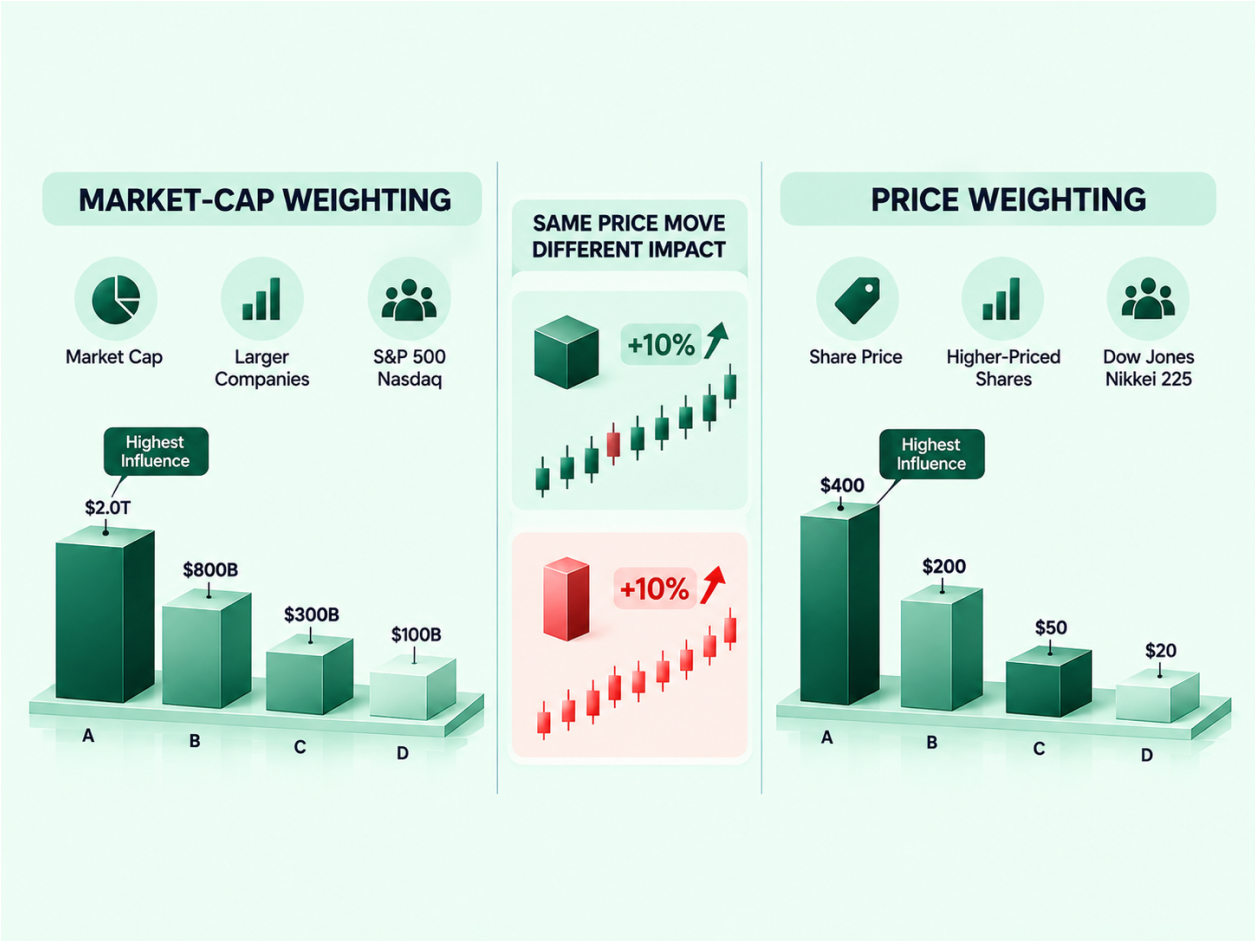
This guide delves into the mechanics, advantages, and disadvantages of the two most prevalent index weighting methodologies: capitalization-weighted and price-weighted. By the end, CFD traders will possess a clearer understanding of how these structures can influence their trading strategies and risk exposure.
Understanding Capitalization-Weighted Indices
A capitalization-weighted index, often referred to as a market-cap-weighted index, is constructed by assigning weight to each component company proportional to its market capitalization. Market capitalization is calculated by multiplying a company’s total number of outstanding shares by its current share price. This means that companies with larger market caps will have a more substantial impact on the index’s performance than those with smaller market caps.
How They Work
Imagine an index composed of three companies:
- Company X: 10 million shares outstanding at $100 per share = $1 billion market cap.
- Company Y: 50 million shares outstanding at $20 per share = $1 billion market cap.
- Company Z: 2 million shares outstanding at $500 per share = $1 billion market cap.
In an equal-weighted index, each would have the same influence. However, in a cap-weighted index, if Company X’s market cap grows to $1.5 billion, its influence on the index would increase, even if Company Y’s share price doubled but its market cap remained smaller overall.
Example:
Consider a simplified index with two companies:
- Tech Giant (TG): 1 billion shares outstanding, $300 per share. Market Cap = $300 billion.
- Innovator Corp (IC): 100 million shares outstanding, $50 per share. Market Cap = $5 billion.
The total market value of this index is $305 billion.
- TG’s weight: ($300 billion / $305 billion) ≈ 98.36%
- IC’s weight: ($5 billion / $305 billion) ≈ 1.64%
If Tech Giant’s stock price moves by 1%, it will have a far greater impact on the index’s value than a 10% move in Innovator Corp’s stock price, due to its overwhelming weight.
Prominent examples of capitalization-weighted indices include the S&P 500 and the Nasdaq Composite. These indices are widely used as benchmarks for the overall health and performance of their respective markets.
Advantages for Traders
- Reflects Market Consensus: Cap-weighted indices are often seen as reflecting the market’s collective opinion on the relative value of companies. Larger companies, by definition, represent a larger portion of the overall market’s value.
- Lower Volatility (Generally): Larger, well-established companies tend to have more stable revenues and operations, contributing to lower overall volatility for the index. This can be appealing for traders seeking smoother trends.
- Lower Turnover for Tracking Funds: Funds that track cap-weighted indices typically experience lower turnover rates, as changes in company size are often gradual, reducing associated trading costs.
Disadvantages for Traders
- Disproportionate Influence: The primary criticism is that a few mega-cap companies can exert an outsized influence on the index. A significant movement in one or two large components can overshadow the performance of dozens of smaller companies. This can distort the perceived health of the broader market.
- Potential for Overvaluation: As a company’s stock price rises, its market capitalization increases, and consequently, its weight in the index grows. This can lead to a situation where index-tracking funds are compelled to buy more shares of already rising (and potentially overvalued) stocks, potentially contributing to price bubbles.
- Concentrated Risk: For CFD traders, this means that an index CFD might be heavily exposed to the fortunes of a few dominant companies. A sudden negative event affecting one of these giants could lead to a substantial drop in the index’s value, even if other components are performing well.
Real-World Impact: Boeing vs. Microsoft in the S&P 500
To illustrate the disproportionate influence of large-cap companies, consider the performance of the S&P 500 on March 22, 2019. On this particular day, two significant constituents, Boeing (BA) and Microsoft (MSFT), both experienced declines in their stock prices:
- Boeing (BA): Closed down -2.83% to $362.17. At the time, Boeing had a market capitalization of approximately $205.39 billion, representing less than 1% of the S&P 500’s total weighting.
- Microsoft (MSFT): Closed down -2.64% to $117.05. Microsoft, however, commanded a much larger market capitalization of around $902.61 billion, accounting for over 3% of the S&P 500’s weighting.
Despite both stocks declining by a very similar percentage, Microsoft’s impact on the overall S&P 500 index was significantly greater than Boeing’s. This is because Microsoft’s substantially larger market capitalization meant that its percentage decline translated into a much larger absolute dollar value reduction in the index’s total market value.
For CFD traders, this example highlights a critical aspect of cap-weighted indices: even if a smaller-weighted company experiences a larger percentage move, a top-weighted company with a similar or even smaller percentage move can have a far more profound effect on the index’s direction. This underscores the necessity of monitoring the performance and news of the largest constituents when trading index CFDs, as their movements will predominantly dictate the index’s overall trajectory.
Understanding Price-Weighted Indices
In stark contrast to capitalization-weighted indices, a price-weighted index assigns influence to its components based solely on their absolute share price. Companies with higher stock prices will have a greater impact on the index’s movement, regardless of their overall market capitalization or company size.
How They Work
To calculate a simple price-weighted index, you sum the share prices of all its components and then divide by a specific divisor. This divisor is adjusted over time to account for corporate actions like stock splits, dividends, or changes in the index’s constituents, ensuring continuity in the index’s value.
Example:
Consider a simplified price-weighted index with three companies:
- Company A: Share price $500
- Company B: Share price $100
- Company C: Share price $50
If Company A’s stock price increases by $10, it will have the same absolute impact on the index as if Company B’s price increased by $10, even though a $10 move represents a much larger percentage change for Company B.
The most famous example of a price-weighted index is the Dow Jones Industrial Average (DJIA). The Nikkei 225 is another prominent example.
Advantages for Traders
- Simplicity: The calculation method is straightforward to understand: higher-priced stocks move the index more.
- Direct Reflection of Price Movements: It directly reflects the average price movement of its components, which can be intuitive for some traders.
Disadvantages for Traders
- Disproportionate Influence of High-Priced Stocks: A company with a high share price, even if it’s a relatively small company by market capitalization, will have a greater impact on the index than a much larger company with a lower share price. This can create a misleading view of market performance.
- Stock Splits Impact: Stock splits dramatically reduce a company’s share price, immediately diminishing its influence on a price-weighted index, even if the company’s underlying value remains unchanged. This necessitates divisor adjustments to maintain index continuity.
- Lack of Economic Representation: Price-weighted indices do not necessarily reflect the economic significance or overall market value of their constituent companies. A high stock price doesn’t always correlate with a company’s size, health, or market footprint.
Comparative Analysis: Price vs. Cap-Weighted Indices
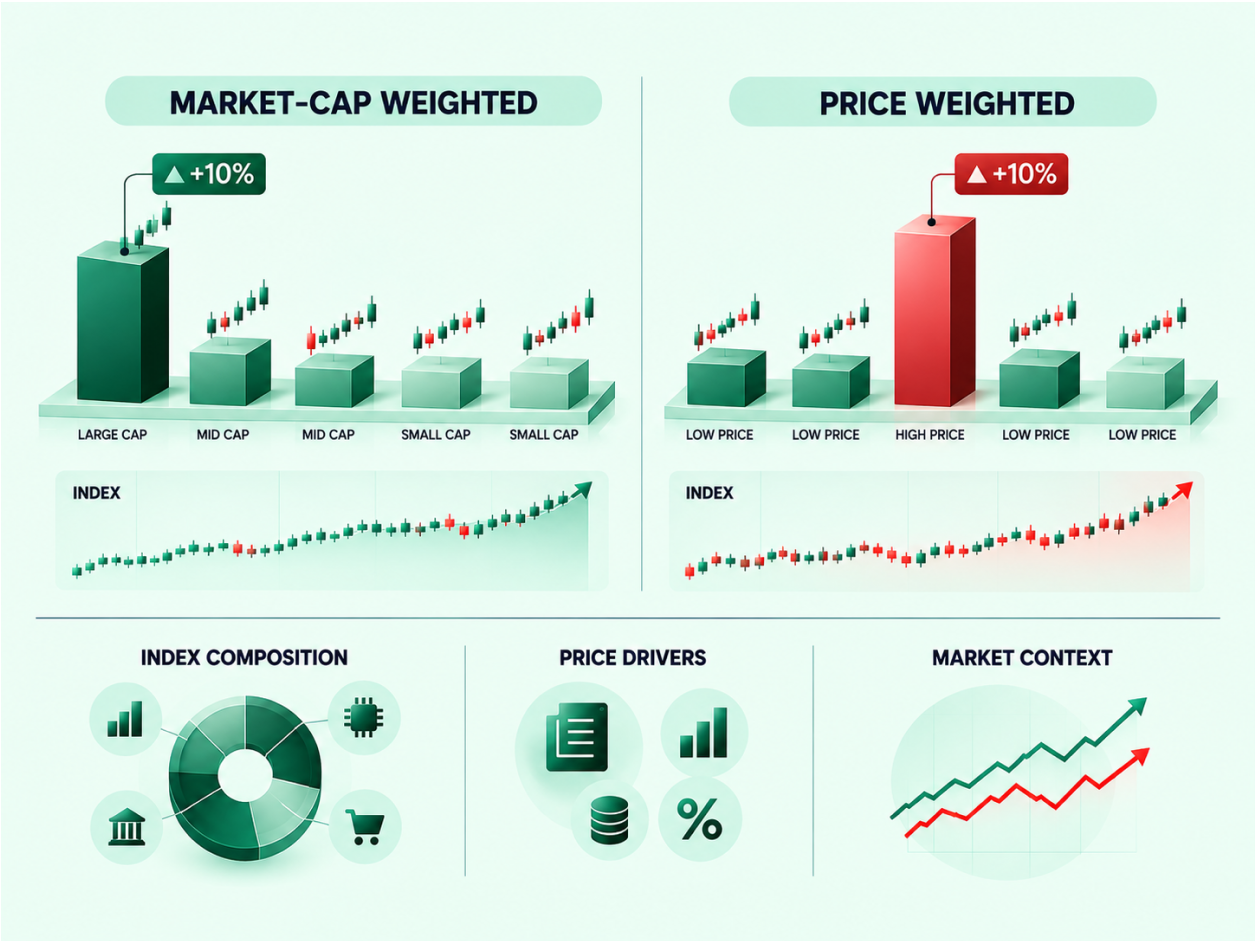
The fundamental difference lies in what metric determines a company’s influence within the index:
| Feature | Capitalization-Weighted Index | Price-Weighted Index |
|---|---|---|
| Weighting Basis | Market Capitalization (Shares Outstanding x Price) | Absolute Share Price |
| Influence Driver | Larger companies (by market cap) have more impact. | Higher-priced stocks have more impact. |
| Market View | Reflects the total market value of components. | Reflects the average price movement of components. |
| Examples | S&P 500, Nasdaq Composite | Dow Jones Industrial Average (DJIA), Nikkei 225 |
| Sensitivity | More sensitive to movements in mega-cap stocks. | More sensitive to movements in high-priced stocks. |
| Corporate Actions | Less affected by stock splits (market cap remains same). | Highly affected by stock splits (requires divisor adjustment). |
Consider an analogy: Imagine two classrooms. In the first, “Cap-Weighted Class,” students’ project grades contribute to the overall class average based on the size of their project (e.g., a large research paper counts more than a small homework assignment). In the second, “Price-Weighted Class,” grades are averaged based on the raw score of each assignment, regardless of its complexity or time investment. A student who consistently gets high scores on small, frequent quizzes might inflate the class average more than a student who aces a single, massive final project.
Implications for CFD Traders
Understanding these weighting methodologies is crucial for CFD traders for several reasons:
-
Risk Assessment:
- Cap-Weighted Index CFDs: Be aware of concentration risk. If you are trading an S&P 500 CFD, a significant portion of its movement will be dictated by a handful of mega-cap tech or industrial giants. Monitor news and earnings reports for these dominant components closely. A sudden downturn in a leading component can disproportionately impact your CFD position.
- Price-Weighted Index CFDs: Recognize that high-priced stocks, regardless of their market cap, can drive the index. A 1% move in a $500 stock will have a much larger absolute impact than a 1% move in a $50 stock, even if the $50 stock belongs to a larger company. This means focusing on the absolute price movements of the most expensive components.
-
Volatility Expectations:
- Cap-weighted indices, due to the stabilizing effect of large, mature companies, might exhibit slightly lower day-to-day volatility compared to an equally-weighted index of the same constituents. However, a major event affecting a top-weighted company can still induce significant swings.
- Price-weighted indices can sometimes appear more volatile if their high-priced components are inherently more volatile, or if a single high-priced stock experiences a large absolute price change.
-
Strategy Development:
- Fundamental Analysis: When trading a cap-weighted index CFD, fundamental analysis on the top 5-10 weighted companies becomes paramount. Their financial health, earnings, and outlook will heavily influence the index.
- Technical Analysis: For both types, standard technical analysis (chart patterns, indicators) still applies to the index CFD itself. However, understanding the underlying weighting helps in interpreting divergences or strong moves. For instance, if a cap-weighted index CFD is rising, check if it’s broad-based or driven by just a few top components.
- Diversification vs. Concentration: While an index CFD offers inherent diversification across its components, the weighting method can reintroduce concentration risk. Traders should be mindful that their “diversified” index CFD might still be heavily reliant on a few stocks.
-
News Interpretation: When a news event impacts a specific company, a trader can quickly assess its potential effect on an index CFD by knowing the company’s weighting. For example, negative news for a top-weighted S&P 500 component will likely have a more immediate and noticeable effect than similar news for a lower-weighted component.
Other Index Weighting Methods
While price-weighted and capitalization-weighted indices are the most common, other methodologies exist, each with its own philosophy:
- Equal-Weighted Indexes: Each component is given the same influence, regardless of its market size or price. This typically requires frequent rebalancing.
- Fundamentally Weighted Indexes: Components are weighted based on fundamental metrics like earnings, dividends, sales, or book value, aiming to reflect a company’s economic footprint rather than just its market value.
- Factor Indexes: These are constructed to emphasize specific investment factors, such as value, growth, momentum, quality, or low volatility.
Each method offers a different lens through which to view market performance. For CFD traders, recognizing the underlying construction of the index they are trading is a foundational step toward more precise analysis and strategic execution.
Frequently Asked Questions
Why do some argue that cap-weighted indices present a distorted view of the market?
Critics argue that cap-weighted indices can distort the market view because they give disproportionate influence to a few large companies. This means the index’s performance might heavily reflect the fortunes of these giants, potentially masking the performance of hundreds of smaller, yet numerous, companies within the index.
How do stock splits affect price-weighted indices differently than cap-weighted indices?
Stock splits significantly reduce a company’s share price, which directly diminishes its influence in a price-weighted index, even though the company’s overall market value remains the same. In contrast, stock splits have no direct impact on a company’s weighting in a cap-weighted index because while the share price decreases, the number of outstanding shares increases proportionally, keeping the total market capitalization constant.
What is the primary benefit for a CFD trader in understanding index weighting methodologies?
The primary benefit for a CFD trader is enhanced risk management and more informed strategy development. Understanding how an index is weighted allows traders to identify concentration risks, anticipate which component companies will drive index movements, and better interpret market news in the context of their CFD positions.
Knowledge Check
1. Which of the following statements is TRUE regarding a capitalization-weighted index?
- A) All component companies have an equal influence on the index’s performance.
- B) A company’s influence is determined solely by its absolute share price.
- C) Companies with larger market capitalizations exert greater influence on the index.
- D) Stock splits significantly reduce a company’s weighting in the index.
2. The Dow Jones Industrial Average (DJIA) is a prime example of which type of index weighting?
- A) Equal-weighted
- B) Capitalization-weighted
- C) Fundamentally weighted
- D) Price-weighted
3. For a CFD trader, a significant disadvantage of a capitalization-weighted index is:
- A) Its calculation method is overly complex and difficult to understand.
- B) It often requires frequent rebalancing, leading to higher transaction costs.
- C) A few mega-cap companies can exert a disproportionate influence, leading to concentrated risk.
- D) It tends to be more volatile than other index types due to small-cap exposure.
Click to view the answers
1. **C)** – Companies with larger market capitalizations have a greater influence on a capitalization-weighted index’s performance.
2. **D)** – The Dow Jones Industrial Average (DJIA) is a well-known example of a price-weighted index.
3. **C)** – In a capitalization-weighted index, a few dominant companies can have an outsized impact, leading to concentrated risk for traders.