


The world of cryptocurrency trading offers unparalleled opportunities for speculative gains, particularly through Contracts for Difference (CFDs). However, the very characteristics that make crypto markets exciting also introduce significant risks, primarily driven by extreme volatility. For traders engaging with crypto CFDs, understanding and proactively managing this volatility is not merely advisable – it is paramount for sustainable engagement.
Contracts for Difference (CFDs) on cryptocurrencies allow traders to speculate on the price movements of digital assets like Bitcoin or Ethereum without owning the underlying asset. This trading method inherently carries significant risks, primarily amplified by the extreme volatility characteristic of the cryptocurrency market.
This guide delves into the unique risks associated with trading crypto CFDs in volatile conditions and outlines a robust framework of strategies and tools to help you navigate these dynamic markets effectively.
Understanding the Dynamics of Crypto CFD Volatility
Crypto CFDs vs. Spot Crypto: Understanding the Core Risk Difference
While both crypto CFDs and direct cryptocurrency ownership involve exposure to the volatile digital asset market, their underlying mechanisms and associated risk profiles differ significantly. Grasping this distinction is crucial for any trader or investor.
When you trade crypto CFDs, you are speculating on the price movements of cryptocurrencies without actually owning the underlying digital asset. This method typically involves leverage, which means you can control a large position with a relatively small amount of capital. While leverage can amplify potential profits, it equally magnifies potential losses. Crucially, with CFDs, you can lose more than your initial deposit, and you are subject to margin calls, requiring you to inject additional funds to maintain your positions if the market moves against you.
In contrast, buying and owning actual cryptocurrencies directly (spot crypto) means you hold the digital asset in a wallet. Your risk is generally limited to the amount you initially invested; you cannot lose more than your initial capital, as there is no leverage involved. You are also not subject to margin calls. While the value of your holdings can fluctuate dramatically, you retain ownership of the asset itself, which can be held long-term or used for transactions.
Understanding these fundamental differences highlights why crypto CFD trading carries an amplified risk profile compared to simply buying and holding cryptocurrencies. The combination of leverage, the absence of underlying asset ownership, and the potential for losses exceeding your initial investment makes robust risk management even more critical for CFD traders.
Volatility is the degree of variation of a trading price series over time. While present in all financial markets, it is exceptionally pronounced in cryptocurrencies due to several inherent characteristics:
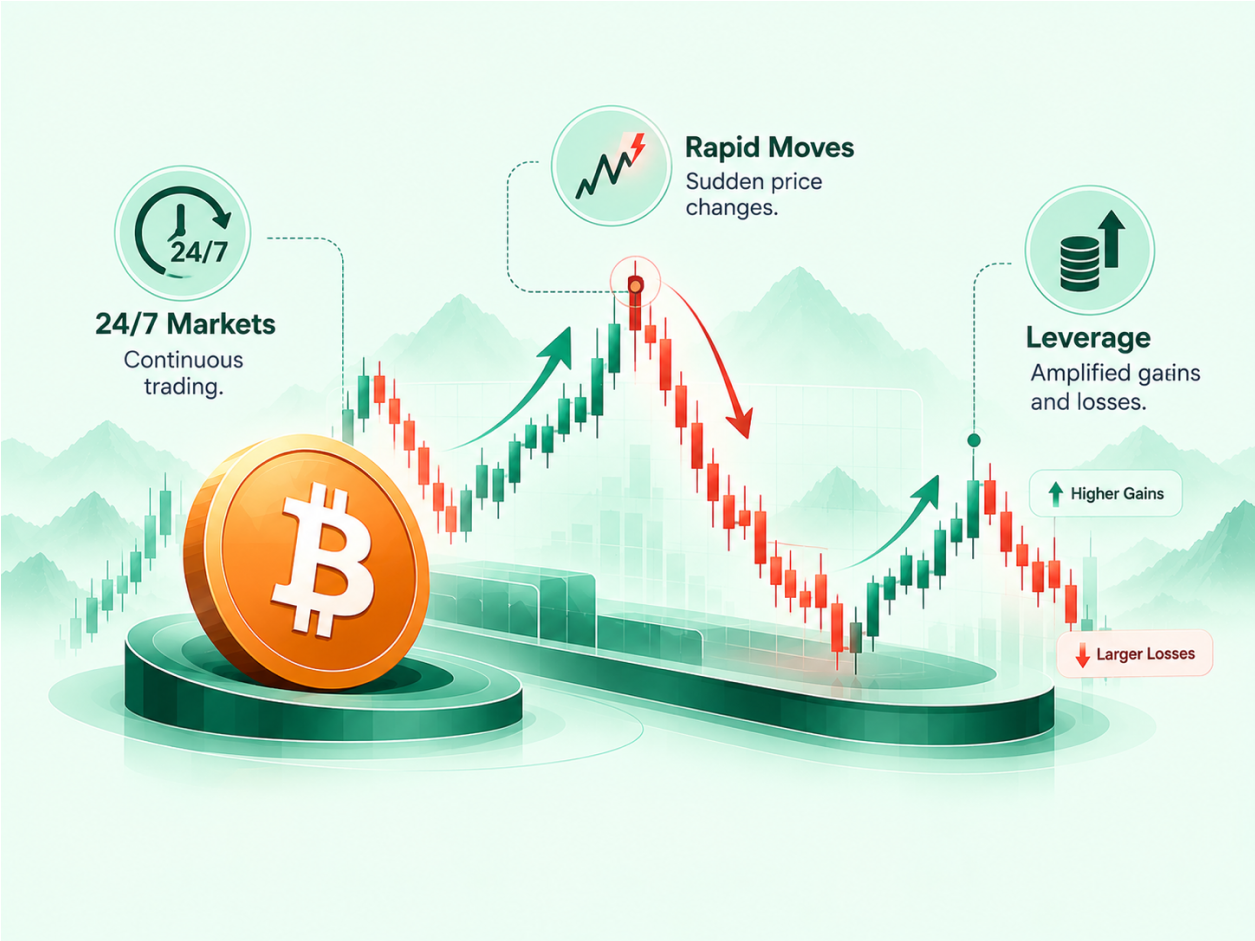
24/7 Market Activity
Unlike traditional stock markets that operate within defined hours, cryptocurrency markets never sleep. They trade continuously, 24 hours a day, seven days a week, including weekends and holidays. This constant activity means significant price movements can occur at any time, even when you are away from your trading screen, potentially leading to unexpected gains or losses.
Rapid Price Movements
Cryptocurrency prices can shift dramatically within minutes or hours. A single regulatory announcement, a major technical upgrade, or even a prominent social media post can trigger substantial price swings. This rapid fluctuation can quickly turn a profitable position into a losing one, or vice versa, demanding quick decision-making and robust risk protocols.
Sentiment-Driven Markets
Cryptocurrency markets are highly sensitive to sentiment. News cycles, regulatory developments, institutional adoption, and even widespread social media discussions can rapidly alter market psychology. Positive news can trigger massive rallies, while negative news or security breaches can lead to sharp sell-offs, often with little fundamental change to the underlying technology.
Reduced Liquidity During Extreme Volatility
During periods of extreme crypto market volatility, liquidity can significantly decrease. This means there are fewer buyers and sellers actively participating in the market, making it harder to execute trades efficiently. When liquidity dries up, the bid-ask spread (the difference between the highest price a buyer is willing to pay and the lowest price a seller is willing to accept) can widen considerably. This widening spread increases the cost of entering and exiting trades and exacerbates the impact of slippage, as orders may be filled at prices far worse than anticipated.
Leverage Amplification
When trading crypto CFDs, you utilize leverage, meaning you only need to deposit a fraction of the total trade value to open a position. While leverage can magnify potential profits from favorable price movements, it equally amplifies potential losses when the market moves against your prediction. In a highly volatile crypto market, even a small adverse price swing can quickly erode your initial margin or lead to a margin call, where you are required to deposit additional funds to maintain your position.
Essential Risk Management Strategies for Crypto CFDs
Effective risk management is the cornerstone of successful crypto CFD trading, especially during periods of heightened volatility. Implementing a structured approach can help protect your capital and enhance your long-term trading viability.
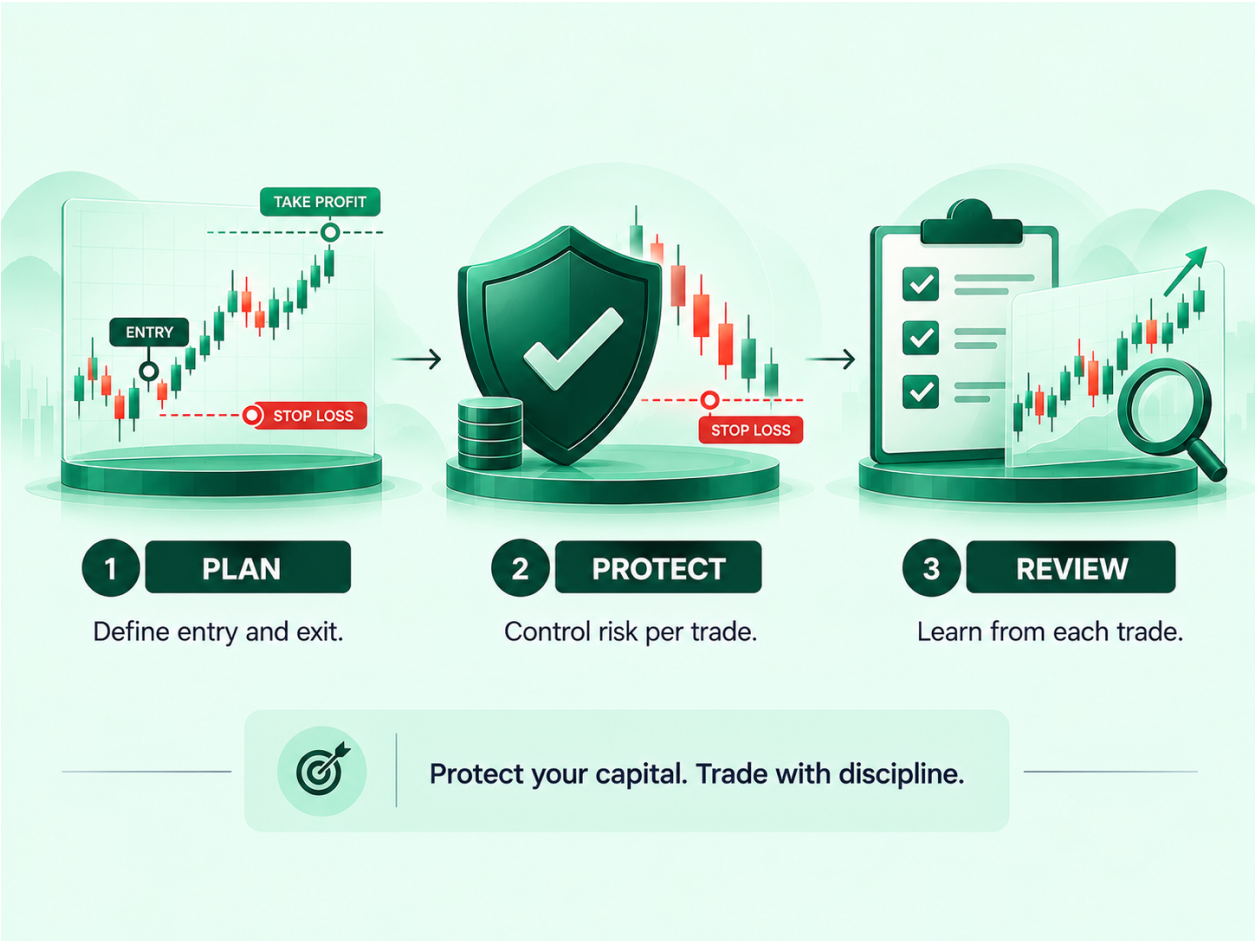
1. Prudent Position Sizing
Position sizing dictates how much capital you allocate to a single trade. This is arguably the most critical risk management tool. Many experienced traders adhere to a strict rule of risking only a small percentage (e.g., 1% to 5%) of their total trading capital on any single trade.
Example: If you have a $10,000 trading account and limit your risk to 2% per trade, you are risking a maximum of $200 on any given position. This approach ensures that even a series of consecutive losing trades will not severely deplete your capital, allowing you to remain in the market and recover. Losing 50% of your capital requires a 100% gain to break even, whereas losing 10% requires only an 11% gain.
2. Strategic Stop-Loss Orders
A stop-loss order is an instruction to automatically close a position when the market reaches a predefined price level, limiting potential losses. This tool removes emotional decision-making during adverse market movements.
-
Standard Stop-Loss: When setting a stop-loss for crypto CFDs, consider the asset’s inherent volatility. A stop-loss placed too close to your entry price might be triggered by normal market “noise,” leading to premature exits. Conversely, a stop-loss set too wide increases your potential loss. During volatile periods, you might need to set a wider stop-loss to account for larger price swings, but this should be compensated by reducing your position size to keep the overall dollar risk consistent.
Example: If you buy a Bitcoin CFD at $60,000 and expect a 5% daily fluctuation, a stop-loss at $59,500 might be too tight. You might consider placing it at $58,000 (a 3.3% drop) and adjust your position size accordingly to keep your dollar risk within your comfort zone. -
Slippage: It’s important to note that standard stop-loss orders are not guaranteed to execute at the exact specified price.
The 24/7, highly volatile nature of cryptocurrency markets, coupled with their propensity for “gapping” (sudden, large price jumps without trading in between, often over weekends or due to unexpected news), makes standard stop-loss orders vulnerable to significant slippage. This is where guaranteed stop-loss orders (GSLOs) offer unique value. A GSLO ensures your position is closed at the exact price you specify, regardless of market conditions or gapping, providing absolute certainty regarding your maximum potential loss. While GSLOs typically come with a small premium or wider spread, this cost can be a worthwhile investment for traders seeking to mitigate the risk of extreme, unpredictable price movements inherent in crypto.
During periods of extreme volatility, low liquidity, or when markets “gap” (jump from one price to another without trading in between), your order might be filled at a worse price than intended. This phenomenon is known as slippage.
- Guaranteed Stop-Loss: LQH Markets does not currently offer guaranteed stop-loss orders. Standard stop-loss orders are subject to market conditions and may experience slippage during periods of high volatility or low liquidity, meaning they may be executed at a different price than intended.
3. Favorable Risk-Reward Ratios
Before entering any trade, calculate your potential profit relative to your potential loss. This is your risk-reward ratio. Many successful traders aim for a ratio of at least 1:2, meaning their target profit is at least twice the size of their maximum acceptable loss.
Example: If your stop-loss indicates a potential $100 loss, you should aim for a profit target of at least $200. With a 1:2 risk-reward ratio, you can still be profitable even if only 40% of your trades are winners, as your winning trades will more than cover your losing ones.
4. Judicious Leverage Management
Leverage is a double-edged sword. While it can amplify gains, it equally amplifies losses. During highly volatile crypto market conditions, it is often prudent to reduce the amount of leverage you employ. Lowering your leverage ratio means you control a smaller position size relative to your capital, providing a greater buffer against adverse price swings and reducing the risk of margin calls. Beginners, in particular, should start with minimal leverage until they gain experience.
Strategic Approaches in Volatile Crypto Markets
Beyond fundamental risk management tools, specific trading strategies can be adapted for volatile crypto CFD environments:
Breakout Trading
This strategy involves identifying assets that have moved decisively beyond established support or resistance levels, indicating a potential shift in momentum. In volatile crypto markets, breakouts can be powerful, signaling significant price fluctuations. Traders using this approach look for strong volume accompanying the breakout to confirm its validity.
Mean Reversion
In contrast to breakout trading, mean reversion operates on the principle that asset prices, over time, tend to revert to their historical average. Extreme highs and lows are often unsustainable. Traders employing this strategy might look to short overextended rallies or buy into significant dips, anticipating a return to the mean. This approach often requires a longer timeframe or careful timing to avoid being caught in extended trends.
Momentum Trading
As the name suggests, momentum trading seeks to capitalize on existing price trends, both upward and downward. Traders identify strong trends and enter positions in the direction of that trend, aiming to ride the wave for a short to medium timeframe. This strategy is particularly popular in fast-moving crypto markets, but requires constant monitoring and quick exits when momentum wanes.
Analogy: Imagine a seasoned sailor navigating a stormy sea. They wouldn’t rely on just one technique; instead, they’d employ a range of maneuvers depending on the waves and wind. Similarly, in volatile crypto CFD markets, traders utilize distinct strategies—breakout for catching new surges, mean reversion for anticipating corrections, and momentum for riding established currents—each adapted to the prevailing market conditions.
Psychological Discipline and Utilizing Trading Tools
Even the best strategies can fail without emotional discipline and the intelligent use of available resources.
Plan Your Trades Before Entry
One of the most effective risk management practices is to define your entry point, stop-loss level, and profit target before you open a trade. This pre-planning happens when you are objective, free from the emotional pressure of a live market. Sticking to your plan minimizes impulsive decisions driven by fear or greed.
Avoid Emotional and Revenge Trading
After a losing trade, the urge to immediately jump back in and “win back” losses (revenge trading) can be strong. This often leads to poor, emotionally charged decisions. If you experience a significant loss, step away from the screen. Re-evaluate your strategy and only re-enter the market when you can make decisions based on analysis, not emotion.
Test Approaches with a Demo Account
Before risking real capital, utilize a demo account. These accounts provide virtual funds and often mirror real-time market conditions, allowing you to test new strategies, refine your risk management techniques, and familiarize yourself with the platform’s tools without financial risk. Remember, past performance in a demo environment is not indicative of future real trading results.
Leverage Trading Tools
A robust trading platform offers a suite of analytical tools to aid decision-making:
- Charts and Technical Indicators: Use professional charting tools with indicators like Moving Averages (MA), Bollinger Bands, Relative Strength Index (RSI), and Moving Average Convergence Divergence (MACD) to identify potential support/resistance levels, trend strength, and overbought/oversold conditions. These can inform your stop-loss placement and profit targets.
- Price Alerts: Set notifications to inform you when a cryptocurrency CFD reaches a specific price level. This allows you to monitor multiple markets without constant screen time, though alerts are for information only and do not replace active risk management.
- Complete Transaction History: Keep detailed records of your trades, including your reasoning, position sizes, outcomes, and lessons learned. This valuable record allows you to identify patterns, evaluate your performance, and continually refine your approach.
Navigating the volatile landscape of crypto CFD trading demands a disciplined, strategic, and informed approach. By understanding the unique risks, implementing robust risk management techniques, employing suitable trading strategies, and maintaining psychological discipline, you can better position yourself to manage the inherent challenges and potentially capitalize on the dynamic opportunities these markets present.
Frequently Asked Questions
What makes crypto CFD trading riskier than other CFD markets?
Crypto CFD trading is uniquely risky due to the extreme 24/7 volatility of cryptocurrencies, their sensitivity to market sentiment and news, and the amplification of these factors by leverage. Unlike traditional markets, crypto assets can experience massive, rapid price swings at any time, significantly increasing potential losses if not managed carefully.
How can I protect my capital during extreme crypto price swings?
Protecting capital during extreme crypto price swings involves several strategies: implementing strict position sizing (e.g., risking only 1-5% of capital per trade), setting appropriate stop-loss orders (potentially wider for crypto), and judiciously managing leverage by reducing it during highly volatile periods.
What is “slippage” in crypto CFD trading and how can I mitigate it?
Slippage occurs when a trade is executed at a different price than intended, often due to rapid market movements, low liquidity, or market gaps. In crypto CFDs, this means your stop-loss might not be filled at your specified price. You can mitigate slippage by setting appropriate stop-loss orders, though these are subject to market conditions and may experience slippage during periods of high volatility or low liquidity.
Should I use high leverage when trading volatile crypto CFDs?
No, it is generally not advisable to use high leverage when trading volatile crypto CFDs, especially for new traders or during periods of heightened market turbulence. While leverage can magnify profits, it equally amplifies losses. Lowering your leverage ratio provides a larger buffer against adverse price movements, significantly reducing the risk of margin calls and substantial capital loss.
Knowledge Check
1. Which of the following is NOT a primary characteristic contributing to high volatility in crypto CFD markets?
- A) 24/7 continuous trading
- B) Rapid, sentiment-driven price movements
- C) Underlying asset ownership
- D) Leverage amplification of gains and losses
2. If a trader has a $15,000 account and adheres to a 2% risk per trade rule, what is the maximum dollar amount they should risk on a single crypto CFD position?
- A) $150
- B) $300
- C) $750
- D) $1,500
3. What is the main benefit of using a guaranteed stop-loss order in highly volatile crypto CFD markets?
- A) It guarantees a profit on the trade.
- B) It reduces the commission charged by the broker.
- C) It ensures the trade is executed at the exact specified price, even with slippage.
- D) It automatically adjusts the position size based on market conditions.
Click to view the answers
1. **C) Underlying asset ownership** – When trading CFDs, you speculate on price movements without owning the underlying asset, so this is not a characteristic contributing to volatility.
2. **B) $300** – 2% of $15,000 is $300 ($15,000 * 0.02 = $300).
3. **C) It ensures the trade is executed at the exact specified price, even with slippage.** – Guaranteed stop-loss orders protect against slippage by ensuring execution at the specified price.