


In the dynamic world of trading, where market fluctuations can rapidly impact capital, effective risk management is paramount. While identifying profitable trading opportunities is essential, knowing how much to risk on each trade is arguably more critical for long-term success. This is where the concept of position sizing becomes indispensable.
Position sizing is the strategic process of determining the optimal number of units of a security to trade, aligning each transaction with your overall account size and predefined risk tolerance. This fundamental risk management technique is crucial for preserving capital and fostering sustainable trading growth.
What is Position Sizing?
Position sizing refers to the methodology traders employ to decide the appropriate quantity of a financial instrument to buy or sell for a specific trade. It’s not merely about choosing a random number of shares, contracts, or lots; it’s a deliberate calculation designed to ensure that no single trade, regardless of its outcome, can disproportionately harm your trading capital.
For CFD (Contract for Difference) traders, position sizing takes on an amplified importance due to the inherent leverage offered by these instruments. While leverage can magnify potential profits, it equally magnifies potential losses. Therefore, a disciplined approach to position sizing acts as a vital safeguard, enabling traders to participate in markets with confidence, knowing their risk exposure is meticulously controlled.
Why Position Sizing Matters More Than Many Traders Realize
Many aspiring traders focus heavily on entry and exit points, technical indicators, or fundamental analysis. While these are crucial components of a trading strategy, neglecting position sizing can undermine even the most sophisticated analytical approach. Here’s why it’s a cornerstone of professional trading:
- Capital Preservation: The primary goal of position sizing is to protect your trading capital. By risking only a small, fixed percentage of your total account on any single trade, you can endure a series of losing trades without facing catastrophic drawdowns. This ensures you remain in the game to capitalize on future opportunities.
- Emotional Discipline: Trading with an uncontrolled position size often leads to emotional decision-making. Over-sizing a trade can induce fear or greed, prompting impulsive actions like prematurely closing winning trades or holding onto losing trades for too long. A predefined position size removes this guesswork, fostering a more disciplined and objective approach.
- Consistent Growth: By managing risk consistently, you create a stable foundation for compounding returns. Even with a modest win rate, disciplined risk management allows your capital to grow steadily over time, rather than being subjected to volatile swings.
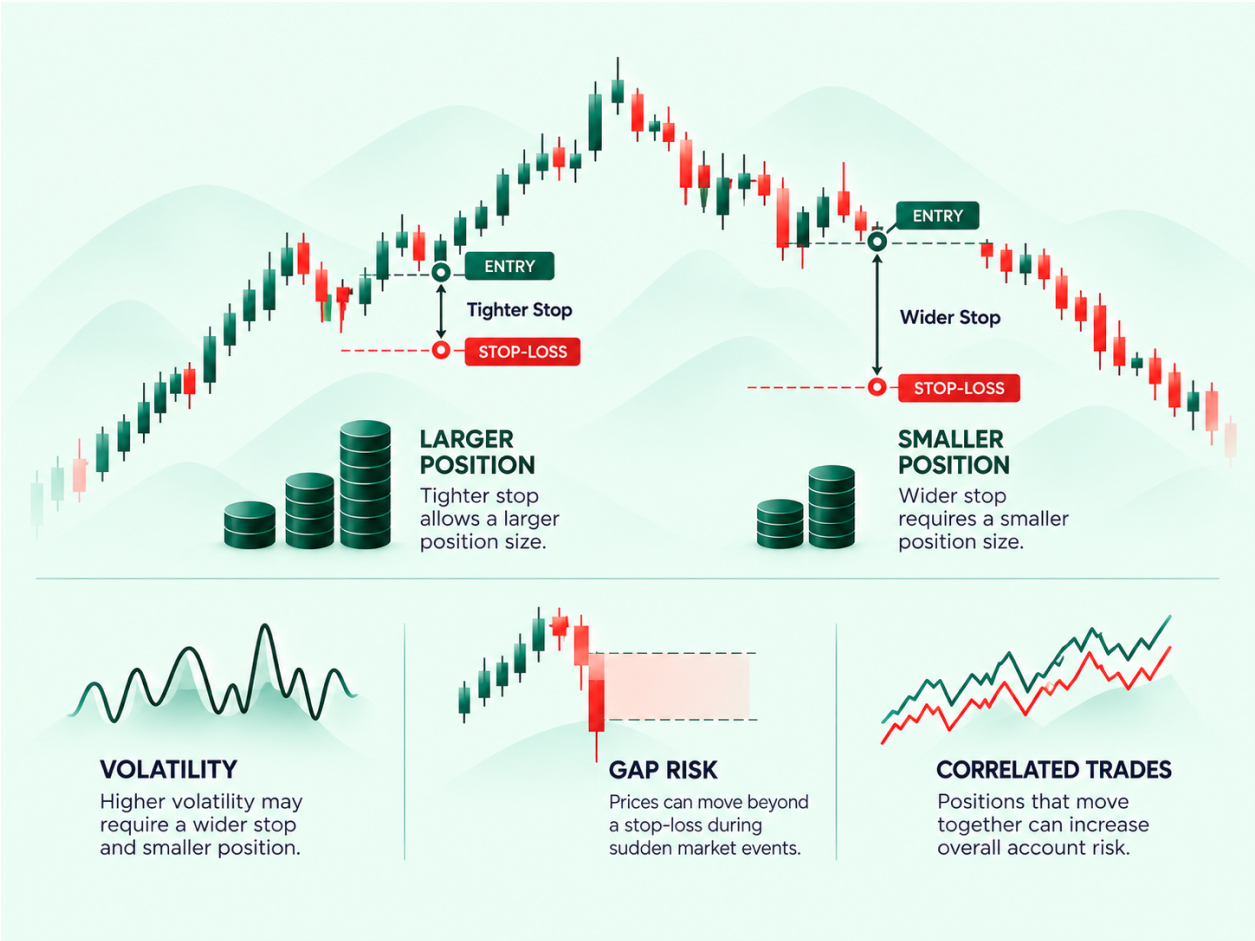
- Adaptability to Volatility: Market conditions are constantly changing. Position sizing allows you to adapt. During periods of high volatility, a wider stop-loss might be necessary, which in turn would lead to a smaller position size to maintain the same dollar risk. Conversely, in calmer markets, a tighter stop-loss might allow for a larger position.
The Core Position Sizing Rule: A Step-by-Step Guide
The beauty of position sizing lies in its straightforward, systematic application. It involves three key steps:
1. Define Your Account Risk
This is the most crucial step. You must decide the maximum percentage of your total trading capital you are willing to risk on any single trade. Most experienced traders recommend risking no more than 1% to 2% of their account on a given trade. This seemingly small percentage is powerful because it allows your account to withstand multiple consecutive losses.
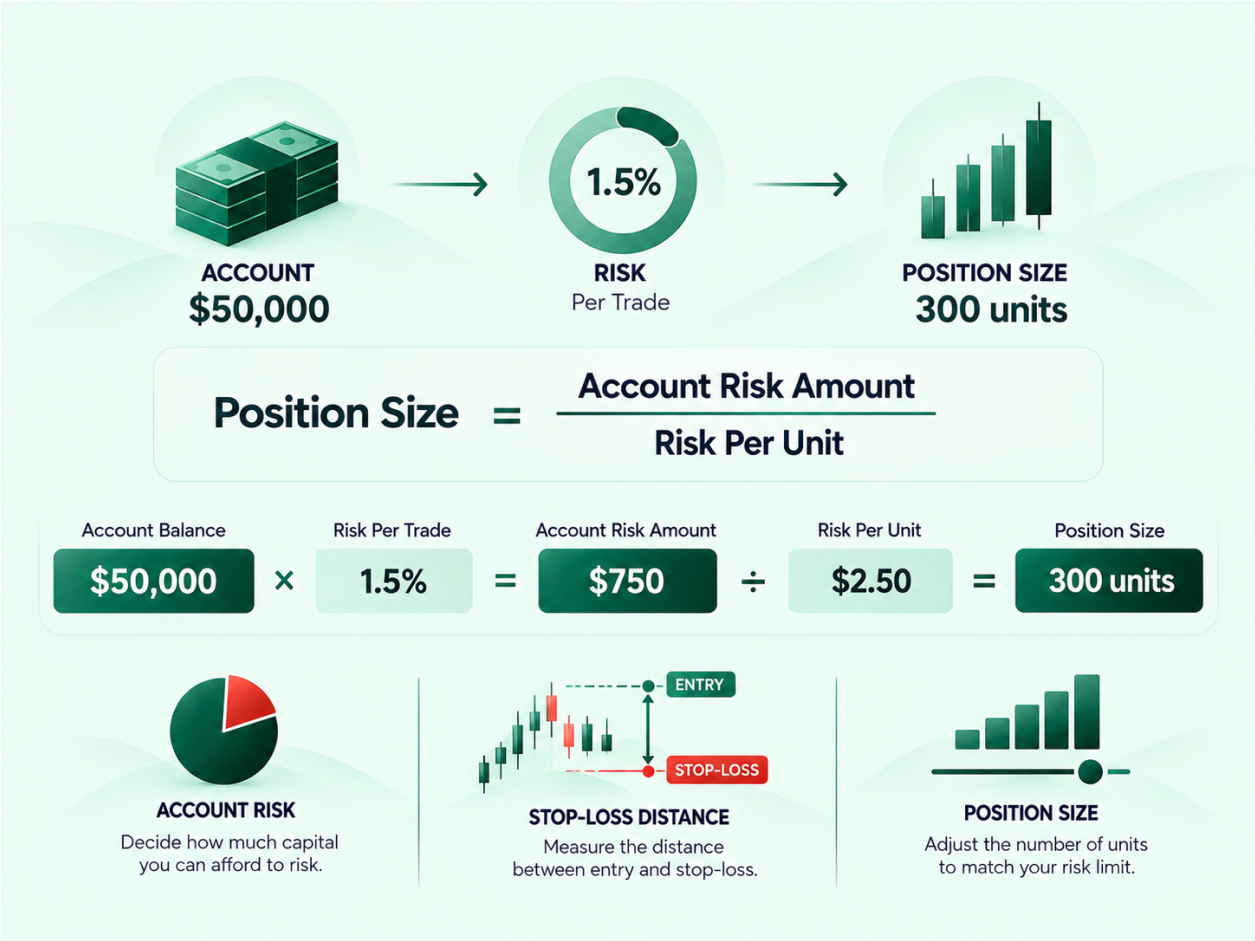
Example: If your trading account has $50,000, and you decide to risk 1.5% per trade: Maximum Account Risk Amount = Account Balance × Risk Percentage Maximum Account Risk Amount = $50,000 × 0.015 = $750
This means you are prepared to lose no more than $750 on any single trade.
The power of this conservative approach becomes evident during inevitable losing streaks. Even if you were to experience 10 consecutive losing trades, each sized at 1.5% of your $50,000 account, your total capital loss would be $7,500 (10 trades × $750 per trade), representing only 15% of your initial capital. This resilience ensures that your account can absorb significant setbacks without being decimated, allowing you to remain in the market and recover. It also reinforces emotional discipline, as the knowledge that no single loss can severely damage your account helps mitigate fear and impulsive decision-making, which are common pitfalls for traders.
2. Determine Your Trade Risk
Next, you need to identify the potential loss for the specific trade you are considering. This is determined by the difference between your entry price and your stop-loss order. A stop-loss order is a pre-set instruction to close a trade if the price moves against you to a certain level, limiting your potential loss.
Example (Stock CFD): You identify a potential long trade on “InnovateTech” CFD. Entry Price = $125.00 Stop-Loss Price = $122.50 Trade Risk Per Unit = Entry Price - Stop-Loss Price Trade Risk Per Unit = $125.00 - $122.50 = $2.50
This means for every unit of InnovateTech CFD you trade, you risk $2.50.
Example (Forex CFD): You identify a potential short trade on EUR/USD CFD. Entry Price = 1.0850 Stop-Loss Price = 1.0875 Trade Risk Per Unit (in pips) = Stop-Loss Price - Entry Price = 0.0025 (25 pips) Assuming a standard lot (100,000 units) of EUR/USD has a pip value of $10, then 1 unit has a pip value of $0.0001. So, the dollar risk per unit is 0.0025 × $1 = $0.0025. Trade Risk Per Unit = $0.0025
3. Calculate Your Position Size
With your maximum account risk amount and the trade risk per unit, you can now use a position size calculator to determine the optimal position size.
Position Size = Maximum Account Risk Amount / Trade Risk Per Unit
Continuing the Examples:
For InnovateTech CFD: Position Size = $750 (from Step 1) / $2.50 (from Step 2) = 300 units You would trade 300 units of InnovateTech CFD.
For EUR/USD CFD: Position Size = $750 (from Step 1) / $0.0025 (from Step 2) = 300,000 units This equates to 3 standard lots (or 30 mini-lots, or 300 micro-lots).
This calculated position size ensures that if your trade hits its stop-loss, you will lose exactly your predefined account risk amount ($750 in this case), no more.
Advanced Considerations for CFD Traders
While the core rule is simple, CFD traders must consider additional factors:
Leverage and Margin
CFDs allow you to trade with leverage, meaning you only need to put up a fraction of the trade’s total value as margin. It’s crucial to understand that leverage does not change the dollar amount you risk per trade if you follow the position sizing rule. The formula still ensures you only lose your defined percentage of capital. However, leverage does affect the margin required to open your calculated position. Ensure you have sufficient margin to cover the trade and potential fluctuations.
Gap Risk
Market gaps occur when the price of an asset “jumps” from one level to another without any trading in between. This often happens over weekends, during major news announcements, or before earnings reports. If a market gaps beyond your stop-loss order, your trade might be closed at a less favorable price, leading to a loss larger than your intended account risk.
Mitigation Strategies:
- Reduce Position Size: Before high-impact news events, consider halving your usual position size.
- Guaranteed Stop-Losses: Some brokers offer guaranteed stop-loss orders (GSLOs), which ensure your trade is closed at the exact price you specify, even if the market gaps. Be aware that these typically come with a wider spread or a premium. LQH Markets does not currently provide this feature and traders should be aware that standard stop-loss orders may be subject to slippage, especially during volatile market conditions or market gaps, meaning trades might be closed at a price different from the specified stop-loss level.
Volatility
Market volatility impacts how far prices move in a given period. In highly volatile markets, stop-losses often need to be wider to avoid being prematurely stopped out by normal price swings. A wider stop-loss, according to the position sizing formula, will naturally lead to a smaller position size for the same dollar risk. Tools like the Average True Range (ATR) indicator can help objectively determine appropriate stop-loss distances based on current volatility.
Correlation
If you hold multiple open positions, be mindful of their correlation. Holding several highly correlated assets (e.g., multiple tech stocks, or different pairs involving the USD) can effectively increase your overall portfolio risk, even if each individual position is sized correctly. A major market event impacting one asset might similarly affect all correlated assets, leading to simultaneous losses across your portfolio.
Beyond Fixed Percentage: Exploring Other Position Sizing Methodologies
While the fixed percentage method is highly effective and widely recommended, it’s not the only approach to position sizing. Traders can explore other methodologies, each with its own advantages and disadvantages, depending on their trading style and risk appetite.
Fixed Dollar Position Sizing
This method involves risking a fixed dollar amount on every trade, such as $500, irrespective of the account balance. The position size is then determined by dividing this fixed dollar amount by the trade risk per unit.
- Pros: Offers straightforward simplicity and absolute control over the dollar amount risked. It’s easy to understand and implement.
- Cons: Unlike the fixed percentage method, it doesn’t dynamically scale with your account. This means the relative risk (percentage of capital) changes as your account grows or shrinks, potentially limiting growth or increasing risk during drawdowns.
Fixed Ratio Position Sizing
Developed by Ryan Jones, the fixed ratio method adjusts position size based on a predefined “delta” or profit increment. For instance, you might increase your position size by one unit only after your account has grown by a specific dollar amount (e.g., $1,000). This means you “earn” the right to trade larger sizes.
- Pros: Scales position size with account growth in a stepped manner, which can be beneficial for managing psychological aspects of trading larger capital.
- Cons: More complex to implement than fixed percentage. It can be slower to adjust position size during rapid account growth or significant drawdowns, as it relies on discrete profit increments rather than continuous percentage-based adjustments.
Building a Robust Position Sizing Plan
A position sizing rule is most effective when integrated into a comprehensive trading plan:
- Document Your Rules: Clearly write down your chosen risk percentage, your method for determining stop-loss levels, and any specific adjustments for different market conditions or asset classes.
- Regular Review: Periodically review your account balance and adjust your maximum dollar risk amount accordingly. As your account grows, so too will your dollar risk capacity, allowing for larger positions while maintaining the same risk percentage.
- Consistency is Key: The power of position sizing comes from its consistent application. Resist the urge to deviate from your plan, especially after a winning or losing streak.
The Bottom Line
Position sizing is not just a mathematical calculation; it’s a fundamental pillar of disciplined trading and effective risk management. By consistently applying a sound position sizing strategy, traders can protect their capital, manage emotional impulses, and create a sustainable path toward long-term profitability. It ensures that even when the market moves against you, your trading journey continues, ready for the next opportunity.
Frequently Asked Questions
How does leverage influence position sizing for CFD traders?
Leverage allows traders to control larger positions with less capital (margin). While it doesn’t change the dollar amount you risk per trade if you follow the position sizing formula, it amplifies both potential gains and losses, making disciplined position sizing even more critical to prevent rapid capital depletion.
What is the recommended maximum percentage of capital to risk per trade?
Most experienced traders and risk management experts recommend risking no more than 1% to 2% of your total trading capital on any single trade. This conservative approach helps protect your account from significant drawdowns during losing streaks.
How can market volatility affect my position sizing strategy?
In highly volatile markets, stop-loss orders often need to be placed further from the entry point to avoid being triggered by normal price fluctuations. A wider stop-loss, when combined with your fixed dollar risk per trade, will naturally result in a smaller calculated position size to maintain consistent risk exposure.
Is position sizing relevant for all types of trading, including long-term investing?
Yes, position sizing is a universal risk management principle applicable across all trading styles and investment horizons. While the frequency of adjustments might differ, the core idea of aligning investment size with account capital and risk tolerance remains crucial for both short-term traders and long-term investors to preserve capital and achieve sustainable growth.
What is gap risk and how can position sizing help manage it?
Gap risk refers to the possibility of an asset’s price “gapping” beyond a pre-set stop-loss order, leading to a larger-than-intended loss. Position sizing helps manage this by allowing traders to reduce their trade size before high-impact news events, thereby limiting the potential dollar loss even if a gap occurs.
Knowledge Check
1. What is the primary purpose of position sizing in trading?
- A) To maximize profits on every trade.
- B) To determine the best entry and exit points for a trade.
- C) To protect trading capital by limiting potential losses on individual trades.
- D) To identify market trends and reversals.
2. If a trader has an account balance of $20,000 and decides to risk 1% per trade, what is their maximum acceptable dollar loss for any single trade?
- A) $20
- B) $200
- C) $2,000
- D) $100
3. When market volatility increases, requiring a wider stop-loss distance, how should a trader typically adjust their position size to maintain the same dollar risk?
- A) Increase the position size.
- B) Decrease the position size.
- C) Keep the position size the same.
- D) Double the position size.
Click to view the answers
1. C) – Position sizing’s main goal is to protect capital by ensuring no single trade can cause disproportionate harm to the overall account.
2. B) – The maximum acceptable dollar loss is calculated as Account Balance × Risk Percentage ($20,000 × 0.01 = $200).
3. B) – To maintain the same dollar risk with a wider stop-loss (increased trade risk per unit), the calculated position size must decrease.