

Stock indices are fundamental barometers of economic health and market sentiment, offering traders and investors a consolidated view of performance across specific sectors or entire economies. For those engaging with Contracts for Difference (CFDs), understanding these major global indices is crucial for informed speculation and portfolio diversification.
Stock indices are single markets composed of a selection of stocks, whose price tracks the combined value of their constituent companies. They serve as crucial indicators of broader stock market and economic performance.
This guide delves into the mechanics of indices, differentiates them from stock exchanges, and provides an overview of the world’s most influential benchmarks, explaining why they are popular instruments for CFD trading.
What Are Stock Indices and How Do They Work?
An index functions as a composite measure, reflecting the collective performance of a basket of stocks. Instead of tracking thousands of individual companies, an index distills this information into a single, trackable value. For example, if the companies comprising an index generally experience an increase in their stock prices, the index’s value will rise, signaling positive market sentiment or economic growth. Conversely, a decline in constituent stock prices will lead to a fall in the index’s value.
Stock Exchanges vs. Stock Indices
It’s important to distinguish between a stock exchange and a stock index. A stock exchange, such as the Nasdaq or the New York Stock Exchange (NYSE), is a marketplace where shares of various companies are bought and sold. It hosts potentially thousands of listed companies.
A stock index, on the other hand, is a curated selection of companies from one or more exchanges, grouped together to represent a particular segment of the market or an entire economy. For instance, the Nasdaq is an exchange listing over 3,000 companies, while the Nasdaq-100 is an index comprising 100 of the largest non-financial companies listed on that exchange.
Index Weighting Methodologies
The way an index calculates its value from its constituent stocks is determined by its weighting methodology. This approach dictates which companies have the greatest influence on the index’s overall movement.
- Market Capitalization Weighting: This is the most common method, used by indices like the S&P 500 and DAX 40. Companies with larger market capitalizations (total value of outstanding shares) have a greater impact on the index’s price. For example, if an index is market-cap weighted and includes a tech giant with a $2 trillion market cap and a smaller firm with a $20 billion market cap, a 1% price change in the tech giant will move the index significantly more than a 1% change in the smaller firm.
- Price Weighting: In this less common method, stocks with higher share prices exert more influence on the index, irrespective of their market capitalization. The Dow Jones Industrial Average is a notable exception that uses this methodology. If two companies in a price-weighted index have share prices of $500 and $50, a $1 increase in the $500 stock will have ten times the impact of a $1 increase in the $50 stock.
- Fundamental Weighting: This method uses factors beyond market price, such as sales, earnings, dividends, or assets, to determine a stock’s weight. Companies with higher fundamental metrics will have a greater impact. This approach aims to potentially reduce the impact of market bubbles.
- Equal Weighting: As the name suggests, every stock within an equally weighted index holds the same significance, regardless of its market cap or share price. If an index has 100 components, each stock contributes exactly 1% to the index’s movement.
Component Selection and Review
The stocks, or “components,” included in an index are typically reviewed at regular intervals. Some indices have clear, quantitative rules for inclusion, such as the FTSE 100, which generally lists the top 100 companies by market capitalization on the London Stock Exchange. Others, like the S&P 500, involve a committee that applies specific eligibility criteria (e.g., minimum market cap, trading volume) but also exercises subjective judgment in selection. This ensures the index remains representative and relevant to the market it aims to track.
Major Global Indices
Major global indices, often referred to as “benchmarks,” provide critical insights into the performance of specific economies or regions.
Beyond the Basics: Key Characteristics of Major Indices
- Dow Jones Industrial Average (DJIA): Founded by Charles Dow and Edward Jones, the DJIA initially comprised just 12 stocks. Procter & Gamble holds the distinction of being its longest-standing constituent, having been part of the index since 1932. Despite its historical significance, the DJIA’s accuracy as a broad market gauge is often debated, primarily due to its price-weighted methodology and limited number of 30 components, which some argue may not fully reflect the vastness of the U.S. economy.
- S&P 500: The S&P 500’s origins trace back to a 1941 merger between Poor’s Publishing and Standard Statistics Company. It expanded significantly in March 1957, transitioning from a 90-stock index to the comprehensive 500-stock format that is widely recognized today.
- Nasdaq-100: A unique characteristic of the Nasdaq-100 is its explicit exclusion of financial companies. Stocks from the financial sector are instead listed on its dedicated sister index, the Nasdaq Financial-100.
- FTSE 100: While primarily a UK benchmark, the FTSE 100 allows for the inclusion of non-UK companies, provided they maintain a listing on the London Stock Exchange.
- DAX 40: The DAX 40 maintains a dynamic review process. An existing member may be removed if its market capitalization ranking on the Frankfurt Stock Exchange falls outside the top 45. Conversely, a non-member company can be added to the index if it successfully breaks into the top 25 by market capitalization.
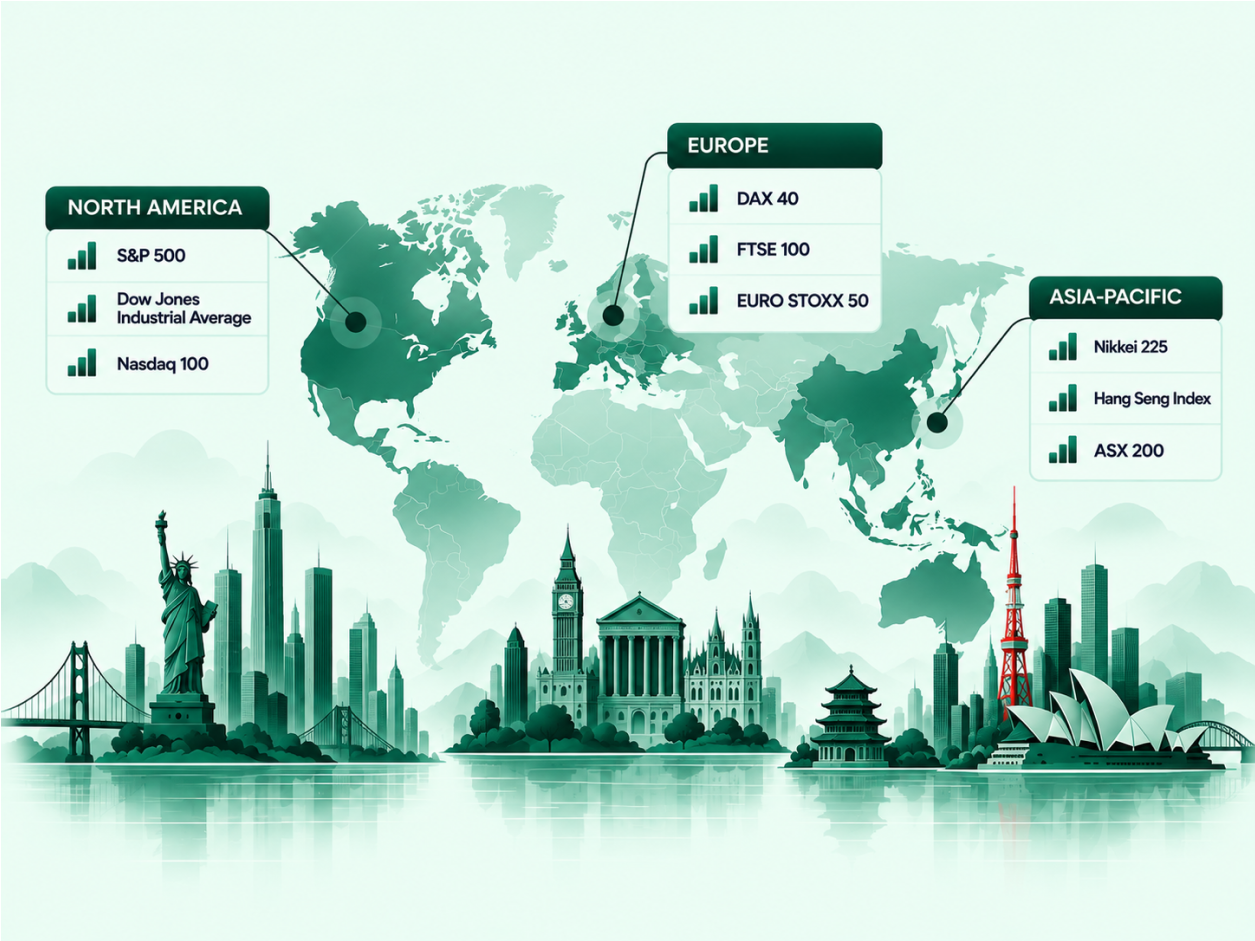
North America
- Dow Jones Industrial Average (DJIA): Launched in 1896, the DJIA is one of the oldest and most-watched indices globally. It tracks 30 large, publicly traded U.S. companies, often referred to as “blue-chip” stocks, selected by a committee. Despite its name, it’s not strictly industrial anymore, including companies like Apple, Microsoft, and Visa. It employs a price-weighted methodology.
- S&P 500: Short for “Standard & Poor’s 500,” this index includes 500 of the largest U.S. companies listed on the NYSE or Nasdaq. Representing approximately 80% of the total U.S. stock market capitalization, it is widely considered the most accurate gauge of overall U.S. economic performance. It is market-capitalization weighted.
- Nasdaq-100: Created in 1985, the Nasdaq-100 comprises 100 of the largest non-financial companies listed on the Nasdaq stock exchange. Often dubbed the “US Tech 100,” it is heavily weighted towards technology and growth companies like Apple, Amazon, and Alphabet. It is market-capitalization weighted and rebalanced annually.
Europe
- FTSE 100: The “Financial Times Stock Exchange 100” is the benchmark index for the UK economy, representing the 100 largest companies by market capitalization listed on the London Stock Exchange. Launched in 1984, it accounts for over 80% of the LSE’s total market cap. Its constituents are reviewed quarterly, and its performance can be significantly influenced by the strength of the British Pound. It is market-capitalization weighted.
- DAX 40: Germany’s premier stock market index, the DAX 40, tracks the 40 largest and most liquid German companies traded on the Frankfurt Stock Exchange. These companies represent over 75% of the exchange’s total market capitalization and span diverse sectors from automotive (e.g., Volkswagen) to pharmaceuticals (e.g., Merck) and finance (e.g., Deutsche Bank). It is market-capitalization weighted.
- CAC 40: The “Cotation Assistée en Continu 40” is the benchmark index for the French stock market, comprising the 40 largest companies listed on Euronext Paris by market capitalization. Established in 1987, it includes global brands like L’Oréal, Airbus, and AXA, reflecting the health of the French economy. It is market-capitalization weighted.
- Euro Stoxx 50: This index represents 50 of the largest and most liquid blue-chip companies across various Eurozone countries. It offers a broad measure of the Eurozone’s stock market performance and includes prominent companies like Siemens, Banco Santander, and BNP Paribas. It is market-capitalization weighted.
Asia-Pacific
- ASX 200: Maintained by Standard & Poor’s, the S&P/ASX 200 is Australia’s primary benchmark index. Launched in 2000, it tracks approximately 200 of the largest companies listed on the Australian Stock Exchange, including major banks (e.g., Commonwealth Bank) and mining giants (e.g., BHP Group). It is market-capitalization weighted.
- Nikkei 225: Japan’s most widely followed stock market index, the Nikkei 225, is a price-weighted average of 225 blue-chip companies traded on the Tokyo Stock Exchange. Established in 1950, it includes globally recognized names like Toyota, Sony, and Honda, offering insights into the Japanese economy.
- Hang Seng Index (HSI): The Hang Seng Index is the benchmark for the Hong Kong stock market, tracking the performance of the largest and most liquid companies listed on the Hong Kong Stock Exchange. It is a market-capitalization weighted index, reflecting the economic pulse of one of Asia’s major financial hubs.
Why Trade Indices via CFDs?
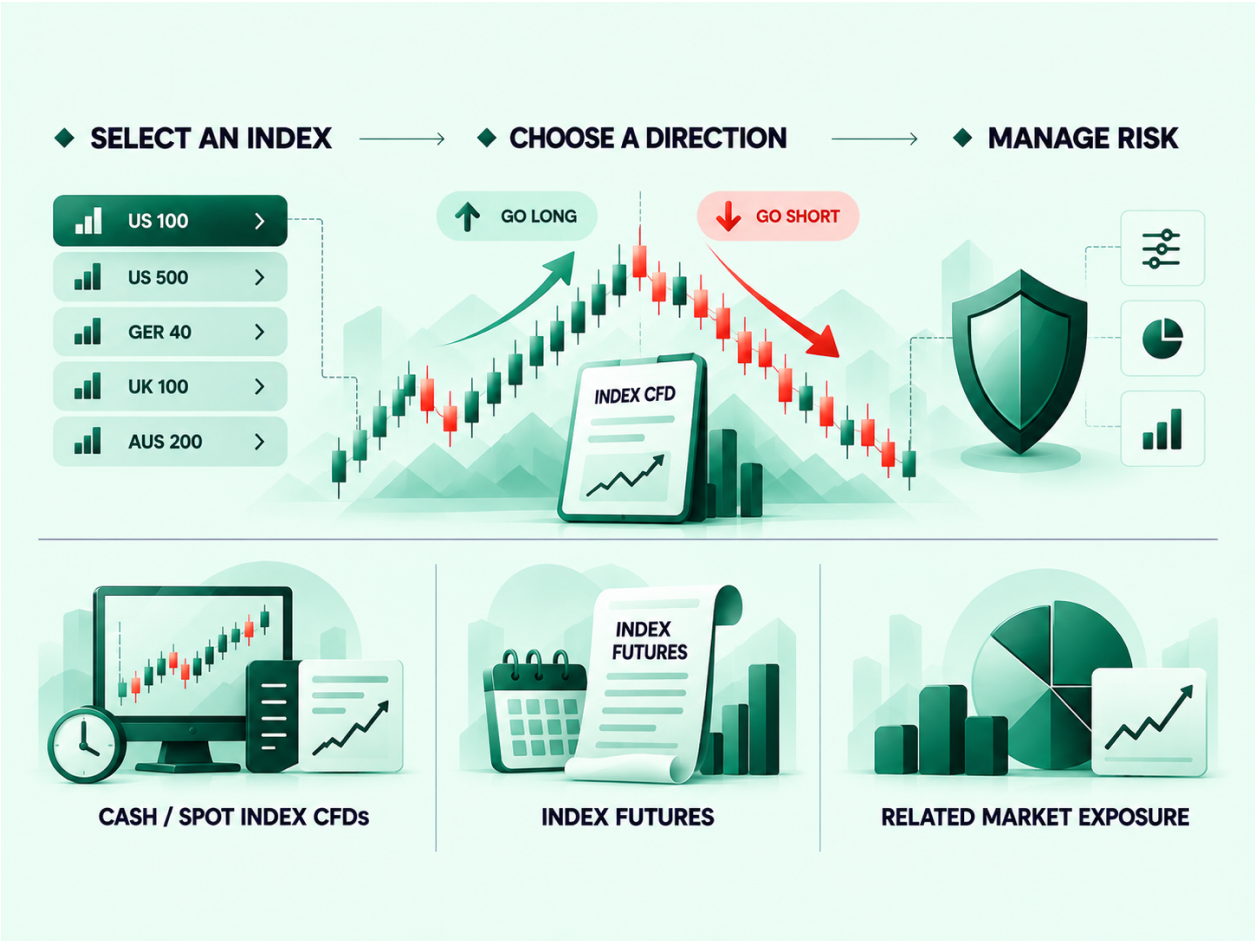
Trading major global indices through Contracts for Difference (CFDs) offers several compelling advantages for market participants:
- Diversified Exposure: CFDs on indices allow traders to gain exposure to a broad basket of stocks from a specific economy or sector with a single position. This means you can speculate on the overall direction of the U.S. tech sector via the Nasdaq-100, for instance, without needing to buy individual shares of each company. This inherent diversification can help mitigate the risk associated with single-stock volatility.
- Access to Global Markets: Indices provide a gateway to international markets that might otherwise be difficult or expensive to access directly. With CFDs, you can easily trade the DAX 40 from Germany or the Nikkei 225 from Japan, diversifying your geographical exposure.
- Long-Term Trends and Economic Correlation: Many major indices, particularly those tracking developed economies, exhibit a long-term upward trend, reflecting global economic growth. This makes them attractive for trend-following strategies. Furthermore, indices often correlate strongly with the underlying economic health of their respective countries, allowing traders to align their positions with macroeconomic forecasts.
- Liquidity and Transparency: Major indices are among the most liquid financial instruments globally, ensuring tight spreads and efficient execution. Their composition and weighting methodologies are publicly known, contributing to market transparency and making them less susceptible to manipulation compared to individual, smaller-cap stocks.
-
Speculate on Both Rising and Falling Markets: CFD trading allows you to potentially profit from both upward (going long) and downward (going short) price movements of an index. If you anticipate an economic downturn, you can open a sell position on a relevant index, speculating on its decline.
-
Frequent Volatility for Active Trading: Due to their broad market representation and sensitivity to macroeconomic news, earnings seasons, and geopolitical events, major indices often exhibit significant and “frequent volatility.” This characteristic creates ample opportunities for active, short-term traders to capitalize on price swings. The DAX 40, for example, is frequently favored by day traders for its dynamic movements and responsiveness to market catalysts.
- Resistance to Manipulation: Compared to individual stocks, indices are “extremely difficult to manipulate.” Influencing an index’s price would necessitate impacting the prices of numerous top-tier constituent companies simultaneously across multiple markets. This inherent complexity makes indices highly transparent and robust markets for speculation, fostering greater confidence in overall market integrity and fairness.
Understanding the unique characteristics, weighting methods, and economic significance of major global indices is paramount for any trader. By leveraging CFDs, market participants can efficiently engage with these powerful economic indicators, diversifying their strategies and accessing opportunities across the world’s leading economies.
Frequently Asked Questions
What is the primary difference between a stock exchange and a stock index?
A stock exchange is a physical or electronic marketplace where individual stocks are bought and sold, listing thousands of companies. A stock index, conversely, is a theoretical construct that tracks the combined performance of a selected group of stocks from one or more exchanges, acting as a benchmark for a specific market segment or economy.
How does market capitalization weighting influence an index’s movement?
In a market capitalization-weighted index, companies with larger total market values (share price multiplied by outstanding shares) have a proportionally greater impact on the index’s overall price movement. This means a small percentage change in a large company’s stock price will affect the index more significantly than the same percentage change in a smaller company’s stock.
Why are indices considered strong indicators of economic performance?
Indices are often composed of the largest and most influential companies within an economy, making their collective performance a reliable reflection of broader economic trends. Factors like consumer sentiment, GDP growth, and corporate earnings directly impact these companies, and thus the index, providing a quick snapshot of economic health.
Can I trade indices for both short-term and long-term strategies?
Yes, indices are suitable for both short-term speculative trading and longer-term investment strategies. Short-term traders might capitalize on daily volatility or news events, while long-term traders might focus on the inherent upward trend of many major indices, aligning with economic growth cycles.
Knowledge Check
1. Which of the following weighting methodologies gives stocks with higher share prices more influence on an index, regardless of their market capitalization?
- A) Market Capitalization Weighting
- B) Fundamental Weighting
- C) Price Weighting
- D) Equal Weighting
2. The S&P 500 is widely considered a leading indicator for the U.S. economy because it:
- A) Tracks exactly 30 blue-chip companies.
- B) Is exclusively composed of technology stocks.
- C) Represents approximately 80% of the total U.S. stock market capitalization.
- D) Is the oldest stock index in the world.
3. Which of the following indices is the primary benchmark for the German stock market?
- A) FTSE 100
- B) Nasdaq-100
- C) DAX 40
- D) ASX 200
Click to view the answers
1. **C) Price Weighting** – Price weighting assigns greater influence to stocks with higher share prices, as explicitly stated in the article.
2. **C) Represents approximately 80% of the total U.S. stock market capitalization.** – The S&P 500’s broad coverage of 500 large U.S. companies makes it a comprehensive measure of the U.S. economy.
3. **C) DAX 40** – The article identifies the DAX 40 as Germany’s premier stock market index.