

In the dynamic world of financial markets, understanding sentiment and potential future movements is paramount. The Cboe Volatility Index, widely known by its ticker symbol VIX, stands as a critical barometer for market participants. Often dubbed the “Fear Index,” the VIX offers a forward-looking perspective on expected market turbulence, making it an indispensable tool for both risk management and strategic trading.
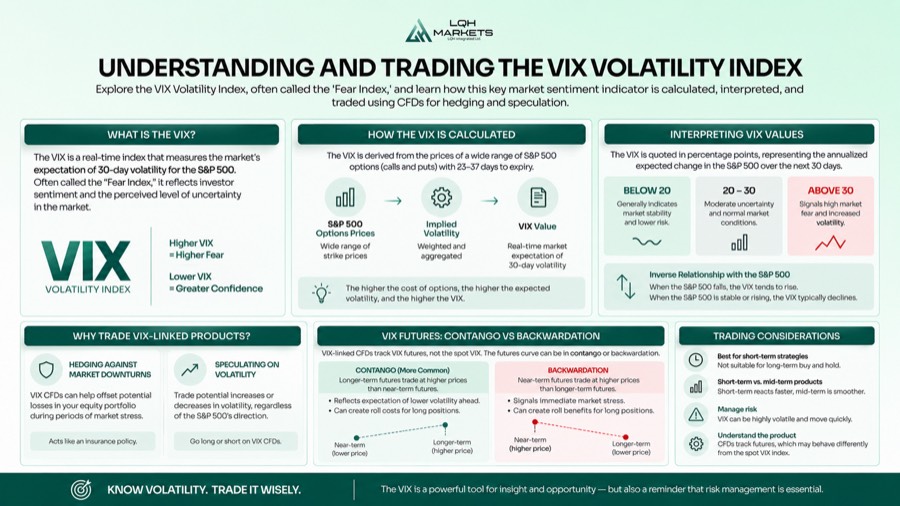
The Cboe Volatility Index (VIX) is a real-time market index that measures the market’s expectation of 30-day volatility for the S&P 500 index. It serves as a widely recognized gauge of investor sentiment, reflecting the perceived level of fear or uncertainty in the broader U.S. stock market.
What is the VIX Volatility Index?
The VIX, introduced by the Cboe Global Markets, is not a measure of past price swings but rather a projection of future volatility. Specifically, it quantifies the market’s expectation of how much the S&P 500 index will fluctuate over the next 30 calendar days. This forward-looking nature distinguishes it from historical volatility measures, providing a unique insight into prevailing market sentiment.
The index’s calculation is rooted in the prices of a wide range of S&P 500 index options. These options contracts reflect collective investor expectations about the likelihood of significant price movements in the underlying index. When investors anticipate greater price swings, they are willing to pay more for options, which in turn drives up the implied volatility embedded in those options’ prices, and consequently, the VIX value. This direct correlation between options pricing and expected uncertainty is why the VIX is often referred to as the “Fear Index” – higher values typically indicate increased investor anxiety and a greater expectation of market instability.
How the VIX is Calculated
The VIX calculation is a sophisticated process that aggregates the implied volatilities of numerous S&P 500 call and put options. These options must have an expiry period between 23 and 37 days to be included in the calculation. The methodology involves weighting the prices of these options across various strike prices, effectively creating a composite measure of expected volatility.
While the precise mathematical formula is complex, the fundamental principle is straightforward: it gauges the cost of insuring against or speculating on S&P 500 price movements over the near term. Options with valid bid and ask prices are continuously evaluated to reflect real-time market views. This continuous, real-time calculation ensures the VIX provides an up-to-the-minute snapshot of market expectations.
The History and Evolution of the VIX
The VIX has a rich history of evolution, adapting to market needs and technological advancements. It was initially launched by the Cboe in 1993, at which point its calculation was based on the implied volatility of S&P 100 index options. A significant milestone occurred in 2003 when, in collaboration with Goldman Sachs, the methodology was updated to reflect the broader S&P 500 index, making it a more comprehensive gauge of market sentiment. This change cemented its status as the premier measure of U.S. equity market volatility. Further expanding its utility, VIX futures were introduced in 2004, followed by VIX options in 2006, allowing market participants to directly trade expected volatility. This evolution transformed the VIX from a mere indicator into a tradable asset. A popular market adage often heard is, “When the VIX is high, it’s time to buy. When the VIX is low, look out below,” reflecting a contrarian view that extreme VIX levels can signal potential turning points in the market.
Interpreting VIX Values
Understanding VIX values is crucial for deciphering market sentiment. The index is quoted in percentage points, representing the annualized expected percentage change in the S&P 500 over the next 30 days.
A key characteristic of the VIX is its strong inverse correlation with the S&P 500 index. Historically:
- When the S&P 500 falls sharply, the VIX tends to rise. This reflects increased uncertainty and a rush by investors to hedge their portfolios or speculate on further declines. Think of it as a market “stress meter” — the higher the reading, the more stressed the market.
- When the S&P 500 is stable or rising, the VIX typically declines. This indicates a period of lower perceived risk and greater market confidence.
General thresholds for interpreting VIX values include:
- Below 20: Often associated with periods of market stability, lower perceived risk, and relative calm.
- Above 30: Generally signals heightened market fear, significant uncertainty, and increased volatility. Historically, spikes above 30 have coincided with major market downturns or crises.
For instance, if the VIX is trading at 15, it implies an annualized expected volatility of 15% for the S&P 500. If it jumps to 35, the market is suddenly pricing in a much higher degree of expected fluctuation, signaling potential turbulence ahead.
Beyond the S&P 500: A Family of Volatility Indices
While the VIX is the most prominent “fear index,” it is part of a broader family of volatility indices offered by the Cboe, each designed to measure expected volatility for different underlying assets or over varying time horizons. For the S&P 500 itself, there are variants like the Cboe S&P 500 9-Day Volatility Index (VXST) for ultra-short-term expectations, the Cboe S&P 500 3-Month Volatility Index (VXV), and the Cboe S&P 500 6-Month Volatility Index (VXMT) for longer-term outlooks. Beyond the S&P 500, the Cboe also calculates volatility indices for other major benchmarks, including the Cboe Nasdaq-100 Volatility Index (VXN), the Cboe DJIA Volatility Index (VXD), and the Cboe Russell 2000 Volatility Index (RVX). These specialized indices provide a more granular view of expected turbulence across different market segments and timeframes.
Why Trade VIX-Linked Products?
While the VIX index itself cannot be directly bought or sold, traders and investors can gain exposure to its movements through various derivative products, such as Contracts for Difference (CFDs) that track VIX futures. The primary motivations for trading VIX-linked instruments include:
Hedging Against Market Downturns
VIX-linked products offer a powerful tool for portfolio hedging due to their inverse relationship with the broader stock market. If an investor holds a long position in a diversified equity portfolio and anticipates a potential market correction, they might consider taking a long position on a VIX-linked CFD.
- Example: An investor holds a $100,000 portfolio of S&P 500 stocks. They foresee a geopolitical event that could trigger market instability. By opening a long CFD position on the VIX, they aim to profit if volatility spikes and the S&P 500 declines. If the market indeed falls by 5%, the gains from the VIX CFD could partially or fully offset the losses in their equity portfolio, acting like an insurance policy. If the market remains stable or rises, the VIX CFD position might incur a small loss, similar to paying an insurance premium that wasn’t needed.
Speculating on Volatility
Beyond hedging, VIX-linked products allow traders to directly speculate on changes in market volatility, irrespective of the S&P 500’s direction. Traders can profit from both increases and decreases in expected volatility.
- Going Long (Anticipating Increased Volatility): A trader might go long on a VIX CFD if they expect a major economic announcement, an earnings season, or an unexpected global event to trigger significant market uncertainty and price swings. For example, ahead of a crucial Federal Reserve interest rate decision, a trader might anticipate heightened market reaction and buy a VIX CFD, betting on a rise in the index.
- Going Short (Anticipating Decreased Volatility): Conversely, a trader might go short on a VIX CFD if they believe market fears are overblown and stability is likely to return, leading to a decline in the VIX. For instance, after a sharp, panic-driven market sell-off, a trader might short a VIX CFD, expecting the market to stabilize and the “fear premium” to dissipate. However, shorting volatility carries substantial risk, as VIX spikes can be rapid and extreme, potentially leading to significant losses.
Trading VIX with CFDs: Understanding the Nuances
When trading VIX-linked CFDs, it’s crucial to understand that these instruments typically derive their price from VIX futures contracts, not the spot VIX index directly. This distinction is vital because VIX futures behave differently from the spot VIX, especially over longer time horizons.
Key VIX-Linked Exchange Traded Products (ETPs)
While CFDs offer direct exposure to VIX futures, several popular Exchange Traded Products (ETPs) also allow investors to trade volatility. These products, primarily Exchange Traded Notes (ETNs) and Exchange Traded Funds (ETFs), track VIX futures contracts and are subject to the same contango and backwardation dynamics.
One of the most widely recognized is the iPath Series B S&P 500 VIX Short-Term Futures ETN (VXX). This ETN aims to track a daily rolling long position in the first- and second-month VIX futures contracts. Due to the persistent state of contango in the VIX futures curve, VXX is heavily impacted by “roll costs,” where expiring near-term contracts are replaced by more expensive longer-term ones. This phenomenon often leads to a decay in value over time, making VXX generally unsuitable for long-term holding and better suited for short-term tactical plays.
For those seeking exposure to longer-dated volatility expectations, the iPath Series B S&P 500 VIX Mid-Term Futures ETN (VXZ) tracks a portfolio of fourth-, fifth-, sixth-, and seventh-month VIX futures. VXZ tends to be less sensitive to immediate VIX spikes than VXX, reflecting a smoother, longer-term view of expected volatility, though it is still subject to roll costs.
On the inverse side, the ProShares Short VIX Short-Term Futures ETF (SVXY) is designed to deliver one-half the inverse of the daily performance of the S&P 500 VIX Short-Term Futures Index. SVXY is an extremely high-risk product intended only for sophisticated traders with a very short-term, daily trading horizon. Holding inverse VIX products for more than a single day can lead to significant and rapid losses due to compounding and the inherent decay characteristics of such instruments.
VIX Futures and the Concept of Contango and Backwardation
VIX futures contracts allow traders to lock in a price for expected volatility at a future date. The relationship between the price of near-term VIX futures and longer-term VIX futures is described by two key terms:
- Contango: This is the more common scenario, where longer-term VIX futures contracts trade at higher prices than near-term ones. It reflects a normal market expectation that volatility will revert to its historical average over time, or that near-term stability is expected. When VIX futures are in contango, holding a long position in VIX-linked products that continuously “roll” from expiring near-term contracts to more expensive longer-term contracts can incur “roll costs” or negative carry, which can erode returns over time.
- Analogy: Imagine booking a hotel room. Booking for tonight (near-term) might be cheaper than booking for a popular holiday weekend a few months away (longer-term), as there’s an expectation of higher demand (volatility) in the future.
- Backwardation: This occurs when near-term VIX futures trade at higher prices than longer-term ones. It’s typically a sign of immediate market stress and high current volatility, with an expectation that volatility will decrease in the future. In backwardation, roll costs can turn into “roll benefits” for long positions, though this scenario is less frequent and usually short-lived.
Because VIX-linked CFDs track these futures, their performance can diverge significantly from the spot VIX index. The constant rolling of futures contracts, especially in contango, means that VIX-linked products are generally not suitable for long-term buy-and-hold strategies. They are best utilized for short-term tactical positioning and active risk management.
Short-Term vs. Mid-Term VIX Futures Products
Some VIX-linked products focus on short-term futures (e.g., first and second month contracts), while others track mid-term futures (e.g., fourth through seventh month contracts).
- Short-term products: Tend to be more sensitive to immediate changes in spot VIX and react more sharply to sudden market spikes.
- Mid-term products: Respond more slowly and reflect longer-term expectations for volatility, often having a smoother price trajectory.
Traders must understand which futures curve their chosen VIX CFD product tracks, as this will dictate its sensitivity and behavior.
Risks and Considerations for Trading VIX CFDs
Trading VIX-linked products, especially via CFDs, involves significant risks and requires a clear understanding of their mechanics:
- Complexity: VIX-linked products are sophisticated instruments. Their performance is influenced by the VIX index, VIX futures curve dynamics (contango/backwardation), and roll costs, which can make their behavior unpredictable for inexperienced traders.
- Not for Buy-and-Hold: Due to futures roll costs and the mean-reverting nature of volatility (it tends to return to an average over time), VIX-linked products are generally designed for short-term trading strategies rather than long-term investment.
- Leverage: CFDs offer leverage, which can amplify both profits and losses. While leverage can magnify gains from correct predictions, it can also lead to rapid and substantial losses if the market moves against your position.
- Inverse Products: Be particularly cautious with inverse VIX products, which aim to deliver the opposite of VIX futures performance. These are extremely high-risk and are intended for daily trading only, as their performance can decay significantly over longer periods.
- Market Timing: Successfully trading VIX requires precise market timing and active monitoring. Unexpected news or shifts in sentiment can cause rapid and extreme movements.
Conclusion
The VIX Volatility Index is a powerful and widely recognized indicator of market sentiment and expected future volatility in the S&P 500. While the index itself cannot be traded directly, CFDs tracking VIX futures offer a versatile way for traders to hedge existing equity positions or speculate on volatility changes. However, due to the complexities of VIX futures, including contango, backwardation, and roll costs, VIX-linked products are best suited for experienced traders with a short-term outlook and robust risk management strategies. A deep understanding of how these instruments function is crucial for navigating the inherent risks and potentially capitalizing on market volatility.
Frequently Asked Questions
What is the primary difference between the VIX and historical volatility?
The VIX is a forward-looking index that measures the market’s expectation of S&P 500 volatility over the next 30 days, derived from options prices. Historical volatility, conversely, is a backward-looking measure calculated from past price movements of an asset.
Why is the VIX often called the “Fear Index”?
The VIX earns its nickname because it typically rises sharply during periods of market stress, uncertainty, and investor anxiety, reflecting a collective increase in the willingness to pay for options as a form of protection or speculation on downturns. Higher VIX values correlate with greater perceived risk.
Can I directly invest in the VIX index?
No, you cannot directly invest in or trade the VIX index itself, as it is a theoretical calculation. Instead, investors and traders gain exposure to VIX movements through derivative products like CFDs, futures contracts, or exchange-traded products (ETPs) that track VIX futures.
What does “contango” mean in the context of VIX futures?
Contango describes a market condition where VIX futures contracts with longer expiration dates trade at higher prices than those with nearer expiration dates. This is a common state for VIX futures and can lead to “roll costs” for long positions in VIX-linked products as expiring contracts are continuously replaced with more expensive longer-dated ones.
How can VIX-linked CFDs be used for hedging?
VIX-linked CFDs can be used for hedging by taking a long position when you anticipate a potential downturn in your equity portfolio. Since the VIX typically rises when the stock market falls, gains from the VIX CFD can help offset losses in your stock holdings, acting as a temporary protective measure against market volatility.
Knowledge Check
1. What does the Cboe Volatility Index (VIX) primarily measure?
- A) The historical volatility of the S&P 500 over the past 30 days.
- B) The current price of the S&P 500 index.
- C) The market’s expectation of 30-day volatility for the S&P 500.
- D) The trading volume of S&P 500 options.
2. Which of the following statements accurately describes the typical relationship between the VIX and the S&P 500 index?
- A) They tend to move in the same direction; when the S&P 500 rises, the VIX also rises.
- B) They have an inverse relationship; when the S&P 500 falls, the VIX tends to rise.
- C) There is no consistent correlation between the VIX and the S&P 500.
- D) The VIX only moves when the S&P 500 is completely stable.
3. Why are VIX-linked products, which track VIX futures, generally not suitable for long-term buy-and-hold strategies?
- A) They are too expensive to purchase and hold for extended periods.
- B) The VIX index is only calculated during U.S. market hours, limiting long-term exposure.
- C) Futures roll costs, especially in contango, can erode returns over time due to the continuous replacement of expiring contracts with more expensive ones.
- D) VIX-linked products are only available to institutional investors, not retail traders for long-term holding.
Click to view the answers
1. **C)** – The VIX measures the market’s forward-looking expectation of S&P 500 volatility over the next 30 days.
2. **B)** – The VIX typically has an inverse relationship with the S&P 500; it tends to rise when the S&P 500 falls, reflecting increased market fear.
3. **C)** – Futures roll costs, particularly in a contango market, can significantly erode returns for VIX-linked products held over the long term, making them unsuitable for buy-and-hold strategies.