


Trading in financial markets, particularly with leveraged instruments like Contracts for Difference (CFDs), inherently involves risk. While the potential for profit is a driving force, managing downside exposure is paramount for sustainable trading success. This is where stop-loss orders become an indispensable tool in a trader’s arsenal, acting as a crucial safeguard against significant capital erosion.
A stop-loss order is an automated instruction to your broker to close an existing position once a specific price level, known as the stop price, is reached. Its primary purpose is to limit potential losses on a trade or to protect accumulated profits by ensuring an exit if the market moves unfavorably.
Understanding Stop-Loss Orders
A stop-loss order is a fundamental risk management technique designed to automatically exit a trade at a predetermined level, thereby preventing further losses. It transforms into a market order once the specified stop price is triggered, aiming to execute the trade at the best available price.
How a Stop-Loss Order Works
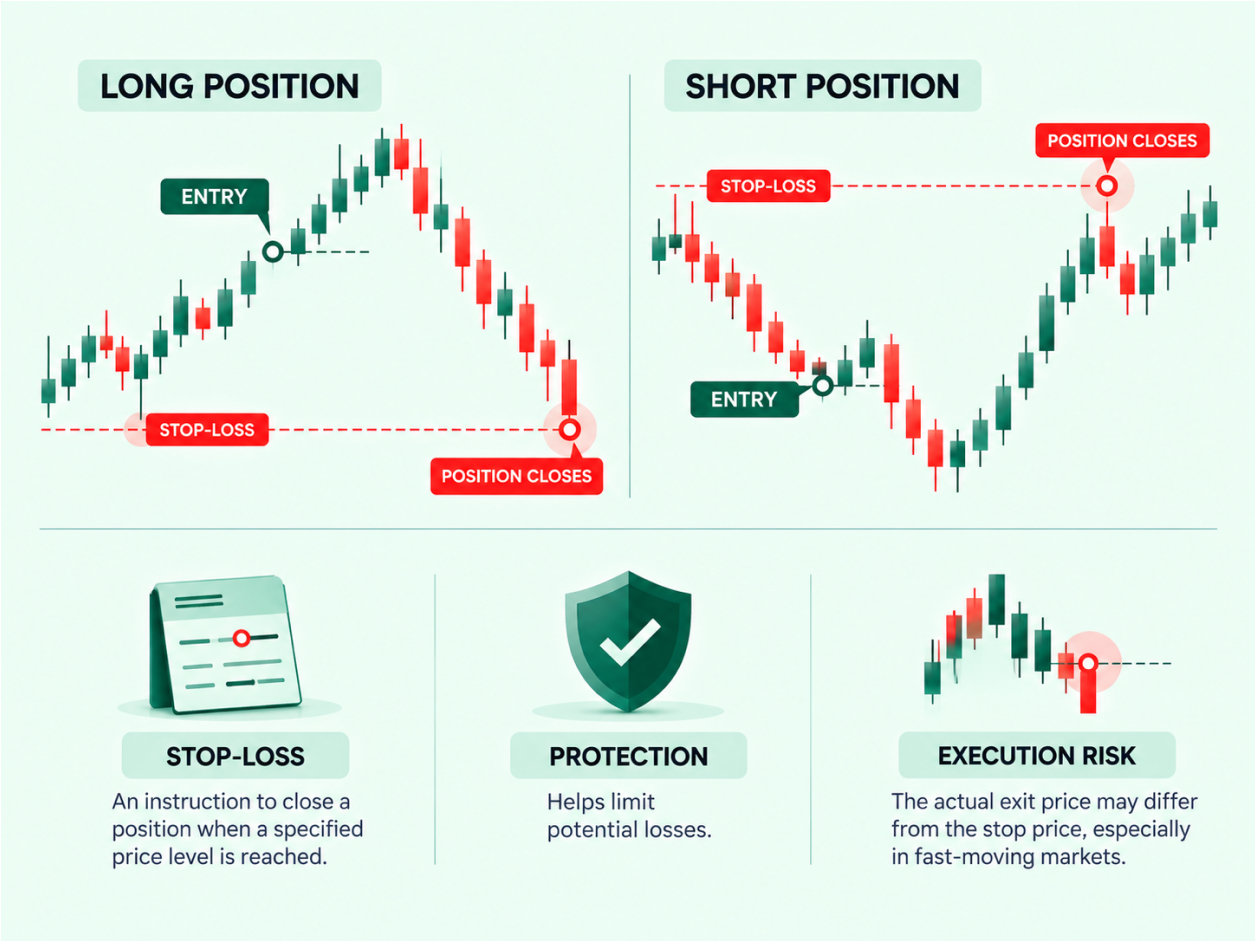
When you place a stop-loss order, you are essentially setting a “red line” for your trade. If the market price of the asset reaches or crosses this stop price, your stop-loss order is activated and immediately converted into a market order.
- For a Long Position (Buy Trade): If you buy an asset, your stop-loss order will be a sell stop-loss, placed below your entry price. If the market price falls to or below your stop price, a market order to sell is triggered.
- For a Short Position (Sell Trade): If you sell an asset short, your stop-loss order will be a buy stop-loss, placed above your entry price. If the market price rises to or above your stop price, a market order to buy (to cover your short position) is triggered.
Example: Managing a Long Position
Imagine you open a CFD position to buy 500 shares of TechCorp at $120 per share, anticipating a price increase. To protect against a significant downturn, you decide you’re willing to risk a maximum of $10 per share. You place a sell stop-loss order at $110.
- Scenario 1 (Market Rises): TechCorp’s price climbs to $135. Your stop-loss remains at $110, allowing your profits to grow. You might later adjust your stop-loss upwards to lock in some of these gains.
- Scenario 2 (Market Falls): TechCorp announces unexpected negative news, and its price begins to fall. When the price drops to $110, your stop-loss order is triggered, converting into a market order to sell your 500 shares. The position is closed, limiting your loss to approximately $10 per share (plus commissions/spreads).
The Critical Role of Market Orders and Slippage
It’s crucial to understand that once triggered, a stop-loss becomes a market order. This means it will be executed at the next available price in the market. While this guarantees execution, it does not guarantee execution at the exact stop price. This phenomenon is known as slippage.
Slippage occurs when the market moves rapidly, or when there is insufficient liquidity at the stop price level. For instance, if your stop-loss is at $110 but the market gaps down sharply overnight due to news, the next available price might be $108. Your order would be filled at $108, resulting in a slightly larger loss than anticipated. This is a trade-off for guaranteed execution, especially in volatile conditions.
The Strategic Advantages of Stop-Loss Orders
Integrating stop-loss orders into your trading strategy offers several compelling benefits:
- Effective Risk Management: The most significant advantage is limiting potential losses. By defining your maximum acceptable loss per trade, you protect your trading capital from catastrophic drawdowns.
- Emotional Discipline: Trading decisions can often be clouded by emotions like fear and greed. A pre-set stop-loss removes the need for impulsive decisions during market volatility, enforcing a disciplined exit strategy.
- Time Efficiency: Stop-loss orders eliminate the need for constant, minute-by-minute monitoring of your positions. Once set, you can trust the system to manage your risk, freeing up your time.
- Capital Preservation: By consistently cutting losses short, stop-loss orders help preserve your trading capital, ensuring you have funds available for future opportunities.
- Profit Protection: While primarily a loss-limiting tool, stop-loss orders can also be adjusted upwards (for long positions) or downwards (for short positions) as a trade moves favorably, effectively locking in a portion of your profits.
Key Considerations and Potential Drawbacks
While invaluable, stop-loss orders are not without their nuances and potential downsides:
- Slippage Risk: As discussed, rapid market movements or gaps can lead to your order being filled at a price worse than your stop price. This is an inherent characteristic of market orders.
- Whipsaws and Premature Exits: In choppy or highly volatile markets, prices can temporarily dip below your stop-loss level before quickly reversing and continuing in your favor. This can lead to being “stopped out” prematurely, missing out on potential profits.
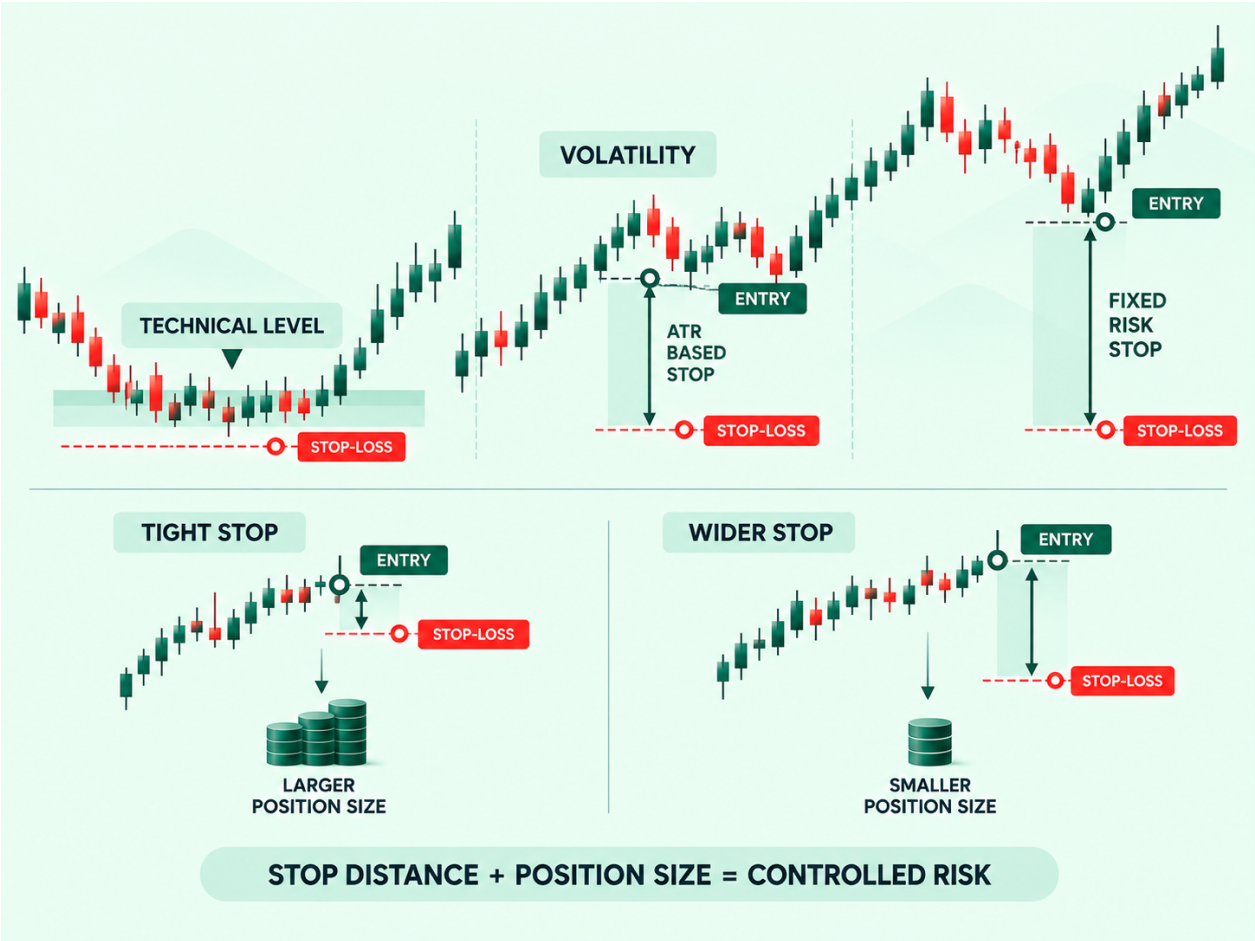
- Setting the Right Level: Determining the optimal stop-loss level is critical.
- Too tight: Increases the risk of being stopped out by normal market fluctuations (whipsaws).
- Too wide: Exposes you to larger losses than necessary.
- Methods for setting:
- Percentage-based: A fixed percentage below your entry price (e.g., 5% or 10%).
- Technical analysis: Placing stops below key support levels, above resistance levels, or beyond significant moving averages.
- Volatility-adjusted: Using indicators like Average True Range (ATR) to set stops based on the asset’s typical price movement.
Order Duration: Good ‘Til Canceled (GTC)
When placing a stop-loss order, specifying its duration is a practical consideration. A common and highly effective option for stop-loss orders is “Good ‘Til Canceled” (GTC). A GTC order remains active in the market until it is either executed or you manually cancel it. This is particularly useful for stop-loss orders as it provides continuous risk management without requiring you to re-enter the order daily. In contrast, a “day order” automatically expires at the end of the trading day if not filled, which would necessitate re-placing your stop-loss every morning.
Advanced Stop Order Types
Beyond the basic stop-loss, several variations offer enhanced flexibility and control.
Trailing Stop Orders
A trailing stop order is a dynamic type of stop-loss that automatically adjusts its price as your trade moves in a profitable direction. It “trails” the market price by a specified distance (either a fixed amount or a percentage).
How it Works: If you are long an asset, a trailing stop will move up as the price rises, maintaining its distance from the new high. If the price then reverses and falls by the specified trailing amount, the order is triggered. This allows you to protect profits as they accrue while still limiting potential downside.
Example: Trailing Stop for a Long Position
You buy a CFD on Company X at $50 and set a trailing stop of $2.
- If the price rises to $52, your trailing stop automatically moves up to $50 (your original entry).
- If the price continues to $55, your trailing stop moves to $53.
- If the price then drops from $55 to $53, your trailing stop at $53 is triggered, closing your position and locking in a $3 profit per share.
- If the price had never dropped by $2 from its high, the stop would keep moving up, protecting more profit.
Stop Entry Orders
While not a stop-loss in the traditional sense, a stop entry order is another type of stop order used to open a new position. It’s placed at a price level that is “less favorable” than the current market price, typically used to capitalize on momentum or breakout strategies.
How it Works: A buy stop entry order is placed above the current market price. If the market rises to this level, it triggers a market order to buy. Conversely, a sell stop entry order is placed below the current market price, triggering a market order to sell if that level is reached.
Example: Stop Entry for a Breakout Strategy
A stock is currently trading at $75, but you’ve identified a strong resistance level at $78. You believe that if the stock breaks decisively above $78, it will gain significant upward momentum. You place a buy stop entry order at $78.50.
- If the stock price rises to $78.50, your order is triggered, and you open a long position, aiming to profit from the anticipated breakout and subsequent rally.
- If the stock never reaches $78.50, your order remains pending and is not executed.
Stop-Loss vs. Stop-Limit Orders
It’s important to distinguish stop-loss vs. stop-limit orders:
- Stop-Loss Order: Guarantees execution (becomes a market order) once the stop price is hit, but does not guarantee the exact execution price due to potential slippage.
- Stop-Limit Order: Combines a stop price and a limit price. Once the stop price is hit, it becomes a limit order, meaning it will only execute at the specified limit price or better. The advantage is price control, but the disadvantage is that the order may not be filled if the market moves past the limit price too quickly.
Guaranteed Stop-Loss Orders
While standard stop-loss orders offer crucial risk management, they come with the inherent risk of slippage, especially in volatile markets. To address this, some brokers offer guaranteed stop-loss orders (GSLOs). A GSLO ensures that your position will be closed at the exact stop price you specify, regardless of market volatility, gaps, or slippage. This eliminates the uncertainty of execution price, providing absolute certainty regarding your maximum potential loss.
The trade-off for this guarantee is typically a wider spread on the trade or a small premium charged by the broker, which is often refunded if the GSLO is not triggered. This premium acts as an insurance policy against adverse market movements. GSLOs are particularly valuable in highly volatile market conditions, during major news announcements, or when holding positions over weekends or during periods of low liquidity, where price gaps are more likely. They offer an extra layer of protection for traders who prioritize precise risk control and want to avoid the potential for larger-than-expected losses.
Who Benefits from Stop-Loss Orders?
Stop-loss orders are particularly beneficial for:
- Short-term Traders: Day traders and swing traders rely heavily on stop-losses to manage the inherent volatility and rapid price movements in their strategies.
- CFD Traders: Due to the leverage involved in CFD trading, losses can be magnified quickly. Stop-loss orders are crucial for managing this elevated risk.
- Disciplined Investors: Any trader or investor who prioritizes capital preservation and aims to remove emotional biases from their decision-making will find stop-losses invaluable.
Long-term investors, who aim to hold assets for many years and are less concerned with short-term fluctuations, may use stop-losses less frequently. Their strategy often involves riding out market downturns, potentially even adding to positions during dips. However, even long-term investors might consider using stop-losses for speculative portions of their portfolios or to protect against fundamental shifts in an asset’s outlook.
Conclusion
Stop-loss orders are more than just a safety net; they are a cornerstone of disciplined and responsible trading. By pre-defining your risk tolerance and automating your exit strategy, you empower yourself to navigate volatile markets with greater confidence, protect your capital, and foster a more sustainable approach to trading. Understanding their mechanics, advantages, and limitations is essential for any serious participant in the financial markets.
Frequently Asked Questions
What is the main difference between a stop-loss and a stop-limit order?
A stop-loss order, once triggered, becomes a market order, guaranteeing execution but not necessarily the exact price. A stop-limit order, once triggered, becomes a limit order, guaranteeing a specific price or better, but not guaranteeing execution if the market moves past the limit.
Can a stop-loss order guarantee my exact exit price?
No, a stop-loss order does not guarantee an exact exit price. Once triggered, it becomes a market order, which aims to fill at the best available price. In volatile markets or during price gaps, this can result in slippage, where the execution price is worse than the specified stop price.
Are stop-loss orders suitable for long-term investors?
Generally, long-term investors who aim to ride out market fluctuations over many years may not find stop-loss orders as critical as short-term traders. However, they can still be useful for managing risk on speculative positions or protecting against severe, unexpected downturns that fundamentally alter an investment thesis.
How does a trailing stop-loss differ from a standard stop-loss?
A standard stop-loss is static, staying at a fixed price level unless manually adjusted. A trailing stop-loss is dynamic; it automatically adjusts its stop price as the market moves favorably, maintaining a set distance from the asset’s peak price to protect accumulating profits while still limiting downside risk.
Knowledge Check
1. What happens immediately after a stop-loss order’s trigger price is reached?
- A) The order becomes a limit order.
- B) The order is canceled automatically.
- C) The order becomes a market order.
- D) The order is converted into a stop-limit order.
2. Which of the following is a potential disadvantage of using a standard stop-loss order?
- A) It requires constant monitoring of the position.
- B) It guarantees execution at the exact stop price, even in volatile markets.
- C) It can lead to being “stopped out” prematurely in choppy markets.
- D) It prevents any possibility of profit protection.
3. The primary benefit of a trailing stop order is its ability to:
- A) Guarantee execution at a precise price point.
- B) Dynamically adjust to protect profits as the market moves favorably.
- C) Open a new position when a specific price level is reached.
- D) Eliminate all risk of slippage in fast-moving markets.
Click to view the answers
1. C) – Once a stop-loss order’s trigger price is reached, it immediately becomes a market order, aiming for the best available execution.
2. C) – A disadvantage of stop-loss orders is the risk of being stopped out by temporary market fluctuations before the price reverses in the desired direction.
3. B) – A trailing stop order is designed to automatically adjust its stop price as the market moves in a profitable direction, thereby protecting accumulated gains.