


Trading financial markets, especially with Contracts for Difference (CFDs), inherently involves navigating a landscape of potential gains and losses. At the heart of every strategic decision lies the fundamental concept of risk and reward. Understanding how these two elements interact, particularly through the lens of the risk-reward ratio, is paramount for any trader aiming for consistent, disciplined, and ultimately profitable outcomes.
The risk-reward ratio is a fundamental metric that quantifies the potential profit of a trade relative to its potential loss. It serves as a vital tool for traders to evaluate the attractiveness and inherent risk profile of any given trading opportunity.
This guide will delve into the intricacies of the risk-reward ratio, demonstrating its calculation, interpretation, and practical application in your CFD trading strategy.
The Foundation: Risk and Reward in Financial Markets
Every trading decision involves a trade-off between risk and reward. Risk represents the potential downside or the maximum amount you stand to lose on a position. Reward, conversely, is the potential upside or the profit you anticipate gaining. These two forces are inextricably linked: generally, higher potential rewards often come with higher potential risks, and vice-versa.
What is Risk in Financial Markets?
In financial markets, risk is fundamentally a measure of uncertainty regarding a trade’s outcome. Markets are dynamic and unpredictable, meaning there’s no guarantee that prices will move as you anticipate. This uncertainty directly correlates with the potential for monetary losses. The greater the uncertainty surrounding an asset’s future value, the higher the risk involved. Traders often seek a more favorable expected rate of return (RoR) to compensate for taking on higher probabilities of loss.
Traders often exhibit different risk profiles:
- Risk-Averse: Prioritizes minimizing potential downside while maximizing upside. Given two opportunities with equal expected returns, a risk-averse trader would choose the one with lower risk.
- Risk-Neutral: Focuses solely on achieving the highest expected returns, largely indifferent to the accompanying risk.
- Risk-Seeking: Actively pursues high-risk opportunities, accepting a greater probability of loss for the chance of substantial potential gains.
What is Reward in Financial Markets?
Reward, in the context of trading, refers to the potential profit or expected return from a trade or investment. It’s the benchmark rate of return that has a reasonable possibility of materializing. Expected returns can be estimated in several ways:
- Historical Data Analysis: Calculating the average rate of return over a past period. While straightforward, it’s crucial to remember that past performance is not indicative of future results.
- Forward-Looking Projections: Analysts may assign probabilities to various potential future returns and then calculate a probability-weighted average to derive an expected return. This method attempts to account for current market conditions and future expectations.
Understanding the Risk-Reward Ratio
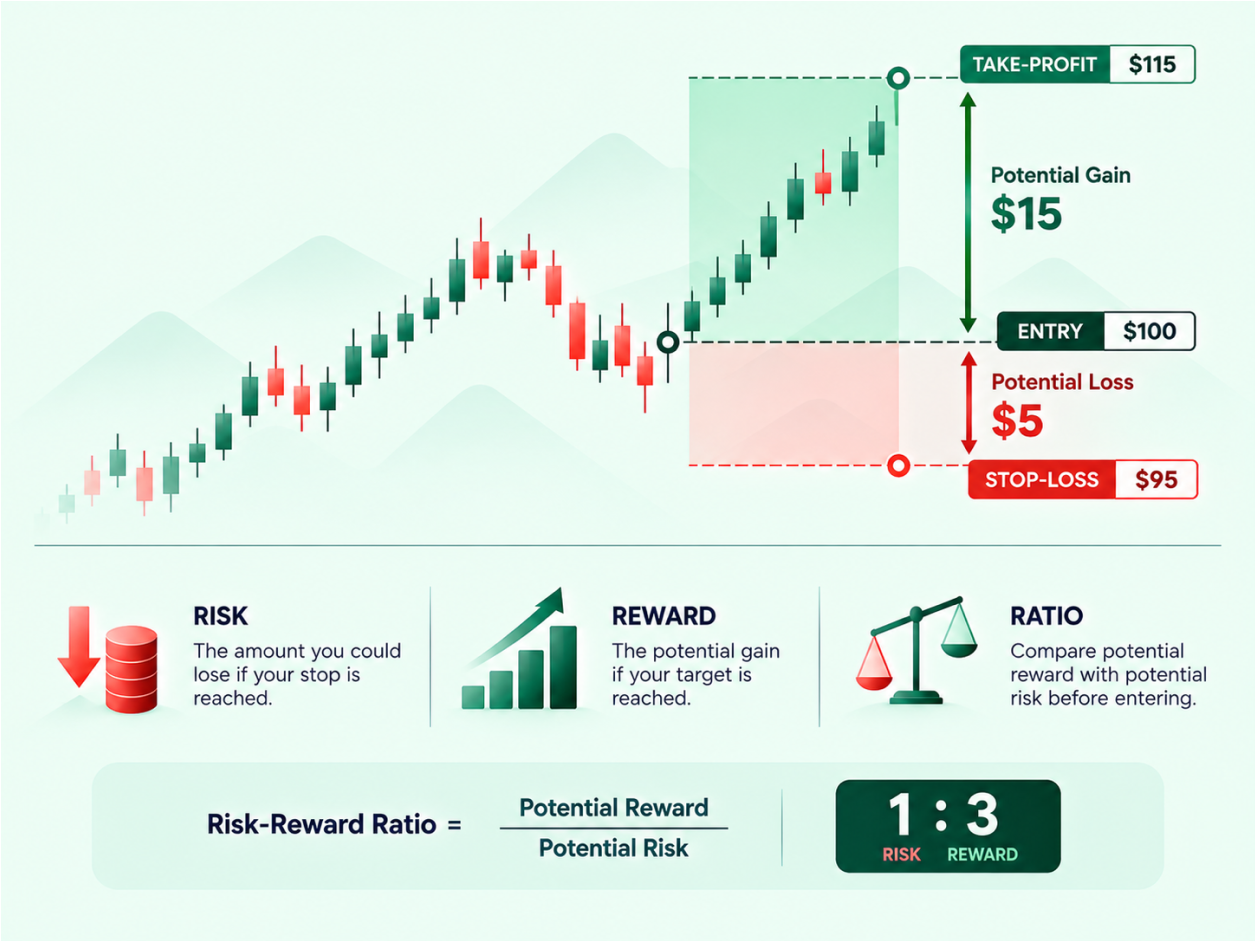
The risk-reward ratio (R/R ratio) is a powerful analytical tool that helps traders quantify the potential profit for each unit of capital risked. It’s calculated by dividing the maximum potential loss (risk) by the maximum potential gain (reward) for a specific trade.
Formula:
Risk-Reward Ratio = Potential Loss / Potential Gain
Interpreting the Ratio
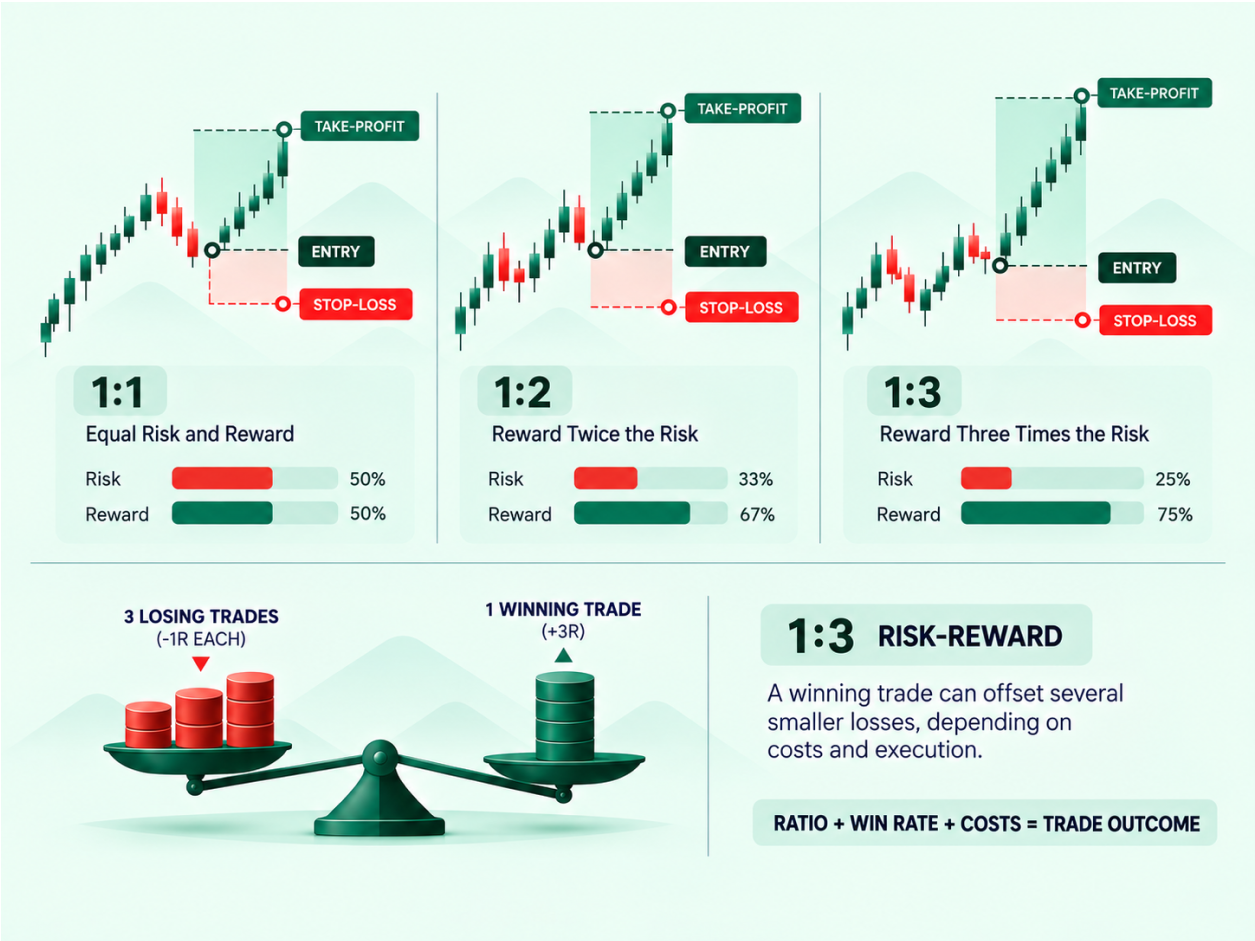
- Ratio Less Than 1.0 (e.g., 0.5 or 1:2): This indicates that your potential reward is greater than your potential risk. For example, a 1:2 ratio means you stand to gain $2 for every $1 you risk. This is generally considered a favorable ratio.
- Ratio Greater Than 1.0 (e.g., 2.0 or 2:1): This suggests your potential risk is greater than your potential reward. A 2:1 ratio means you risk $2 to potentially gain $1. This is generally considered an unfavorable ratio for most trading strategies.
- Ratio Equal to 1.0 (1:1): Potential risk and reward are equal.
A commonly favored benchmark among experienced traders is a risk-reward ratio of 1:2 or 1:3, meaning they aim for at least two or three units of profit for every one unit of risk.
Practical Example: Applying the Risk-Reward Ratio
Let’s consider a CFD trade on a hypothetical stock, “Global Innovations Inc.” (GII). Suppose GII is currently trading at $100 per share. You believe the price will rise due to an upcoming positive market report.
- Entry Point: You decide to buy 100 GII CFDs at $100.
- Stop-Loss Order: To cap your potential losses, you place a stop-loss order at $95. This means if the price drops to $95, your position will automatically close.
- Potential Loss per share: $100 (Entry) – $95 (Stop-Loss) = $5
- Total Potential Loss: 100 shares * $5/share = $500
- Take-Profit Order: You anticipate the price could reach $115 and set a take-profit order there.
- Potential Gain per share: $115 (Take-Profit) – $100 (Entry) = $15
- Total Potential Gain: 100 shares * $15/share = $1,500
Now, let’s calculate the risk-reward ratio:
Risk-Reward Ratio = Potential Loss / Potential Gain = $500 / $1,500 = 0.33
This can also be expressed as a 1:3 ratio, meaning for every $1 you risk, you stand to gain $3. This is a highly favorable ratio, suggesting a strong potential return relative to the risk taken.
The Dynamic Nature of the Risk-Reward Ratio
It’s crucial to understand that the risk-reward ratio is not a static calculation; it can change significantly over the life of a trade. Market movements directly impact both the potential reward and risk components. As the price of an asset moves closer to your take-profit target, the remaining potential reward naturally diminishes. Conversely, if the price moves away from your target, the potential reward might increase, but so might the time and volatility required to reach it.
Similarly, the risk component can be dynamically altered. Traders often employ strategies like trailing stop-loss orders, which automatically adjust the stop-loss level as the price moves in a favorable direction. This helps to lock in profits and reduce risk as the trade progresses. However, any adjustment to a stop-loss or take-profit order will immediately recalculate your effective risk-reward ratio, requiring continuous monitoring and potential adjustments to ensure the trade remains aligned with your initial trading goals and overall risk tolerance.
Risk-Reward Ratio and Win Rate
It’s crucial to understand that the risk-reward ratio doesn’t exist in isolation. It works in tandem with your win rate (the percentage of your trades that are profitable) to determine your overall profitability.
- A high win rate (e.g., 70%) can still be profitable even with a less favorable risk-reward ratio (e.g., 1:1 or slightly worse).
- A lower win rate (e.g., 40%) can be highly profitable if you consistently employ a favorable risk-reward ratio (e.g., 1:3 or 1:4). The few winning trades will significantly outweigh the losses from more frequent, but smaller, losing trades.
For example, with a 1:3 risk-reward ratio, you only need to win 25% of your trades to break even. Any win rate above 25% would lead to profitability. This illustrates how a strong risk-reward ratio can provide a significant edge.
Integrating Risk-Reward into Your Trading Strategy
The practical application of the risk-reward ratio involves defining your entry, stop-loss, and take-profit levels for every trade.
Setting Stop-Loss and Take-Profit Orders
- Stop-Loss Orders: These are indispensable for managing your risk. By setting a stop-loss, you define the maximum amount you are willing to lose on a trade. This directly determines the “risk” component of your ratio. Your broker may offer:
- Normal Stop-Loss: Triggers at your specified price, but in volatile or fast-moving markets, the actual execution price might differ (slippage).
- Guaranteed Stop-Loss: Ensures your trade closes at the exact price you set, eliminating slippage. This usually incurs a small premium if triggered. This certainty is a significant advantage, as it completely removes the risk of unexpected losses due to price gaps, especially during volatile market openings or news events. However, this precision comes at a cost; they typically incur a small premium or wider spread if triggered, which is the fee for this guaranteed execution.
- Take-Profit Orders (Limit Orders): These automatically close your position when the market reaches a predetermined favorable price, locking in your profits. This defines the “reward” component of your ratio.
Adjusting these levels directly impacts your risk-reward ratio. Moving your stop-loss closer to your entry point reduces potential loss but may increase the probability of being stopped out prematurely. Conversely, moving your take-profit target further away increases potential reward but might decrease the probability of reaching that target.
Beyond the Basic Ratio: Comprehensive Risk Measurement
While the risk-reward ratio is a direct measure for individual trades, other statistical models offer broader perspectives on market and portfolio risk:
- Variance and Standard Deviation (SD): These measure the volatility of an asset’s returns. Higher variance or SD indicates greater dispersion of returns around the average, implying higher risk. A smaller SD suggests more certainty about the probable range of returns.
- Value-at-Risk (VaR): VaR quantifies the potential loss of an investment over a specific time horizon, at a given confidence level. For example, a 1-day 95% VaR of $10,000 means there’s a 5% chance the portfolio will lose $10,000 or more in one day.
- Beta: Beta measures an asset’s price volatility relative to the overall market. A beta of 1 means the asset moves with the market. A beta greater than 1 suggests higher volatility than the market, while a beta less than 1 indicates lower volatility.
Managing Risk in CFD Trading
CFD trading involves leverage, which significantly amplifies both potential profits and losses. This makes robust risk management not just advisable, but absolutely essential.
The Impact of Leverage
Leverage allows you to control a large position with a relatively small initial deposit (margin). For example, a 1:10 leverage ratio means a 1% price movement in the underlying asset results in a 10% change in your initial deposit. While this can magnify gains, it equally magnifies losses, potentially exceeding your initial margin if not managed carefully. Understanding this amplification is critical when setting your risk-reward parameters.
Essential Risk Management Tools and Strategies
- Stop-Loss and Limit Orders: As discussed, these are your primary defense mechanisms against excessive losses and tools for securing profits.
- Diversification: Spreading your capital across various uncorrelated assets or markets can reduce unsystematic risk (risks specific to a particular asset or industry).
- Hedging: This involves strategically opening offsetting positions to mitigate potential losses from an existing trade. For instance, if you have a long position, you might open a short position in a related or inversely correlated asset.
- Trading Plan: A well-defined trading plan outlines your personal motivations, time commitment, chosen strategies, and specific risk parameters (including your preferred risk-reward ratio). It helps remove emotion from decision-making.
- Trading Alerts: Customizable alerts notify you when specific market conditions or price levels are met, allowing you to take timely action without constant market monitoring.
- Advanced: Protective Put Options: In broader investment scenarios, protective put options offer a sophisticated method to manage the risk component of the risk-reward ratio. A protective put gives the holder the right, but not the obligation, to sell an underlying asset at a specified strike price before a certain expiration date. This effectively sets a floor on potential losses for a long position, similar to a guaranteed stop-loss, but with different mechanics, costs (the premium paid for the put option), and flexibility. It serves as an advanced hedging strategy that directly limits downside risk.
Key Types of Trading and Investment Risk
While the risk-reward ratio focuses on quantifiable trade-specific risk, it’s important to be aware of the broader risk landscape:
- Systematic Risk: Market-wide risks that cannot be diversified away, such as economic recessions, geopolitical events, or interest rate changes.
- Unsystematic Risk: Specific to an individual asset or company, such as management changes, product recalls, or supply chain disruptions. This can be mitigated through diversification.
- Business Risk: The threat to a company’s ability to achieve its financial goals, often due to market forces or regulatory changes.
- Volatility Risk: The risk associated with unpredictable and rapid price movements in a market.
- Liquidity Risk: The risk of being unable to quickly buy or sell an asset at a fair price without significantly impacting its market value.
- Inflation Risk: The risk that rising inflation will erode the purchasing power of your returns.
- Interest Rate Risk: The risk that changes in interest rates will adversely affect the value of an investment, particularly fixed-income assets.
- Credit Risk: The risk that a borrower (company or individual) will default on their debt obligations. In CFD trading, this can apply if a counterparty fails to meet its obligations.
- Counterparty Risk: The risk that the other party in a financial transaction will fail to fulfill their contractual obligations.
- Currency Risk: The risk of adverse movements in exchange rates affecting the value of investments denominated in foreign currencies.
Conclusion
The risk-reward ratio is more than just a calculation; it’s a foundational principle for disciplined and strategic trading. By consistently applying a favorable risk-reward ratio in conjunction with a solid win rate, and by leveraging comprehensive risk management tools, traders can significantly enhance their potential for long-term profitability in the dynamic world of CFD trading. It empowers you to make informed decisions, control your exposure, and approach the markets with a clear, objective mindset.
Frequently Asked Questions
What is the primary purpose of the risk-reward ratio in trading?
The primary purpose of the risk-reward ratio is to help traders assess the potential profitability of a trade relative to its potential loss. It enables informed decision-making by quantifying how much a trader stands to gain for every unit of capital risked.
How does leverage impact the importance of the risk-reward ratio in CFD trading?
Leverage amplifies both potential profits and losses in CFD trading, making the risk-reward ratio even more critical. A favorable ratio becomes essential to ensure that the magnified gains from winning trades can adequately cover the magnified losses from losing trades, protecting your capital.
Can a trader achieve profitability with a low win rate if they use a favorable risk-reward ratio?
Yes, a trader can achieve profitability with a relatively low win rate if they consistently employ a favorable risk-reward ratio (e.g., 1:2 or 1:3). The larger profits from winning trades can outweigh the smaller losses from more frequent losing trades, leading to overall positive returns.
What is the difference between a normal stop-loss and a guaranteed stop-loss order?
A normal stop-loss order triggers at a specified price but may execute at a worse price due to market slippage during volatile conditions. A guaranteed stop-loss, however, ensures execution at the exact specified price, eliminating slippage, though it typically incurs a small premium if triggered.
How can a trading plan contribute to effective risk management alongside the risk-reward ratio?
A trading plan provides a structured framework for all trading decisions, including predefined risk parameters like the desired risk-reward ratio. It helps traders maintain discipline, avoid emotional decisions, and consistently apply their risk management strategies, thereby enhancing overall effectiveness.
Knowledge Check
1. Which of the following best describes a favorable risk-reward ratio?
- A) A ratio greater than 1.0, indicating higher potential risk than reward.
- B) A ratio equal to 1.0, meaning potential risk and reward are balanced.
- C) A ratio less than 1.0, indicating higher potential reward than risk.
- D) A ratio that fluctuates frequently.
2. When calculating the risk-reward ratio for a CFD trade, what does the “risk” component primarily represent?
- A) The total capital invested in the trade.
- B) The maximum potential loss, typically defined by a stop-loss order.
- C) The margin required to open the position.
- D) The historical volatility of the underlying asset.
3. Why is understanding the interplay between the risk-reward ratio and win rate crucial for a trader’s long-term profitability?
- A) A high win rate always guarantees profitability, regardless of the risk-reward ratio.
- B) A favorable risk-reward ratio can offset a lower win rate, allowing for profitability even if not every trade is a winner.
- C) The risk-reward ratio only matters for individual trades, not overall profitability.
- D) Win rate is irrelevant if the risk-reward ratio is consistently 1:1.
Click to view the answers
1. **C)** – A ratio less than 1.0 (e.g., 1:2 or 0.5) signifies that the potential reward outweighs the potential risk, which is generally considered favorable.
2. **B)** – The risk component in the risk-reward ratio calculation is primarily the maximum potential loss on a trade, typically set by a stop-loss order.
3. **B)** – A favorable risk-reward ratio is crucial because it allows a trader to remain profitable even with a lower win rate, as the gains from winning trades can compensate for the losses from more frequent, but smaller, losing trades.