


Financial markets are the bedrock of modern economies, serving as dynamic arenas where capital is allocated, risks are managed, and prices are discovered. Understanding their intricate workings is fundamental for anyone looking to invest, trade, or simply comprehend the economic landscape.
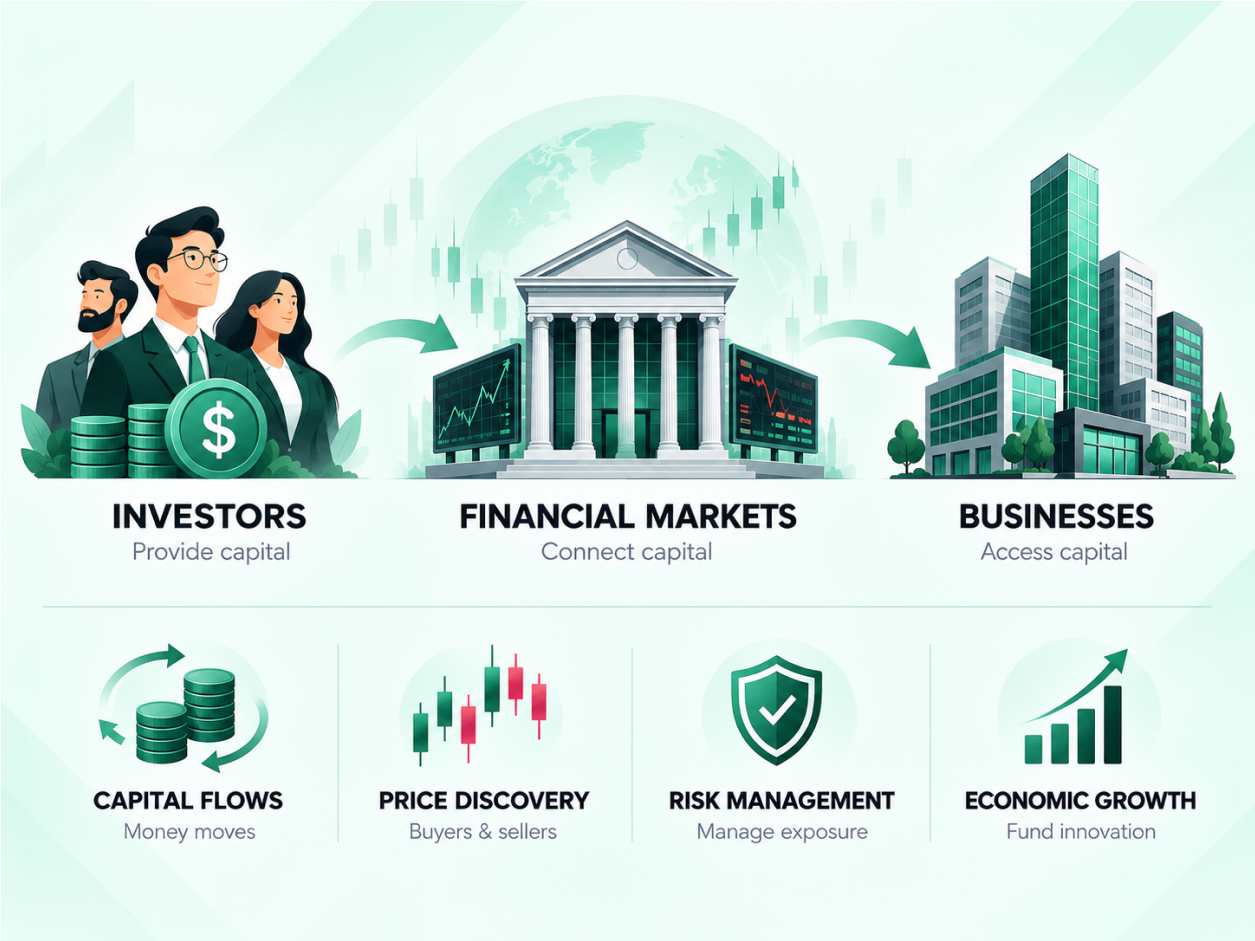
Financial markets are marketplaces where various financial instruments, such as stocks, bonds, currencies, and derivatives, are bought and sold. They act as critical arteries, facilitating the flow of capital from those with surplus funds to those who need them for investment and growth.
The Essential Role of Financial Markets
At their core, financial markets perform several vital functions that underpin economic activity and stability:
1. Capital Allocation and Formation
Financial markets efficiently channel funds from savers (investors) to borrowers (companies, governments, individuals). Imagine a growing technology startup needing capital to expand its operations, hire engineers, and develop new products. Instead of relying solely on bank loans, the startup can issue shares or bonds in the financial markets. Investors, seeking a return on their savings, purchase these instruments, effectively providing the capital the startup needs. This process, known as capital formation, is crucial for innovation, job creation, and economic expansion.
2. Price Discovery
One of the most fundamental functions of financial markets is price discovery. This is the process by which the true market price of an asset is determined through the continuous interaction of buyers and sellers. When a company’s stock is traded, for example, each buy and sell order contributes to the current market price. If more investors want to buy than sell, the price tends to rise, reflecting increased demand. Conversely, if more sellers emerge, the price may fall. This dynamic interplay of supply and demand, influenced by available information, helps establish fair and efficient prices for all traded assets.
3. Liquidity Provision
Liquidity refers to the ease with which an asset can be converted into cash without significantly affecting its price. Financial markets provide immense liquidity, allowing investors to buy or sell assets quickly and efficiently. Without liquid markets, an investor might struggle to find a buyer for their shares or bonds when needed, or be forced to accept a much lower price. High liquidity ensures that transactions can occur smoothly, reducing the risk for participants and encouraging greater market activity. For instance, the foreign exchange market is renowned for its unparalleled liquidity, allowing trillions of dollars in currency to be exchanged daily with minimal price impact.
4. Risk Transfer and Management
Financial markets offer mechanisms for individuals and institutions to manage and transfer various types of financial risk. Derivatives, for example, are instruments whose value is derived from an underlying asset. A farmer concerned about a future drop in crop prices might use a futures contract to lock in a selling price for their harvest today, transferring the risk of price fluctuations to another party willing to take that risk (perhaps a speculator). This ability to hedge against adverse price movements is crucial for businesses and investors alike, enabling better planning and stability.
Key Participants in Financial Markets
A diverse ecosystem of participants drives the activity within financial markets, each with distinct objectives and roles:
- Retail Investors: These are individual investors who trade securities for their personal portfolios, often seeking long-term growth, income, or short-term gains. They typically operate with smaller capital amounts compared to institutional players.
- Institutional Investors: Large organizations such as pension funds, mutual funds, hedge funds, and asset management firms that invest vast pools of capital on behalf of their clients or members. They often engage in large-volume trades and can significantly influence market trends.
- Corporate Issuers: Companies that issue stocks (equity) or bonds (debt) to raise capital for their operations, expansion, or other corporate objectives.
- Commercial Banks: Financial institutions that provide lending, deposit services, and often act as intermediaries in various financial transactions.
- Investment Banks: Firms that assist companies in raising capital (e.g., through initial public offerings or bond issuance), facilitate mergers and acquisitions, and provide advisory services.
- Brokers: Intermediaries who execute trades on behalf of buyers and sellers, earning commissions or fees for their services. While some brokers act purely as agents, others, like LQH Markets, may act as principals, acting as your counterparty and hedging our exposure with liquidity providers.
- Market Makers: Entities (often large financial institutions) that stand ready to buy and sell specific securities, providing continuous bid and ask prices. They profit from the spread between these prices and play a crucial role in ensuring market liquidity.
- Regulators and Central Banks: Government bodies (like the Securities and Exchange Commission in the U.S.) and central banks (like the Federal Reserve) that oversee financial markets to ensure stability, fairness, and transparency, and to implement monetary policy.
Major Types of Financial Markets
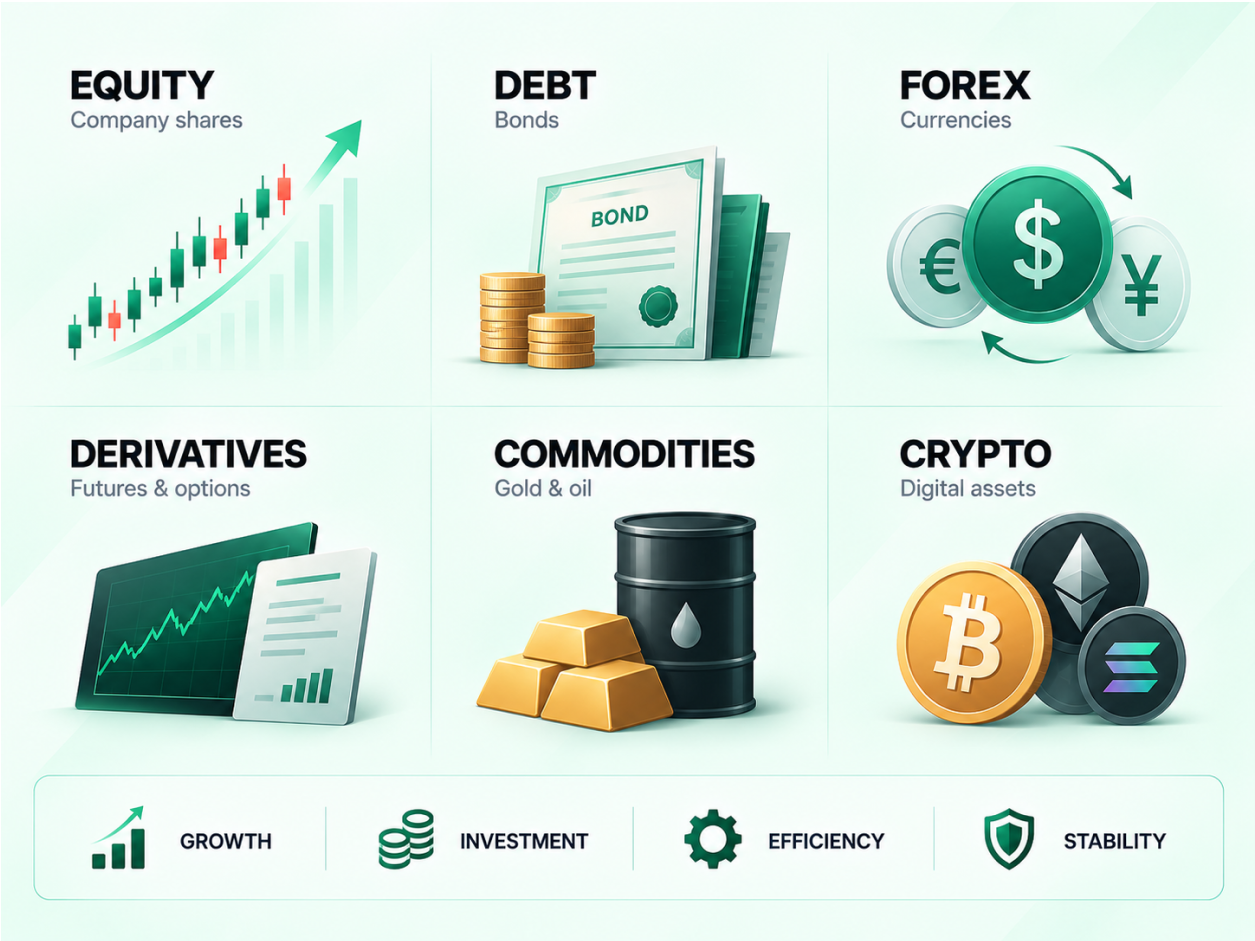
Financial markets are broadly categorized by the types of assets traded and their structure:
1. Equity Markets (Stock Markets)
These are venues where shares of publicly traded companies are bought and sold. Companies issue stocks to raise capital, and investors purchase them hoping for capital appreciation and dividends.
- Primary Market: Where new stock issues are sold, typically through an Initial Public Offering (IPO).
- Secondary Market: Where existing shares are traded among investors after their initial issuance. Most daily stock trading occurs here.
2. Debt Markets (Bond Markets)
Also known as the credit or fixed-income market, this is where debt instruments, primarily bonds, are issued and traded. When an entity (like a government or corporation) issues a bond, it is essentially borrowing money from investors and agreeing to pay interest over a specified period, returning the principal at maturity.
3. Foreign Exchange (Forex) Market
The largest and most liquid financial market globally, the forex market facilitates the exchange of currencies. Participants buy, sell, hedge, and speculate on the exchange rates between different currency pairs. It is a decentralized, over-the-counter (OTC) market, meaning trades occur directly between participants rather than through a centralized exchange.
4. Derivatives Markets
These markets trade contracts whose value is derived from an underlying asset, such as stocks, bonds, commodities, currencies, or interest rates. Common derivatives include:
- Futures Contracts: Agreements to buy or sell an asset at a predetermined price on a specified future date. They are standardized and typically traded on exchanges.
Clearinghouses play a critical role in futures markets by acting as intermediaries for every trade, guaranteeing the performance of contracts for both buyers and sellers. This mechanism standardizes contract specifications, ensures market integrity, and significantly mitigates counterparty risk. This contrasts with “forwards,” which are typically bilateral, less regulated agreements traded over-the-counter.
- Options Contracts: Give the holder the right, but not the obligation, to buy or sell an underlying asset at a specific price (strike price) on or before a certain date.
5. Commodities Markets
Commodities markets deal with the trading of raw materials and primary agricultural products. This includes “hard” commodities like gold, oil, and natural gas, and “soft” commodities such as corn, coffee, and sugar. Trading occurs in both spot markets (for immediate physical delivery) and, more commonly, through derivatives like futures and options.
6. Money Markets
These markets specialize in highly liquid, short-term debt instruments (maturities typically less than one year). They are characterized by a high degree of safety and relatively lower returns. Examples include U.S. Treasury bills, commercial paper, and certificates of deposit. Money markets are crucial for managing short-term liquidity for institutions and governments.
7. Cryptocurrency Markets
A relatively newer segment, cryptocurrency markets facilitate the buying, selling, and swapping of digital assets like Bitcoin and Ethereum. These markets can be centralized (operated by exchanges) or decentralized (peer-to-peer). While offering innovative financial possibilities, they often present unique volatility and regulatory considerations compared to traditional markets.
8. Over-the-Counter (OTC) Markets
Over-the-Counter (OTC) markets represent a decentralized financial market structure, distinct from centralized exchanges like the NYSE. In OTC markets, participants trade securities directly with one another, typically via electronic networks, rather than through a physical trading floor or a central intermediary. This peer-to-peer approach means OTC markets often lack the stringent listing requirements of exchanges, making them accessible for smaller or riskier companies that may not meet those criteria.
Characteristically, OTC markets can be less regulated, potentially less liquid, and more opaque than their exchange-traded counterparts. Despite this, they are fundamental for certain financial instruments, including many types of derivatives, and form the backbone of the entire foreign exchange (forex) market.
Market Efficiency and Transparency
Real-World Implications and Market Risks
The 2008 financial crisis serves as a stark reminder of how complex financial instruments and market structures, particularly those operating with less transparency, can lead to systemic risk and widespread market failure. At the heart of the crisis were Mortgage-Backed Securities (MBS) and Collateralized Debt Obligations (CDOs), often traded in the less regulated Over-the-Counter (OTC) markets. These instruments bundled thousands of individual mortgages, including a significant portion of high-risk “subprime” loans.
As a housing bubble inflated and subsequently burst, widespread defaults on these subprime mortgages rendered the underlying assets of MBS and CDOs toxic. The intricate layering and lack of transparency within these OTC derivatives made it nearly impossible for investors to assess their true risk. This opacity, combined with the interconnectedness of financial institutions, triggered a severe liquidity contagion. Major financial institutions, heavily exposed to these now-worthless assets, faced collapse, necessitating massive taxpayer-funded bailouts. The crisis underscored the critical importance of market transparency, robust regulation, and effective risk management to prevent such catastrophic failures.
For financial markets to function optimally, efficiency and transparency are paramount. Market efficiency implies that asset prices fully reflect all available information. In an efficient market, it is difficult to consistently “beat the market” because all public information is already priced in. Transparency, achieved through timely and accurate disclosure of financial information and regulatory oversight, ensures that all participants have access to the same critical data, fostering fair competition and informed decision-making.
In conclusion, financial markets are complex yet indispensable engines of the global economy. By understanding their fundamental roles in capital allocation, price discovery, liquidity provision, and risk management, as well as the diverse types of markets and participants, individuals can navigate the financial world with greater insight and confidence.
Frequently Asked Questions
What is the primary purpose of financial markets in an economy?
The primary purpose of financial markets is to facilitate the efficient allocation of capital by connecting those with surplus funds (investors) to those who need capital for investment and growth (borrowers). They also enable price discovery, provide liquidity for assets, and offer mechanisms for risk management.
How do financial markets help businesses grow and innovate?
Financial markets enable businesses to raise necessary capital by issuing stocks or bonds to the public. This funding allows companies to invest in research and development, expand operations, hire employees, and pursue strategic initiatives that drive innovation and economic expansion.
What is the difference between primary and secondary financial markets?
The primary market is where newly issued securities are sold to investors for the first time, such as during an Initial Public Offering (IPO). The secondary market, in contrast, is where existing securities are traded among investors after their initial issuance, providing liquidity and enabling ongoing price discovery.
Why is liquidity considered so important in financial markets?
Liquidity is crucial because it allows investors to buy or sell financial assets quickly and efficiently without causing significant price fluctuations. High liquidity reduces transaction costs and risks, making it easier for participants to enter and exit positions, which in turn encourages greater market participation and capital flow.
Knowledge Check
1. Which of the following is NOT considered a primary function of financial markets?
- A) Facilitating capital allocation
- B) Promoting price discovery
- C) Providing entertainment for traders
- D) Enabling risk transfer
2. In which type of financial market would you primarily find the trading of short-term debt instruments like U.S. Treasury bills?
- A) Equity Markets
- B) Derivatives Markets
- C) Money Markets
- D) Commodities Markets
3. What role do market makers typically play in financial markets?
- A) They act solely as advisors to retail investors.
- B) They issue new securities for corporations.
- C) They provide continuous bid and ask prices to ensure liquidity.
- D) They regulate market activity and enforce trading rules.
Click to view the answers
1. **C)** – Financial markets are designed for economic functions like capital flow and risk management, not entertainment.
2. **C)** – Money Markets specialize in highly liquid, short-term debt instruments.
3. **C)** – Market makers are crucial for liquidity, offering to buy and sell assets at quoted prices.