

Navigating the financial markets requires a clear understanding of the instruments available to achieve specific objectives. For those looking to gain exposure to broad market indices like the S&P 500, FTSE 100, or DAX 40, two popular avenues emerge: Index Contracts for Difference (CFDs) and Index Exchange-Traded Funds (ETFs). While both offer a pathway to participate in index movements, their underlying structures, risk profiles, cost implications, and suitability for different trading styles diverge significantly.
This guide provides a comprehensive comparison of Index CFDs and ETFs, empowering you to make informed decisions that align with your strategic goals, risk tolerance, and time horizon.
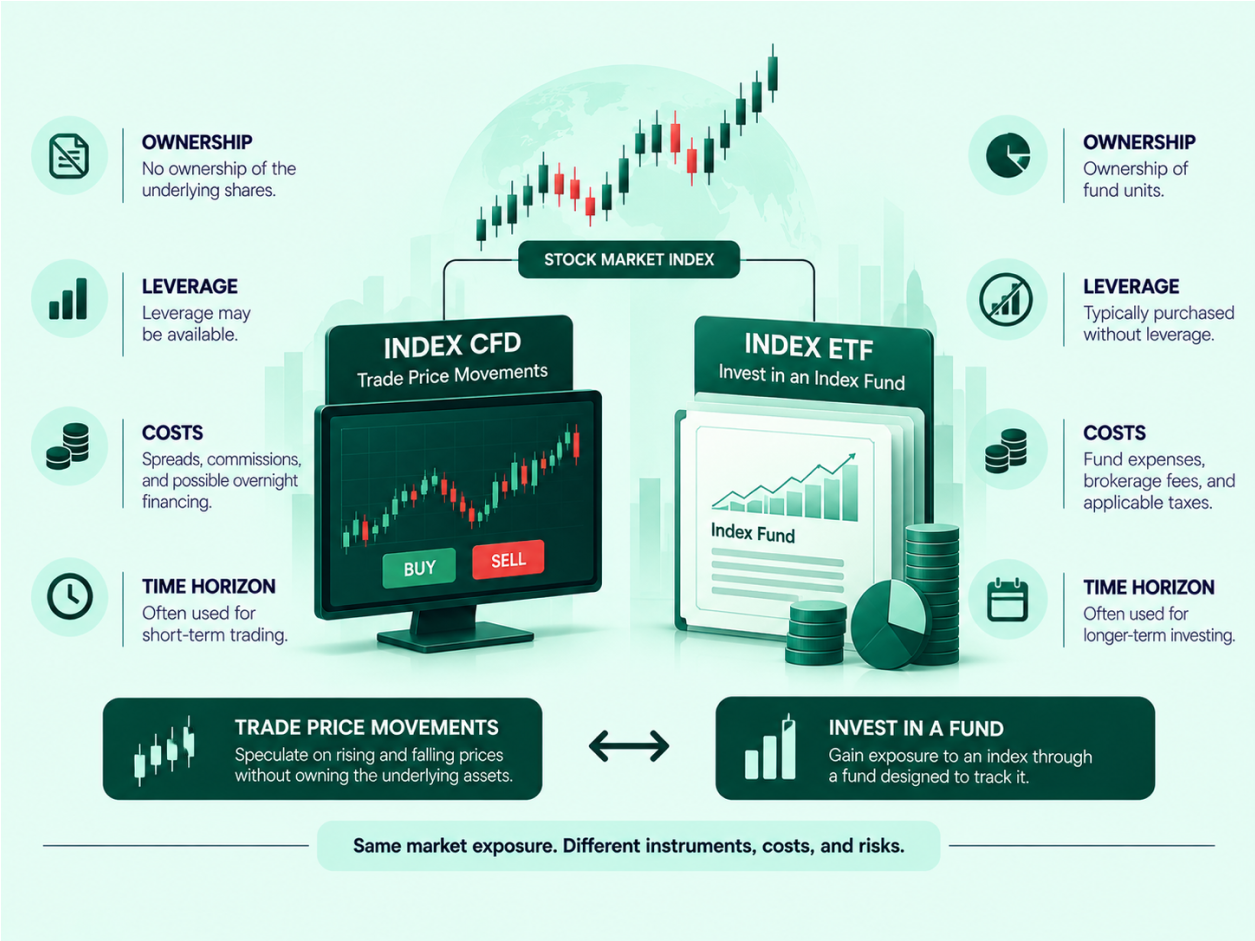
Index CFDs are leveraged derivative contracts that allow traders to speculate on the price movements of an underlying index without owning its constituent assets.
Index ETFs are investment funds traded on exchanges that hold a basket of assets designed to track the performance of a specific market index.
Understanding Index CFDs
An Index CFD is a contractual agreement between a trader and a broker to exchange the difference in the value of an index from the time the contract is opened until it is closed. When you trade an Index CFD, you are not purchasing shares or any physical assets that comprise the index. Instead, you are speculating on whether the index’s price will rise or fall.
Key Characteristics of Index CFDs
- No Asset Ownership: The fundamental distinction is that you never own the underlying stocks or bonds that make up the index. Your profit or loss is purely derived from the price difference of the index multiplied by your position size.
- Leverage: Index CFDs are typically traded on margin, meaning you only need to deposit a fraction of the total trade value to open a position. For example, with 1:20 leverage, a $500 deposit could control an index position worth $10,000. This magnifies both potential gains and losses.
- Long and Short Positions: CFDs offer the flexibility to profit from both rising and falling markets. If you anticipate an index will decline, you can “sell” or go short, aiming to buy back at a lower price. Conversely, if you expect a rise, you “buy” or go long.
- Costs: The primary costs associated with Index CFDs include the spread (the difference between the buy and sell price) and overnight financing charges (also known as swap fees) for positions held open past the daily market close. LQH Markets offers commission-free trading on its Standard, Pro, and Zero Commission accounts. A competitive commission of $3.00 per side (per standard lot) for Forex, or 0.003% notional value for Metals, Energy & Crypto, applies to its Institutional, Raw Spread, and Deposit Bonus accounts.
- Risk Profile: Index CFDs carry a higher risk profile, primarily due to leverage. Losses can exceed your initial deposit, especially in volatile markets. Traders also face margin calls, where additional funds are required to maintain a position if the market moves unfavorably. Furthermore, since CFDs are over-the-counter (OTC) products traded directly with a broker, counterparty risk is a consideration, though mitigated by regulation and reputable brokers.
- Purpose: Index CFDs are generally favored by active traders for short-term speculation, hedging existing portfolios against downside risk, or taking tactical positions based on immediate market sentiment.
Example: A trader believes the S&P 500 index will fall in the short term due to an upcoming economic report. They might open a “sell” position on an S&P 500 CFD. If the index drops as anticipated, they close their position, realizing a profit from the price difference. If the index rises, they incur a loss.
Understanding Index ETFs
An Index ETF is an investment fund that holds a diversified basket of securities (like stocks, bonds, or commodities) with the specific goal of tracking the performance of a particular market index. When you buy an Index ETF, you are purchasing units in that fund, which are then traded on a stock exchange like individual shares.
Key Characteristics of Index ETFs
- Indirect Asset Ownership: When you buy an Index ETF, you become a shareholder in the fund itself. The fund, in turn, owns the underlying assets that constitute the index. For instance, an S&P 500 ETF holds shares in the 500 companies that make up the S&P 500, often in proportion to their weighting in the index.
- No Inherent Leverage: Standard Index ETFs do not employ leverage, meaning your potential gains and losses are directly proportional to the performance of the underlying index. While some specialized ETFs use internal leverage, these are exceptions and carry significantly higher risk.
- Diversification: ETFs offer built-in diversification by providing exposure to an entire index or sector through a single investment. This reduces the risk associated with individual stock selection.
- Costs: Index ETFs typically incur a management fee, often expressed as a Total Expense Ratio (TER), which is deducted annually from the fund’s assets. You will also pay brokerage commissions when buying or selling ETF units on an exchange, and a small bid-ask spread at the time of transaction. These costs tend to be lower and more predictable for longer holding periods compared to the accumulating overnight fees of CFDs.
- Risk Profile: Index ETFs are generally considered lower risk than leveraged CFDs. Losses are typically limited to the amount invested. The primary risk is market risk – the value of your investment will fluctuate with the performance of the underlying index. Tracking error is another consideration, where an ETF’s performance might slightly deviate from its benchmark index due to fees, operational costs, or replication strategies.
- Purpose: Index ETFs are ideal for long-term investors seeking diversified market exposure, portfolio building, and a more passive investment approach. They are suitable for those who prefer to “set and forget” their investments over months or years.
Example: An investor wants long-term exposure to the overall performance of the U.S. technology sector. They might purchase units in a NASDAQ 100-tracking ETF. As the technology sector grows over time, the value of their ETF units is expected to appreciate, reflecting the performance of the underlying index, minus the fund’s management fees.
Understanding Different ETF Structures
While standard Index ETFs aim for direct replication of an index’s performance, the ETF landscape offers various structures designed for different objectives and risk profiles. Two primary methods of replication are Physical ETFs and Synthetic ETFs. Physical ETFs directly hold the underlying assets (e.g., stocks, bonds) that comprise the index, providing transparent and direct exposure. In contrast, Synthetic ETFs use financial derivatives, such as total return swaps, with a counterparty to replicate the performance of an index without actually owning the underlying assets. This introduces counterparty risk, though it can be efficient for hard-to-access markets.
Beyond replication methods, specialized ETFs like Leveraged ETFs and Inverse ETFs exist. Leveraged ETFs aim to multiply the daily returns of an index (e.g., 2x or 3x), while Inverse ETFs seek to profit from a decline in an index’s value. Both types achieve their goals using derivatives and often require daily rebalancing, making them highly complex and generally unsuitable for long-term holding. Their heightened risk profiles, especially due to compounding effects over time, mean they are typically used by experienced traders for short-term tactical plays.
Core Differences: Index CFDs vs. ETFs
The table below summarizes the fundamental distinctions that define Index CFDs and ETFs, guiding your choice based on your specific needs.
| Feature | Index CFDs | Index ETFs |
|---|---|---|
| Ownership | No ownership of underlying index components | Indirect ownership of underlying index components (via fund units) |
| Leverage | Available, amplifies P&L | Generally not available (standard ETFs) |
| Position Types | Long (buy) or Short (sell) | Typically Long (buy) |
| Primary Costs | Spread, overnight financing fees, (commissions) | Management fee (TER), brokerage commission, spread |
| Risk Profile | Higher (leverage, margin calls, counterparty) | Lower (market risk, tracking error, limited to investment) |
| Best For | Short-term speculation, hedging | Long-term investing, diversification |
| Market Type | Over-the-Counter (OTC) with a broker | Exchange-traded (like stocks) |
| Time Horizon | Hours to weeks | Months to years |
Regulatory Landscape and Trading Hours
A significant distinction lies in their regulatory frameworks and trading accessibility. Index ETFs are standardized investment funds regulated by financial authorities and traded on public exchanges, similar to stocks. This exchange-traded nature provides transparency and oversight, contributing to their perceived lower risk. Conversely, Index CFDs are Over-the-Counter (OTC) products, meaning they are contracts directly between a trader and a broker. While reputable CFD brokers are regulated, the OTC nature introduces counterparty risk and means terms are set by the broker.
From a practical standpoint, CFDs often offer extended trading hours, allowing traders to react to global news and market events outside of traditional exchange operating times. ETFs, being exchange-traded, are generally limited to the trading hours of their respective exchanges, which can restrict immediate responses to overnight developments.
Strategic Considerations: Choosing the Right Instrument
The decision between Index CFDs and ETFs hinges on your trading or investment objectives, risk tolerance, and time horizon.
Time Horizon
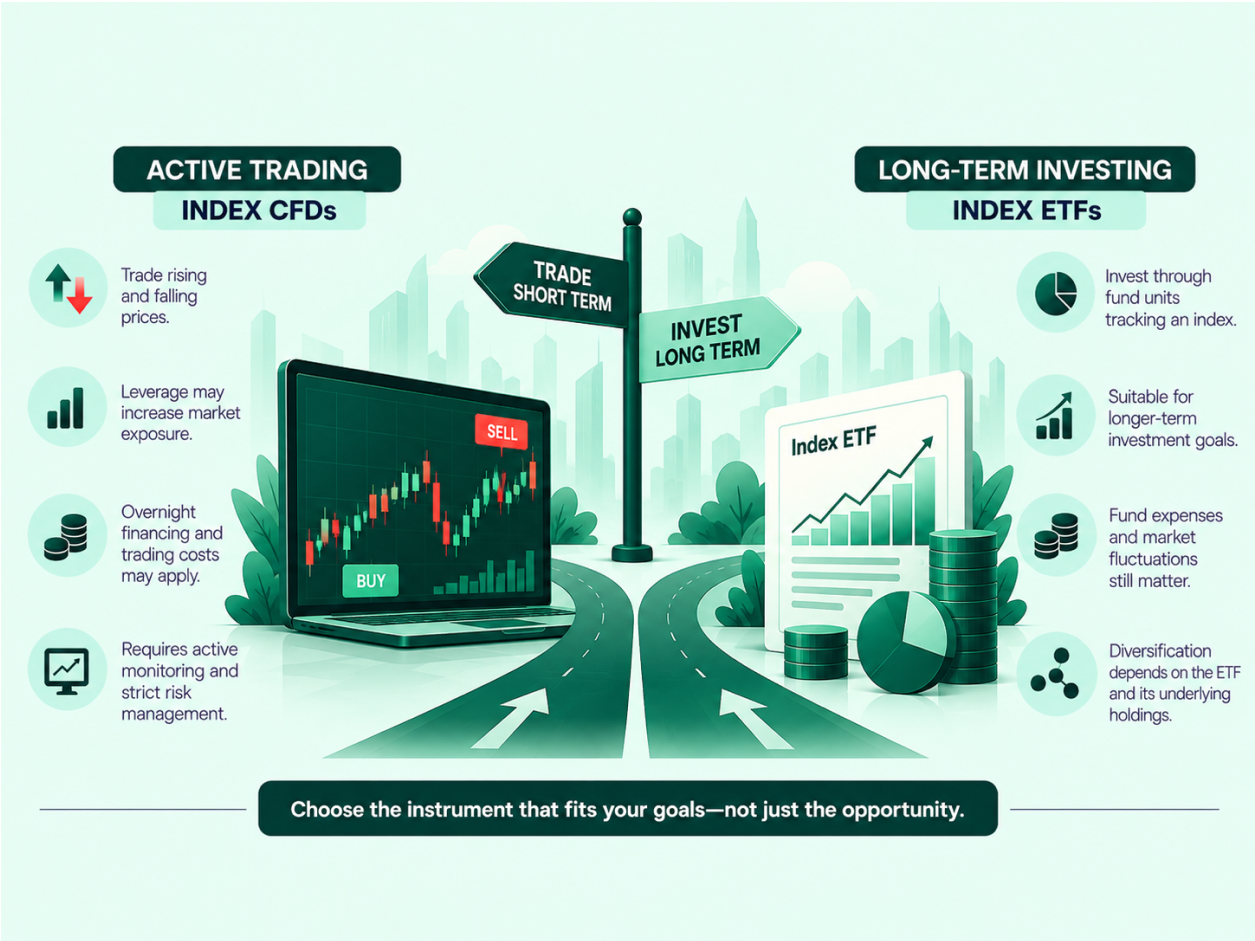
- Short-Term Focus (Hours to Weeks): Index CFDs are often preferred for their flexibility and leverage, allowing traders to capitalize on intraday or short-term price fluctuations. The accumulating overnight financing charges make them less suitable for extended holding periods.
- Long-Term Focus (Months to Years): Index ETFs are designed for long-term growth and capital appreciation. Their lower, more predictable cost structure (primarily management fees) makes them cost-effective for holding positions over extended periods.
Risk Appetite
- High Risk Tolerance: Traders comfortable with significant potential losses, including amounts exceeding their initial deposit, and who actively manage leverage, may find Index CFDs suitable.
- Moderate to Low Risk Tolerance: Investors who prefer to limit their potential losses to the amount invested and seek diversified exposure without the complexities of leverage will likely favor Index ETFs.
Capital Efficiency and Market View
- Leveraged Exposure: If you aim to control a large index position with a relatively small amount of capital, Index CFDs offer this efficiency through leverage. This is beneficial for directional speculation.
- Diversified Exposure: For those seeking broad market exposure and diversification across an entire index or sector, Index ETFs provide a straightforward and transparent solution. They are ideal for building a core portfolio.
Hedging Strategies
Index CFDs can serve as an effective hedging tool. For example, if you hold a portfolio of U.S. stocks and anticipate a short-term market downturn, you could open a short position on an S&P 500 CFD to offset potential losses in your equity holdings, without having to sell your long-term investments.
The S&P 500: CFD or ETF Access?
Trading CFDs on ETFs: A Hybrid Approach
While the primary comparison often focuses on Index CFDs versus Index ETFs, it’s also possible to trade CFDs where the underlying asset is an ETF itself. This “ETF CFD trading” offers a hybrid approach, combining the structural flexibility and leverage of CFDs with the diversified exposure typically provided by an ETF.
Traders might opt for ETF CFDs for several reasons. Firstly, it allows them to gain leveraged exposure to a diversified fund, potentially amplifying returns from an ETF’s price movements with a smaller capital outlay. Secondly, it provides an accessible way to short-sell ETFs, enabling traders to profit from anticipated declines in an ETF’s value, which can sometimes be more complex or restricted when trading physical ETFs. However, it’s crucial to remember that this strategy combines the inherent market risks of the ETF with the heightened risks of CFD leverage, meaning potential losses can be substantial and exceed the initial deposit.
The S&P 500 is a prominent stock market index, not a directly tradable asset itself. Both CFDs and ETFs offer ways to gain exposure to its performance, but with distinct implications:
- S&P 500 CFD: Allows you to speculate on the real-time price movements of the S&P 500 index. You can use leverage, go long or short, and react quickly to market news. This is suited for active traders with a strong directional view on the U.S. large-cap market.
- S&P 500 ETF: Involves buying units in a fund that holds the actual shares of the 500 companies in the S&P 500. This provides long-term, diversified exposure to the U.S. equity market, with returns reflecting the index’s performance minus the ETF’s fees. It’s ideal for investors building a core portfolio.
Conclusion
Index CFDs and Index ETFs are powerful instruments for gaining exposure to market indices, but they cater to fundamentally different financial strategies. Index CFDs offer a flexible, leveraged approach for short-term speculation and hedging, appealing to active traders comfortable with higher risk. Index ETFs provide a diversified, unleveraged pathway for long-term investment and portfolio building, suitable for investors prioritizing capital preservation and steady growth.
Understanding these core differences is paramount. Your choice should always align with your personal financial objectives, risk tolerance, and the timeframe over which you intend to manage your market exposure.
Frequently Asked Questions
What is the main difference in how you gain exposure to an index using CFDs versus ETFs?
With Index CFDs, you speculate on the price movement of an index through a contract with a broker, without owning any underlying assets. With Index ETFs, you purchase units in a fund that actually holds the underlying securities of the index, providing indirect ownership exposure.
Can I lose more than my initial investment when trading Index CFDs?
Yes, due to the leverage inherent in CFDs, adverse price movements can lead to significant losses. LQH Markets provides Negative Balance Protection (NBP) for retail clients, which limits losses on a given account so that the balance does not fall below zero under normal trading conditions, subject to the prohibitions on abuse described in the Client Agreement.
Are Index CFDs and ETFs suitable for the same investment horizon?
No, they are generally suited for different time horizons. Index CFDs are typically used for short-term trading (hours to weeks) due to accumulating overnight financing charges and leverage, while Index ETFs are designed for long-term investing (months to years) due to their diversified nature and lower, more predictable ongoing costs.
How does counterparty risk apply to Index CFDs but not typically to Index ETFs?
Index CFDs are OTC products, meaning you enter a contract directly with your broker, introducing counterparty risk related to the broker’s ability to fulfill their obligations. Index ETFs are exchange-traded funds, and while they carry market risk, the risk of the fund itself defaulting is generally separate from direct counterparty risk with a broker for the transaction.
Knowledge Check
1. Which of the following is a primary characteristic of Index CFDs?
- A) Ownership of the underlying index components
- B) Built-in diversification with limited market risk
- C) The availability of leverage to control larger positions
- D) A long-term investment horizon with predictable management fees
2. An investor looking for long-term, diversified exposure to a market index without using leverage would typically choose which instrument?
- A) An Index CFD
- B) A single stock CFD
- C) An Index ETF
- D) A leveraged futures contract
3. What is a key cost associated with holding an Index CFD position overnight?
- A) Total Expense Ratio (TER)
- B) Brokerage commission on exchange
- C) Management fee
- D) Overnight financing charges
Click to view the answers
1. **C)** – Index CFDs allow traders to use leverage, enabling them to control a larger market position with a smaller initial capital outlay.
2. **C)** – Index ETFs are designed for long-term investors seeking diversified exposure to an index without the use of leverage.
3. **D)** – Overnight financing charges are a common cost incurred when holding an Index CFD position open beyond the daily market close.