


Understanding how to read forex quotes is a foundational skill for anyone engaging in currency trading. Every transaction in the foreign exchange market begins with a quote, which is more than just a number; it’s a dynamic snapshot of market sentiment, liquidity, and cost. Without a clear grasp of these essential components, traders are essentially navigating the market blind, making it challenging to manage risk, calculate potential profits, or execute trades effectively.
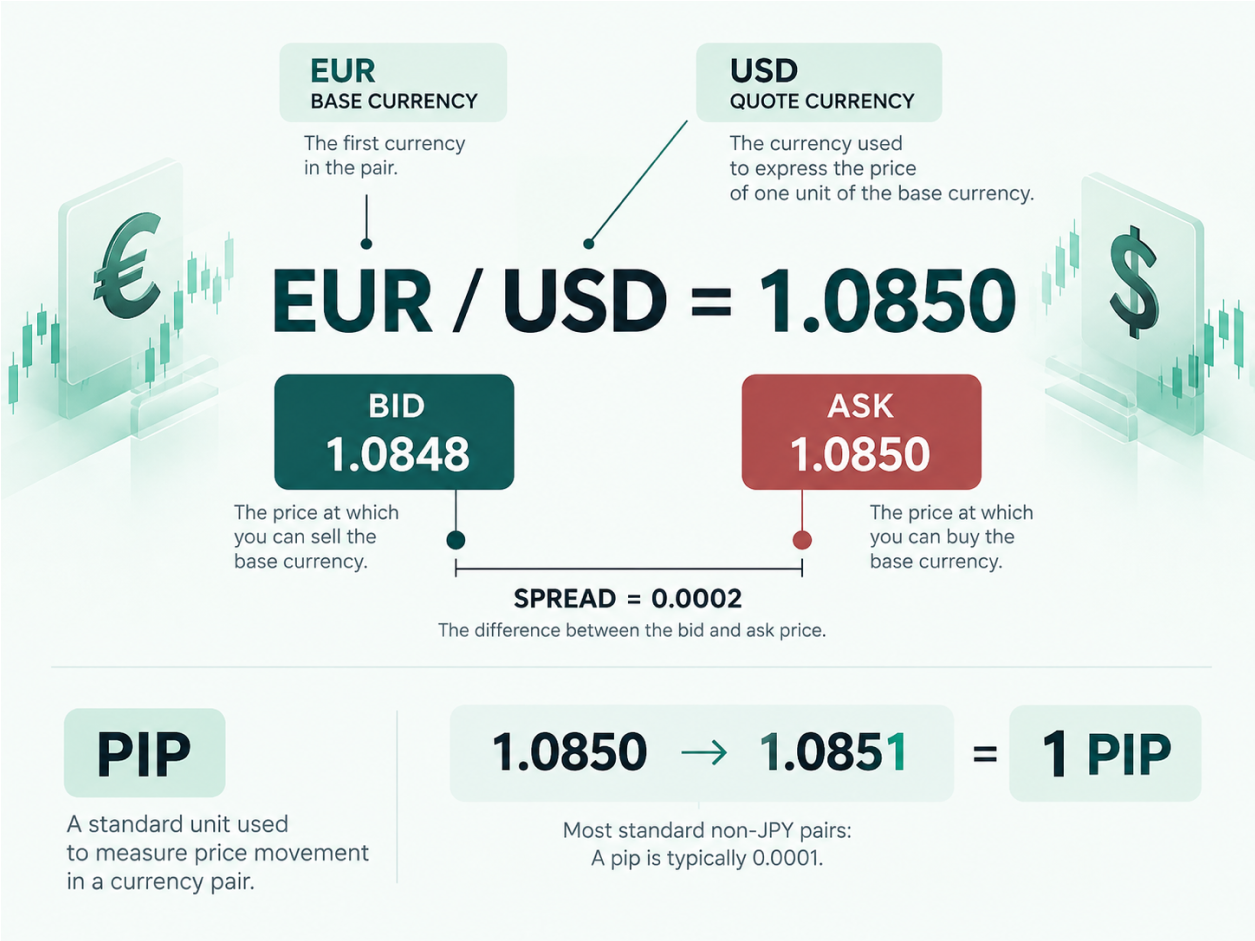
A forex quote displays the exchange rate between two currencies, showing the value of one currency relative to another. It includes the bid price (the highest price buyers are willing to pay), the ask price (the lowest price sellers are willing to accept), and the spread (the cost of trading).
This guide will demystify forex quotes, breaking down their structure, explaining key terminology like bid, ask, and spread, and providing a practical framework for interpreting them. By the end, you’ll possess the knowledge to read forex quotes with confidence, enhancing your trading precision and overall market comprehension.
What Are Forex Quotes?
Forex quotes represent the value of one currency in relation to another. Since currencies are always exchanged in pairs, a quote always features two currencies. For example, if you see EUR/USD = 1.0850, it means that one Euro is equivalent to 1.0850 US Dollars.
In every currency pair, the first currency listed is known as the base currency, and the second is the quote currency (or counter currency). In the EUR/USD example, the Euro (EUR) is the base currency, and the US Dollar (USD) is the quote currency. When you buy EUR/USD, you are effectively buying Euros and simultaneously selling US Dollars. Conversely, when you sell EUR/USD, you are selling Euros and buying US Dollars.
Forex quotes are not static; they fluctuate continuously throughout the trading day, driven by a myriad of factors including global supply and demand dynamics, economic data releases, central bank policies, interest rate differentials, and geopolitical developments. Reputable trading platforms provide live, real-time quotes, ensuring traders have access to the most current market prices.
A crucial aspect of understanding forex quotes is recognizing the precision with which prices are displayed. Most major currency pairs are quoted to four decimal places, with the smallest unit of movement known as a pip (percentage in point). For instance, if EUR/USD moves from 1.0850 to 1.0851, that represents a one-pip increase. Some brokers also offer pipettes, or fractional pips, which add a fifth decimal place (or a third for Japanese Yen pairs), allowing for even finer price granularity.
Bid and Ask Prices: The Two Sides of Every Trade
At the heart of every forex quote are two distinct prices: the bid and the ask. These prices define the immediate cost and potential revenue for any trade.
The Bid Price
The bid price is the highest price that buyers in the market are currently willing to pay for the base currency. When you want to sell a currency pair, you will execute your trade at the bid price. For example, if the quote for GBP/USD is Bid: 1.2530 / Ask: 1.2532, and you decide to sell British Pounds, you would do so at 1.2530.
The Ask Price (Offer Price)
The ask price (also known as the offer price) is the lowest price that sellers in the market are willing to accept for the base currency. When you want to buy a currency pair, you will execute your trade at the ask price. Using the same GBP/USD example of Bid: 1.2530 / Ask: 1.2532, if you decide to buy British Pounds, you would do so at 1.2532.
This inherent difference means that when a trader opens a position, they typically start with a small, unrealized loss. If you buy at the ask price and immediately try to sell, you would only receive the bid price, which is always lower. This initial difference is the spread, a direct cost of trading. Understanding the bid and ask is vital as it directly impacts trade execution, overall trading costs, the effective placement of stop-loss orders, and ultimately, short-term profitability.
The Forex Bid-Ask Spread and Trading Costs
The spread is the difference between the ask price and the bid price in a forex quote. This, along with commissions (which apply to Raw Spread accounts at $3 per lot per side), constitutes the transaction costs for traders in the forex market.
Consider a quote for USD/CAD:
- Bid Price: 1.3615
- Ask Price: 1.3618
- Spread: 1.3618 – 1.3615 = 0.0003, or 3 pips.
This 3-pip spread is the cost you pay to enter a trade. If you buy USD/CAD at 1.3618 and the price doesn’t move, selling it immediately would only yield 1.3615, resulting in a 3-pip loss. For your trade to become profitable, the market price must move in your favor by more than the spread.
Factors Influencing Spread Width
Spreads are not static; they are dynamic and can change based on several market conditions:
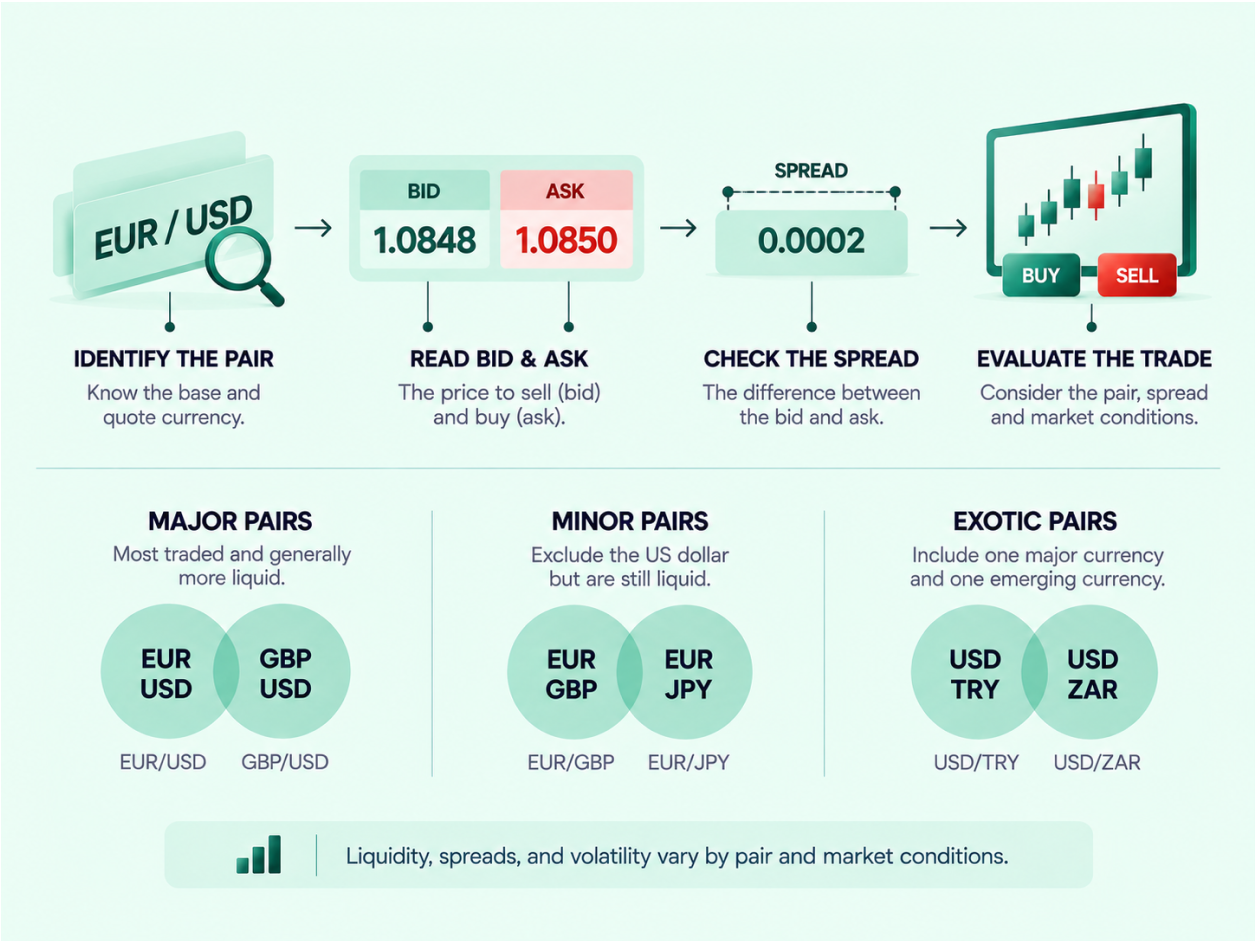
- Liquidity: Highly liquid currency pairs, such as the majors (e.g., EUR/USD, USD/JPY), typically have tighter spreads because there are many buyers and sellers, making it easy to find a counterparty. Less liquid pairs, like exotics, often have wider spreads.
- Volatility: During periods of high market volatility, such as major economic news releases (e.g., central bank interest rate decisions, inflation reports, non-farm payrolls), spreads can widen significantly as market makers adjust for increased risk and uncertainty.
- Trading Sessions: Spreads can vary depending on the active trading session. For instance, EUR/USD might have a very tight spread during the overlap of the London and New York sessions due to high trading volume, but spreads may widen during quieter Asian sessions.
- Market Sentiment: Broad shifts in market sentiment or unexpected geopolitical events can also lead to wider spreads as liquidity providers become more cautious.
For short-term traders, like scalpers (provided their strategies are consistent with fair use of the platform), who enter and exit positions frequently, even small changes in the spread can have a substantial impact on their profitability. A wider spread means higher transaction costs, which can erode potential gains quickly.
Pips and Pipettes: Measuring Price Movement
To quantify price movements and calculate profits or losses, forex traders use specific units: pips and pipettes.
What is a Pip?
A pip (percentage in point or price interest point) is the standard unit of measurement for the change in the exchange rate of a currency pair. For most currency pairs, a pip is the fourth decimal place (0.0001).
- Example 1 (Standard Pair): If EUR/USD moves from 1.0850 to 1.0865, it has moved up by 15 pips (0.0015).
- Example 2 (JPY Pair): For Japanese Yen pairs, a pip is the second decimal place (0.01) because the yen is worth significantly less per unit. If USD/JPY moves from 148.20 to 148.45, it has moved up by 25 pips (0.25).
What are Pipettes (Fractional Pips)?
Many modern trading platforms display quotes with an additional decimal place beyond the standard pip. This fifth decimal place (or third for JPY pairs) represents a pipette or fractional pip, which is one-tenth of a regular pip.
- Example: If EUR/USD moves from 1.08500 to 1.08505, that’s a 5-pipette move, equivalent to 0.5 pips.
While pipettes offer greater precision, most retail traders focus on full pips for their analysis and calculations, reserving pipettes for very high-frequency or algorithmic trading strategies.
Why Pips Matter
Pips are crucial for:
- Calculating Profit/Loss: The value of a pip depends on the currency pair, trade size, and account currency. For a standard lot (100,000 units) of EUR/USD, one pip is typically worth $10. For a mini lot (10,000 units), it’s $1, and for a micro lot (1,000 units), it’s $0.10.
- Risk Management: Understanding pip values allows traders to accurately calculate position sizes, set appropriate stop-loss and take-profit levels, and manage their risk exposure in dollar terms.
Direct and Indirect Quotes: American vs. European Terms
Forex quotes can also be categorized as direct or indirect, often referred to as American or European terms, respectively. These conventions dictate how the exchange rate is presented relative to a specific domestic currency, typically the US Dollar.
Direct Quotes (American Terms)
A direct quote shows how much of the domestic currency is needed to buy one unit of a foreign currency. For a US-based trader, a quote like EUR/USD = 1.0850 is a direct quote. It directly tells you that you need $1.0850 to buy one Euro. In American terms, the US Dollar is the quote currency (e.g., EUR/USD, GBP/USD).
Indirect Quotes (European Terms)
An indirect quote shows how much foreign currency you receive for one unit of your domestic currency. For a US-based trader, a quote like USD/JPY = 148.20 is an indirect quote. It tells you that one US Dollar buys 148.20 Japanese Yen. In European terms, the US Dollar is the base currency (e.g., USD/JPY, USD/CHF).
While these terms originated from historical trading practices, most retail forex platforms standardize currency pair listings (e.g., EUR/USD, not USD/EUR) to ensure consistency and ease of reading for a global audience. However, understanding the underlying convention helps in interpreting financial news and cross-currency analysis.
How to Read Forex Quotes: A Step-by-Step Tutorial
Reading a forex quote correctly is a fundamental skill that underpins all trading decisions. Here’s a step-by-step process:
Step 1: Identify the Currency Pair
Always read the pair from left to right. The first currency is the base currency, and the second is the quote currency.
- Example: For AUD/USD, AUD (Australian Dollar) is the base currency, and USD (US Dollar) is the quote currency.
Step 2: Locate the Bid and Ask Prices
On your trading platform, you’ll see two prices for the pair. The lower price is the bid, and the higher price is the ask.
- Example: AUD/USD 0.6655 / 0.6658
- Bid: 0.6655
- Ask: 0.6658
Step 3: Calculate the Spread
Subtract the bid price from the ask price to find the spread. This is your immediate cost of entering a trade.
- Example: 0.6658 (Ask) – 0.6655 (Bid) = 0.0003, or 3 pips.
Step 4: Interpret the Exchange Rate
- If you buy AUD/USD, you pay the ask price (0.6658). This means you are buying 1 AUD for $0.6658 USD.
- If you sell AUD/USD, you receive the bid price (0.6655). This means you are selling 1 AUD for $0.6655 USD.
Step 5: Determine Your Trading Action
Based on your market analysis and expectations:
- If you anticipate the base currency (AUD) to strengthen against the quote currency (USD), you would buy AUD/USD at the ask price (0.6658). You are “going long,” aiming to profit from a rise in the exchange rate.
- If you anticipate the base currency (AUD) to weaken against the quote currency (USD), you would sell AUD/USD at the bid price (0.6655). You are “going short,” aiming to profit from a fall in the exchange rate.
Complete Trading Example
Let’s say you believe the Australian economy is poised for growth, leading to a stronger AUD.
Current Quote: AUD/USD 0.6655 / 0.6658
- Action: You decide to buy one mini lot (10,000 units) of AUD/USD.
- Entry Price: You buy at the ask price of 0.6658.
- Initial Cost: Your spread cost is 3 pips. For a mini lot of AUD/USD, each pip is worth $1. So, your initial cost is $3.
- Market Movement: The market moves in your favor. AUD/USD rises to 0.6705 / 0.6708.
- Exit Action: You decide to close your position by selling at the new bid price of 0.6705.
- Profit Calculation:
- Entry: 0.6658
- Exit: 0.6705
- Gross Movement: 0.6705 – 0.6658 = 0.0047, or 47 pips.
- Gross Profit: 47 pips * $1/pip = $47
- Net Profit: $47 (Gross Profit) – $3 (Spread Cost) = $44
This example illustrates how understanding each component of a forex quote translates directly into your trading outcomes.
Visualizing Quotes: How Platforms Display Prices
While the core components of a forex quote—bid, ask, and spread—remain consistent, their presentation can vary significantly across different trading platforms. Understanding these display methods is crucial for accurate interpretation and timely decision-making.
On many charting interfaces, you might primarily see a single price line representing the midpoint between the bid and ask prices. This simplification offers a cleaner visual for technical analysis but is not an executable price. For actual trading, platforms typically display explicit bid and ask prices, often in a “Market Watch” window or directly on the order entry panel. Some advanced platforms may even offer a “price ladder” or “depth of market” view, showing multiple bid and ask prices at various levels, indicating market liquidity.
Mobile trading applications often streamline the display further, prioritizing clarity on smaller screens. They might show the current midpoint or a prominent bid/ask pair, with options to expand for more detail. A critical distinction to note is between real-time and delayed quotes. Reputable brokers provide live, real-time quotes that update continuously, reflecting the immediate market. However, some free or demo platforms might offer delayed quotes, which can be misleading for active trading. The frequency of these updates is also vital; faster updates ensure you’re always seeing the most current price, minimizing the risk of slippage.
Factors Influencing Forex Quote Movements
The dynamic nature of forex quotes is driven by a complex interplay of global economic and political forces. Understanding these factors can help traders anticipate potential price movements:
- Economic Indicators: Key economic data releases, such as Gross Domestic Product (GDP) reports, Consumer Price Index (CPI) for inflation, and employment figures (e.g., Non-Farm Payrolls in the US), can trigger significant volatility and rapid quote changes. Stronger-than-expected data often leads to currency appreciation.
- Central Bank Policies: Decisions by central banks regarding interest rates are paramount. A rate hike typically strengthens a currency, while a rate cut or dovish outlook can weaken it. Quantitative easing or tightening measures also have a profound impact.
- Geopolitical Events: Political instability, elections, trade disputes, or international conflicts introduce uncertainty and can cause sudden shifts in currency values. Currencies perceived as “safe havens,” like the US Dollar, Japanese Yen, or Swiss Franc, may strengthen during times of global risk aversion.
- Supply and Demand: The fundamental forces of supply and demand, driven by international trade, cross-border investments, and speculative flows, constantly influence exchange rates. Increased demand for a currency will push its value higher, and vice versa.
Critical Mistakes Beginners Make (And How to Avoid Them)
Even experienced traders can stumble, but beginners are particularly susceptible to common pitfalls when reading forex quotes. Avoiding these errors is crucial for long-term success:
- Confusing Bid and Ask Prices: Many new traders buy at the ask price but then see their position immediately valued at the lower bid price, leading to confusion about an instant “loss.” Always remember: you buy at the ask, and you sell at the bid.
- Ignoring the Spread: Overlooking the spread as a transaction cost is a frequent mistake. Every trade starts “underwater” by the amount of the spread. Factor it into your profit targets and risk calculations, especially for short-term strategies.
- Miscalculating Pip Values: Assuming a pip is always 0.0001 for all pairs, or failing to convert pip values to your account’s base currency, can lead to inaccurate profit/loss projections and improper position sizing. Always confirm the pip value for the specific pair and lot size you are trading, and convert it to your account currency (e.g., USD).
- Trading Exotic Pairs Blindly: While exotic pairs can offer high volatility, their spreads are often significantly wider (10-50+ pips), making them very expensive to trade. Stick to major pairs with tighter spreads until you have a robust understanding of market dynamics and cost implications.
- Misinterpreting Direct vs. Indirect Quotes: Getting the base and quote currency perspective wrong can lead to completely reversed market analysis. For instance, mistaking USD/CAD 1.3500 to mean one Canadian Dollar buys $1.35 USD (when it actually means one US Dollar buys 1.35 Canadian Dollars) will lead to incorrect trading decisions.
- Not Accounting for Pip Value in Your Account Currency: While a pip’s value is often quoted in USD (e.g., $10 for a standard lot of EUR/USD), this isn’t universal. The actual dollar value of a pip depends on the quote currency of the pair and your trading account’s base currency. For example, if you’re trading EUR/GBP with a USD-denominated account, a 1-pip move might be £10, but this needs to be converted to USD to understand your true profit/loss. Failing to perform this conversion can lead to miscalculations in position sizing and an inaccurate assessment of risk exposure. Always use a reliable pip value calculator or your broker’s tools to confirm the exact value in your account currency.
- Assuming the Quoted Price is Always Executable (Slippage): Charts and “Market Watch” windows often display a single, consolidated price (usually the midpoint) for visual convenience. However, this is rarely the exact price at which your order will be filled. During periods of high volatility, rapid price movements, or low liquidity, the actual execution price can deviate from the price you saw when placing your order. This phenomenon, known as “price slippage” is particularly common with market orders, where you instruct the broker to execute at the best available price. Always be aware that the market can move between the time you click “buy” or “sell” and when your order is processed.”
By diligently understanding and applying the principles of reading forex quotes, traders can avoid these common mistakes, build a stronger foundation for their trading strategies, and approach the market with greater precision and confidence.
Frequently Asked Questions
What is the primary purpose of a forex quote?
The primary purpose of a forex quote is to display the current exchange rate between two currencies, indicating how much of the quote currency is required to buy one unit of the base currency. It also provides the bid and ask prices, which are essential for trade execution.
How do brokers make money from forex quotes?
Brokers typically earn revenue through the bid-ask spread and/or commissions. For LQH Markets, trading costs can include both spreads (from 0.0 pips on Raw Spread accounts) and a commission of $3 per lot per side on Raw Spread accounts, while Zero Commission accounts trade without commissions.
Why do forex quotes have different numbers of decimal places?
Most major currency pairs are quoted to four decimal places, where the fourth decimal represents a pip. Japanese Yen pairs, however, are quoted to two decimal places because the yen has a much smaller individual unit value. Some brokers also offer fractional pips (pipettes) with an additional decimal for enhanced precision.
Can I always execute my trade at the exact price shown on a chart?
Charts often display the midpoint between the bid and ask price for visual clarity, which is not an executable price. Additionally, during periods of high volatility or low liquidity, the actual execution price might differ slightly from the quoted price due to “slippage,” especially with market orders.
Why is understanding forex quotes important for risk management?
Understanding forex quotes is crucial for risk management because it allows traders to accurately calculate transaction costs (spread), determine the precise value of pip movements, and set appropriate stop-loss and take-profit levels in dollar terms, ensuring trades align with their risk tolerance.
Knowledge Check
1. In a forex quote like EUR/USD 1.0850 / 1.0853, what does the 1.0850 represent?
- A) The price at which a trader can buy EUR.
- B) The price at which a trader can sell EUR.
- C) The spread between EUR and USD.
- D) The value of one US Dollar in Euros.
2. If USD/JPY moves from 148.25 to 148.50, how many pips has it moved?
- A) 2.5 pips
- B) 25 pips
- C) 0.25 pips
- D) 250 pips
3. Which of the following factors is most likely to cause a forex pair’s bid-ask spread to widen significantly?
- A) A period of low market volatility.
- B) A major economic news release, such as an interest rate decision.
- C) Trading during the most active market session overlap.
- D) High liquidity in the currency pair.
Click to view the answers
1. **B)** – The bid price (1.0850) is the price at which a trader can sell the base currency (EUR) in the pair.
2. **B)** – For JPY pairs, a pip is the second decimal place, so a move from 148.25 to 148.50 is 0.25, which translates to 25 pips.
3. **B)** – Major economic news releases typically increase market volatility and uncertainty, causing liquidity providers to widen spreads to manage their risk.