


Embarking on the journey of financial trading can be both exciting and challenging. For those seeking to capitalize on market movements without direct ownership of underlying assets, Contracts for Difference (CFDs) offer a versatile avenue. This guide provides a comprehensive overview of how to approach trading, focusing on the essential concepts, tools, and strategies necessary for informed decision-making.
Trading involves speculating on the price movements of various financial assets, such as indices, shares, forex, or commodities, typically without owning the underlying instrument. CFDs are leveraged derivatives that enable traders to gain full exposure to an asset’s value with only a fraction of the total cost as an initial deposit.
It’s crucial to distinguish between trading, particularly with CFDs, and traditional investing. While both aim to generate returns, their approaches differ significantly. Traditional investing typically involves buying and owning assets outright, such as shares in a company, with the intention of holding them for the long term to benefit from capital appreciation or dividends. This requires paying the full value of the asset upfront. In contrast, CFD trading focuses on speculating on short-to-medium term price movements without taking direct ownership of the underlying asset. Traders use margin to open positions, meaning they only put up a fraction of the total trade value. This fundamental difference in asset ownership, capital commitment, and time horizon makes CFDs a distinct tool for market participation compared to long-term investment strategies.
Understanding How Trading Works with CFDs
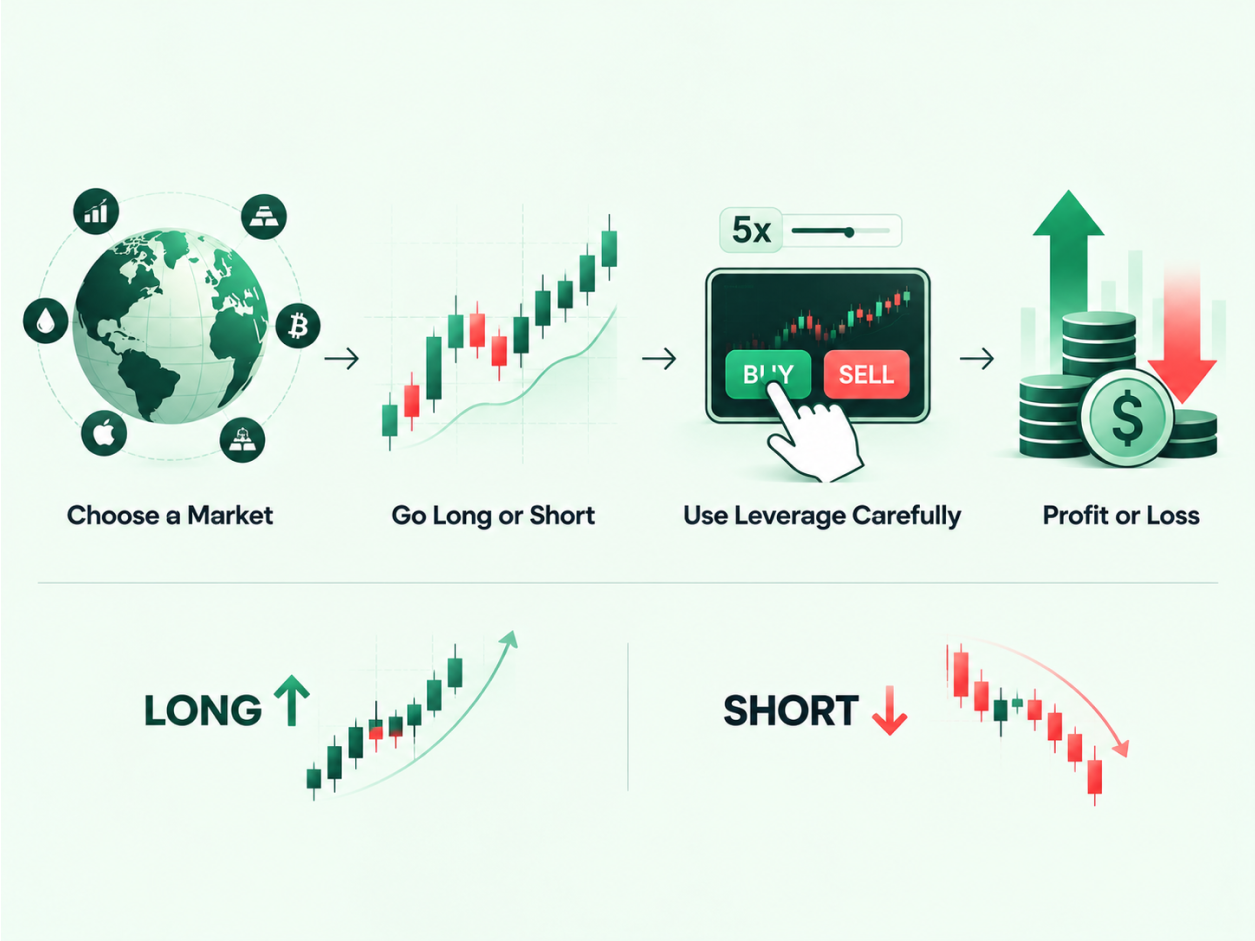
At its core, trading with CFDs is about speculating on whether an asset’s price will rise or fall. Unlike traditional investing, where you purchase and own an asset outright, CFD trading allows you to profit from price fluctuations in either direction.
Leverage and Margin Explained
CFDs are leveraged products. Leverage allows you to control a large position in the market with a relatively small amount of capital, known as margin. Your broker effectively loans you the remaining capital required for the full position size.
For example, if you wish to open a CFD position worth $10,000 on a stock index with a 5% margin requirement, you would only need to deposit $500 ($10,000 * 0.05) to control that position. While this amplifies potential profits, it also magnifies potential losses, making robust risk management paramount. If the market moves against your leveraged position, losses are calculated on the full $10,000 value, not just your initial $500 margin.
A margin call is typically triggered when the equity in your trading account falls below a certain percentage of the initial margin requirement, often around 50%. While brokers usually attempt to notify traders as their equity drops (e.g., at 99%, 75%, and 55% of the margin), it remains the trader’s ultimate responsibility to ensure sufficient funds are maintained in the account. Failure to meet a margin call can lead to positions being automatically closed by the broker to prevent further losses, potentially crystallizing significant losses.
Going Long vs. Going Short
A key advantage of CFD trading is the ability to speculate on both rising and falling markets:
- Going Long (Buy): If you anticipate an asset’s price will increase, you open a “buy” position. If the price rises, you profit.
- Going Short (Sell): If you expect an asset’s price to decline, you open a “sell” position. If the price falls, you profit.
Consider a scenario with Crude Oil CFDs. If you believe global demand will push oil prices higher, you might “buy” 100 barrels of Crude Oil at $75.00 per barrel. If the price rises to $76.00, you’d make a profit of $100 (100 barrels * $1.00 profit per barrel), minus any trading costs. Conversely, if you anticipated a downturn due to oversupply, you might “sell” 100 barrels at $75.00. If the price drops to $74.00, you’d again profit by $100. However, if the market moves against your prediction in either case, you would incur a loss.
The Bid-Ask Spread
The bid-ask spread is the difference between the bid (sell) price and the ask (buy) price of an asset. When you open a buy position, you trade at the ask price; when you open a sell position, you trade at the bid price. This spread is a primary component of the cost of trading and represents the immediate difference you must overcome for your trade to become profitable. A tighter spread generally means lower transaction costs.
Essential Steps to Start Trading
Embarking on your trading journey requires a structured approach. Here are the fundamental steps:
1. Research Available Markets
A diverse range of financial markets are accessible via CFDs (may vary with individual brokers), allowing you to diversify your portfolio and find opportunities across different asset classes. Popular CFD markets include:
- Forex (FX): Speculate on currency pair movements, such as EUR/USD or GBP/JPY.
- Indices: Trade on the performance of major stock market indices like the S&P 500, Dow Jones Industrial Average, or DAX 40.
- Commodities: Gain exposure to raw materials like gold, silver, crude oil, or natural gas.
- Shares: Trade CFDs on individual company stocks, such as Apple, Tesla, or Amazon, without owning the shares themselves.
- Cryptocurrencies: Trade CFDs on Bitcoin or popular Altcoins and Stablecoins like Ethereum, Solana or Tether.
2. Understand Risk Management
Given the leveraged nature of CFDs, effective risk management is non-negotiable. It protects your capital and helps ensure the longevity of your trading career.
Key Risks:
- Leverage Risk: Magnifies both profits and losses.
- Volatility Risk: Rapid price swings can lead to quick losses.
- Margin Call Risk: If your account equity falls below a certain level, your broker may request additional funds (a margin call) or automatically close positions to cover potential losses.
Risk Management Tools:
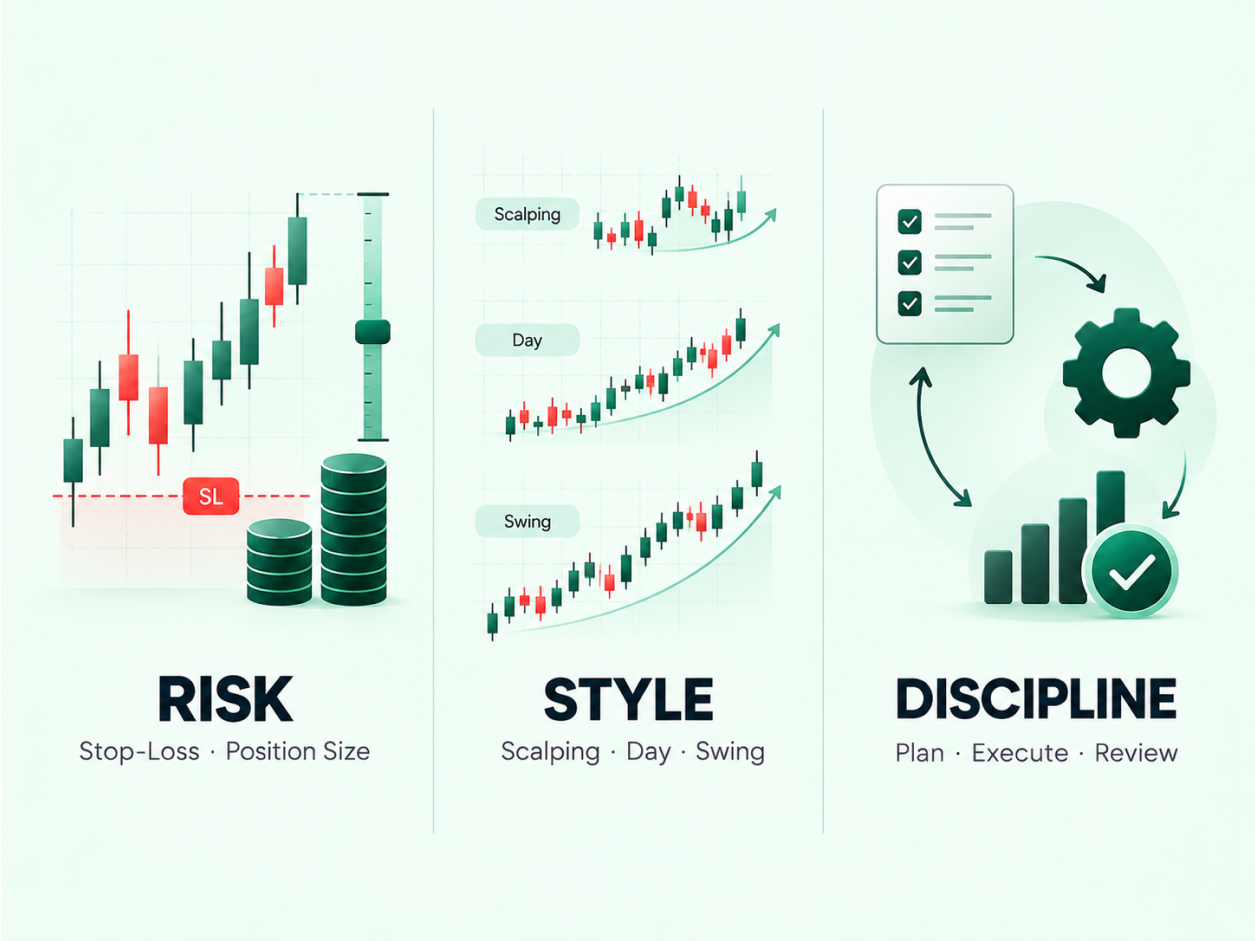
- Stop-Loss Orders: Automatically close a losing position when the market reaches a predetermined price, limiting potential downside. However, standard stop-losses do not guarantee execution at the exact specified price in volatile markets (known as slippage).
- Guaranteed Stop-Loss Orders (GSLOs): Where available and typically for a small premium, GSLOs ensure your position is closed at the exact price you set, regardless of market volatility or gapping. This provides absolute protection against slippage. LQH Markets does not offer GSLOs, but does offer standard Stop Loss orders.
- Limit Orders: Automatically close a profitable position when the market reaches a predetermined price, helping to lock in gains.
- Price Alerts: Notify you via email or push notification when a market reaches a specified level, allowing you to monitor opportunities without constant screen time.
- Negative Balance Protection: For retail clients, this ensures that you cannot lose more than the funds available in your trading account, preventing your balance from going into negative territory.
3. Develop a Trading Style and Strategy
Your trading approach should align with your personality, available time, and risk tolerance. It comprises both a trading style and a trading strategy.
Trading Styles (Based on Timeframe)
- Scalping: Holding positions for seconds to minutes, aiming for very small, frequent profits. Requires intense focus and high trading volume.
- Day Trading: Opening and closing all positions within a single trading day to avoid overnight risks and costs. Focuses on intraday price movements.
- Swing Trading: Holding positions for several days to weeks, capitalizing on short-to-medium term price swings within a larger trend.
- Position Trading: Holding trades for weeks, months, or even years, focusing on long-term market trends and fundamental drivers, largely ignoring short-term fluctuations.
Trading Strategies (Based on Methodology)
A trading strategy is a specific methodology for identifying entry and exit points, often utilizing analytical tools.
- Trend Trading: Identifying and following the prevailing direction of the market. Traders go long in uptrends and short in downtrends, using indicators like moving averages to confirm direction.
- Range Trading: Operating in markets that are consolidating or moving sideways within defined support and resistance levels. Traders buy near support and sell near resistance.
- Breakout Trading: Entering a trade when the price moves decisively above a resistance level or below a support level, signaling the potential start of a new trend. Volume indicators are often used to confirm breakouts.
- Reversal Trading: Identifying when an existing trend is about to change direction. This requires keen observation of price action and indicators like the Relative Strength Index (RSI) or Fibonacci retracements to spot potential turning points.
While fundamental analysis (evaluating economic data, company news) can inform long-term views, most short-to-medium term strategies rely heavily on technical analysis (studying price charts and patterns).
4. Create a Trading Plan
A well-defined trading plan is your roadmap. It’s a comprehensive document outlining your specific rules for trading, including:
- What to trade: Which markets or assets will you focus on?
- When to trade: What are your entry and exit criteria?
- How much to risk: What is your maximum risk per trade and overall portfolio?
- Your trading style and strategy: Clearly defined.
- Risk management rules: How will you use stop-losses, limits, and position sizing?
- Performance review: How often will you review your trades and adjust your plan?
This plan should be personal, adapting to your unique risk appetite, capital, and time commitment.
5. Practice with a Demo Account
Before committing real capital, utilize a demo account. This provides a risk-free environment with virtual funds to:
- Familiarize yourself with the trading platform.
- Test different trading styles and strategies.
- Practice executing trades and managing risk without financial consequence.
- Build confidence and refine your trading plan.
6. Open a Live Account
Once you’ve gained confidence and refined your skills on a demo account, you can open a live trading account.
7. Choose a Robust Trading Platform
The trading platform you choose is a critical component of your success. A high-quality, feature-rich platform provides the essential tools and resources needed to analyze markets, execute trades efficiently, and manage your risk effectively. Look for platforms that offer:
- Advanced Charting Capabilities: Detailed price charts allowing you to track the performance of various asset classes across numerous financial markets.
- Comprehensive Technical Indicators: A wide array of indicators (e.g., moving averages, RSI, MACD) to help identify trends, momentum, and potential entry/exit points.
- Real-time News Feeds: Integrated news services, such as Reuters, to keep you informed of market-moving events and economic data as they happen.
- Educational Resources: Access to webinars, seminars, and an academy of learning materials to continuously enhance your trading knowledge and skills.
A robust platform not only facilitates your trading activities but also empowers you with the insights and education necessary to make informed decisions in dynamic markets.
The process typically involves:
- Application: Filling out an online form, including details about your trading knowledge and experience.
- Verification: Identity verification to comply with regulatory requirements.
- Funding: Depositing funds into your account (with a minimum deposit of $10 with LQH Markets for most account types) to begin live trading.
Frequently Asked Questions
What is the primary difference between trading and investing?
Trading typically involves speculating on short-to-medium term price movements of assets, often using leveraged derivatives like CFDs, without owning the underlying asset. Investing, conversely, usually entails buying and holding assets for the long term with the intention of capital appreciation or income generation through dividends.
How does leverage impact CFD trading?
Leverage allows traders to control a larger market position with a smaller initial capital outlay (margin). While this can significantly amplify potential profits from favorable market movements, it equally magnifies potential losses if the market moves against the trader’s position, making risk management crucial.
What role does a trading plan play in effective trading?
A trading plan is a personalized, comprehensive document that outlines a trader’s objectives, chosen markets, entry and exit criteria, risk management rules, and overall strategy. It acts as a disciplined framework, helping traders make objective decisions and avoid emotional errors.
Are stop-loss orders always guaranteed to execute at the specified price?
Standard stop-loss orders are not always guaranteed to execute at the exact specified price, especially in volatile markets or during periods of low liquidity, due to a phenomenon called slippage. To guarantee execution at a precise price, a Guaranteed Stop-Loss Order (GSLO) is typically required, often for a small premium. LQH Markets do not offer GSLOs at present, only standard Stop Loss orders.
Knowledge Check
1. What is the main characteristic of a Contract for Difference (CFD)?
- A) It grants you ownership of the underlying asset.
- B) It allows speculation on price movements using leverage without owning the asset.
- C) It is primarily used for long-term investment strategies.
- D) It guarantees profits due to its leveraged nature.
2. Which of the following is NOT a common risk management tool in CFD trading?
- A) Stop-loss orders
- B) Guaranteed Stop-Loss Orders (GSLOs)
- C) Unlimited profit targets
- D) Negative balance protection
3. A trading style that involves holding positions for seconds to minutes, aiming for very small, frequent profits, is known as:
- A) Position trading
- B) Swing trading
- C) Day trading
- D) Scalping
Click to view the answers
1. B) – CFDs are leveraged derivatives that allow traders to speculate on an asset’s price movements without taking ownership of the underlying asset.
2. C) – Unlimited profit targets are not a risk management tool; rather, limit orders are used to define profit targets.
3. D) – Scalping is a very short-term trading style focused on opening and closing positions within seconds to minutes for small, frequent gains.