


Understanding Risk Management in CFD Trading
Trading Contracts for Difference (CFDs) offers significant opportunities due to leverage, allowing traders to control larger positions with a relatively small amount of capital. However, this same leverage amplifies both potential gains and losses, making robust risk management not just beneficial, but absolutely essential for long-term success. Without a disciplined approach to managing risk, even a series of profitable trades can be wiped out by a single, poorly managed position.
Risk management is the strategic process of balancing potential gains against the possibility of losses from trading decisions, aiming to safeguard capital and optimize profitability. It involves proactively identifying, assessing, and mitigating financial exposures inherent in market participation.
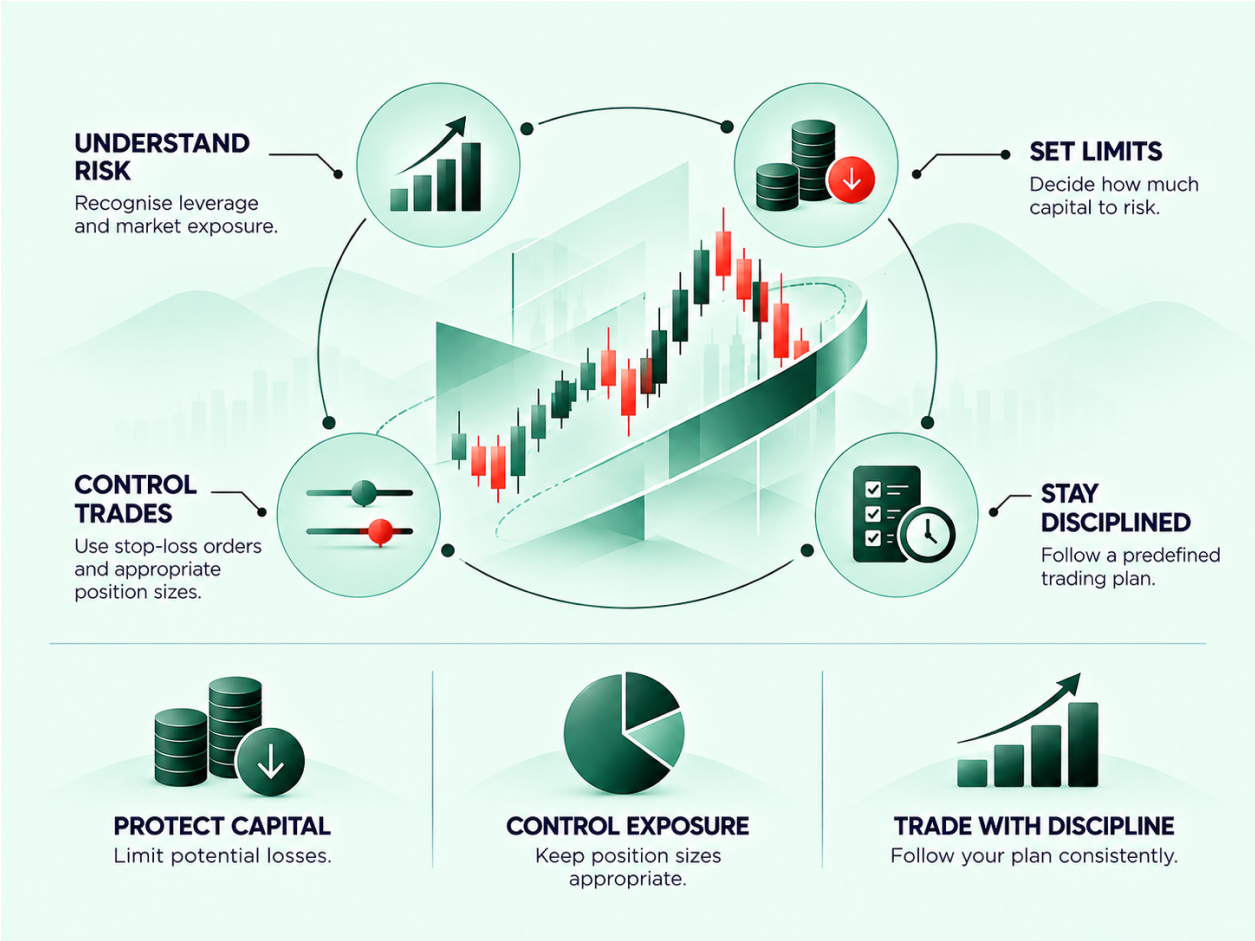
This guide will equip you with foundational techniques to manage your trading risk effectively, helping you protect your capital and navigate the dynamic CFD markets with greater confidence.
Core Principles of Effective Risk Management
Successful trading begins long before an order is placed. It starts with a comprehensive plan and a commitment to execute it without emotional interference.
Plan Your Trade, Trade Your Plan
A common adage in trading, “Plan the trade and trade the plan,” underscores the importance of preparation. Just as a seasoned chess player anticipates multiple moves ahead, a successful trader defines entry, exit, and risk parameters before initiating any position. This structured approach helps in making rational decisions, rather than succumbing to the heat of the moment, which often leads to impulsive and costly errors.
The 1% Rule: Protecting Your Capital
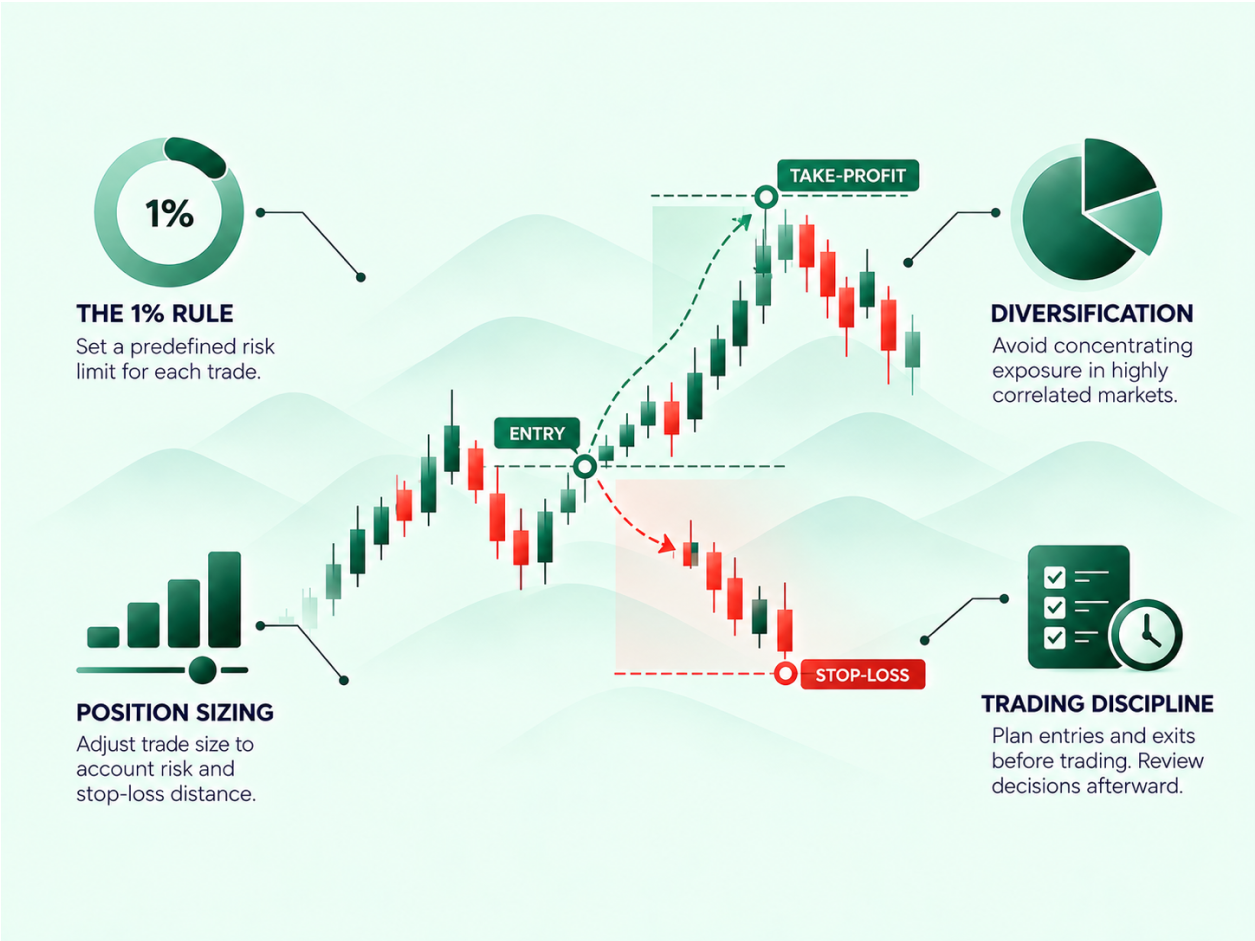
One of the most fundamental rules in risk management is the “1% Rule.” This guideline suggests that a trader should never risk more than 1% (or sometimes 2%, depending on account size and trading frequency) of their total trading capital on any single trade.
Let’s illustrate its power: Imagine you have a trading account with $20,000.
- If you risk 1% per trade ($200): Even after 10 consecutive losing trades, your account would be down $2,000, leaving you with $18,000. To recover, you’d need to make approximately an 11.1% gain on your remaining capital.
- If you risk 5% per trade ($1,000): After 10 consecutive losses, your account would be down $10,000, leaving you with $10,000. You would then need to achieve a 100% gain on your remaining capital just to break even – a significantly harder task.
To further emphasize the impact of drawdown, consider the following scenarios over 15 consecutive losing trades, starting with a $20,000 account:
- Risking 2% ($400) per trade: After 15 losses, your account would be down $6,000, leaving $14,000. You’d need a 42.86% gain to recover.
- Risking 5% ($1,000) per trade: After 15 losses, your account would be down $15,000, leaving $5,000. You’d need a 300% gain to recover.
- Risking 10% ($2,000) per trade: After 15 losses, your account would be down $20,000, leaving $0. Recovery is impossible.
These examples vividly illustrate how quickly higher risk percentages can decimate a trading account. While the 1% rule is a strong general guideline, the “ideal” risk percentage isn’t one-size-fits-all. It often depends on a trader’s frequency and style. For instance, a day trader making many trades might stick closer to 0.5% or 1%, while a swing trader with fewer, longer-term positions might comfortably use 1.5% or 2%. Developing a personal “risk-per-trade scale” that aligns with your specific trading approach and risk tolerance is key to sustainable capital preservation.
This rule is crucial for managing drawdown, which is the reduction in capital after a series of losing trades. By limiting the risk per trade, you preserve capital, allowing you to weather inevitable losing streaks and remain in the market for the long run.
Setting Stop-Loss and Take-Profit Orders
These two order types are indispensable tools for automating risk control and profit realization.
- Stop-Loss (S/L) Order: A stop-loss order is an instruction to close a trade automatically once the price reaches a predetermined level that would result in an acceptable loss. Its primary purpose is to limit potential downside and prevent minor setbacks from escalating into significant capital erosion. For example, if you buy a CFD on XYZ stock at $100, you might place a stop-loss at $98, ensuring your maximum loss on that trade is $2 per share.
- Take-Profit (T/P) Order: Conversely, a take-profit order is an instruction to close a trade automatically once the price reaches a predetermined level that would secure a desired profit. This prevents greed from dictating your decisions, ensuring that you lock in gains before a market reversal potentially erodes them. If you bought XYZ at $100, you might set a take-profit at $105, guaranteeing a $5 per share profit if the price reaches that level.
How to Set Them Effectively: Stop-loss and take-profit levels are often determined using technical analysis.
- Support and Resistance Levels: These are price points where the asset’s price has historically struggled to move above (resistance) or below (support). A common strategy is to place a stop-loss just below a significant support level for a long position, or just above a resistance level for a short position. Take-profit targets can be set near the next major resistance (for long) or support (for short).
- Moving Averages: Widely followed moving averages (e.g., 20-day, 50-day, 200-day) can act as dynamic support or resistance. Traders might place a stop-loss just beyond a key moving average if they anticipate it to hold as support.
- Volatility Adjustment: The market’s volatility should influence your stop-loss placement. In highly volatile markets, a wider stop-loss might be necessary to avoid premature execution due to normal price fluctuations. Conversely, in calmer markets, a tighter stop can be appropriate. A general guideline is to avoid placing stops too close to the current price, typically not closer than 1.5 times the average true range (ATR) or daily high-to-low range.
Calculating Expected Return
Beyond individual trade management, a systematic approach involves calculating the expected return for each potential trade. This quantitative exercise forces traders to objectively assess the viability of a setup before committing capital.
The formula for expected return is:
[(Probability of Gain) x (Take Profit % Gain)] + [(Probability of Loss) x (Stop-Loss % Loss)]
For instance, if you identify a trade with a 60% probability of a 5% gain and a 40% probability of a 2% loss: Expected Return = (0.60 * 0.05) + (0.40 * -0.02) = 0.03 - 0.008 = 0.022 or 2.2%
This means, on average, this trade is expected to yield a 2.2% return. By comparing the expected returns of various opportunities, you can prioritize trades with the highest positive expectation, enhancing your overall profitability.
The Risk/Reward Ratio: Balancing Potential Gains and Losses
While calculating expected return provides a probabilistic view of a trade’s overall profitability, the Risk/Reward Ratio offers a more direct comparison of the potential loss versus the potential gain for a specific trade. This ratio is a fundamental concept in risk management, helping traders assess whether a trade is worth taking based on its inherent profit potential relative to its downside risk.
A common way to express this ratio is 1:X, where 1 represents the amount of capital you are willing to risk, and X represents the potential profit you aim to achieve. For example, a 1:3 risk/reward ratio means you are risking $1 to potentially gain $3.
A favorable risk/reward ratio can significantly impact your overall profitability, even if your win rate is below 50%. Consider a scenario where you consistently aim for a 1:3 risk/reward ratio. If you place 10 trades, risking $100 per trade, and only 3 of them are successful (a 30% win rate), your results would be:
- 3 winning trades: 3 * ($100 risk * 3 reward) = $900 profit
- 7 losing trades: 7 * ($100 risk) = $700 loss
- Net profit: $900 – $700 = $200
This example demonstrates that even with more losing trades than winning ones, a disciplined approach to risk/reward can lead to overall profitability. However, it’s important to note that higher potential rewards often necessitate larger price movements in the market, which may require wider stop-loss placements or longer holding periods.
Diversification and Hedging Strategies
Even with meticulous planning for individual trades, broader market risks can impact your portfolio. Diversification and hedging are macro-level strategies to mitigate these systemic risks.
Diversification: Spreading Your Exposure
The age-old wisdom, “Don’t put all your eggs in one basket,” is profoundly relevant in trading. Diversification involves spreading your capital across a range of different assets, sectors, and even geographic regions to reduce the impact of any single asset or market segment performing poorly.
For example, instead of allocating all your capital to CFDs on technology stocks, you might also consider CFDs on commodities, major currency pairs, or indices from different economies. This approach helps protect against sector-specific downturns or localized economic shocks. The concept of an “investment risk pyramid” suggests allocating the bulk of your capital to more stable assets, with progressively smaller amounts in medium-risk and high-risk opportunities, aligning with your overall risk tolerance.
Hedging: Offsetting Potential Losses
Hedging involves taking a position that offsets the risk of an existing position. It’s like having insurance against adverse market movements. While diversification aims to reduce overall portfolio volatility, hedging specifically targets the risk of a particular asset or exposure.
For a CFD trader, hedging can be particularly versatile:
- Equity Portfolio Hedge: If you hold a portfolio of U.S. technology stocks and anticipate a short-term market correction, you could open a short position on a U.S. Tech Index CFD. If the market falls, the profit from your short CFD position could offset some of the paper losses in your long stock portfolio.
- Currency Exposure Hedge: If you have an underlying business exposure to a foreign currency, you could use a currency CFD to hedge against adverse exchange rate movements. For example, if you expect to receive payment in Euros in three months, and you’re concerned about the EUR/USD rate falling, you could sell a EUR/USD CFD to lock in a more favorable rate.
A more advanced hedging technique involves utilizing protective put options. A put option grants the holder the right, but not the obligation, to sell an underlying asset at a specified price (the strike price) on or before a certain expiration date. When used as a “downside put option,” it acts as an insurance policy for an existing long position. For instance, if you own shares of a stock at $100 and buy a protective put option with a strike price of $90 for a premium of $2 per share, your maximum potential loss on that position (excluding the premium) is effectively capped at $10 per share, as you can sell your shares at $90 even if the market price falls further. This strategy sets a floor for potential losses, safeguarding your capital against significant downturns.
The Human Element: Discipline and Emotional Control
Even the most sophisticated risk management techniques are ineffective without the human discipline to adhere to them. Emotions like fear, greed, hope, and regret are powerful forces that can derail a well-constructed trading plan.
- Fear can lead to exiting profitable trades too early or avoiding good opportunities.
- Greed can cause you to hold onto winning trades for too long, only to see profits evaporate, or to take on excessive risk.
- Hope often manifests as holding onto losing trades, wishing for a reversal that may never come, turning small losses into large ones.
To combat emotional trading, maintain a trading journal. Document your trade setups, rationales, entry/exit points, and the emotions you felt. Regularly reviewing this journal can help identify patterns in your decision-making, reinforce good habits, and expose emotional biases that need to be addressed. Stick to your plan rigorously, and view stop-loss and take-profit orders as non-negotiable components of every trade.
Leverage and CFDs: A Unique Risk Perspective
CFDs are leveraged products, meaning you only need to deposit a small percentage of the total trade value (margin) to open a position. While this magnifies potential profits, it equally magnifies potential losses. A small adverse price movement can result in a significant loss relative to your initial margin, potentially exceeding your deposit.
Therefore, when trading CFDs:
- Understand Margin Requirements: Always be aware of the margin required for your positions and ensure you have sufficient free equity to cover potential margin calls.
- Position Sizing is Paramount: The 1% rule becomes even more critical. Calculate your position size carefully based on your desired risk per trade and the stop-loss distance, rather than simply maximizing leverage.
- Monitor Open Positions Closely: While stop-loss orders are crucial, market gaps can occur, especially during volatile periods or outside regular trading hours, potentially leading to your stop-loss being executed at a worse price than intended. Active monitoring, especially around major news events, is advisable.
Conclusion
Risk management is the bedrock of sustainable trading success, particularly in the leveraged world of CFDs. By diligently planning your trades, adhering to strict capital preservation rules like the 1% rule, utilizing stop-loss and take-profit orders, diversifying your portfolio, and maintaining emotional discipline, you build a resilient framework for navigating market uncertainties. Remember, the goal is not to avoid losses entirely, but to control them, ensuring that your capital is protected to seize future opportunities.
Frequently Asked Questions
What is the primary goal of risk management in trading?
The primary goal of risk management is to protect a trader’s capital from significant losses and ensure long-term sustainability in the markets. It involves balancing potential gains with potential losses to optimize overall profitability.
How does the 1% rule protect a trader’s capital during losing streaks?
The 1% rule limits the amount of capital risked on any single trade, typically to 1-2% of the total account value. This prevents a series of consecutive losses from severely depleting the trading account, making it easier to recover and continue trading.
Can stop-loss orders fully guarantee against losses in highly volatile markets?
While stop-loss orders are crucial for limiting potential losses, they do not offer an absolute guarantee in highly volatile markets. During extreme price movements or market gaps, a stop-loss order might be executed at a price worse than specified, known as “slippage.”
Why is emotional control considered a vital part of risk management?
Emotional control is vital because emotions like fear and greed can lead to impulsive decisions that deviate from a well-planned strategy. Maintaining discipline helps traders stick to their risk management rules, preventing costly errors and promoting rational decision-making.
How does diversification help manage systemic risk in a trading portfolio?
Diversification helps manage systemic risk by spreading investments across different asset classes, sectors, or geographic regions. This reduces the portfolio’s vulnerability to adverse events affecting a single market segment, as different assets may react independently to market forces.
Knowledge Check
1. According to the article, what is the primary purpose of a stop-loss order?
- A) To automatically secure a desired profit level.
- B) To limit potential losses on a trade.
- C) To increase the leverage on a position.
- D) To diversify a trading portfolio.
2. If a trader has a $50,000 account and adheres to the 1% rule, what is the maximum amount they should risk on a single trade?
- A) $50
- B) $500
- C) $5,000
- D) $1,000
3. Which of the following is NOT explicitly mentioned as a method for setting stop-loss and take-profit points?
- A) Using moving averages.
- B) Consulting daily astrological charts.
- C) Identifying support and resistance levels.
- D) Adjusting for market volatility.
Click to view the answers
1. B) – A stop-loss order is designed to automatically close a trade once the price reaches a predetermined level, thereby limiting potential downside losses.
2. B) – The 1% rule dictates risking no more than 1% of the total capital, so for a $50,000 account, 1% is $500.
3. B) – The article mentions using moving averages, support/resistance levels, and adjusting for volatility as methods for setting these points, but not astrological charts.