


In the dynamic world of Contracts for Difference (CFD) trading, leverage and margin are fundamental concepts that empower traders to amplify their market exposure. Understanding these intertwined mechanisms is crucial for both capitalizing on opportunities and effectively managing risk.
Leverage in trading allows you to control a larger position in the market with a relatively small amount of capital, effectively borrowing the remainder from your broker. Margin is the initial deposit or collateral required to open and maintain such a leveraged position.
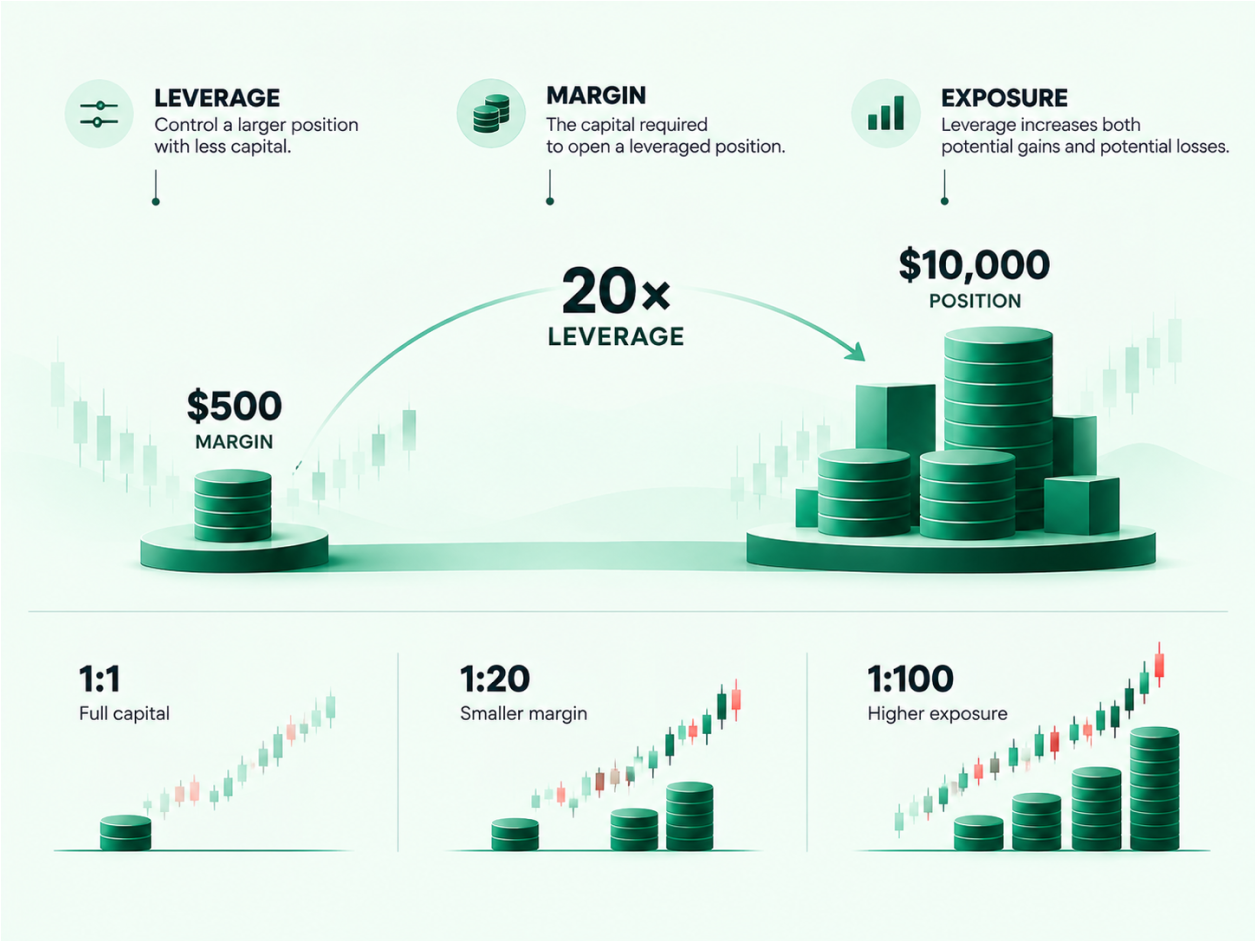
This guide will demystify leverage and margin, explaining how they function, their benefits, inherent risks, and how to integrate them into a robust risk management strategy.
What is Leverage in Trading?
Leverage, often described as a “double-edged sword,” is a facility offered by brokers that enables traders to open positions significantly larger than their initial capital outlay. Imagine using a physical lever to lift a heavy object; a small force applied to one end can move a much larger weight at the other. In financial markets, this means a small deposit can control a much larger notional value of an asset.
When you trade CFDs with leverage, you are speculating on the price movements of an underlying asset (like a stock, currency pair, or commodity) without actually owning it. Your broker essentially lends you the capital required to open the full position, with your own funds serving as a security deposit.
For example, with a leverage ratio of 1:100, you could control a position worth $10,000 with just $100 of your own capital. This magnification means that even minor price movements in the underlying asset can translate into significant profits or losses relative to your initial investment.
Understanding the Leverage Ratio
The leverage ratio expresses the relationship between your total exposure and the margin required. It is typically presented as a ratio, such as 1:10, 1:50, or 1:200.
- 1:10 leverage means for every $1 of your capital, you can control $10 worth of the asset.
- 1:100 leverage means for every $1 of your capital, you can control $100 worth of the asset.
The specific leverage ratios available can vary significantly depending on the financial instrument being traded, market volatility, and regulatory restrictions. Highly liquid and less volatile markets, such as major forex pairs, often offer higher leverage ratios compared to more volatile assets like individual stocks or cryptocurrencies. This is a protective measure to help mitigate the risk of rapid, substantial losses. LQH Markets offers leverage up to 1:500 across, allowing traders to maximize their potential across a wide range of markets.
What is Margin?
Margin is the capital you must deposit with your broker to open and maintain a leveraged position. It’s not a transaction cost or a fee; rather, it’s a portion of your account equity that is set aside as collateral for the borrowed funds that facilitate the larger trade.
There are two primary types of margin:
Initial Margin
The initial margin is the minimum amount of money required to open a new leveraged position. It is calculated as a percentage of the total value of the trade. For instance, if a broker offers 1:50 leverage (or a 2% margin requirement), to open a position with a notional value of $10,000, you would need an initial margin of $200 ($10,000 * 2%). This $200 is held by the broker to cover potential losses.
Maintenance Margin
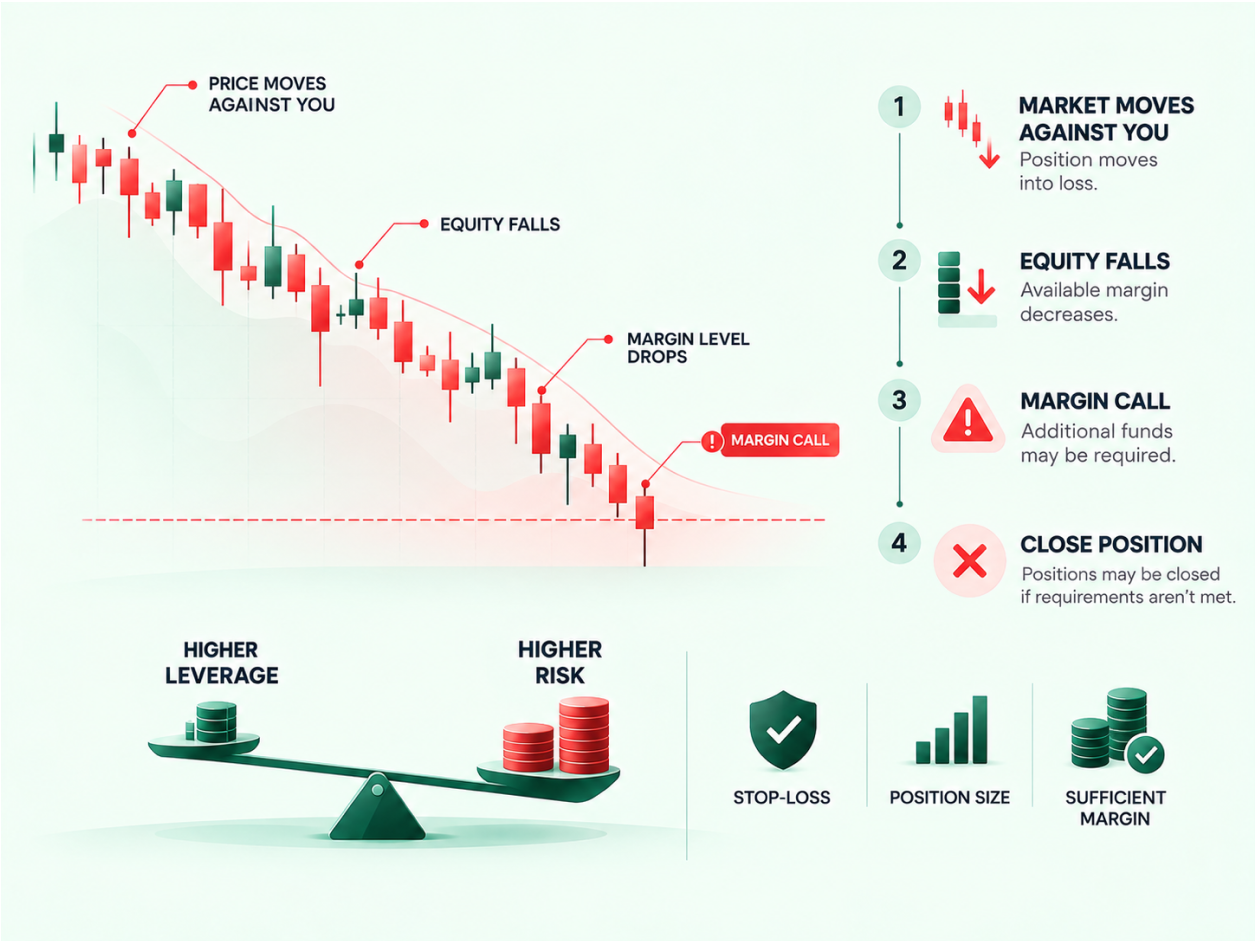
The maintenance margin is the minimum amount of equity that must be maintained in your account to keep an open leveraged position. As your trade moves, your account equity (initial deposit plus or minus any floating profits or losses) fluctuates. If your equity falls below the maintenance margin level due to adverse price movements, it triggers a margin call. The purpose of maintenance margin is to ensure you always have sufficient funds to cover potential running losses.
How Leverage and Margin Work Together: An Example
Let’s illustrate with a practical example:
Suppose you believe Company ABC’s stock, currently trading at $50 per share, will rise. You decide to open a CFD position.
-
Scenario 1: Unleveraged Trading (for comparison)
- To buy 200 shares outright, you would need $10,000 (200 shares * $50/share).
- If the price rises to $52, your profit is $400 (200 shares * $2 profit/share).
- If the price falls to $48, your loss is $400.
-
Scenario 2: Leveraged CFD Trading
- Your broker offers 1:20 leverage on Company ABC stock CFDs, meaning a 5% margin requirement.
- You want to control the same notional value: $10,000 (equivalent to 200 shares * $50/share).
- Initial Margin Required: 5% of $10,000 = $500.
-
You deposit $500 into your trading account to open this position.
-
Outcome A: Favorable Price Movement
- Company ABC’s stock price rises to $52 per share.
- Your position gains $2 per share.
- Total Profit: 200 shares * $2/share = $400.
- Relative to your initial margin of $500, this is an 80% return ($400 profit / $500 margin). Without leverage, the same $400 profit on a $10,000 investment would be a 4% return.
-
Outcome B: Unfavorable Price Movement (Margin Call Trigger)
- Company ABC’s stock price falls to $48 per share.
- Your position loses $2 per share.
- Total Loss: 200 shares * $2/share = $400.
- Your account equity, initially $500 (your margin), is now $100 ($500 – $400 loss).
- If the broker’s maintenance margin requirement for this position is, for example, 3% of the notional value ($300), your current equity of $100 falls below this. This triggers a margin call.
The Margin Call Explained
A margin call occurs when the equity in your trading account drops below the maintenance margin required to keep your open leveraged positions. This typically happens when market movements go against your trade, causing unrealized losses that erode your account equity.
When a margin call is triggered, your broker will notify you (though they are not always obligated to, especially in fast-moving markets) and request that you either:
- Deposit additional funds to bring your account equity back above the maintenance margin level.
- Close some or all of your open positions to reduce the total margin requirement on your account.
If you fail to meet the margin call within a specified timeframe (or immediately in volatile conditions), the broker may automatically close some or all of your positions. This is known as an automatic close-out or stop-out, and it’s done to prevent your account balance from going into a negative territory and to protect both the trader and the broker from further losses. For retail CFD accounts, regulations often mandate automatic closure if account equity falls below a certain percentage (e.g., 50%) of the total margin required.
While brokers typically attempt to notify traders via email alerts when their account equity approaches critical levels (e.g., 75% or 100% of the total margin required), it’s crucial to understand that they are not always legally obligated to provide such warnings. Traders should not rely solely on these notifications but must proactively monitor their account equity and open positions. In fast-moving or highly volatile markets, prices can gap significantly, leading to rapid and substantial losses. Under these extreme conditions, automatic close-outs can occur instantaneously without any prior warning, as the broker’s system acts to protect both the trader and itself from further losses and potential negative balances. This swift action is particularly common when market events cause sudden price shifts. Furthermore, it’s important for traders to recognize that different types of trading accounts, such as CFD accounts compared to traditional share dealing accounts, are often margined independently. This means that a margin call triggered in one account will not necessarily affect the margin status or available funds in another, separate trading account you might hold with the same broker.
Benefits and Risks of Using Leverage
Leverage is a powerful tool, but its benefits come hand-in-hand with significant risks.
Benefits
Capital Gearing and Regulatory Safeguards
One of the significant advantages of leverage is its role in capital gearing, which refers to the efficient use of capital. By requiring only a fraction of the total trade value as margin, leverage frees up a substantial portion of a trader’s capital. This allows funds to be allocated to other investment opportunities, diversify a portfolio across various assets, or simply maintain a larger cash buffer in the trading account for better risk management. This capital efficiency can be particularly appealing for traders looking to maximize their market exposure without tying up large sums of money in a single position.
To protect retail investors from the amplified risks of leverage, financial regulators worldwide, such as the European Securities and Markets Authority (ESMA) and the Australian Securities and Investments Commission (ASIC), have implemented strict rules. These often include setting maximum leverage limits for different asset classes, mandating negative balance protection (NBP) to ensure clients cannot lose more than their deposited funds, and enforcing automatic close-out rules when account equity falls below a certain threshold. These safeguards are designed to provide a crucial layer of investor protection, promoting responsible leverage use and mitigating the potential for catastrophic losses.
- Magnified Profits: The most attractive aspect. Small favorable price movements can lead to substantial returns on your initial capital.
- Capital Efficiency (Gearing): Leverage allows you to control larger positions with less capital, freeing up the rest of your funds for other investments or to maintain a larger buffer in your trading account.
- Ability to Short Markets: With CFDs, you can easily speculate on falling prices (going short) with leverage, allowing you to potentially profit in both rising and falling markets.
- Access to Diverse Markets: Leverage facilitates access to high-value assets and global markets that might otherwise be inaccessible with limited capital.
- 24-Hour Trading: Many leveraged CFD markets, particularly forex and major indices, offer near 24-hour trading, providing flexibility.
Risks
Understanding Overnight Funding Charges
Overnight funding charges, also known as financing costs or swap rates, are applied when a leveraged position is held open past a broker’s daily cut-off time (typically 5 PM ET for forex and some other markets). These charges represent the cost of borrowing the capital from your broker to maintain the magnified exposure of your position overnight. Essentially, you are paying interest on the “borrowed” portion of your trade. The calculation of these charges is usually based on prevailing interbank interest rates (like LIBOR or SOFR) for the currencies involved in the trade, plus a small administrative spread added by the broker. Depending on the asset, the direction of your trade (long or short), and the interest rate differentials, these funding charges can sometimes be positive (meaning you receive a small credit) or negative (meaning you pay a charge). While often small on a daily basis, these costs can accumulate significantly over extended holding periods, impacting the overall profitability of long-term leveraged trades.
- Magnified Losses: This is the primary risk. Just as profits are magnified, so are losses. A small adverse price movement can quickly deplete your initial margin and even lead to losses exceeding your deposit.
- Margin Calls and Automatic Close-Outs: The risk of losing control over your positions if market movements trigger a margin call and you cannot or do not add more funds.
- Funding Charges: Holding leveraged positions overnight often incurs funding charges (interest) from the broker, as you are effectively borrowing capital. These costs can accumulate over time.
- No Ownership Rights: When trading CFDs, you do not own the underlying asset. This means you typically don’t receive shareholder privileges like voting rights or direct dividend payments (though dividend adjustments are usually made to your account).
- Emotional Impact: The rapid fluctuations in profit and loss inherent in leveraged trading can lead to heightened emotional responses, potentially resulting in impulsive and detrimental trading decisions.
Effective Risk Management with Leverage
Given the inherent risks, sound risk management is paramount when trading with leverage.
- Understand Leverage Ratios: Always be aware of the leverage you are using and its implications for potential profit and loss. Higher leverage means higher risk.
- Adequate Account Funding: Ensure you always have sufficient funds in your trading account beyond the initial margin requirement. This buffer helps absorb minor market fluctuations and provides resilience against margin calls.
- Position Sizing: Never risk more than a small percentage of your total trading capital on any single trade. Determine your position size based on your risk tolerance and the potential loss of a trade, rather than solely on the available margin.
- Stop-Loss Orders: Implement stop-loss orders on every trade. A stop-loss automatically closes your position if the price moves against you to a predetermined level, limiting your potential losses.
- Guaranteed Stop-Loss Orders: Some brokers offer guaranteed stop-loss orders, which ensure your position is closed at the exact price you set, even during periods of high volatility or market gapping. These usually come with a small premium.
- Take-Profit Orders: Use take-profit orders to lock in gains when a trade reaches your target profit level, preventing potential reversals from eroding your profits.
- Monitor Your Positions: Regularly review your open positions and account equity. Be prepared to act quickly if market conditions change adversely.
- Negative Balance Protection: LQH Markets offers Negative Balance Protection (NBP) for retail clients, ensuring that your account balance cannot fall below zero under normal trading conditions. This protection is subject to the prohibitions on abuse described in the Client Agreement. This is an important safety net, but it should not replace proactive risk management.
- Start Small: If you are new to leveraged trading, begin with smaller position sizes and lower leverage ratios to gain experience and confidence.
Leverage and margin are powerful tools that can significantly enhance trading potential in CFDs. However, they demand a thorough understanding and a disciplined approach to risk management. By mastering these concepts, traders can navigate the markets more effectively and make informed decisions.
Frequently Asked Questions
1. Can I lose more than my initial deposit when trading with leverage?
While many retail CFD brokers offer negative balance protection, which prevents your account from going into a negative balance, it is theoretically possible to lose more than your initial deposit in highly volatile markets or if you are classified as a professional client. Always understand your broker’s specific terms and use risk management tools like stop-loss orders.
2. What is the difference between initial margin and maintenance margin?
Initial margin is the upfront deposit required to open a new leveraged position, serving as collateral. Maintenance margin is the minimum amount of equity that must be maintained in your account to keep that position open, and if your equity falls below this level, it triggers a margin call.
3. How do brokers determine the leverage ratios for different assets?
Leverage ratios are typically determined by factors such as the asset’s volatility, liquidity, and regulatory requirements. Highly liquid and less volatile assets like major forex pairs may offer higher leverage, while more volatile assets like individual stocks or cryptocurrencies usually have lower leverage to mitigate risk.
4. Is leveraged trading suitable for beginners?
Leveraged trading carries significant risk and can lead to rapid capital loss, making it generally more suitable for experienced traders who have a solid understanding of market dynamics, risk management, and their own risk tolerance. Beginners should start with a demo account and educate themselves thoroughly before engaging in live leveraged trading.
Knowledge Check
1. What is the primary function of leverage in CFD trading?
- A) To reduce the overall risk of a trade.
- B) To allow traders to own the underlying asset directly.
- C) To magnify market exposure with a smaller capital outlay.
- D) To eliminate the need for any initial deposit.
2. Which of the following best describes a margin call?
- A) A request from the broker to open more leveraged positions.
- B) A notification that your account equity has fallen below the maintenance margin requirement.
- C) A bonus payment from the broker for profitable trades.
- D) An automatic closure of all open positions without prior notice.
3. What is a key risk management tool explicitly mentioned for leveraged trading?
- A) Increasing your leverage ratio on volatile assets.
- B) Relying solely on broker notifications for margin calls.
- C) Consistently using stop-loss orders.
- D) Avoiding trading during market hours.
Click to view the answers
1. C) – Leverage allows traders to control a larger notional value in the market than their initial capital, thereby magnifying market exposure.
2. B) – A margin call is triggered when the equity in a trader’s account drops below the required maintenance margin to keep leveraged positions open.
3. C) – Consistently using stop-loss orders is a crucial risk management tool that automatically closes a position at a predetermined level to limit potential losses.