


Trailing stops are an indispensable tool for traders seeking to optimize profit potential while rigorously managing risk. Unlike a fixed stop-loss order, a trailing stop dynamically adjusts, moving in tandem with favorable market price movements to lock in gains and protect against reversals. This guide delves into the mechanics, application, and strategic considerations of using trailing stops effectively in CFD trading.
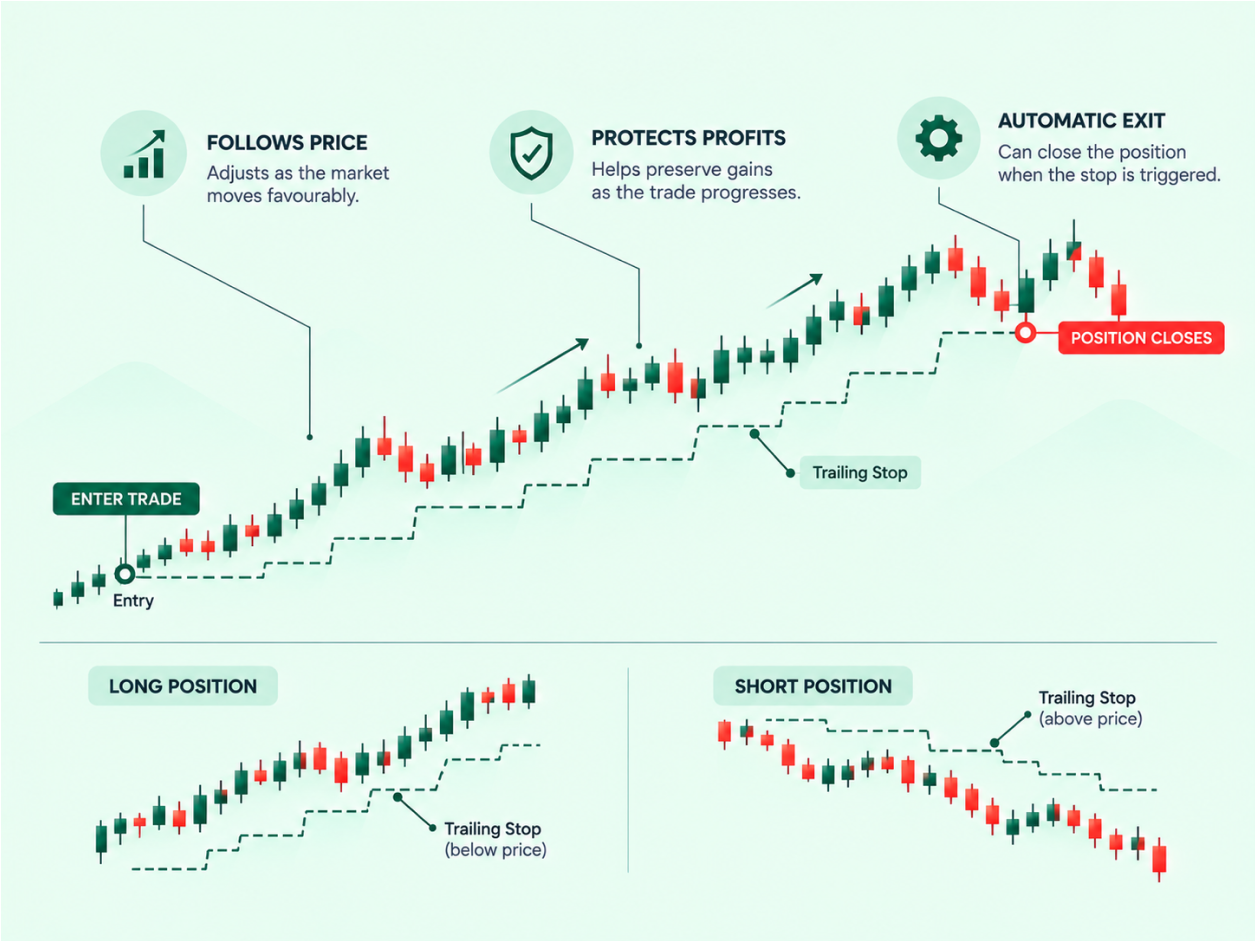
A trailing stop is a stop-loss order that automatically adjusts with the market price, designed to protect accrued profits on a trade from a market reversal. It allows traders to remain in winning positions as long as the market trends favorably, exiting automatically if the trend reverses.
Understanding the Dynamics of a Trailing Stop
At its core, a trailing stop is an advanced form of a stop-loss order. While a traditional stop-loss is set at a fixed price point, a trailing stop is set at a specified distance (e.g., a percentage, a dollar amount, or a number of points) below the market price for a long position, or above it for a short position. As the market price moves in the trader’s favor, the trailing stop price automatically moves with it, maintaining the set distance.
While the concept implies continuous adjustment, many trading platforms implement trailing stops using a “trailing step” mechanism. The trailing step defines the minimum price movement in the trader’s favor required for the stop to adjust. For instance, if you set a trailing stop with a 5-point trailing step, the stop will only move upwards (for a long position) once the market price has moved at least 5 points higher than its previous high. This prevents the stop from adjusting on every minor price fluctuation, providing a layer of control and reducing the risk of premature exits due to market “noise.” It ensures the market demonstrates sustained movement in your favor before the profit protection level is tightened.
Consider a DAX 40 CFD position bought at 10,450 with a 15-point stop distance and a 5-point trailing step. Initially, the stop is at 10,435. If the DAX 40 moves to 10,453, the stop remains at 10,435 because the 5-point step hasn’t been met. However, if it moves to 10,455 (a 5-point gain), the trailing step is triggered, and the stop adjusts to 10,440 (10,455 – 15 points). This adjustment continues only when the market moves another 5 points in your favor. However, if the market price reverses direction, the trailing stop remains fixed at its last adjusted level. If the market then hits this fixed stop price, the trade is closed.
Imagine a mountain climber ascending a peak. They use a safety rope that is anchored to the rock face. As they climb higher, they continuously re-anchor their rope at higher points. This ensures that if they slip, they only fall a short, predetermined distance from their highest point reached, rather than falling all the way back to their initial starting point. A trailing stop functions similarly, constantly re-anchoring your profit protection as your trade climbs higher in value.
The primary objective of a trailing stop is twofold:
- Protect Profits: It ensures that a significant portion of accumulated profits is secured, preventing a winning trade from turning into a losing one or significantly eroding gains.
- Limit Losses: Like a standard stop-loss, it defines the maximum acceptable loss from the entry point, or from the last adjusted stop level.
- Automate Risk Management: It removes the need for constant manual adjustment of stop-loss orders as the market moves, freeing up a trader’s time and reducing emotional decision-making.
Setting Your Trailing Stop: Methods and Considerations
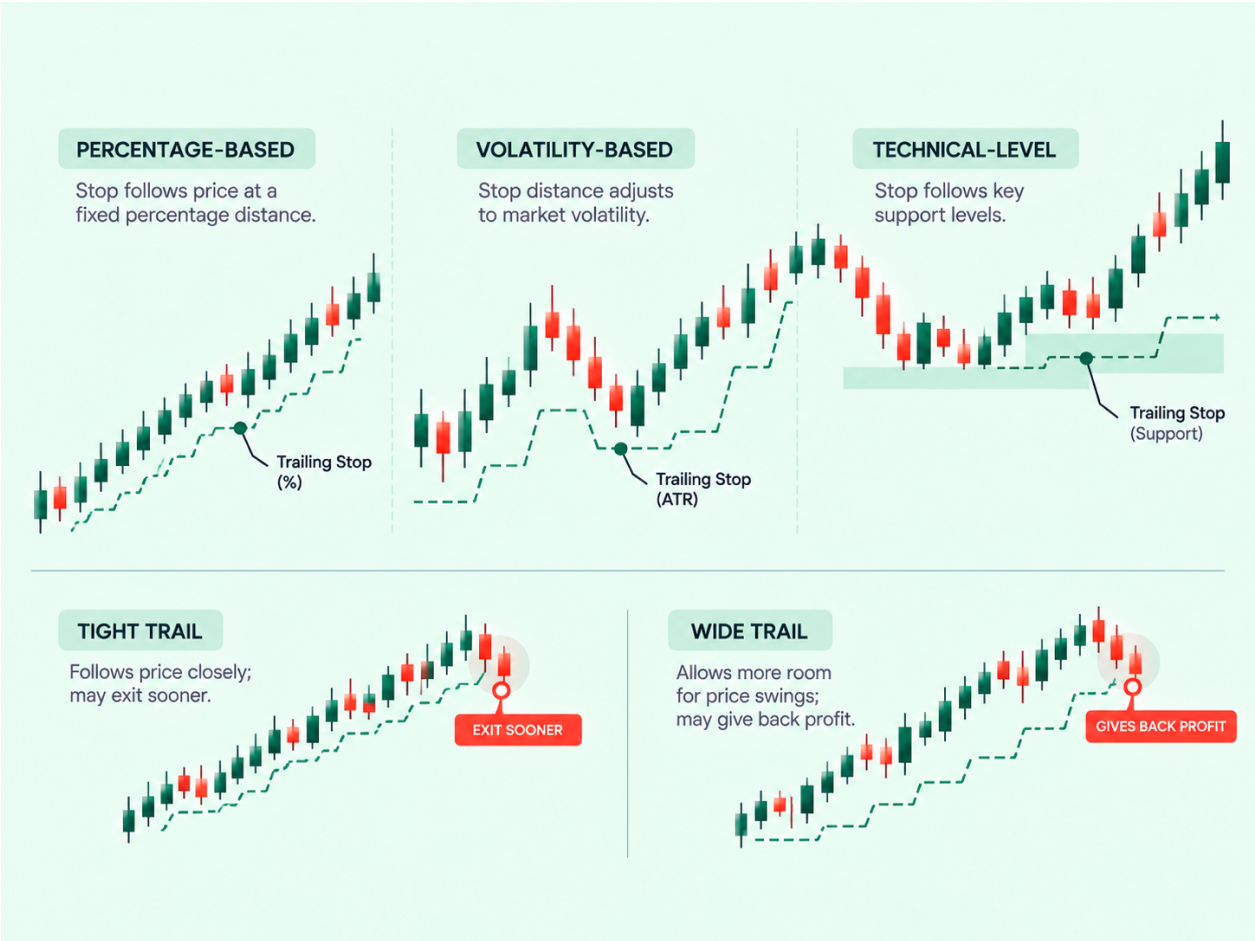
The effectiveness of a trailing stop largely depends on its initial placement and the method used for its adjustment. Setting it too tightly risks premature exits due to normal market volatility, while setting it too loosely might give back too much profit during a reversal.
Here are common methods for determining trailing stop levels:
Optimizing Trailing Stop Distance: Finding the Sweet Spot
Setting the appropriate trailing stop distance is a critical balancing act. A stop that is too tight risks premature exits due to normal market volatility, while one that is too loose can significantly erode potential profits. Consider the example of a hypothetical NVIDIA (NVDA) trade: if a 10% trailing stop secured a 21.5% profit, a looser 20% stop on the same trade might have resulted in only an 8% profit. This illustrates how a too-loose stop can give back substantial gains, even if the trade remains profitable, impacting your overall capital allocation and opportunity cost. The goal is to find a distance that allows the trade room to breathe through minor pullbacks but still protects a significant portion of accumulated gains from a true reversal.
Furthermore, a strategic approach involves initiating a trailing stop after a trade has moved into profit, rather than immediately from the entry point. This allows for initial market fluctuations and provides time for the trend direction to be confirmed before profit protection is fully engaged. By waiting for the trade to show a healthy profit, traders can avoid being stopped out by initial volatility and then apply a trailing stop to secure those established gains, optimizing the “let your profits run” philosophy.
1. Percentage-Based Trailing Stop
This is one of the most straightforward methods. You set the stop at a fixed percentage below the current market price for a long position (or above for a short).
- Example: If you buy a CFD on the “Global Tech 100 Index” at 15,000 points and set a 2% trailing stop, your initial stop would be at 14,700 (15,000 – 2% of 15,000). If the index rises to 15,200, your stop automatically moves to 14,896 (15,200 – 2% of 15,200). It will continue to adjust upwards as long as the index climbs.
For advanced traders, percentage-based trailing stops can sometimes be aligned with Fibonacci retracement levels, especially in long-term trades. These levels often act as dynamic support or resistance points, providing logical areas for stop placement that respect underlying market structure and potential reversal zones.
2. Dollar Amount (or Point) Trailing Stop
Similar to percentage-based, but uses a fixed dollar amount or number of points.
- Example: Buying a Crude Oil Futures CFD at $80.00 per barrel with a $2.00 trailing stop. Your initial stop is $78.00. If oil rises to $81.50, your stop moves to $79.50.
3. Average True Range (ATR) Trailing Stop
ATR is a measure of market volatility. Using ATR helps set a stop that adapts to the current market environment. A multiple of the ATR (e.g., 2x ATR) is often used.
- Example: If the 14-period ATR for a currency pair CFD (e.g., EUR/USD) is 0.0050, you might set your trailing stop 2 times the ATR, or 0.0100, away from the price. This means your stop distance adjusts with the pair’s typical price fluctuations, widening in volatile periods and tightening in calmer ones.
4. Moving Average Trailing Stop
Some traders use a specific moving average (e.g., 20-period, 50-period Exponential Moving Average) as their trailing stop. The stop is placed a certain distance from, or directly on, the moving average.
- Example: For a long position, the trailing stop could be set just below the 20-period Exponential Moving Average (EMA). As the EMA rises, the stop rises with it. A close below the EMA could trigger the exit.
5. Support and Resistance Levels
While not strictly “trailing” in the automated sense, some traders will manually adjust their stop-loss to trail behind significant technical support or resistance levels as the market trends. A break of a key level can signal a trend reversal.
- Example: If a stock CFD is in an uptrend, a trader might move their stop-loss just below the most recent higher low (a support level) that formed during a healthy pullback.
A Practical Trailing Stop Example
Let’s illustrate with a hypothetical CFD trade on a commodity: Gold.
Suppose you believe Gold is entering an uptrend and decide to go long on a Gold CFD at $2,000 per ounce. You decide to implement a 1.5% trailing stop to manage risk and lock in profits.
- Initial Entry: You buy Gold CFD at $2,000.
- Initial Stop: Your 1.5% trailing stop is set at $1,970 ($2,000 – 1.5% of $2,000).
- Gold Rises: Gold’s price climbs to $2,050. Your trailing stop automatically adjusts upwards to $2,019.25 ($2,050 – 1.5% of $2,050). You have now locked in a minimum profit of $19.25 per ounce, assuming perfect execution.
- Further Ascent: Gold continues its rally, reaching a peak of $2,120. At this point, your trailing stop would be at $2,088.20 ($2,120 – 1.5% of $2,120). Your potential profit is now substantially protected.
- Market Reversal: Shortly after hitting $2,120, Gold experiences a sharp pullback. The price drops to $2,085. Since the price has fallen below your last adjusted trailing stop of $2,088.20, your position is automatically closed at $2,088.20.
In this scenario, despite Gold eventually falling further (perhaps to $2,030), your trailing stop ensured you secured a profit of $88.20 per ounce ($2,088.20 – $2,000), rather than giving back a significant portion of your gains.
Advantages of Using Trailing Stops
- Profit Protection: The most significant benefit is the ability to lock in profits as a trade moves in your favor, preventing large gains from evaporating during market reversals.
- Reduced Emotional Trading: By automating the adjustment of your stop, trailing stops help remove emotional biases from exit decisions. You pre-define your risk management strategy, fostering discipline.
- Automated Risk Management: Most CFD trading platforms offer automated trailing stop functionality, eliminating the need for constant manual monitoring and adjustment. This is particularly useful for traders who cannot watch the market continuously.
- Ideal for Trending Markets: Trailing stops shine in strong trending markets, allowing traders to ride significant price movements for extended periods while safeguarding accumulated profits.
- “Let Your Profits Run”: They embody the trading adage of “letting your profits run” by keeping you in a winning trade for as long as the trend persists, without exposing your entire profit to a sudden reversal.
Considerations and Disadvantages
While powerful, trailing stops are not a panacea and come with their own set of challenges:
- Learning Curve: Determining the optimal distance for a trailing stop requires an understanding of market volatility, technical analysis, and the specific instrument being traded.
- Not Suited for All Market Conditions: Trailing stops are less effective in choppy, range-bound, or sideways markets. In such environments, normal price fluctuations can frequently trigger premature exits, leading to frustration and missed opportunities.
- Risk of Premature Exits: If the trailing stop is set too close to the current price, even minor market pullbacks or temporary volatility spikes (often referred to as “noise”) can prematurely stop you out of a trade that would have otherwise continued in your favor.
- Slippage Risk: Trailing stops are typically market orders once triggered. In fast-moving or illiquid markets, the execution price might differ from the specified stop price, leading to slippage risk. This means you might exit at a slightly worse price than intended.
- Requires Technical Understanding: To set effective trailing stops (especially those based on ATR, moving averages, or support/resistance), a basic grasp of technical analysis is beneficial.
Conclusion
Trailing stops are a sophisticated and highly effective risk management tool for CFD traders, particularly those employing trend-following strategies. They offer a disciplined, automated way to protect profits, limit losses, and stay in winning trades longer. However, their successful implementation hinges on careful consideration of market conditions, instrument volatility, and the appropriate method for setting the stop distance. By mastering trailing stops, traders can enhance their overall risk-reward profile and approach the markets with greater confidence and control.
Frequently Asked Questions
What is the primary benefit of using a trailing stop over a fixed stop-loss?
The primary benefit is its dynamic nature; a trailing stop automatically adjusts to lock in profits as the market moves favorably, whereas a fixed stop-loss remains static, requiring manual adjustment to protect gains. This automation helps prevent winning trades from turning into losses and reduces emotional decision-making.
Are trailing stops suitable for all types of trading strategies or market conditions?
No, trailing stops are most effective in trending markets where prices are consistently moving in one direction. They are generally not well-suited for choppy, range-bound, or sideways markets, as normal price fluctuations can lead to frequent premature exits.
How can I determine the optimal distance for my trailing stop?
The optimal distance depends on several factors, including the volatility of the asset, your trading timeframe, and your risk tolerance. Common methods include using a fixed percentage, a specific dollar amount, a multiple of the Average True Range (ATR), or aligning with technical indicators like moving averages or support/resistance levels.
Knowledge Check
1. What is the fundamental difference between a trailing stop and a standard stop-loss order?
- A) A trailing stop is always a guaranteed stop, while a standard stop-loss is not.
- B) A trailing stop automatically adjusts to lock in profits as the market moves favorably, whereas a standard stop-loss remains fixed.
- C) A trailing stop can only be used for long positions, while a standard stop-loss can be used for both long and short.
- D) A trailing stop is set by a dollar amount, while a standard stop-loss is set by a percentage.
2. In which market condition are trailing stops generally most effective?
- A) Highly volatile, non-trending markets.
- B) Range-bound or sideways markets.
- C) Strongly trending markets.
- D) Markets experiencing frequent false breakouts.
3. What is a potential disadvantage of setting a trailing stop too close to the current market price?
- A) It might prevent the trade from being executed at all.
- B) It could lead to giving back too much profit during a reversal.
- C) It risks premature exits due to normal market volatility.
- D) It increases the likelihood of slippage during execution.
Click to view the answers
1. B) – A trailing stop dynamically adjusts to protect profits, while a standard stop-loss is a fixed price point.
2. C) – Trailing stops are designed to allow traders to ride significant price movements in strong trending markets.
3. C) – Setting a trailing stop too tightly means that normal, minor price fluctuations can trigger an early exit from a potentially profitable trade.